
Wilms tumor pathogenesis flowchart
Wilms tumor nephroblastoma pathogenesis molecular mechanism flowchart
Wilms tumor (nephroblastoma) pathogenesis flowchart showing three main syndromic pathways and sporadic pathway. The flowchart should have: - Title: "Wilms Tumor (Nephroblastoma) Pathogenesis" - Three syndromic pathway boxes at top: 1. "WAGR Syndrome" → "Germline WT1 deletion (11p13)" → "Second hit: WT1 nonsense/frameshift mutation" → "WT1 loss of function" 2. "Denys-Drash Syndrome" → "Germline WT1 dominant-negative missense mutation (zinc-finger region)" → "Biallelic WT1 inactivation" → "WT1 loss of function" 3. "Beckwith-Wiedemann Syndrome (BWS)" → "11p15.5 (WT2 locus) abnormality" → "Loss of IGF2 imprinting / uniparental paternal disomy" → "IGF2 overexpression → excess embryonal growth factor" - One sporadic pathway box (90% of cases): "Sporadic Wilms Tumor" → branching into three sub-pathways: (A) β-catenin gain-of-function mutation (CTNNB1) ~10%; (B) miRNA processing gene mutations (DROSHA, DGCR8, DICER1) ~15-20% blastemal → reduced miR-200 → impaired mesenchymal-to-epithelial transition → persistent nephrogenic rests; (C) TP53 mutation → anaplastic histology, poor prognosis - All pathways converge to a central box: "Failure of normal metanephric blastema differentiation / Persistent nephrogenic rests" - Then arrow down to: "Nephroblastoma (Wilms Tumor)" with classic triphasic histology: blastemal + stromal + epithelial - Color code: syndromic pathways in blue shades, sporadic in green, convergent node in orange, final tumor box in red - Clean medical diagram style, white background, clear arrows and labels
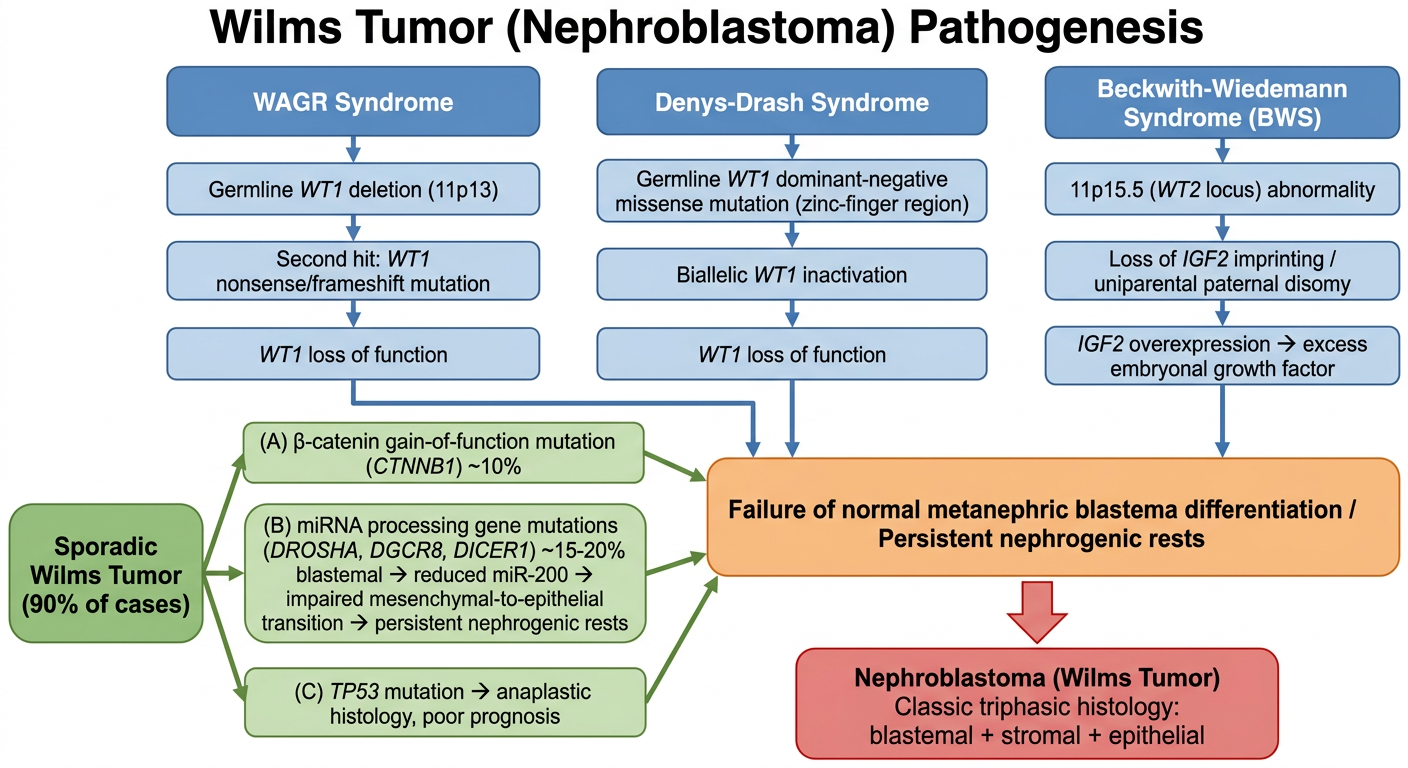
Wilms Tumor (Nephroblastoma) Pathogenesis
Syndromic Pathways (~10% of cases)
1. WAGR Syndrome (risk ~33%)
- Constitutional germline deletion of WT1 at 11p13 = "first hit"
- A somatic nonsense or frameshift mutation in the remaining WT1 allele = "second hit"
- WT1 loss of function → failure of transcriptional regulation of renal differentiation genes
2. Denys-Drash Syndrome (risk ~90%)
- Germline dominant-negative missense mutation in the zinc-finger domain of WT1
- This mutant protein interferes with the wild-type allele's DNA-binding
- Tumorigenesis requires biallelic WT1 inactivation (second hit needed)
- Also causes gonadal dysgenesis + diffuse mesangial sclerosis
3. Beckwith-Wiedemann Syndrome (BWS) - WT2 locus
- Chromosomal locus: 11p15.5 (distal to WT1)
- Two mechanisms, both causing IGF2 overexpression:
- Loss of imprinting - normally silent maternal IGF2 allele re-activates
- Uniparental paternal disomy - maternal allele deleted, paternal (active) allele duplicated
- IGF2 is an embryonal growth factor → organomegaly + tumorigenesis
- Also raises risk for hepatoblastoma, adrenocortical tumors, rhabdomyosarcoma
Sporadic Pathway (90% of cases)
| Mutation | Frequency | Mechanism |
|---|---|---|
| CTNNB1 (β-catenin gain-of-function) | ~10% | Aberrant Wnt signaling → proliferation |
| miRNA processing genes (DROSHA, DGCR8, DICER1) | 15-20% (blastemal type) | Reduced mature miRNAs, especially miR-200 family → impaired mesenchymal-to-epithelial transition → persistent nephrogenic rests |
| TP53 mutation | Minority | Anaplastic histology → poor prognosis |
| WTX gene (X-linked) | ~15-20% | Tumor suppressor on X chromosome; loss in both sexes |
Common Final Pathway
Failure of normal metanephric blastema differentiation → persistent nephrogenic rests (perilobar or intralobar) → precursor lesions → Wilms tumor
- Blastemal - sheets of small blue cells (undifferentiated)
- Stromal - loose spindle cells
- Epithelial - abortive tubules and glomeruloid structures
Key Concept: Two-Hit Model
Give me pathway
Which pathway would you like?
Detailed molecular pathogenesis pathway diagram for Wilms Tumor (Nephroblastoma). Clean white background, professional medical illustration style, with labeled arrows and color-coded pathway boxes. Layout: vertical flow with 4 parallel columns converging at the bottom. COLUMN 1 - Blue: "WAGR Syndrome" ↓ Germline WT1 deletion (chromosome 11p13) — "1st Hit" ↓ Somatic WT1 nonsense/frameshift mutation — "2nd Hit" ↓ Complete WT1 loss of function ↓ Loss of renal differentiation transcription factor COLUMN 2 - Purple: "Denys-Drash Syndrome" ↓ Germline WT1 dominant-negative missense mutation (zinc-finger domain) ↓ Mutant protein inhibits wild-type WT1 DNA binding ↓ Second somatic WT1 hit (biallelic inactivation) ↓ WT1 protein dysfunction → gonadal dysgenesis + nephropathy COLUMN 3 - Orange: "Beckwith-Wiedemann Syndrome (BWS) — WT2 locus 11p15.5" ↓ Loss of IGF2 imprinting OR uniparental paternal disomy ↓ Both maternal + paternal IGF2 alleles active ↓ IGF2 overexpression (embryonal growth factor) ↓ Organomegaly + oncogenic proliferative signaling COLUMN 4 - Green: "Sporadic (90% of cases)" Three sub-branches: → CTNNB1 gain-of-function (~10%): Wnt/β-catenin pathway activation → nuclear β-catenin → proliferation → miRNA processing mutations — DROSHA/DGCR8/DICER1 (~15-20%): ↓ miR-200 family → impaired mesenchymal-to-epithelial transition (MET) → TP53 mutation: genomic instability → anaplastic histology, worst prognosis ALL 4 COLUMNS converge with thick arrows into a central orange box: "Failure of Metanephric Blastema Differentiation → Persistent Nephrogenic Rests (perilobar / intralobar)" Then arrow down to a large red box: "WILMS TUMOR (Nephroblastoma) Classic triphasic histology: • Blastemal cells (undifferentiated blue cells) • Stromal cells (spindle cells) • Epithelial cells (abortive tubules)" Bottom note box in gray: "Favorable histology: ~90% cure rate | Unfavorable (anaplastic, TP53): poor prognosis" Use clear readable font, bold headings, directional arrows throughout.
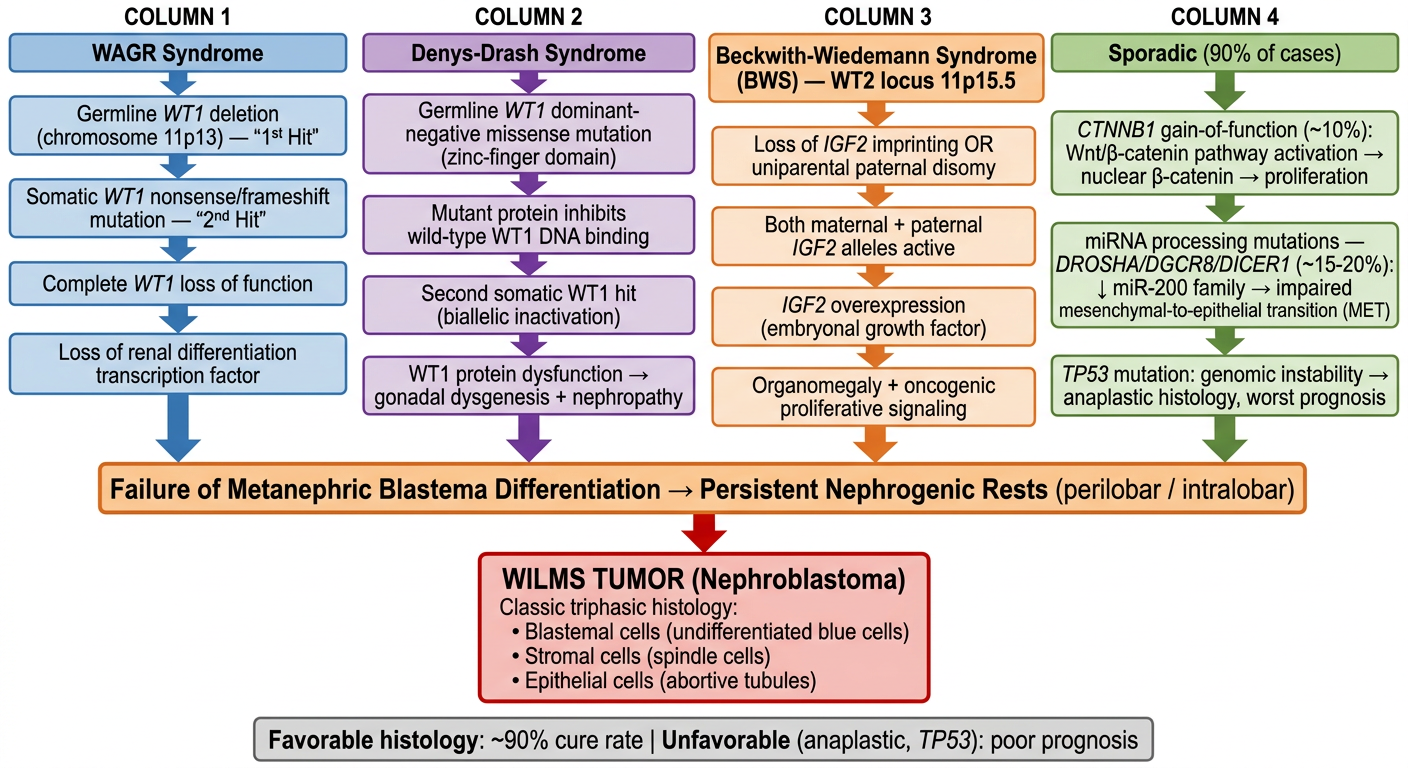
- CTNNB1 gain-of-function → aberrant Wnt/β-catenin signaling (~10%)
- DROSHA/DGCR8/DICER1 mutations → ↓ miR-200 → blocked mesenchymal-to-epithelial transition (~15-20%, blastemal type)
- TP53 mutation → anaplastic variant, poor prognosis
Simple mbbs 2nd year level
Simple clean pathogenesis flowchart of Wilms Tumor for MBBS 2nd year medical students. White background, easy to read, minimal text, bold arrows. Title at top: "Wilms Tumor (Nephroblastoma) — Pathogenesis" Subtitle: "Most common renal tumor in children (2–5 years)" Three starting boxes side by side at top, each with a different pastel color: Box 1 (light blue): "WAGR Syndrome ↓ WT1 gene deletion (chromosome 11p13)" Box 2 (light purple): "Denys-Drash Syndrome ↓ WT1 gene mutation (dominant negative)" Box 3 (light orange): "Beckwith-Wiedemann Syndrome ↓ IGF2 overexpression (chromosome 11p15)" Below these three boxes, a label: "Sporadic (90% cases)" pointing down with a green arrow All four arrows converge into one yellow box in the middle: "Loss of normal kidney developmental control ↓ Metanephric blastema fails to differentiate" Arrow down to a pink box: "Nephrogenic Rests (precursor lesion — abnormal blastema persists)" Arrow down to a red box: "WILMS TUMOR Triphasic: Blastemal + Stromal + Epithelial cells" Arrow down to a gray box at the bottom: "Anaplasia (TP53 mutation) = Poor prognosis Favorable histology = ~90% cure rate" Simple font, large text, clean layout suitable for student notes.
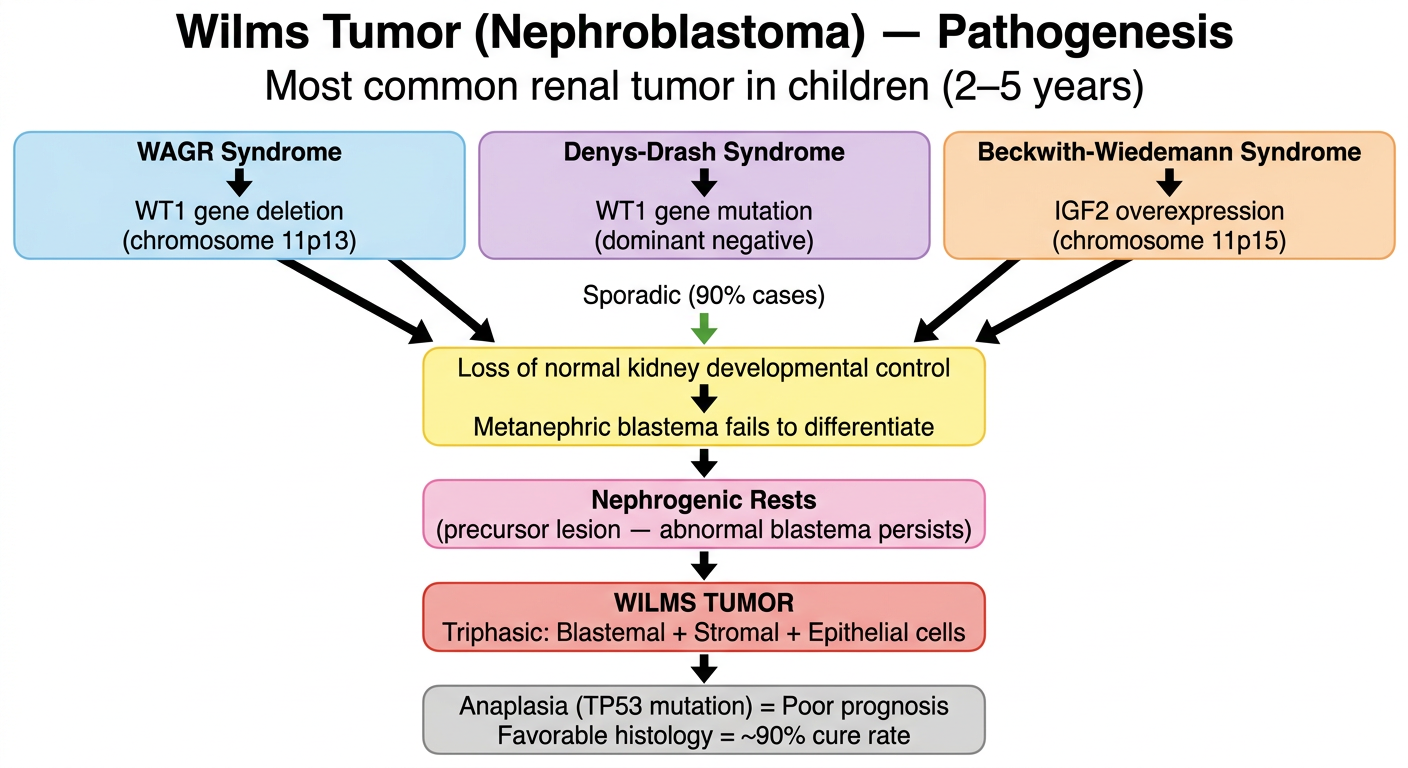
| Point | Key Fact |
|---|---|
| Age | 2-5 years, most common renal tumor in children |
| Gene 1 | WT1 (chr 11p13) - WAGR & Denys-Drash |
| Gene 2 | IGF2/WT2 (chr 11p15) - Beckwith-Wiedemann |
| Precursor | Nephrogenic rests |
| Histology | Triphasic - blastemal + stromal + epithelial |
| Bad prognosis marker | Anaplasia (TP53 mutation) |
| Cure rate | ~90% (favorable histology) |
- WAGR = Wilms + Aniridia + Genitourinary anomalies + Retardation (intellectual disability)
- DDS (Denys-Drash) = Wilms + Gonadal dysgenesis + Nephropathy (~90% risk)
- BWS (Beckwith-Wiedemann) = Wilms + organomegaly + macroglossia + hemihypertrophy