
Ulnar nerve claw hand for 10marks ( basic sciences) for MS ortho exam
Reading File
Searching for comprehensive information on ulnar nerve claw hand covering anatomy, pathophysiology, clinical features, and relevant basic sciences.
search_medical_text
ulnar nerve claw hand intrinsic muscles anatomy pathophysiology
Bailey and Love's Short Practice of Surgery 28th Edition
Page 100
search_medical_text
ulnar nerve anatomy course relations injury levels
Bailey and Love's Short Practice of Surgery 28th Edition
Page 560
search_medical_image
ulnar nerve claw hand deformity intrinsic minus

Hugging Face pmc clinical VQA raw
Page 0
GradeResponse
GradeResponse
GradeResponse
search_medical_text
ulnar nerve muscles supplied hand interossei lumbricals hypothenar
search_medical_text
paradoxical claw hand Benedict's sign Bouvier test ulnar nerve high low lesion
Here is a comprehensive 10-mark answer on Ulnar Nerve Claw Hand for MS Ortho Basic Sciences:
Ulnar Nerve Claw Hand (Main en Griffe)
Definition
Claw hand (main en griffe) is a posture of the hand characterized by hyperextension at the MCP joints and flexion at the PIP and DIP joints, most pronounced in the ring and little fingers (4th and 5th digits), resulting from ulnar nerve palsy.
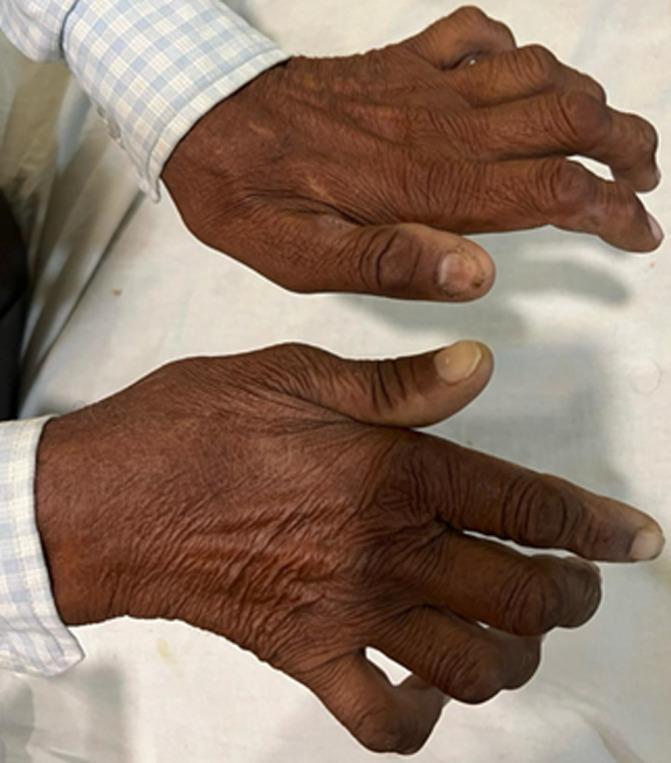
Anatomy of the Ulnar Nerve
Origin & Course
| Segment | Detail |
|---|---|
| Root value | C8, T1 (medial cord of brachial plexus) |
| Arm | Runs medial to brachial artery, pierces medial intermuscular septum at arcade of Struthers |
| Elbow | Passes posterior to medial epicondyle in the cubital tunnel (most vulnerable site) |
| Forearm | Enters between two heads of FCU, runs lateral to FCU tendon |
| Wrist | Enters hand via Guyon's canal (between pisiform and hook of hamate) |
| Hand | Divides into superficial (sensory) and deep (motor) branches |
Muscles Supplied
In the forearm:
- Flexor carpi ulnaris (FCU)
- Medial half of flexor digitorum profundus (FDP) — ring & little fingers
In the hand (all via deep branch):
- Hypothenar muscles: Abductor digiti minimi, Flexor digiti minimi, Opponens digiti minimi
- All 4 dorsal interossei
- All 3 palmar interossei
- Medial 2 lumbricals (3rd & 4th)
- Adductor pollicis
- Deep head of flexor pollicis brevis
Sensory supply: Little finger, medial half of ring finger, medial palm (palmar cutaneous branch), dorsum of medial 1.5 fingers (dorsal cutaneous branch — given off proximal to Guyon's canal)
Pathophysiology of Claw Deformity
The deformity results from an imbalance between extrinsic and intrinsic muscles:
Normal finger mechanics (lumbrical action):
- Lumbricals and interossei flex the MCP joints and extend the IP joints via the lateral bands of the extensor expansion.
- This "intrinsic plus" posture allows smooth, coordinated finger movement.
After ulnar nerve palsy:
The medial 2 lumbricals (3rd & 4th) and all interossei are paralyzed:
| Action lost | Consequence |
|---|---|
| Loss of MCP flexion by intrinsics | Unopposed EDC (extensor digitorum communis) hyperextends MCP joints |
| Loss of IP extension by intrinsics | Unopposed FDP and FDS flex PIP and DIP joints |
This produces the classic intrinsic minus posture — MCP hyperextension + IP flexion.
Why Clawing is More Pronounced in Ring & Little Fingers?
This is a critically important basic science point:
- Index and middle fingers receive their lumbricals from the median nerve (1st and 2nd lumbricals), which are intact.
- Ring and little fingers receive lumbricals from the ulnar nerve (3rd and 4th lumbricals), which are paralyzed.
- Therefore clawing is confined to 4th and 5th digits in isolated ulnar palsy.
High vs. Low Ulnar Nerve Lesion — Paradoxical Claw
| Feature | Low lesion (at/below wrist) | High lesion (at/above elbow) |
|---|---|---|
| FDP to ring & little | Intact (active) | Paralyzed |
| Clawing severity | More pronounced | Less pronounced (paradoxical) |
| Reason | FDP is intact, actively flexing DIP — maximizes IP flexion component | FDP also paralyzed — less flexion force, less claw |
| FCU | Intact | Paralyzed |
| Sensory loss at dorsum | Absent (dorsal cutaneous branch spared) | Present |
Ulnar paradox: High lesions produce less clawing than low lesions, because FDP paralysis reduces the deforming force at the IP joints.
Clinical Tests
1. Bouvier's Test (Finochietto-Bouvier)
- Examiner passively blocks MCP hyperextension (holds MCPs in slight flexion)
- Patient attempts to extend fingers
- Positive (correctable): IP joints extend fully → intrinsic tendons and extensor expansion are intact → surgical correction by MCP blocking procedure will work
- Negative (non-correctable): IP joints fail to extend despite MCP correction → lateral bands or capsular contracture present → tendon transfer alone is insufficient
2. Card Test (Froment's sign variant)
- Patient asked to hold a card between ring and little fingers
- Loss of 4th palmar interosseous (adduction) → cannot hold card
3. Froment's Sign
- Patient grips a paper between thumb and index finger
- With adductor pollicis palsy, FPL compensates → thumb IP flexes to maintain grip
4. Jeanne's Sign
- MCP hyperextension of thumb during pinch grip (due to adductor pollicis + 1st dorsal interosseous weakness)
5. Wartenberg's Sign
- Little finger remains abducted at rest (unopposed extensor digiti minimi, palmar interosseous paralyzed)
Sensory Loss Pattern
- Palmar: Little finger + medial half of ring finger
- Dorsal: Medial 1.5 fingers (only in high lesions — dorsal cutaneous branch exits ~5 cm proximal to wrist)
- Hypothenar eminence: Yes (palmar cutaneous branch of ulnar nerve)
Motor Loss Summary Mnemonic: "LOAF vs Rest"
- Median = LOAF (Lumbricals 1&2, Opponens pollicis, Abductor pollicis brevis, Flexor pollicis brevis superficial head)
- Ulnar = everything else in the hand (all interossei, lumbricals 3&4, hypothenar, adductor pollicis, FPB deep head)
Causes of Ulnar Nerve Injury
| Level | Common causes |
|---|---|
| Elbow | Cubital tunnel syndrome, medial epicondyle fracture, dislocations |
| Wrist | Guyon's canal compression, hook of hamate fractures, lacerations |
| Systemic | Leprosy (most common cause of bilateral claw hand worldwide) |
Surgical Correction (Brief)
The goal is to restore intrinsic function — MCP flexion + IP extension:
- Static procedures: Zancolli capsulodesis (MCP volar plate tightening) — blocks hyperextension
- Dynamic procedures (tendon transfers):
- ECRL/ECRB extension with FDS (Bunnel/Stiles-Bunnel)
- FDS lasso procedure (Zancolli lasso)
- EIP/EDM transfers through interosseous membrane
Key Points for 10-mark Answer
- Ulnar nerve = C8, T1; most vulnerable at medial epicondyle
- Supplies medial 2 lumbricals and ALL interossei → "intrinsic muscles of ring & little fingers"
- Clawing = MCP hyperextension (EDC unopposed) + IP flexion (FDP/FDS unopposed)
- Only ring & little fingers clawed (median supplies 1st & 2nd lumbricals for index & middle)
- Ulnar paradox — high lesion claws less than low lesion
- Bouvier's test differentiates correctable vs non-correctable claw
- Associated signs: Froment, Wartenberg, Jeanne's
- Leprosy = most common cause worldwide (bilateral claw)
- Guyon's canal anatomy is key for wrist-level lesion localization
- Surgical correction targets MCP hyperextension — either static (capsulodesis) or dynamic (tendon transfer)
This is a shared conversation. Sign in to Orris to start your own chat.