
Give me step by step management of an addisonian crisis
Reading File
Now let me search the medical library and PubMed in parallel for Addisonian crisis management.
Finding Sources
Finding Sources
Searching PubMed
"adrenal crisis" management treatment
Good. Now let me read the relevant textbook sections in parallel.
Reading File
Reading File
Finding Sources
Excellent. I have rich content from multiple sources. Let me now pull the most detailed management sections from Rosen's Emergency Medicine, Harrison's, and Goldman-Cecil in parallel.
Reading File
Reading File
Reading File
I now have comprehensive, multi-source content from leading emergency medicine and internal medicine textbooks. Let me also fetch the Harrison's management flowchart image for visual clarity.
Loading Image
I have all the information needed for a thorough, well-cited answer. Here is the complete step-by-step management of Addisonian crisis:
Step-by-Step Management of Addisonian Crisis (Acute Adrenal Insufficiency)
Background
Addisonian crisis is a life-threatening medical emergency characterized by shock with fever, nausea, vomiting, abdominal pain, hypoglycemia, and electrolyte imbalance. It is rapidly fatal unless treatment is instituted early. Because intestinal symptoms and fever are prominent, it is frequently misdiagnosed as an acute abdomen. Common precipitants include intercurrent illness, trauma, severe sepsis, bilateral adrenal hemorrhage (Waterhouse-Friderichsen syndrome), or abrupt withdrawal of long-term corticosteroids. - Bailey and Love's Short Practice of Surgery, 28th Ed.
Step 1 - Recognize and Suspect
Clinical features that should raise suspicion:
- Refractory hypotension / hemodynamic shock unresponsive to fluids and vasopressors
- Fever, nausea, vomiting, abdominal pain
- Hyponatremia, hyperkalemia, hypoglycemia
- Hyperpigmentation (in primary adrenal insufficiency)
- History of known adrenal disease, steroid use, or recent stress/infection
- Eosinophilia (subtle clue)
Key principle: Do NOT wait for lab confirmation to start treatment - treatment must be commenced immediately while results are awaited. - Symptom to Diagnosis, 4th Ed.
Step 2 - Draw Blood Before Treatment (Do Not Delay Steroids)
Send the following immediately, before giving hydrocortisone:
| Test | Purpose |
|---|---|
| Serum cortisol | Baseline - confirms diagnosis |
| Plasma ACTH | Distinguishes primary vs. secondary |
| Plasma renin activity + aldosterone | Confirms mineralocorticoid deficiency |
| Blood glucose | Hypoglycemia common |
| Serum electrolytes (Na⁺, K⁺) | Hyponatremia, hyperkalemia |
| FBC, renal function, cultures | Identify precipitating illness |
If cortisol < 140 nmol/L (< 5 µg/dL) or fails to rise above 500 nmol/L (20 µg/dL) 30-60 min after 250 µg IV cosyntropin (Synacthen) - diagnosis confirmed. - Braunwald's Heart Disease
Step 3 - IV Access and Immediate Fluid Resuscitation
- Insert large-bore IV access
- Begin 0.9% normal saline at 1 L/hour with continuous cardiac monitoring - Harrison's Principles of Internal Medicine, 22nd Ed.
- Target: 2-3 L in the first few hours - Bailey and Love's; Rosen's Emergency Medicine
- Switch to D5/NS (5% dextrose in normal saline) if hypoglycemia is present - Rosen's Emergency Medicine
- Give IV dextrose bolus (50 mL of 50% dextrose) if glucose is critically low
Step 4 - Glucocorticoid Replacement (The Most Critical Step)
Hydrocortisone is the drug of choice because it provides both glucocorticoid and mineralocorticoid activity. - Goldman-Cecil Medicine
Dosing Protocol:
| Timing | Dose | Route |
|---|---|---|
| Immediately (bolus) | 100 mg hydrocortisone | IV bolus |
| Next 24 hours | 200 mg hydrocortisone over 24 h | Continuous IV infusion (preferred) OR 50 mg IV every 6 hours |
| Days 2-4 | Taper over 72-96 hours as patient stabilizes | IV → oral |
- Harrison's 22nd Ed.; Braunwald's Heart Disease; Bailey and Love's
Alternative if no hydrocortisone available:
- Dexamethasone 4 mg IV bolus can be used (does not interfere with subsequent cortisol measurement) - Rosen's Emergency Medicine
- Note: Dexamethasone has no mineralocorticoid activity, so mineralocorticoid replacement will also be needed.
Step 5 - Mineralocorticoid Replacement
- Mineralocorticoid replacement is not immediately necessary during the acute phase because high-dose hydrocortisone provides sufficient mineralocorticoid receptor stimulation
- Initiate fludrocortisone (50-200 µg/day) once the daily hydrocortisone dose has been reduced below 50 mg - Harrison's 22nd Ed.
- In confirmed primary adrenal insufficiency, start fludrocortisone 50-100 µg orally once daily - Rosen's Emergency Medicine
Step 6 - Identify and Treat the Precipitating Cause
This step is essential - failure to identify the trigger leads to treatment failure.
- Infection: Full septic workup (cultures, CXR, urine); initiate appropriate antibiotics. Do NOT assume fever is due to adrenal insufficiency alone - Symptom to Diagnosis, 4th Ed.
- Acute cardiac ischemia
- Cerebral ischemia / stroke
- Intra-abdominal emergency
- Trauma or surgery
- Bilateral adrenal hemorrhage (Waterhouse-Friderichsen syndrome in meningococcemia)
- Abrupt steroid withdrawal
Step 7 - Monitor and Watch for Complications
| Parameter | Action |
|---|---|
| Blood pressure + HR | Continuous monitoring |
| Serum sodium | Watch for over-rapid correction of hyponatremia - both glucocorticoids and fluids suppress ADH, promoting water diuresis and risk of overcorrection - Symptom to Diagnosis, 4th Ed. |
| Blood glucose | Repeat checks; treat hypoglycemia |
| Fluid balance | Avoid fluid overload with cardiovascular monitoring |
| Potassium | May normalize with cortisol replacement |
Step 8 - Taper and Transition to Oral Maintenance
Once hemodynamically stable and tolerating oral intake:
- Taper steroids over 72-96 hours - Braunwald's Heart Disease
- Transition to oral hydrocortisone 15-25 mg/day in 2-3 divided doses (at least half the dose in the morning)
- Add oral fludrocortisone 0.05-0.2 mg each morning (for primary adrenal insufficiency)
- Consider DHEA 50 mg/day in women with primary adrenal insufficiency who have impaired well-being or decreased libido despite GC/MC replacement - Symptom to Diagnosis, 4th Ed.
Step 9 - Endocrinology Consultation and Patient Education
- Endocrinology consultation is advised in all cases - Symptom to Diagnosis, 4th Ed.
- In patients with concomitant hypothyroidism, adrenal insufficiency must be corrected before starting thyroid replacement (thyroid hormone increases cortisol metabolism and can precipitate/worsen crisis) - Symptom to Diagnosis, 4th Ed.
- Educate patient:
- Lifelong glucocorticoid and mineralocorticoid replacement
- Sick-day rules: Double oral dose during minor illness; give 100 mg hydrocortisone IM/IV for major illness, surgery, or prolonged vomiting
- Carry a steroid emergency card and a self-injection kit of hydrocortisone
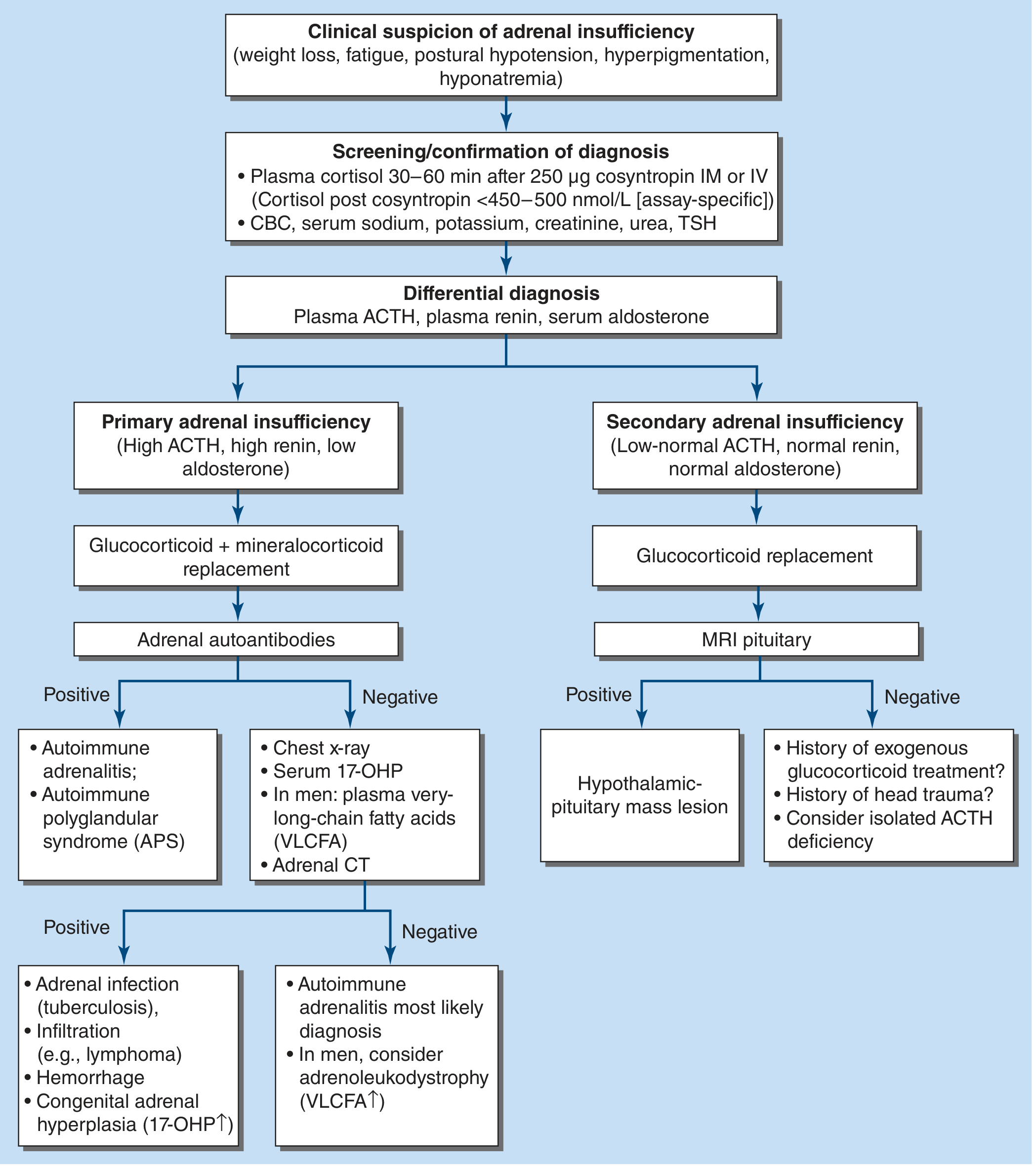
Diagnostic Flowchart (Harrison's)
Quick Summary Card
| Priority | Action |
|---|---|
| 1 | Recognize: shock + hyponatremia + hypoglycemia |
| 2 | Draw cortisol, ACTH, renin, aldosterone - do NOT delay steroids |
| 3 | IV saline 1 L/h (switch to D5NS if hypoglycemic) |
| 4 | Hydrocortisone 100 mg IV bolus NOW, then 200 mg/24h |
| 5 | Identify and treat precipitating cause |
| 6 | Monitor Na⁺ carefully (risk of osmotic overcorrection) |
| 7 | Taper steroids as patient stabilizes; add fludrocortisone |
| 8 | Endocrinology consult + patient education |
Sources: Harrison's Principles of Internal Medicine 22nd Ed.; Rosen's Emergency Medicine; Bailey and Love's Surgery 28th Ed.; Braunwald's Heart Disease; Goldman-Cecil Medicine; Symptom to Diagnosis 4th Ed.
A 2026 Lancet Diabetes & Endocrinology review by Dong, Hahner & Bancos (PMID 41587556) is the most current comprehensive review of Addison's disease management and is consistent with the above approach.
This is a shared conversation. Sign in to Orris to start your own chat.