
Conjunctivitis ki types and etiological classification batao subject ophthalmology MBBS level
Reading File
Finding Sources
Finding Sources
Finding Sources
Finding Sources
Finding Sources
Finding Sources
Now let me read the Kanski ophthalmology content on conjunctivitis classification and the Wills Eye Manual:
Reading File
Reading File
Reading File
Reading File
Reading File
Reading File
I have enough content from Kanski's Clinical Ophthalmology to give a comprehensive MBBS-level answer. Let me now compile the full response.
Loading Image
Ab main ek complete, well-structured MBBS-level answer compile karta hoon Kanski's Clinical Ophthalmology ke content ke basis par.
Conjunctivitis - Types & Etiological Classification
(Kanski's Clinical Ophthalmology, 10th Edition - Ophthalmology)
Definition
Conjunctivitis = Conjunctiva ki inflammation. Yeh sabse common external ocular disease hai. Red eye ke majority cases conjunctivitis se hote hain.
CLASSIFICATION
A. Duration ke basis par
| Type | Duration |
|---|---|
| Acute | < 4 weeks |
| Subacute | 4 weeks |
| Chronic | > 4 weeks |
B. Etiological Classification (Main Classification)
1. BACTERIAL CONJUNCTIVITIS
(i) Acute Bacterial Conjunctivitis
Common organisms:
- Staphylococcus aureus
- Streptococcus pneumoniae
- Haemophilus influenzae
- Moraxella catarrhalis
Special organisms (severe cases):
- Neisseria gonorrhoeae - sexually transmitted, corneal epithelium ko directly invade karta hai (dangerous!)
- Neisseria meningitidis - rare, usually affects children
Signs:
- Bilateral redness (ek aankh 1-2 din pehle, doosri baad)
- Mucopurulent / purulent discharge
- Subconjunctival haemorrhage (severe cases)
- Eyelids subah chipke hue milte hain (stuck together on waking)
- Gonococcal - severely purulent "hyper-acute" presentation, corneal perforation ka risk
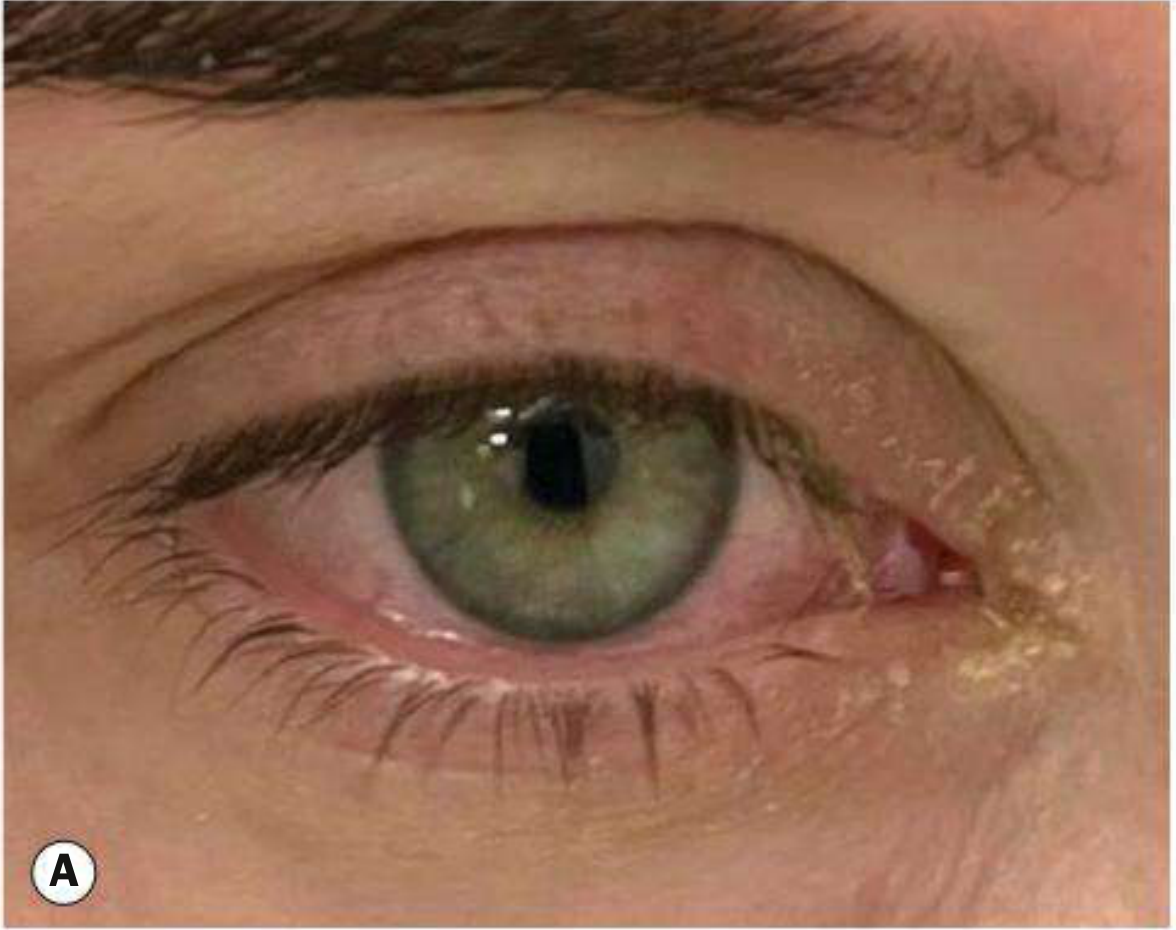
(ii) Chlamydial Conjunctivitis
a) Adult Inclusion Conjunctivitis (TRIC)
- Organism: Chlamydia trachomatis serotypes D-K
- Sexually active adults mein, genital infection se spread
- Chronic follicular conjunctivitis
- Typical: large follicles in lower fornix, mucopurulent discharge
- Preauricular lymphadenopathy
b) Trachoma (Granular Conjunctivitis)
- Organism: C. trachomatis serotypes A, B, Ba, C
- Sab se important cause of preventable blindness worldwide
- 5 stages (MacCallan classification) + WHO simplified grading (TF, TI, TS, TT, CO)
- Upper tarsal follicles, Herbert pits (superior limbus pe shallow depressions)
- Complications: Arlt line (scar), trichiasis, distichiasis, entropion, corneal opacity
- Dry eye (goblet cell destruction)
c) Ophthalmia Neonatorum (Neonatal Conjunctivitis)
- Conjunctival inflammation within first month of life
- Most common neonatal infection - up to 10% neonates
- Organisms acquired during vaginal delivery:
- Chlamydia trachomatis (most common cause in developed countries)
- N. gonorrhoeae (previously 25% childhood blindness)
- Herpes simplex virus
- Chemical (silver nitrate drops) - harmless, self-limiting
- Also: Staphylococcus, Escherichia coli, Pseudomonas
2. VIRAL CONJUNCTIVITIS
Key feature: Epidemic tendency, preauricular lymphadenopathy
(i) Adenoviral Conjunctivitis (Most Common Viral)
Two main clinical syndromes:
| Feature | Epidemic Keratoconjunctivitis (EKC) | Pharyngoconjunctival Fever (PCF) |
|---|---|---|
| Serotype | Ad 8, 19, 37 | Ad 3, 4, 7 |
| Keratitis | Subepithelial infiltrates common | Mild |
| Systemic | Minimal | Pharyngitis + fever + lymphadenopathy |
| Membrane | May form | Uncommon |
- Highly contagious, direct contact se spread
- Watery discharge, follicular reaction
- Pseudomembrane/membrane form ho sakta hai
(ii) Herpes Simplex Virus (HSV) Conjunctivitis
- Unilateral follicular conjunctivitis
- Periocular vesicles (eyelid skin pe)
- Dendrites on cornea (pathognomonic when present)
(iii) Herpes Zoster Ophthalmicus
- VZV reactivation
- Dermatomal distribution along V1
- Hutchinson's sign (nasociliary nerve involvement = tip of nose vesicles)
(iv) Molluscum Contagiosum
- Poxvirus
- Lid nodule se toxic follicular conjunctivitis
(v) Acute Hemorrhagic Conjunctivitis
- Enterovirus 70, Coxsackievirus A24
- Subconjunctival hemorrhages prominent
- Very rapid onset (12-24 hrs), epidemic
3. ALLERGIC CONJUNCTIVITIS
Hallmark symptom: ITCHING (khujli)
| Type | Features |
|---|---|
| Seasonal Allergic (Hay Fever) | Pollens, IgE-mediated Type I hypersensitivity, watery discharge, chemosis |
| Perennial Allergic | Dust mites, animal dander, year-round |
| Vernal Keratoconjunctivitis (VKC) | Children/young males, tropical countries, GIANT papillae (cobblestone) on upper tarsal, shield ulcer, Trantas dots at limbus |
| Atopic Keratoconjunctivitis (AKC) | Adults, associated with atopic dermatitis, lower tarsal papillae, corneal involvement, cataracts |
| Giant Papillary Conjunctivitis (GPC) | Contact lens wearers / ocular prosthesis, upper tarsal large papillae |
4. CHLAMYDIAL (already covered above under Bacterial/Chlamydial)
5. MISCELLANEOUS / OTHER CAUSES
(i) Conjunctivitis in Blistering Mucocutaneous Disease
- Stevens-Johnson Syndrome (SJS) / Toxic Epidermal Necrolysis (TEN)
- Ocular cicatricial pemphigoid (OCP)
- Symblepharon, dry eye, trichiasis - severe sequelae
(ii) Chemical / Toxic Conjunctivitis
- Topical drugs (preservatives), chlorinated swimming pools
- Chemical burns (acid/alkali)
(iii) Mechanical
- Foreign body, contact lens irritation
(iv) Fungal (Rare)
- Immunocompromised patients
DISCHARGE TYPE - Quick Summary (Clinically Important)
| Discharge | Etiology |
|---|---|
| Watery (serous) | Acute viral / acute allergic |
| Mucoid | Chronic allergic, dry eye |
| Mucopurulent | Chlamydial, mild bacterial |
| Purulent (moderate) | Acute bacterial |
| Severe purulent (hyperacute) | N. gonorrhoeae |
CONJUNCTIVAL REACTION TYPES (Morphological Classification)
| Reaction | Description | Etiology |
|---|---|---|
| Follicles | Lymphoid aggregates, avascular centers, more in lower fornix | Viral, chlamydial, toxic |
| Papillae | Vascularized, central vessel, fine/giant | Bacterial, allergic, GPC |
| Pseudomembrane | Coagulated exudate, can be peeled (epithelium intact) | Adenoviral, gonococcal, SJS |
| True Membrane | Embedded in epithelium, bleeding on removal | Severe adenoviral, diphtheria |
| Chemosis | Conjunctival oedema | Hypersensitivity, severe infection |
| Subconjunctival haemorrhage | Viral (petechial/small), bacterial (large/diffuse) | Viral/bacterial severe |
EXAM MNEMONICS
Trachoma causes of blindness: "Trachoma = Trichiasis + corneal Opacity" (SAFE strategy: Surgery, Antibiotics, Facial hygiene, Environment)
Ophthalmia neonatorum onset:
- Chemical (silver nitrate) - Day 1
- Gonococcal - Day 2-5
- Bacterial - Day 5-14
- Chlamydial - Day 5-14 (up to week 3)
- HSV - Day 6-14
Sources: Kanski's Clinical Ophthalmology - A Systematic Approach, 10th Edition; Wills Eye Manual, 8th Edition
Main point only
Conjunctivitis - Types & Etiological Classification
A. Duration-based
- Acute < 4 weeks
- Chronic > 4 weeks
B. Etiological Classification
1. BACTERIAL
- Common: S. aureus, S. pneumoniae, H. influenzae, Moraxella
- Severe/Hyperacute: N. gonorrhoeae (can invade intact cornea)
- Chlamydial:
- Adult Inclusion Conjunctivitis → serotypes D-K
- Trachoma → serotypes A, B, Ba, C (leading cause of preventable blindness)
- Ophthalmia Neonatorum → C. trachomatis (most common), N. gonorrhoeae, HSV, chemical
2. VIRAL
- Adenovirus → EKC (Ad 8,19,37) & Pharyngoconjunctival Fever (Ad 3,4,7)
- HSV → unilateral, follicular, dendrites
- HZV → Hutchinson's sign
- Enterovirus 70 / Coxsackie A24 → Acute Hemorrhagic Conjunctivitis
- Molluscum contagiosum → toxic follicular conjunctivitis
3. ALLERGIC
- Seasonal / Perennial → IgE-mediated, watery discharge
- VKC → giant cobblestone papillae, shield ulcer, Trantas dots
- AKC → adults, atopic dermatitis
- GPC → contact lens wearers
4. OTHERS
- Mucocutaneous disease → SJS, OCP
- Chemical/Toxic
- Fungal (rare, immunocompromised)
C. Discharge = Etiology Clue
| Discharge | Cause |
|---|---|
| Watery | Viral / acute allergic |
| Mucoid | Chronic allergic, dry eye |
| Mucopurulent | Chlamydial, mild bacterial |
| Purulent | Bacterial |
| Hyperacute purulent | N. gonorrhoeae |
D. Morphological Reaction
| Reaction | Etiology |
|---|---|
| Follicles | Viral, chlamydial |
| Papillae | Bacterial, allergic |
| Giant papillae | VKC, GPC |
| Pseudomembrane | Adenoviral, gonococcal |
| True membrane | Diphtheria, severe adenoviral |
Ophthalmia Neonatorum - Onset Order
Chemical (Day 1) → Gonococcal (Day 2-5) → Bacterial/Chlamydial/HSV (Day 5-14)
This is a shared conversation. Sign in to Orris to start your own chat.