
Topic 2) basic adrenal anatomy,histology and overview Topic 3) adrenal cortex:Cushing syndrome Topic 4) adrenal cortical insufficiency Topic 5) neoplasm of adrenal cortex Topic 6)adrenal medullary neoplasm
Reading File
Now let me run parallel searches across all 5 topics simultaneously.
Finding Sources
Finding Sources
Finding Sources
Finding Sources
Finding Sources
Finding Sources
Finding Sources
Finding Sources
Good - now let me read the most relevant blocks in parallel. Schwartz's Surgery and Sabiston have adrenal sections; Campbell-Walsh has great Cushing and pheo sections. Let me read these simultaneously.
Reading File
Reading File
Reading File
Excellent - I have rich content. Let me read the Schwartz's adrenal anatomy section and more on Cushing/adrenal insufficiency/cortical neoplasms in parallel.
Reading File
Reading File
Reading File
I have excellent content from Schwartz's Surgery and Campbell-Walsh Urology. Let me now read the Schwartz's adrenal anatomy/histology section more fully and fetch images, plus read adrenal insufficiency and cortical neoplasm sections in parallel.
Reading File
Reading File
I now have comprehensive content covering all 5 topics. Let me fetch the key anatomical diagram image and compile the full response.
Loading Image
Here is a comprehensive, structured study guide covering all five topics drawn from Schwartz's Principles of Surgery, Campbell-Walsh Urology, and Brenner & Rector's The Kidney.
ADRENAL GLAND - Comprehensive Study Notes (Topics 2-6)
TOPIC 2: Basic Adrenal Anatomy, Histology & Overview
Historical Background
- Eustachius gave the first anatomic description of the adrenals in 1563
- Cuvier described the cortex-medulla division in 1805
- Thomas Addison described adrenal insufficiency in 1855
- Harvey Cushing described his syndrome in 1932 (11 patients with moon facies, truncal obesity, hypertension)
- Aldosterone was identified in 1952; Conn's syndrome described in 1955
Embryology
The adrenal gland is essentially two organs in one, with entirely distinct origins:
| Component | Embryologic Origin | Timing |
|---|---|---|
| Cortex | Mesoderm (adrenogenital ridge) | ~5th week of gestation |
| Medulla | Neuroectoderm (neural crest cells) | ~5th week; migrates to cortex |
Key points:
- The fetal cortex is functional by 8 weeks and produces fetal steroids, but involutes after birth - adrenal weight decreases in first 3 postpartum months
- The definitive cortex forms the adult cortex over the first 3 years of life
- Because the cortex originates near the gonads, ectopic adrenocortical tissue can be found in the ovaries, spermatic cord, and testes
- Neural crest cells migrate to form the medulla; most extra-adrenal neural tissue regresses, but the organ of Zuckerkandl (near the aortic bifurcation/inferior mesenteric artery origin) is the largest persistent remnant
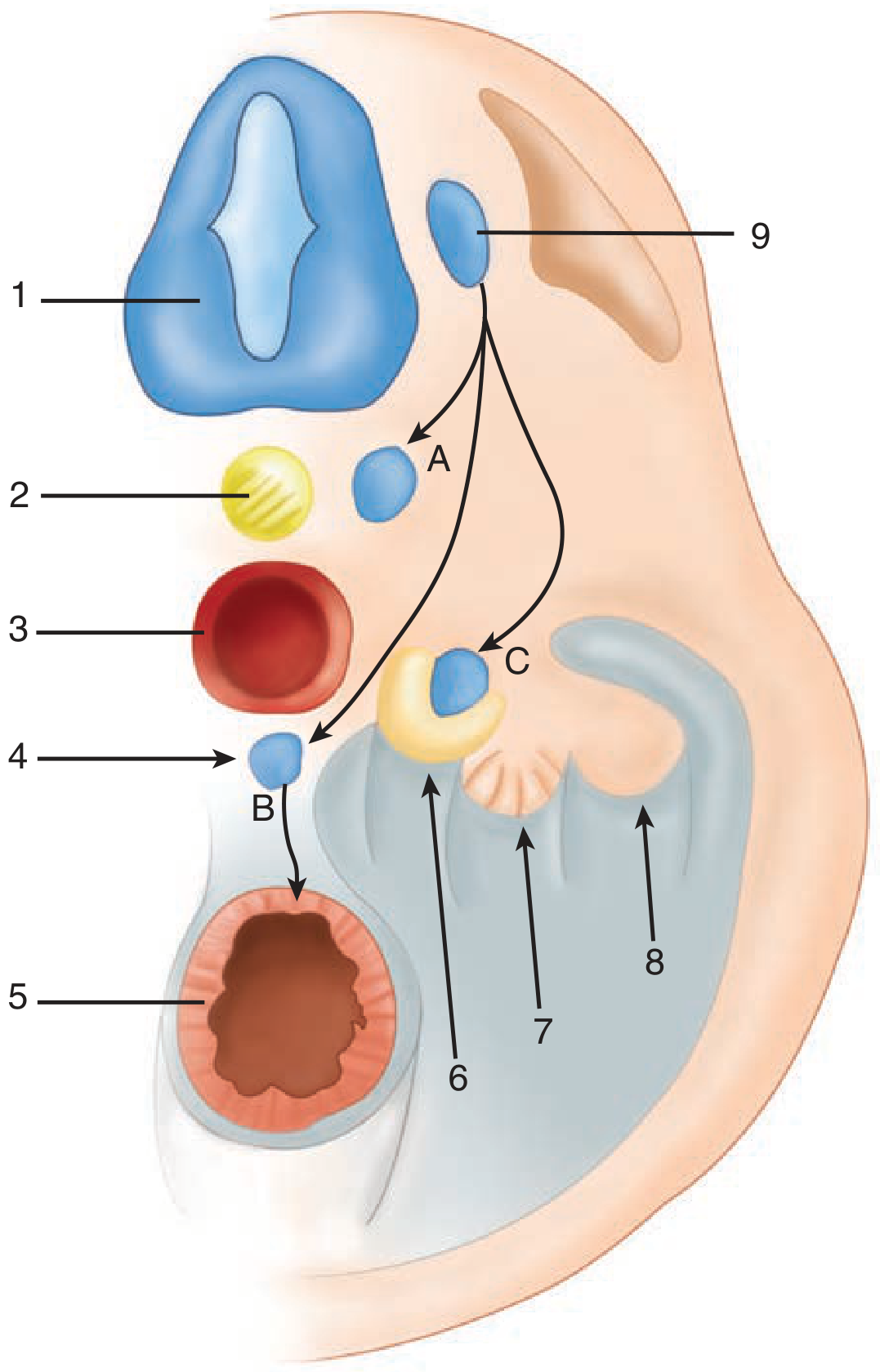
Figure: Cross-section of the embryo depicting adrenal development - Schwartz's Principles of Surgery, 11e
Adult Anatomy
- Right adrenal: pyramidal shape, sits above the right kidney; right adrenal vein drains directly into the inferior vena cava (short and wide - high risk of hemorrhage during surgery)
- Left adrenal: semilunar/crescentic shape; left adrenal vein drains into the left renal vein
- Arterial supply: three sources - superior suprarenal artery (from inferior phrenic), middle suprarenal (directly from aorta), inferior suprarenal (from renal artery)
- Weight: each gland ~4-5 g in adults
Histology - The Three Zones of the Cortex
The cortex is divided into three concentric zones ("GFR" = from outer to inner):
| Zone | Mnemonic | Product | Regulation |
|---|---|---|---|
| Zona Glomerulosa (outermost) | "Salt" | Mineralocorticoids (aldosterone) | Renin-angiotensin system, K+ |
| Zona Fasciculata (middle, largest) | "Sugar" | Glucocorticoids (cortisol) | ACTH |
| Zona Reticularis (innermost) | "Sex" | Androgens (DHEA, androstenedione) | ACTH |
Memory aid: "GFR" - Glomerulosa, Fasciculata, Reticularis (outer to inner); products: "Salt, Sugar, Sex"
- The medulla contains chromaffin cells (modified postganglionic sympathetic neurons) that produce catecholamines: epinephrine (~80%) and norepinephrine (~20%)
- Medullary cells stain brown with chromate salts - the "chromaffin reaction"
Adrenal Physiology Overview
- Cortisol: zona fasciculata secretes up to 20 mg/day; follows a circadian rhythm - peak in morning, nadir at ~11 PM
- HPA Axis: Hypothalamus → CRH → Anterior pituitary → ACTH → Adrenal cortex → Cortisol → negative feedback
- ACTH is cleaved from the precursor molecule pro-opiomelanocortin (POMC)
- Without ACTH, all cortical cells except mineralocorticoid-producing zona glomerulosa undergo apoptosis
TOPIC 3: Adrenal Cortex - Cushing Syndrome
Definition & Epidemiology
- Cushing syndrome: hypercortisolism from excessive glucocorticoid production
- Incidence: 2-5 per million per year (rare)
- Most common cause today: exogenous/iatrogenic (prescribed corticosteroids)
Causes - Classification
| Category | Cause | % of Endogenous Cases |
|---|---|---|
| ACTH-dependent | Cushing's disease (pituitary adenoma) | ~60-70% |
| ACTH-dependent | Ectopic ACTH (small cell lung ca, bronchial carcinoid) | ~10-12% |
| ACTH-independent | Adrenal adenoma | ~10-15% |
| ACTH-independent | Adrenal carcinoma | ~5-10% |
| ACTH-independent | AIMAH (bilateral macronodular hyperplasia) | rare |
Key: Adrenal tumors secreting cortisol are ACTH-independent and account for ~10% of non-iatrogenic cases.
Clinical Features
| System | Manifestation |
|---|---|
| General | Central obesity, buffalo hump, moon facies, supraclavicular fat pads |
| Skin | Hirsutism, plethora, purple striae, acne, easy bruising, skin atrophy |
| Cardiovascular | Hypertension |
| Musculoskeletal | Proximal muscle weakness, osteopenia/osteoporosis |
| Metabolic | Diabetes/glucose intolerance, hyperlipidemia |
| Neuropsychiatric | Depression, emotional lability, psychosis |
| Renal | Polyuria, renal stones |
| Gonadal | Impotence, decreased libido, menstrual irregularities |
- Hyperpigmentation suggests ectopic ACTH (very high circulating ACTH levels stimulate melanocortin receptors)
- Children: obesity + stunted growth (growth suppression distinguishes it from simple obesity)
Diagnostic Workup
Step 1 - Confirm hypercortisolism (screening):
- Overnight low-dose DST: 1 mg dexamethasone at 11 PM → cortisol at 8 AM. Normal suppresses to <3 μg/dL (or <1.8 μg/dL by strict criteria)
- 24-hour urinary free cortisol: sensitivity 95-100%, specificity 98%; <100 μg/day rules out hypercortisolism
- Late-night salivary cortisol: reflects loss of diurnal rhythm; increasingly used
Step 2 - Determine ACTH dependence:
- Plasma ACTH levels (normal 10-100 pg/mL):
- Cushing's disease: 15-500 pg/mL (elevated)
- Ectopic ACTH: >1000 pg/mL (markedly elevated)
- Adrenal tumor: <5 pg/mL (suppressed)
Step 3 - Localize:
- High-dose DST (2 mg q6h x 8 doses, or 8 mg overnight): pituitary adenoma usually suppresses; ectopic ACTH does not
- CRH stimulation test: pituitary adenoma responds (ACTH rises); ectopic ACTH does not
- MRI pituitary for Cushing's disease
- CT adrenal for adrenal cause
- Petrosal sinus sampling: gold standard to distinguish pituitary vs. ectopic when imaging inconclusive
Treatment
- Cushing's disease: trans-sphenoidal pituitary surgery (first line)
- Adrenal adenoma: laparoscopic adrenalectomy (adrenal-dependent disease)
- Bilateral adrenal disease / ectopic ACTH not resectable: bilateral adrenalectomy
- Medical bridging: metyrapone, ketoconazole, aminoglutethimide, etomidate (block steroidogenesis); mitotane
- Prognosis: life expectancy reduced; cardiovascular risk persists even after normalization of cortisol
Subclinical Cushing Syndrome
- Occurs in ~8% of adrenal incidentalomas
- No overt clinical features, but subtle cortisol excess (loss of diurnal variation, resistance to dexamethasone suppression)
- Risk: postoperative adrenal crisis due to unrecognized contralateral adrenal suppression
TOPIC 4: Adrenal Cortical Insufficiency (Addison's Disease)
Classification
| Type | Mechanism | Examples |
|---|---|---|
| Primary (Addison's disease) | Direct adrenal destruction | Autoimmune (most common in developed world), TB (most common worldwide historically), fungal infection, metastases, hemorrhage, sarcoidosis |
| Secondary | Insufficient ACTH | Pituitary disease, exogenous steroid withdrawal |
| Tertiary | Insufficient CRH | Hypothalamic disease |
Primary vs. Secondary: Key Differences
| Feature | Primary (Addison's) | Secondary |
|---|---|---|
| Aldosterone | Deficient (mineralocorticoid deficit) | Normal (RAAS intact) |
| ACTH | Very HIGH (loss of feedback) | Low |
| Skin pigmentation | YES - hyperpigmentation (high ACTH/MSH) | No |
| Hyponatremia | Hyponatremia + hyperkalemia | Hyponatremia only (no hyperkalemia) |
Clinical Features of Primary Adrenal Insufficiency
- Chronic: fatigue, weakness, anorexia, weight loss, nausea, hyperpigmentation (buccal mucosa, scars, creases), salt craving, postural hypotension
- Electrolytes: hyponatremia, hyperkalemia, mild acidosis (from aldosterone deficiency)
- Adrenal crisis (acute): severe hypotension/shock, vomiting, abdominal pain, fever, hypoglycemia - precipitated by stress (infection, trauma, surgery)
Diagnosis
- 8 AM cortisol: <3 μg/dL is diagnostic; >18 μg/dL excludes
- ACTH stimulation test (cosyntropin test): give 250 μg synthetic ACTH IV; cortisol should rise to >18 μg/dL. Failure confirms adrenal insufficiency
- Plasma ACTH: elevated in primary, low in secondary
- Anti-21-hydroxylase antibodies: positive in ~90% of autoimmune Addison's
Treatment
- Chronic replacement:
- Hydrocortisone 15-25 mg/day (split doses; higher in morning to mimic diurnal rhythm)
- Fludrocortisone 0.05-0.2 mg/day (mineralocorticoid replacement - only needed in primary)
- DHEA replacement in some patients (especially women, for well-being/libido)
- Sick day rules: double/triple hydrocortisone dose during illness
- Adrenal crisis: IV hydrocortisone 100 mg bolus → 50-100 mg q6-8h + aggressive IV fluids (normal saline + dextrose)
Congenital Adrenal Hyperplasia (CAH)
- Autosomal recessive deficiency of steroidogenic enzymes
- Most common: 21-hydroxylase deficiency (~90%) → cannot make cortisol → excess ACTH → adrenal hyperplasia + excess androgens
- Classic forms: salt-wasting (severe, neonatal crisis) and simple virilizing
- Results in female pseudohermaphroditism (virilization of 46,XX females)
TOPIC 5: Neoplasms of the Adrenal Cortex
Adrenal Adenoma
- Benign, usually functioning (Conn's or Cushing's) or non-functioning
- Imaging (CT): homogeneous, well-encapsulated, smooth margins, <10 Hounsfield units (lipid-rich), low attenuation
- MRI: low signal intensity T2-weighted relative to liver (mass-to-liver ratio <1.4)
- Most are <4 cm; carcinoma accounts for only 2% of lesions <4 cm
Adrenocortical Carcinoma (ACC)
- Rare, highly aggressive malignancy
- Incidence: ~1-2 per million per year
- Most present with large tumors (median 10-12 cm at diagnosis)
- ~60% are functioning - most commonly excess cortisol ± androgens (Cushing + virilization is a suspicious combination)
Imaging features suggesting malignancy:
- Size >6 cm (~25% malignancy risk; but carcinomas occur in smaller lesions too)
- CT attenuation >18 Hounsfield units (lipid-poor)
- Inhomogeneous, irregular borders, local invasion, lymphadenopathy
- MRI T2: moderate-high signal intensity (mass-to-liver ratio 1.2-2.8)
- Slow washout of contrast on delayed CT imaging
Staging (modified Sullivan/Macfarlane):
- Stage I: <5 cm, no invasion
- Stage II: >5 cm, no invasion
- Stage III: local invasion or nodal disease
- Stage IV: distant metastases
Treatment:
- Complete surgical resection (open adrenalectomy preferred for ACC - wide margins needed)
- Mitotane (adrenolytic agent): adjuvant treatment; also used for unresectable/metastatic disease
- Additional chemotherapy: EDP-M regimen (etoposide, doxorubicin, cisplatin + mitotane)
- Prognosis is poor: 5-year survival ~15-35% overall
Adrenal Incidentaloma
- Adrenal mass found incidentally on imaging performed for another reason
- Prevalence increases with age (~5% of abdominal CT scans)
- Mandatory workup for ALL incidentalomas (except obvious cysts, hemorrhage, myelolipoma, diffuse mets):
- Overnight 1 mg DST (rule out subclinical Cushing)
- 24-hour urine catecholamines/metanephrines OR plasma metanephrines (rule out pheochromocytoma - must exclude before any procedure)
- Aldosterone/renin ratio if hypertensive (rule out Conn's)
- 17-ketosteroids if sex steroid excess suspected
Indications for adrenalectomy:
- Functioning tumor (any hormone excess)
- Size >4-6 cm (increased malignancy risk)
- Growth >1 cm on follow-up imaging
Primary Aldosteronism (Conn's Syndrome)
- Most common cause of secondary hypertension (3-13% of hypertensive patients in primary care; up to 30% at referral centers)
- Characterized by autonomous aldosterone production → suppressed renin → hypertension + hypokalemia (though hypokalemia absent in ~50%)
- Subtypes: unilateral adrenal adenoma (~35-40%) vs. bilateral idiopathic hyperplasia (~60%)
- Diagnosis: aldosterone-to-renin ratio (ARR) as screening test
- Treatment: adenoma → laparoscopic adrenalectomy; bilateral hyperplasia → mineralocorticoid antagonist (spironolactone/eplerenone)
Adrenal Myelolipoma
- Benign, non-functioning lesion
- Composed of hematopoietic tissue + mature adipose tissue
- Characteristic CT appearance: fat attenuation (negative Hounsfield units)
- Usually requires no treatment; surgery if symptomatic or large
TOPIC 6: Adrenal Medullary Neoplasms
Pheochromocytoma
Definition & Epidemiology
- Catecholamine-secreting tumor arising from chromaffin cells of the adrenal medulla
- Estimated incidence: 2-8 cases per million per year
- Found in 0.2-0.6% of hypertensive patients (1.7% of hypertensive children)
- Paraganglioma: same tumor type arising from extra-adrenal chromaffin tissue (sympathetic paraganglia)
The "10% Rule" (classic, now updated)
| Feature | Classic "10%" | Modern reality |
|---|---|---|
| Extra-adrenal | ~10% | ~10-15% |
| Bilateral | ~10% | Higher in familial cases |
| Malignant | ~10% | >10% metastatic at diagnosis |
| Familial | ~10% | Now >30% have germline mutations |
| In children | ~10% | More common than thought |
Familial Syndromes Involving Pheochromocytoma
| Syndrome | Gene | Associated Features |
|---|---|---|
| MEN 2A | RET proto-oncogene | Pheo (~50%, often bilateral), medullary thyroid carcinoma, parathyroid adenoma, cutaneous lichen amyloidosis |
| MEN 2B | RET | Pheo (usually bilateral), medullary thyroid ca, mucosal neuromas, marfanoid habitus, Hirschsprung disease |
| Von Hippel-Lindau type 2 | VHL (3p25-26) | ~20% get pheo/paraganglioma; renal cell carcinoma, cerebellar hemangioblastoma, retinal angiomas |
| Neurofibromatosis type 1 | NF1 (17q11.2) | ~2% get catecholamine-secreting tumor; café-au-lait spots, neurofibromas, Lisch nodules |
| SDH mutations | SDHB, SDHC, SDHD | Paraganglioma syndromes; SDHB strongly associated with malignancy |
Clinical Features
- Classic triad: episodic headache, diaphoresis (sweating), and hypertension (sustained or paroxysmal)
- Present in 95% of cases in some large series
- Other: palpitations, pallor, anxiety, weight loss, hyperglycemia
- Hypertensive crisis can be fatal and may be precipitated by surgery, anesthesia, contrast dye, certain medications (beta-blockers, TCA, metoclopramide)
- May present as: heart failure, cardiomyopathy, stroke, or incidentaloma
Diagnosis
Biochemical (first step):
- Plasma free metanephrines (normetanephrine + metanephrine): highest sensitivity (~99%); test of choice for screening
- 24-hour urine catecholamines + metanephrines + VMA: good sensitivity, widely available
- Combination of plasma + urine tests maximizes accuracy
Localization (after biochemical confirmation):
- CT abdomen/pelvis: first-line imaging; 90-95% sensitivity for adrenal pheo
- MRI: preferred in children, pregnancy, known metastases; pheochromocytoma is characteristically very bright on T2 (mass-to-liver ratio >3)
- MIBG scan (metaiodobenzylguanidine): functional imaging; useful for extra-adrenal, metastatic, and recurrent disease
- PET scan (FDOPA or FDG-PET): increasingly used for metastatic/familial disease
Preoperative Preparation (CRITICAL)
- Alpha-blockade FIRST (phenoxybenzamine 10-40 mg/day, titrated over 7-14 days; or prazosin/doxazosin)
- Beta-blockade only AFTER adequate alpha-blockade (to control tachycardia) - NEVER give beta-blocker first (risks unopposed alpha causing hypertensive crisis)
- Liberal salt and fluid intake to expand contracted intravascular volume
- Delay surgery 7-14 days after localization to normalize BP, heart rate, and volume
- Metyrosine (tyrosine hydroxylase inhibitor) for very large tumors or non-surgical candidates
Surgery
- Laparoscopic adrenalectomy: preferred for small, benign-appearing adrenal pheochromocytomas
- Open approach: for large tumors, suspected malignancy, or paragangliomas in difficult locations
- Intraoperative risks: severe hypertension during tumor manipulation, severe hypotension after ligation of adrenal vein
- Postoperative: monitor for hypotension, hypoglycemia, adrenal insufficiency
Follow-up
- Repeat biochemical testing 4-6 weeks postop (to confirm complete resection)
- Long-term annual follow-up (recurrence, metachronous tumors, especially in familial cases)
- Genetic testing recommended for all patients - especially for SDHB (high malignancy risk), VHL, RET, NF1
Malignant Pheochromocytoma
- Defined by presence of metastases (not histologic features alone) in sites where chromaffin tissue is normally absent (bone, liver, lung, lymph nodes)
-
10% are malignant at diagnosis; SDHB mutation is the strongest predictor
- Treatment: surgery + MIBG therapy, sunitinib, CVD chemotherapy (cyclophosphamide-vincristine-dacarbazine)
- Prognosis: highly variable; 5-year survival ~50% for malignant disease
Neuroblastoma
- Most common extracranial solid tumor of childhood
- Arises from neural crest cells (same as pheochromocytoma) - can arise in the adrenal medulla or anywhere along the sympathetic chain
- Secretes catecholamines (mostly norepinephrine + dopamine) but rarely causes hypertension
- Presents with abdominal mass, opsoclonus-myoclonus, skin nodules ("blueberry muffin"), bone pain, orbital ecchymosis ("raccoon eyes")
- Biochemical marker: elevated urine VMA and HVA (vanillylmandelic acid and homovanillic acid)
- Genetics: MYCN amplification (poor prognosis), chromosome 1p deletion
- Treatment: surgery, chemotherapy, radiation, differentiation therapy (retinoic acid), MIBG therapy
Quick Comparison Summary
| Cushing | Conn's | Addison's | ACC | Pheo | |
|---|---|---|---|---|---|
| Hormone excess | Cortisol | Aldosterone | Deficiency (cortisol + aldosterone) | Cortisol ± androgens | Catecholamines |
| BP | High | High | Low (crisis) | High (if functional) | Paroxysmal/sustained high |
| K+ | Normal/low | Low | High | Low | Normal |
| Na+ | Normal/high | High/normal | Low | - | Normal |
| ACTH | Variable | Normal | Very HIGH (primary) | Suppressed | Normal |
| Key test | DST/24-hr UFC | ARR | Cosyntropin stim | CT/imaging | Plasma metanephrines |
| Treatment | Surgery/medical | Adrenalectomy/spironolactone | Hydrocortisone + fludrocortisone | Open resection + mitotane | Alpha-block THEN surgery |
Sources: Schwartz's Principles of Surgery 11e, Campbell-Walsh Urology (9780323546423), Brenner & Rector's The Kidney
Acth and cry full form
ACTH = Adrenocorticotropic Hormone (also called corticotropin)
CRH = Corticotropin-Releasing Hormone (produced by the hypothalamus)
These are part of the HPA axis:
Hypothalamus → releases CRH → Anterior Pituitary → releases ACTH → Adrenal Cortex → releases Cortisol
This is a shared conversation. Sign in to Orris to start your own chat.