
Rheumatic fever prevention according to parks textbook
Rheumatic Fever Prevention - Park's Textbook of Preventive and Social Medicine
Overview
A. Primary Prevention
- Theoretically simple but practically difficult in developing countries
- To prevent a single case of RHD, several thousand streptococcal throat infections must be identified and treated
- Many infections are inapparent or go unreported
- Quick and reliable laboratory services are needed to confirm diagnosis
- Concentrate on school-age children (5-15 years), slum dwellers, and those in closed communities (e.g., barracks)
- Keep high-risk children under surveillance for streptococcal pharyngitis
| Route | Drug | Adult dose | Child dose |
|---|---|---|---|
| IM (single injection) | Benzathine benzyl penicillin | 1.2 million units | 600,000 units |
| Oral | Penicillin V or Penicillin G | 10 days course | 10 days course |
| Allergy to penicillin | Erythromycin | Drug of choice | Drug of choice |
B. Secondary Prevention
- Benzathine benzyl penicillin IM injection at intervals of 3 weeks (every 21 days)
- Adults: 1.2 million units
- Children: 600,000 units
- Prevents streptococcal sore throat, thereby preventing recurrence of RF and RHD
| Clinical Category | Duration |
|---|---|
| RF without carditis | At least 5 years from last attack, or until 18 years of age, whichever is later |
| RF with mild carditis (mild MR or healed carditis) | 10 years after last attack, or until 25 years of age, whichever is longer |
| Severe valvular disease / post-valve surgery | Life-long treatment |
C. Non-Medical Measures
- Improve living conditions and break the poverty-disease-poverty cycle
- Better housing and improved socio-economic conditions will reduce RF incidence in the long term
- Park's notes: "Penicillin alone will not lead to effective control" - socio-economic improvements are essential
- Countries with severe economic constraints are unlikely to significantly alter disease incidence through living standard improvements alone in the foreseeable future
D. Programme Evaluation
- Best indicator: Prevalence of RHD in school children from periodic surveys of random samples
- Surveys should be carried out on samples of schools (not individuals) in the 6-14 year age group at 5-year intervals
- Recommended sample size: 20,000 to 30,000 children depending on expected prevalence
High-Risk Groups to Target
- School-age children (5-15 years)
- Slum dwellers
- Those living in closed communities (barracks, hostels)
Vision 2020
Which context are you asking about Vision 2020?
Vision 2020: The Right to Sight - Park's Textbook of Preventive and Social Medicine
What is Vision 2020?
- Launched by: WHO on 18th February 1999
- Key distinguishing feature: The concept centres around Rights issues - recognition of sight as a fundamental human right by all countries, serving as a catalyst for prevention and control of blindness
Objective
- Cataract
- Xerophthalmia and other causes of childhood blindness
- Refractive error and low vision
- Trachoma and other causes of corneal blindness
India's Plan of Action under Vision 2020
1. Target Diseases
- Cataract
- Refractive errors
- Childhood blindness
- Corneal blindness
- Glaucoma
- Diabetic retinopathy
2. Four-Tier Structure for Eye Care Services
| Tier | Type | Number (Proposed) |
|---|---|---|
| Tier 1 | Centres of Excellence | 20 |
| Tier 2 | Training Centres | 200 |
| Tier 3 | Service Centres | 2,000 |
| Tier 4 | Vision Centres | 20,000 |
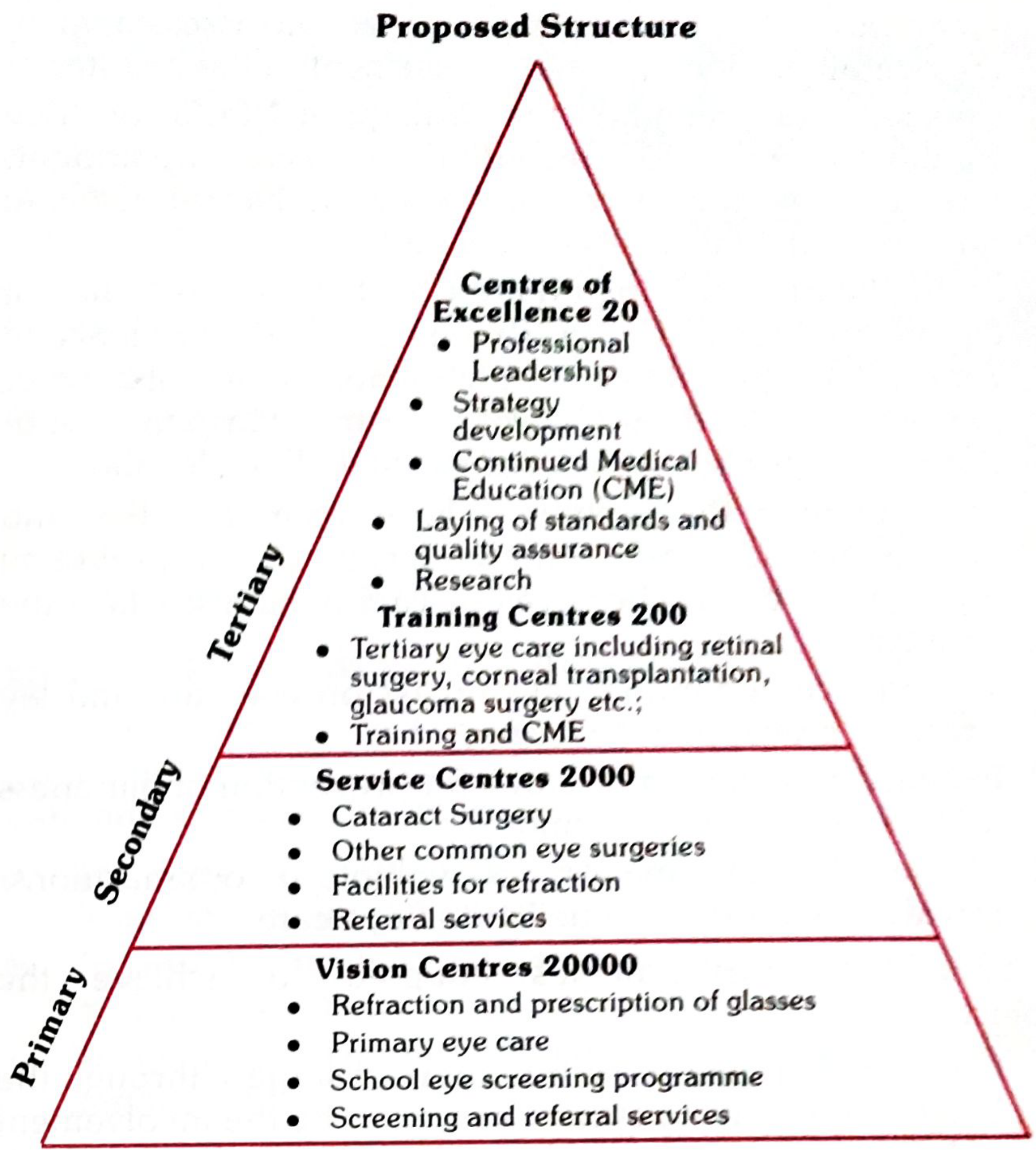
WHO Assistance for Vision 2020 in India
- Intra-country fellowships in corneal transplantation, vitreo-retinal surgery, lasers in ophthalmology, and paediatric ophthalmology
- Pilot survey on childhood blindness in Delhi
- Training in district programme management
- Study on situational analysis of eye care infrastructure and human resources
- High-quality workshops for faculty of medical colleges
- Development of plan of action for the initiative
Global Eye Health Action Plan 2014-2019 (Post-Vision 2020 Follow-up)
- Universal access and equity
- Human rights
- Evidence-based practice
- A life course approach
- Empowerment of people with visual impairment
Three National-Level Progress Indicators:
- Prevalence and causes of visual impairment
- Number of eye care personnel
- Cataract surgical service delivery (cataract surgical rate + cataract surgical coverage)
Key Background Statistics
- In 2010: 285 million people visually impaired globally, of which 39 million were blind
- If just the two major causes (refractive errors + cataract) were addressed, two-thirds of visually impaired could recover good eyesight
- The health system approach integrates eye care at primary, secondary, and tertiary levels
Imp questions that can be asked in university under the topic of epidemiology of non communicable disease
Important University Questions: Epidemiology of Non-Communicable Diseases (Park's Textbook)
🔴 LONG QUESTIONS (10-15 marks)
1. Discuss the epidemiology, risk factors, and prevention of Coronary Heart Disease (CHD).
- Definition: "Impairment of heart function due to inadequate blood flow caused by obstructive changes in the coronary circulation"
- Synonyms: Ischaemic heart disease
- Presentations: Angina pectoris, MI, arrhythmias, cardiac failure, sudden death
- Measuring burden: PMR, loss of life expectancy, incidence rate, age-specific death rates, prevalence rate
- Risk factors: Non-modifiable (age, sex, family history) + Modifiable (hypertension, hyperlipidaemia, smoking, diabetes, obesity, physical inactivity, diet)
- Framingham Heart Study concept
- Primary, secondary, tertiary prevention
2. Describe the epidemiology of Diabetes Mellitus with its classification, complications, and control measures.
- WHO 2019 Classification: Type 1, Type 2, Hybrid forms (LADA/Slowly evolving immune-mediated, Ketosis-prone Type 2), Monogenic, Other specific types, Unclassified
- Complications: Retinopathy, nephropathy, neuropathy, CVD, peripheral arterial disease, cataracts
- Association with TB (increased risk)
- Screening for diabetes (urine/blood sugar)
- National Programme for Prevention and Control of Cancer, Diabetes, CVD and Stroke (NPCDCS)
- Primary prevention: Lifestyle modification, weight control
3. Describe the epidemiology, risk factors, and control of Hypertension.
- Definition and JNC classification
- Risk factors: Age, sex, obesity, salt intake, alcohol, physical inactivity, stress
- Complications: Stroke, CHD, renal failure, heart failure
- Prevention of Hypertension (Park's dedicated section)
- Sodium reduction, DASH diet
- Screening and treatment
4. Write in detail about the Epidemiology of Cancer (with specific reference to India).
- Global burden; leading cancers by sex
- Cancer patterns in India (ICMR data)
- Common cancers in India: oral, cervix, breast, lung, oesophagus
- Risk factors: tobacco, alcohol, diet, infections (HPV, HBV), occupational carcinogens
- Cancer control measures (primary, secondary - screening, tertiary)
- Vision 2020 equivalent - National Cancer Control Programme
- "Westernization" trend and changing cancer patterns
5. Write in detail about Obesity - its measurement, determinants, health hazards and control.
- Definition: BMI ≥ 30 kg/m²
- Assessment: BMI, waist circumference, waist-hip ratio, skinfold thickness
- Determinants: Dietary habits, physical inactivity, genetic factors, endocrine, drugs
- Hazards of obesity: CVD, T2DM, hypertension, osteoarthritis, sleep apnoea, cancers, psychological
- Prevention and control
🟡 SHORT QUESTIONS (5 marks)
6. Risk factors of Coronary Heart Disease
- Non-modifiable: Age, male sex, family history, personality type (Type A)
- Modifiable: Hypertension, hypercholesterolaemia, smoking, diabetes, obesity, sedentary lifestyle, stress, diet (saturated fat)
7. Jones Criteria / WHO Criteria for Rheumatic Fever (often combined with NCD section)
- 2002-03 WHO criteria based on revised Jones criteria
- Major criteria: Carditis, polyarthritis, chorea, erythema marginatum, subcutaneous nodules
- Minor criteria: Fever, raised ESR/CRP, prolonged PR interval
- Evidence of preceding streptococcal infection required
8. Stroke - Epidemiology and Control
- Types: Ischaemic vs haemorrhagic
- Risk factors: Hypertension (most important), diabetes, smoking, AF, hyperlipidaemia
- Stroke control programme in India
- NPCDCS (National Programme for Prevention and Control of Cancer, Diabetes, CVD and Stroke)
9. BMI and Classification of Obesity
- Formula: Weight (kg) / Height² (m²)
- WHO classification: Underweight <18.5, Normal 18.5-24.9, Overweight 25-29.9, Obese ≥30
- Asian cut-offs (lower thresholds used for Indians)
- Waist circumference: Men >102 cm, Women >88 cm (WHO); Men >90 cm, Women >80 cm (Asian)
10. National Programme for Prevention and Control of Cancer, Diabetes, CVD and Stroke (NPCDCS)
- Launched as part of 11th Five Year Plan
- Objectives: Health promotion, early diagnosis, treatment at primary care level
- Sub-components: A. Diabetes + CVD + Stroke; B. Cancer
- District NCD Clinic, Community Health Centre NCD clinic, CHO-led NCD screening at primary level
11. Metabolic Syndrome (Syndrome X)
- Definition and diagnostic criteria (IDF/ATP III)
- Components: Central obesity + any 2 of: hypertension, raised fasting glucose, raised triglycerides, low HDL
- Significance: Strong predictor of CVD and T2DM
- Management: Lifestyle modification as cornerstone
12. Epidemiology of Rheumatic Heart Disease (RHD)
- Group A beta-haemolytic streptococcal pharyngitis as cause
- High-risk groups: 5-15 years, slum dwellers
- India: 5-7/1000 in 5-15 year age group; ~1 million cases
- Primary vs secondary prevention (benzathine penicillin)
🟢 VERY SHORT / ONE-LINER QUESTIONS (2-3 marks)
| Question | Key Answer |
|---|---|
| Modern epidemic according to WHO | CHD (Coronary Heart Disease) |
| Most important modifiable risk factor for stroke | Hypertension |
| Drug for secondary prevention of RF | Benzathine benzyl penicillin IM 3-weekly |
| BMI formula | Weight (kg) / Height² (m²) |
| Global burden of visual impairment (2010) | 285 million visually impaired; 39 million blind |
| Most common cancer in Indian males | Oral cavity/lung cancer |
| Most common cancer in Indian females | Cervix uteri/breast |
| NPCDCS stands for | National Programme for Prevention and Control of Cancer, Diabetes, CVD and Stroke |
| Iceberg phenomenon applies to | Diabetes, Hypertension (many undiagnosed cases) |
| Type A personality associated with | CHD risk |
| Framingham study significance | Identified major CHD risk factors (prospective cohort study) |
| Cataract surgery rate - indicator in | Vision 2020 / Global Eye Health Action Plan |
🔵 FREQUENTLY ASKED SPECIAL TOPICS
13. Levels of Prevention for NCDs (with examples)
- Primordial: Prevent risk factors from emerging (healthy public policy, tobacco control)
- Primary: Health promotion + specific protection (exercise, diet counselling, vaccinations for HBV/HPV)
- Secondary: Early diagnosis and prompt treatment (screening for diabetes, hypertension, cancer)
- Tertiary: Disability limitation + rehabilitation (cardiac rehab, diabetic foot care)
14. Tobacco and NCDs
- Linked to: Lung cancer, oral cancer, CHD, COPD, stroke, peripheral vascular disease
- Relative risk of lung cancer in smokers vs non-smokers: ~10-fold
- Prevention: COTPA 2003 in India, MPOWER framework (WHO)
15. Diet and NCDs
- Saturated fat → CHD
- Excess salt → Hypertension
- Vitamin A deficiency → Blindness (Xerophthalmia)
- Dietary fibre deficiency → Colorectal cancer
- Excess calories/sugar → Obesity, Diabetes
Exam tip: University exams frequently ask questions that combine two NCDs (e.g., "Diabetes and Hypertension as risk factors for CHD"), or that pair a disease with its national programme (e.g., "NPCDCS" or "Vision 2020"). Always structure answers with: Definition → Epidemiology/Burden → Risk factors → Prevention → National Programme.
Make this as pdf
ls /home/daytona/workspace/ 2>/dev/null || echo "workspace empty or missing"
mkdir -p /home/daytona/workspace/ncd-questions && python3 -c "from reportlab.lib.pagesizes import A4; print('reportlab ok')"
~/ncd-questions/generate_pdf.py
from reportlab.lib.pagesizes import A4
from reportlab.lib.styles import getSampleStyleSheet, ParagraphStyle
from reportlab.lib.units import cm
from reportlab.lib import colors
from reportlab.platypus import (
    SimpleDocTemplate, Paragraph, Spacer, Table, TableStyle,
    HRFlowable, KeepTogether
)
from reportlab.lib.enums import TA_LEFT, TA_CENTER, TA_JUSTIFY

OUTPUT = "/home/daytona/workspace/ncd-questions/NCD_Epidemiology_University_Questions.pdf"

doc = SimpleDocTemplate(
    OUTPUT,
    pagesize=A4,
    leftMargin=2*cm, rightMargin=2*cm,
    topMargin=2*cm, bottomMargin=2*cm,
    title="Epidemiology of NCDs - University Questions",
    author="Park's Textbook Reference"
)

styles = getSampleStyleSheet()

# Custom styles
title_style = ParagraphStyle(
    'CustomTitle', parent=styles['Title'],
    fontSize=18, textColor=colors.HexColor('#1a237e'),
    spaceAfter=6, spaceBefore=0, alignment=TA_CENTER
)
subtitle_style = ParagraphStyle(
    'Subtitle', parent=styles['Normal'],
    fontSize=11, textColor=colors.HexColor('#455a64'),
    spaceAfter=16, alignment=TA_CENTER, italic=True
)
section_style = ParagraphStyle(
    'Section', parent=styles['Heading1'],
    fontSize=13, textColor=colors.white,
    backColor=colors.HexColor('#1a237e'),
    spaceBefore=14, spaceAfter=4,
    leftIndent=-0.3*cm, rightIndent=-0.3*cm,
    borderPadding=(6, 8, 6, 8)
)
q_heading_style = ParagraphStyle(
    'QHeading', parent=styles['Heading2'],
    fontSize=11, textColor=colors.HexColor('#0d47a1'),
    spaceBefore=10, spaceAfter=3
)
body_style = ParagraphStyle(
    'Body', parent=styles['Normal'],
    fontSize=9.5, leading=14, spaceAfter=3,
    alignment=TA_JUSTIFY
)
bullet_style = ParagraphStyle(
    'Bullet', parent=styles['Normal'],
    fontSize=9.5, leading=13, leftIndent=16, spaceAfter=2,
    bulletIndent=4
)
sub_bullet_style = ParagraphStyle(
    'SubBullet', parent=styles['Normal'],
    fontSize=9, leading=13, leftIndent=30, spaceAfter=1,
    bulletIndent=18, textColor=colors.HexColor('#333333')
)
note_style = ParagraphStyle(
    'Note', parent=styles['Normal'],
    fontSize=9, leading=13, textColor=colors.HexColor('#e65100'),
    backColor=colors.HexColor('#fff3e0'),
    borderPadding=(5,6,5,6), spaceAfter=6, spaceBefore=4,
    leftIndent=4, rightIndent=4
)
label_style = ParagraphStyle(
    'Label', parent=styles['Normal'],
    fontSize=8.5, textColor=colors.white,
    backColor=colors.HexColor('#c62828'),
    alignment=TA_CENTER
)

story = []

# ── TITLE ──────────────────────────────────────────────────────────────────
story.append(Spacer(1, 0.3*cm))
story.append(Paragraph("Important University Questions", title_style))
story.append(Paragraph("Epidemiology of Non-Communicable Diseases", title_style))
story.append(Paragraph("Based on Park's Textbook of Preventive and Social Medicine", subtitle_style))
story.append(HRFlowable(width="100%", thickness=2, color=colors.HexColor('#1a237e'), spaceAfter=8))

# ── SECTION 1 : LONG QUESTIONS ─────────────────────────────────────────────
story.append(Paragraph("LONG QUESTIONS  (10–15 Marks)", section_style))
story.append(Spacer(1, 0.2*cm))

lqs = [
    {
        "num": "Q1.",
        "title": "Discuss the epidemiology, risk factors, and prevention of Coronary Heart Disease (CHD).",
        "points": [
            "Definition: 'Impairment of heart function due to inadequate blood flow caused by obstructive changes in the coronary circulation' (WHO calls it the modern epidemic)",
            "Presentations: Angina pectoris, Myocardial infarction, Arrhythmias, Cardiac failure, Sudden death",
            "Measuring burden: PMR, Loss of life expectancy, Incidence rate, Age-specific death rates, Prevalence rate",
            "Non-modifiable risk factors: Age, Male sex, Family history, Type A personality",
            "Modifiable risk factors: Hypertension, Hypercholesterolaemia, Smoking, Diabetes, Obesity, Sedentary lifestyle, Stress, Diet (saturated fat)",
            "Mention Framingham Heart Study (identified major CHD risk factors - prospective cohort)",
            "Primary, secondary, tertiary prevention"
        ]
    },
    {
        "num": "Q2.",
        "title": "Describe the epidemiology of Diabetes Mellitus with its classification, complications, and control measures.",
        "points": [
            "Definition: Group of metabolic disorders characterised by hyperglycaemia due to defects in insulin secretion, action or both",
            "WHO 2019 Classification: Type 1, Type 2, Hybrid forms (Slowly evolving immune-mediated / LADA; Ketosis-prone Type 2), Monogenic, Diseases of exocrine pancreas, Endocrine disorders, Drug-induced, Unclassified",
            "Complications: Retinopathy, Nephropathy, Neuropathy, CVD, Peripheral arterial disease, Cerebrovascular disease, Cataracts, Increased TB risk",
            "Screening: Urine sugar, fasting/post-prandial blood glucose, HbA1c",
            "NPCDCS - National Programme for Prevention and Control of Cancer, Diabetes, CVD and Stroke",
            "Primary prevention: Lifestyle modification, weight control, diet"
        ]
    },
    {
        "num": "Q3.",
        "title": "Describe the epidemiology, risk factors, and control of Hypertension.",
        "points": [
            "Definition and JNC/WHO classification of blood pressure levels",
            "Risk factors: Age, obesity, excess salt intake, alcohol, physical inactivity, stress, family history",
            "Complications: Stroke (most common), CHD, Renal failure, Heart failure, Retinopathy",
            "Prevention: Sodium reduction (<5g/day), DASH diet, weight reduction, exercise, alcohol moderation",
            "Screening: Mass screening vs selective screening of high-risk groups",
            "Treatment: Lifestyle + pharmacotherapy (diuretics, beta-blockers, ACEi, CCBs, ARBs)"
        ]
    },
    {
        "num": "Q4.",
        "title": "Write in detail about the Epidemiology of Cancer with specific reference to India.",
        "points": [
            "Global burden: Leading causes of cancer death - lung, stomach, liver (males); breast, cervix, colorectum (females)",
            "India - ICMR National Cancer Registry data; Common cancers: oral cavity, cervix, breast, lung, oesophagus",
            "Risk factors: Tobacco (most important), alcohol, diet, infections (HPV → cervix, HBV → liver), occupational carcinogens, radiation",
            "Cancer patterns: Westernization trend - decline in infection-related cancers, rise in breast/prostate/colorectal",
            "Cancer control: Primary (avoid risk factors), Secondary (screening - Pap smear, mammography, oral exam), Tertiary (treatment/palliation)",
            "National Cancer Control Programme (NCCP) objectives"
        ]
    },
    {
        "num": "Q5.",
        "title": "Write in detail about Obesity - measurement, determinants, health hazards, and control.",
        "points": [
            "Definition: BMI ≥30 kg/m² (WHO); Asian cut-off ≥27.5 kg/m²",
            "Assessment methods: BMI (wt/ht²), Waist circumference, Waist-hip ratio, Skinfold thickness (Harpenden callipers)",
            "WHO BMI classification: Underweight <18.5, Normal 18.5–24.9, Overweight 25–29.9, Obese ≥30",
            "Determinants: Excess calorie intake, physical inactivity, genetic factors, endocrine (hypothyroidism, Cushing's), drugs",
            "Health hazards: T2DM, Hypertension, CHD, Dyslipidaemia, Osteoarthritis, Sleep apnoea, Cancers (breast, colon, endometrium), Psychological",
            "Control: Diet modification, physical activity, behaviour therapy, pharmacotherapy, bariatric surgery"
        ]
    }
]

for q in lqs:
    items = [
        Paragraph(f'<b>{q["num"]}</b> {q["title"]}', q_heading_style),
    ]
    items.append(Paragraph("<b>Key points to cover:</b>", body_style))
    for pt in q["points"]:
        items.append(Paragraph(f"\u2022 {pt}", bullet_style))
    items.append(Spacer(1, 0.2*cm))
    story.append(KeepTogether(items))

# ── SECTION 2 : SHORT QUESTIONS ────────────────────────────────────────────
story.append(Spacer(1, 0.3*cm))
story.append(Paragraph("SHORT QUESTIONS  (5 Marks)", section_style))
story.append(Spacer(1, 0.2*cm))

sqs = [
    ("Q6.", "Risk factors of Coronary Heart Disease (CHD)", [
        "Non-modifiable: Age (>45 men, >55 women), Male sex, Family history, Type A personality",
        "Modifiable: Hypertension, Hypercholesterolaemia (LDL↑, HDL↓), Smoking, Diabetes mellitus, Obesity (BMI ≥30), Sedentary lifestyle, Diet rich in saturated fat",
        "Framingham study established smoking, hypertension, dyslipidaemia as the 'big three' risk factors"
    ]),
    ("Q7.", "Secondary Prevention of Rheumatic Fever", [
        "Benzathine benzyl penicillin IM every 3 weeks (21 days)",
        "Dose: Adults 1.2 million units; Children 600,000 units",
        "Duration: No carditis → 5 years or until 18 yrs; Mild carditis → 10 years or until 25 yrs; Severe/post-surgery → Life-long",
        "Alternative (penicillin allergy): Erythromycin / Sulfadiazine"
    ]),
    ("Q8.", "Stroke - Epidemiology and Control", [
        "Types: Ischaemic (80%) vs Haemorrhagic (20%)",
        "Most important risk factor: Hypertension",
        "Other risk factors: Diabetes, Smoking, Atrial fibrillation, Hyperlipidaemia, Obesity, Sedentary lifestyle",
        "Stroke control programme in India under NPCDCS",
        "Prevention: Control of hypertension, antiplatelet drugs, anticoagulation in AF"
    ]),
    ("Q9.", "BMI and Classification of Obesity", [
        "Formula: Weight (kg) ÷ Height² (m²)",
        "WHO: Underweight <18.5 | Normal 18.5–24.9 | Overweight 25–29.9 | Obese ≥30 | Morbidly obese ≥40",
        "Asian/Indian cut-offs: Overweight ≥23 | Obese ≥25",
        "Waist circumference risk threshold: Men >102 cm (WHO) / >90 cm (Asian); Women >88 cm / >80 cm (Asian)"
    ]),
    ("Q10.", "NPCDCS - National Programme for Prevention and Control of Cancer, Diabetes, CVD and Stroke", [
        "Launched under 11th Five Year Plan; now continued under NHM",
        "Two sub-components: (A) Cancer; (B) Diabetes + CVD + Stroke",
        "Infrastructure: District NCD Clinic, CHC NCD Clinic, CHO-led primary care NCD screening",
        "Objectives: Health promotion, early diagnosis, treatment at primary level, referral system",
        "Population-based screening for hypertension, diabetes, 3 common cancers (oral, breast, cervix)"
    ]),
    ("Q11.", "Metabolic Syndrome", [
        "Also called Syndrome X / Insulin resistance syndrome",
        "IDF criteria: Central obesity (waist ≥90 cm men / ≥80 cm women for Asians) PLUS any 2 of:",
        "  – Raised triglycerides ≥150 mg/dL  |  Low HDL <40 (men) / <50 (women) mg/dL",
        "  – Hypertension ≥130/85 mmHg  |  Raised fasting glucose ≥100 mg/dL",
        "Significance: 5× increased risk of T2DM; 2× increased CVD risk",
        "Treatment: Lifestyle modification (cornerstone), treat individual components"
    ]),
    ("Q12.", "Epidemiology of Rheumatic Heart Disease (RHD) in India", [
        "Caused by Group A beta-haemolytic streptococcal pharyngitis → Acute Rheumatic Fever → RHD",
        "India prevalence: 5–7 per 1000 in 5–15 year age group; ~1 million RHD cases",
        "20–30% of all CVD hospital admissions in India are due to RHD",
        "High-risk groups: School-age children (5–15 yrs), slum dwellers, closed communities",
        "RF occurs in 1–3% of streptococcal infections; higher in poor socio-economic conditions",
        "Prevention: Primary (treat strep throat) + Secondary (benzathine penicillin prophylaxis)"
    ]),
]

for q in sqs:
    items = [Paragraph(f'<b>{q[0]}</b> {q[1]}', q_heading_style)]
    for pt in q[2]:
        indent = sub_bullet_style if pt.startswith("  –") else bullet_style
        items.append(Paragraph(f"\u2022 {pt.strip()}", indent))
    items.append(Spacer(1, 0.15*cm))
    story.append(KeepTogether(items))

# ── SECTION 3 : VERY SHORT / ONE-LINERS ───────────────────────────────────
story.append(Spacer(1, 0.3*cm))
story.append(Paragraph("VERY SHORT / ONE-LINER QUESTIONS  (2–3 Marks)", section_style))
story.append(Spacer(1, 0.3*cm))

table_data = [
    [Paragraph("<b>Question</b>", label_style), Paragraph("<b>Key Answer</b>", label_style)],
    ["Modern epidemic according to WHO", "Coronary Heart Disease (CHD)"],
    ["Most important modifiable risk factor for stroke", "Hypertension"],
    ["Drug for secondary prevention of Rheumatic Fever", "Benzathine benzyl penicillin IM (3-weekly)"],
    ["BMI formula", "Weight (kg) / Height² (m²)"],
    ["Global visually impaired (2010)", "285 million (39 million blind)"],
    ["Vision 2020 launched on", "18th February 1999 by WHO"],
    ["Four-tier structure under Vision 2020 (India)", "Centres of Excellence (20), Training (200), Service (2000), Vision Centres (20,000)"],
    ["Most common cancer in Indian females", "Cervix uteri / Breast"],
    ["Most common cancer in Indian males", "Oral cavity / Lung"],
    ["NPCDCS stands for", "National Programme for Prevention and Control of Cancer, Diabetes, CVD and Stroke"],
    ["Iceberg phenomenon applicable to", "Diabetes, Hypertension (many undiagnosed cases)"],
    ["Framingham study design", "Prospective cohort study - identified major CHD risk factors"],
    ["Type A personality associated with", "Increased CHD risk"],
    ["WHO criterion: Obesity BMI", "≥ 30 kg/m²"],
    ["RF incidence in streptococcal infection", "1–3% of streptococcal pharyngitis cases"],
    ["Target for Global Eye Health Action Plan 2014-2019", "25% reduction in avoidable visual impairment by 2019 from 2010 baseline"],
]

col_widths = [9*cm, 8.5*cm]
tbl = Table(table_data, colWidths=col_widths, repeatRows=1)
tbl.setStyle(TableStyle([
    ('BACKGROUND', (0,0), (-1,0), colors.HexColor('#c62828')),
    ('TEXTCOLOR', (0,0), (-1,0), colors.white),
    ('FONTNAME', (0,0), (-1,0), 'Helvetica-Bold'),
    ('FONTSIZE', (0,0), (-1,0), 9),
    ('FONTSIZE', (0,1), (-1,-1), 9),
    ('ROWBACKGROUNDS', (0,1), (-1,-1), [colors.white, colors.HexColor('#fce4ec')]),
    ('GRID', (0,0), (-1,-1), 0.5, colors.HexColor('#bdbdbd')),
    ('VALIGN', (0,0), (-1,-1), 'MIDDLE'),
    ('TOPPADDING', (0,0), (-1,-1), 5),
    ('BOTTOMPADDING', (0,0), (-1,-1), 5),
    ('LEFTPADDING', (0,0), (-1,-1), 6),
    ('RIGHTPADDING', (0,0), (-1,-1), 6),
    ('WORDWRAP', (0,0), (-1,-1), True),
]))
story.append(tbl)

# ── SECTION 4 : SPECIAL TOPICS ─────────────────────────────────────────────
story.append(Spacer(1, 0.4*cm))
story.append(Paragraph("SPECIAL / FREQUENTLY ASKED TOPICS", section_style))
story.append(Spacer(1, 0.2*cm))

specials = [
    ("Q13.", "Levels of Prevention for NCDs (with examples)", [
        "Primordial: Prevent risk factors from emerging — healthy public policy, tobacco control legislation",
        "Primary: Health promotion + specific protection — diet counselling, exercise promotion, HBV/HPV vaccination",
        "Secondary: Early diagnosis and prompt treatment — screening for DM, HTN, breast/cervical cancer",
        "Tertiary: Disability limitation + Rehabilitation — cardiac rehab, diabetic foot care, stroke rehabilitation"
    ]),
    ("Q14.", "Tobacco and Non-Communicable Diseases", [
        "Tobacco linked to: Lung cancer (RR ~10×), oral cancer, CHD, COPD, stroke, peripheral vascular disease, bladder cancer",
        "COTPA 2003 (Cigarettes and Other Tobacco Products Act) - India's legislative framework",
        "WHO MPOWER package: Monitor, Protect, Offer cessation, Warn, Enforce bans, Raise taxes",
        "Smokeless tobacco (betel quid, khaini) strongly linked to oral cavity cancer in India"
    ]),
    ("Q15.", "Diet and NCDs", [
        "Saturated fat / trans fat → ↑LDL → CHD",
        "Excess dietary sodium → Hypertension",
        "Vitamin A deficiency → Xerophthalmia → Blindness (commonest preventable cause of childhood blindness)",
        "Dietary fibre deficiency → Colorectal cancer",
        "Excess calories / refined sugars → Obesity → Diabetes, HTN, CVD",
        "Alcohol → Liver cirrhosis, oral/oesophageal/hepatic cancer, hypertension, cardiomyopathy"
    ]),
    ("Q16.", "Vision 2020: The Right to Sight", [
        "Global initiative to eliminate avoidable blindness; launched by WHO on 18th February 1999",
        "Key concept: Sight as a fundamental HUMAN RIGHT",
        "Target diseases: Cataract, Xerophthalmia, Childhood blindness, Refractive errors, Trachoma, Corneal blindness",
        "India additionally includes: Glaucoma, Diabetic retinopathy",
        "Four-tier structure: Centres of Excellence (20), Training Centres (200), Service Centres (2000), Vision Centres (20,000)",
        "Global Eye Health Action Plan 2014–19: 25% reduction in avoidable VI from 2010 baseline"
    ]),
]

for q in specials:
    items = [Paragraph(f'<b>{q[0]}</b> {q[1]}', q_heading_style)]
    for pt in q[2]:
        items.append(Paragraph(f"\u2022 {pt}", bullet_style))
    items.append(Spacer(1, 0.15*cm))
    story.append(KeepTogether(items))

# ── EXAM TIP BOX ─────────────────────────────────────────────────────────
story.append(Spacer(1, 0.3*cm))
story.append(HRFlowable(width="100%", thickness=1, color=colors.HexColor('#e65100'), spaceAfter=6))
story.append(Paragraph(
    "<b>Exam Tip:</b> University exams frequently combine two NCDs (e.g., 'Diabetes and Hypertension as "
    "risk factors for CHD'), or pair a disease with its national programme. Always structure answers as: "
    "Definition → Epidemiology/Burden → Risk Factors → Prevention → National Programme.",
    note_style
))
story.append(HRFlowable(width="100%", thickness=1, color=colors.HexColor('#e65100'), spaceBefore=4))

# ── FOOTER NOTE ──────────────────────────────────────────────────────────
story.append(Spacer(1, 0.3*cm))
story.append(Paragraph(
    "Source: Park's Textbook of Preventive and Social Medicine | Community Medicine Reference",
    ParagraphStyle('Footer', parent=styles['Normal'], fontSize=8,
                   textColor=colors.HexColor('#9e9e9e'), alignment=TA_CENTER)
))

doc.build(story)
print(f"PDF created: {OUTPUT}")
python3 /home/daytona/workspace/ncd-questions/generate_pdf.py
NCD Epidemiology University Questions
PDF Document · PDF
- 5 Long Questions (10-15 marks) - CHD, Diabetes, Hypertension, Cancer, Obesity - each with structured key points
- 7 Short Questions (5 marks) - Risk factors, RF prevention, Stroke, BMI, NPCDCS, Metabolic Syndrome, RHD
- One-liner table (2-3 marks) - 16 high-yield one-liners in a formatted table
- 4 Special Topics - Levels of prevention, Tobacco & NCDs, Diet & NCDs, Vision 2020
- Exam tip box at the end on how to structure answers
Imp questions that can be asked in university under the topic of epidemiology of communicable disease
~/ncd-questions/generate_cd_pdf.py
from reportlab.lib.pagesizes import A4
from reportlab.lib.styles import getSampleStyleSheet, ParagraphStyle
from reportlab.lib.units import cm
from reportlab.lib import colors
from reportlab.platypus import (
    SimpleDocTemplate, Paragraph, Spacer, Table, TableStyle,
    HRFlowable, KeepTogether
)
from reportlab.lib.enums import TA_LEFT, TA_CENTER, TA_JUSTIFY

OUTPUT = "/home/daytona/workspace/ncd-questions/CD_Epidemiology_University_Questions.pdf"

doc = SimpleDocTemplate(
    OUTPUT, pagesize=A4,
    leftMargin=2*cm, rightMargin=2*cm,
    topMargin=2*cm, bottomMargin=2*cm,
    title="Epidemiology of Communicable Diseases - University Questions",
    author="Park's Textbook Reference"
)

styles = getSampleStyleSheet()

title_style = ParagraphStyle('T', parent=styles['Title'], fontSize=18,
    textColor=colors.HexColor('#1b5e20'), spaceAfter=4, alignment=TA_CENTER)
subtitle_style = ParagraphStyle('ST', parent=styles['Normal'], fontSize=11,
    textColor=colors.HexColor('#455a64'), spaceAfter=14, alignment=TA_CENTER, italic=True)
section_style = ParagraphStyle('Sec', parent=styles['Heading1'], fontSize=13,
    textColor=colors.white, backColor=colors.HexColor('#1b5e20'),
    spaceBefore=14, spaceAfter=4, leftIndent=-0.3*cm, rightIndent=-0.3*cm,
    borderPadding=(6,8,6,8))
q_style = ParagraphStyle('Q', parent=styles['Heading2'], fontSize=11,
    textColor=colors.HexColor('#2e7d32'), spaceBefore=10, spaceAfter=3)
body_style = ParagraphStyle('B', parent=styles['Normal'], fontSize=9.5,
    leading=14, spaceAfter=3, alignment=TA_JUSTIFY)
bullet_style = ParagraphStyle('Blt', parent=styles['Normal'], fontSize=9.5,
    leading=13, leftIndent=16, spaceAfter=2, bulletIndent=4)
sub_bullet_style = ParagraphStyle('SBlt', parent=styles['Normal'], fontSize=9,
    leading=13, leftIndent=30, spaceAfter=1, bulletIndent=18,
    textColor=colors.HexColor('#333333'))
note_style = ParagraphStyle('Note', parent=styles['Normal'], fontSize=9,
    leading=13, textColor=colors.HexColor('#e65100'),
    backColor=colors.HexColor('#fff3e0'), borderPadding=(5,6,5,6),
    spaceAfter=6, spaceBefore=4, leftIndent=4, rightIndent=4)
footer_style = ParagraphStyle('Ft', parent=styles['Normal'], fontSize=8,
    textColor=colors.HexColor('#9e9e9e'), alignment=TA_CENTER)

story = []

# TITLE
story.append(Spacer(1, 0.3*cm))
story.append(Paragraph("Important University Questions", title_style))
story.append(Paragraph("Epidemiology of Communicable Diseases", title_style))
story.append(Paragraph("Based on Park's Textbook of Preventive and Social Medicine", subtitle_style))
story.append(HRFlowable(width="100%", thickness=2, color=colors.HexColor('#1b5e20'), spaceAfter=8))

# ── SECTION 1: LONG QUESTIONS ──────────────────────────────────────────────
story.append(Paragraph("LONG QUESTIONS  (10–15 Marks)", section_style))
story.append(Spacer(1, 0.2*cm))

long_qs = [
    {
        "num": "Q1.",
        "title": "Discuss the epidemiology, modes of transmission, and control of Tuberculosis.",
        "points": [
            "Definition: Specific infectious disease caused by Mycobacterium tuberculosis; primarily affects lungs",
            "Global burden: ~10 million cases in 2019; 1.2 million deaths (HIV-negative); 8.2% co-infected with HIV; 1/3rd of world population asymptomatically infected",
            "MDR/RR-TB: 3.3% of new cases; 18% of previously treated cases had MDR/RR-TB",
            "India: Highest TB burden globally (~26% of world's cases); Nikshay portal for notification",
            "Agent: M. tuberculosis (acid-fast bacillus); one smear-positive case can infect 10–15 persons per year",
            "Transmission: Droplet nuclei (airborne); 5% of infected develop primary disease; 5% develop reactivation later",
            "Risk factors: Malnutrition, overcrowding, HIV/AIDS, diabetes, silicosis, immunosuppression",
            "Diagnosis: Sputum smear microscopy, culture, CBNAAT/GeneXpert, Tuberculin skin test (TST/Mantoux), IGRA",
            "Treatment: DOTS (Directly Observed Treatment Short-course): 2HRZE + 4HR (first-line regimen)",
            "National TB Elimination Programme (NTEP) - target: Eliminate TB by 2025 (5 years ahead of SDG target)",
            "Prevention: BCG vaccination at birth, early case detection, contact tracing, chemoprophylaxis with isoniazid"
        ]
    },
    {
        "num": "Q2.",
        "title": "Describe the epidemiology, vector, life cycle, and control of Malaria.",
        "points": [
            "Definition: Protozoal disease caused by Plasmodium species (P. falciparum, P. vivax, P. malariae, P. ovale, P. knowlesi)",
            "Vector: Female Anopheles mosquito; breeds in clear, slow-moving water",
            "Life cycle: Sporogony in mosquito; schizogony in human (liver: exoerythrocytic; RBCs: erythrocytic)",
            "Global burden: 229 million cases in 2019; India largest reduction in SEA - 20 million (2000) to 5.6 million (2019)",
            "Typical attack: Cold stage → Hot stage → Sweating stage; P. vivax/ovale = 48 hrs (tertian); P. malariae = 72 hrs (quartan)",
            "Severe/complicated malaria: Caused by P. falciparum; cerebral malaria, blackwater fever, algid malaria",
            "Diagnosis: Blood smear (gold standard), RDT, QBC, PCR",
            "Treatment: Uncomplicated P. falciparum → ACT (Artemisinin Combination Therapy); P. vivax → Chloroquine + Primaquine",
            "Chemoprophylaxis: Chloroquine or Mefloquine for travellers",
            "Vector control: ITNs (Insecticide Treated Nets), IRS (Indoor Residual Spraying), larvivorous fish (Gambusia)",
            "National Vector Borne Disease Control Programme (NVBDCP); National Framework for Malaria Elimination (NFME) 2016–2030"
        ]
    },
    {
        "num": "Q3.",
        "title": "Discuss the epidemiology, clinical features, and control of Cholera.",
        "points": [
            "Causative agent: Vibrio cholerae O1 (Classical / El Tor biotype) and O139 (first identified in Bangladesh, 1992)",
            "O139 confined to South-East Asia; El Tor now dominates globally; new El Tor variants with higher CFR emerging",
            "Incubation period: Few hours to 5 days (usually 1–3 days)",
            "Clinical: Sudden profuse painless watery ('rice-water') diarrhoea, vomiting, rapid dehydration, muscle cramps, suppression of urine; CFR up to 30–40% if untreated",
            "Global burden: 923,037 cases in 2019 (55 countries); true burden estimated 1.3–4 million cases/year",
            "Transmission: Faecal-oral via contaminated water/food; closely linked to inadequate water & sanitation",
            "Cholera is a key indicator of lack of social development (WHO)",
            "Vibrio Carrier state: Important in spread; convalescent carriers",
            "Treatment: ORS (cornerstone), IV Ringer's lactate for severe dehydration; antibiotics (doxycycline, azithromycin) shorten illness",
            "Control: Safe water supply, sanitation, food hygiene, cholera vaccine (Shanchol/OCV), case notification",
            "OCV (Oral Cholera Vaccine): 2-dose schedule; used in outbreak settings and high-risk areas"
        ]
    },
    {
        "num": "Q4.",
        "title": "Write in detail about the epidemiology, classification, and control of Leprosy.",
        "points": [
            "Causative agent: Mycobacterium leprae (Hansen's bacillus); does not grow in vitro",
            "Primarily affects peripheral nerves, skin, eyes, mucous membranes",
            "Ridley-Jopling classification: TT (Tuberculoid), BT, BB, BL, LL (Lepromatous) - spectrum based on host immunity",
            "WHO classification (for treatment): Paucibacillary (PB) - up to 5 lesions; Multibacillary (MB) - 6 or more lesions",
            "Cardinal features: Hypopigmented/erythematous skin patch with loss of sensation, thickened peripheral nerves, AFB in skin smear",
            "Source of infection: Untreated lepromatous patient; transmission via nasal droplets and skin contact",
            "Incubation period: 2–5 years average (range 6 months to 40 years)",
            "Global burden: Prevalence fell from 21.1/10,000 (1985) to 22.4/million (2018); >16 million cured in 20 years",
            "MDT (Multi-Drug Therapy) - WHO regimen: PB = Rifampicin (monthly) + Dapsone (daily) × 6 months; MB = Rifampicin + Dapsone + Clofazimine × 12 months",
            "National Leprosy Eradication Programme (NLEP); elimination target: <1 case per 10,000 population",
            "Disability prevention and rehabilitation: Grade 0/1/2 disability grading; self-care instructions"
        ]
    },
    {
        "num": "Q5.",
        "title": "Describe the epidemiology and control of Typhoid Fever.",
        "points": [
            "Causative agent: Salmonella typhi (enteric fever also includes S. paratyphi A, B, C)",
            "Incubation period: 10–14 days (range 3–60 days)",
            "Clinical: Continuous (Widal's ladder pattern) fever 3–4 weeks, relative bradycardia, rose spots, splenomegaly, constipation then diarrhoea",
            "Global burden: 11–20 million cases/year; 128,000–161,000 deaths/year; predominantly children in Asia",
            "MDR typhoid: Resistant to chloramphenicol, ampicillin and cotrimoxazole; XDR (extensively drug-resistant) strains emerging",
            "Transmission: Faecal-oral via contaminated water and food; carrier state important (Typhoid Mary concept)",
            "Carrier types: Convalescent, temporary, chronic (gallbladder/urinary) carriers",
            "Diagnosis: Blood culture (gold standard - Week 1), Widal test (Week 2 onwards), bone marrow culture (most sensitive)",
            "Treatment: Fluoroquinolones (ciprofloxacin) first line; cefixime/ceftriaxone for MDR; azithromycin",
            "Vaccines: Vi polysaccharide vaccine (single dose, ≥2 years, 70% efficacy); Typhoid Conjugate Vaccine (TCV) - longer immunity",
            "Prevention: Safe water, food hygiene, sanitation, hand washing; notification to health authorities"
        ]
    },
    {
        "num": "Q6.",
        "title": "Discuss Herd Immunity - definition, elements, threshold, and significance in disease control.",
        "points": [
            "Definition: Type of immunity where vaccination of a portion of population protects unprotected individuals by interrupting chain of infection",
            "Mechanism: When large numbers are immune, susceptible persons are unlikely to contact infectious agent",
            "Classical example: Measles epidemic in Faroe Islands (1854) - 'virgin' population, high attack + CFR; epidemic declined with build-up of natural herd immunity",
            "Elements contributing to herd immunity: (a) Clinical and subclinical infections in herd; (b) Immunization of herd; (c) Herd structure",
            "Herd structure: Influenced by new births, deaths, population mobility; also includes animal hosts and insect vectors",
            "Herd immunity threshold: Proportion of immune individuals above which disease can no longer persist; varies with R0 (basic reproduction number), vaccine efficacy, contact pattern",
            "100% herd immunity not necessary - smallpox eradicated, polio near-eliminated without it",
            "Exception: Tetanus - herd immunity does NOT protect the individual (toxin-mediated, not person-to-person)",
            "Determined by: Serological surveys (serological epidemiology)",
            "Applications: Eradication of smallpox, elimination of polio, control of measles, diphtheria",
            "High herd immunity maintained by ongoing immunization programmes"
        ]
    },
    {
        "num": "Q7.",
        "title": "Write in detail about Dengue Fever - epidemiology, clinical spectrum (dengue syndrome), and management.",
        "points": [
            "Causative agent: Dengue virus (Flavivirus) - 4 serotypes (DEN 1, 2, 3, 4); all 4 can cause dengue and DHF",
            "Vector: Aedes aegypti (primary); Aedes albopictus (secondary); peridomestic, day-biting mosquito",
            "Breeding site: Clean, stagnant water in artificial containers (flower pots, tyres, coolers, overhead tanks)",
            "Clinical spectrum: (1) Undifferentiated fever; (2) Classic Dengue Fever (DF); (3) Dengue Haemorrhagic Fever (DHF); (4) Dengue Shock Syndrome (DSS)",
            "Classic DF: Sudden fever, severe headache, retro-orbital pain, myalgia, arthralgia ('breakbone fever'), rash",
            "DHF: High fever + haemorrhagic manifestations + thrombocytopenia (<1,00,000) + plasma leakage (haemoconcentration, pleural effusion, ascites)",
            "WHO DHF Grades: Grade I (fever + tourniquet test positive); Grade II (+spontaneous bleeding); Grade III (circulatory failure); Grade IV (profound shock)",
            "Dengue Shock Syndrome: Grade III and IV DHF with hypotension/narrow pulse pressure",
            "Pathophysiology: Secondary infection with different serotype → antibody-dependent enhancement → severe disease",
            "Management: No specific antiviral; supportive (fluids, paracetamol - NOT NSAIDs/aspirin); Grade III/IV → ICU",
            "Prevention: Source reduction (eliminate breeding sites), larvicides (Temephos), biological control, personal protection (repellents, nets)",
            "NVBDCP: National Vector Borne Disease Control Programme manages dengue control in India"
        ]
    }
]

for q in long_qs:
    items = [Paragraph(f'<b>{q["num"]}</b> {q["title"]}', q_style)]
    items.append(Paragraph("<b>Key points to cover:</b>", body_style))
    for pt in q["points"]:
        items.append(Paragraph(f"\u2022 {pt}", bullet_style))
    items.append(Spacer(1, 0.2*cm))
    story.append(KeepTogether(items))

# ── SECTION 2: SHORT QUESTIONS ─────────────────────────────────────────────
story.append(Spacer(1, 0.3*cm))
story.append(Paragraph("SHORT QUESTIONS  (5 Marks)", section_style))
story.append(Spacer(1, 0.2*cm))

short_qs = [
    ("Q8.", "DOTS (Directly Observed Treatment Short-course) for Tuberculosis", [
        "WHO recommended strategy for TB control; cornerstone of NTEP (National TB Elimination Programme)",
        "5 components of DOTS: Political commitment; Microscopy services; Drug supply; Surveillance & evaluation; Direct observation of treatment",
        "DOTS regimen (Category I): Intensive phase: 2 months HRZE (Isoniazid, Rifampicin, Pyrazinamide, Ethambutol); Continuation phase: 4 months HR",
        "Daily fixed-dose combinations (FDC) now preferred over thrice-weekly regimen",
        "DOTS-Plus: For MDR-TB; second-line drugs under PMDT (Programmatic Management of Drug-resistant TB)",
        "India's target: Eliminate TB by 2025 (5 yrs ahead of global SDG 2030 target)"
    ]),
    ("Q9.", "Chain of Infection / Epidemiological Triad", [
        "Three components: Agent (pathogen) + Host (susceptible person) + Environment",
        "Chain: Infectious agent → Reservoir → Portal of exit → Mode of transmission → Portal of entry → Susceptible host",
        "Breaking the chain: Eliminate reservoir; Block portal of exit; Interrupt transmission; Block portal of entry; Increase host resistance",
        "Modes of transmission: Direct (contact, droplet, transplacental) and Indirect (vehicle-borne, vector-borne, air-borne, fomite)",
        "Applied to all communicable diseases; essential framework for outbreak investigation"
    ]),
    ("Q10.", "Outbreak Investigation - Steps", [
        "1. Confirm existence of outbreak (verify diagnosis; compare with baseline)",
        "2. Case definition and case finding (attack rate calculation)",
        "3. Descriptive epidemiology - Person, Place, Time (epidemic curve)",
        "4. Formulate hypothesis about source/vehicle/mode",
        "5. Test hypothesis (analytic study - case-control or cohort)",
        "6. Control measures (simultaneously, do not wait for full investigation)",
        "7. Report writing and follow-up surveillance",
        "Epidemic curve shape: Point source (sharp rise/fall); Propagated (multiple peaks); Mixed"
    ]),
    ("Q11.", "BCG Vaccine and its Role in TB Control", [
        "BCG (Bacille Calmette-Guérin): Live attenuated strain of M. bovis",
        "Given at birth (or as early as possible after birth) - 0.1 mL intradermal, left deltoid",
        "Efficacy: 80% against severe forms (miliary TB, TB meningitis) in children; variable for pulmonary TB",
        "Does NOT prevent infection but prevents dissemination and severe disease",
        "Mantoux test (TST): Read at 48–72 hours; induration ≥10 mm = positive (≥5 mm if immunocompromised/HIV)",
        "BCG does not affect Mantoux positivity interpretation if given in infancy"
    ]),
    ("Q12.", "Pulse Polio Immunization (PPI) Programme in India", [
        "India declared Polio-free by WHO on 27th March 2014",
        "PPI: Supplementary immunization activity - 2 drops OPV to all children <5 years on National Immunization Days (NIDs)",
        "Strategy: NID (National Immunization Days) + SNID (Sub-National Immunization Days) + mopping-up",
        "AFP (Acute Flaccid Paralysis) surveillance: Sensitive indicator for monitoring polio eradication",
        "OPV (Oral Polio Vaccine - Sabin): Live attenuated; 3 serotypes; mucosal immunity; herd immunity via faeco-oral spread",
        "IPV (Inactivated Polio Vaccine - Salk): Now introduced in routine immunization in India alongside OPV"
    ]),
    ("Q13.", "Classification and Treatment of Leprosy (MDT Regimen)", [
        "WHO Classification: Paucibacillary (PB) - ≤5 skin lesions; Multibacillary (MB) - ≥6 skin lesions",
        "PB-MDT: Rifampicin 600 mg monthly (supervised) + Dapsone 100 mg daily × 6 months",
        "MB-MDT: Rifampicin 600 mg + Clofazimine 300 mg monthly (supervised) + Dapsone 100 mg + Clofazimine 50 mg daily × 12 months",
        "Children: Doses adjusted based on weight",
        "Leprosy reactions: Type 1 (reversal reaction) - treat with steroids; Type 2 (ENL/Erythema Nodosum Leprosum) - treat with thalidomide/clofazimine",
        "NLEP: National Leprosy Eradication Programme; elimination target <1/10,000 population - achieved nationally"
    ]),
    ("Q14.", "Carrier in Communicable Diseases", [
        "Definition: Person who harbours the infectious agent without apparent illness but can transmit it to others",
        "Types: Incubatory carrier (window period), Convalescent carrier (recovery phase), Chronic carrier (>3 months; e.g., Typhoid Mary), Healthy/contact carrier",
        "Examples: Typhoid (gallbladder carrier), Cholera (convalescent), Diphtheria (nasal carrier), Hepatitis B (HBsAg positive), HIV (asymptomatic)",
        "Importance: Major source of infection; difficult to detect; maintain endemicity",
        "Detection: Stool cultures (typhoid), Throat swabs (diphtheria), Blood tests (HBsAg, HIV ELISA)",
        "Control: Treatment, surveillance, restriction from high-risk occupations (food handlers, healthcare workers)"
    ]),
    ("Q15.", "National Immunization Schedule (UIP - Universal Immunization Programme)", [
        "At birth: BCG, OPV-0, Hepatitis B (birth dose)",
        "6, 10, 14 weeks: OPV 1/2/3, Pentavalent (DPT+Hep B+Hib) 1/2/3, Rotavirus vaccine, IPV, PCV (in select states)",
        "9 months: MR (Measles-Rubella) vaccine 1st dose, Vitamin A 1st dose, JE (in endemic districts)",
        "16–24 months: DPT booster 1, OPV booster, MR 2nd dose, Vitamin A 2nd dose",
        "5–6 years: DPT booster 2; 10 & 16 years: TT vaccine",
        "UIP provides free vaccines for 12 vaccine-preventable diseases under the National Health Mission"
    ]),
]

for q in short_qs:
    items = [Paragraph(f'<b>{q[0]}</b> {q[1]}', q_style)]
    for pt in q[2]:
        items.append(Paragraph(f"\u2022 {pt}", bullet_style))
    items.append(Spacer(1, 0.15*cm))
    story.append(KeepTogether(items))

# ── SECTION 3: ONE-LINERS TABLE ────────────────────────────────────────────
story.append(Spacer(1, 0.3*cm))
story.append(Paragraph("VERY SHORT / ONE-LINER QUESTIONS  (2–3 Marks)", section_style))
story.append(Spacer(1, 0.3*cm))

header_label = ParagraphStyle('HL', parent=styles['Normal'], fontSize=9,
    textColor=colors.white, backColor=colors.HexColor('#1b5e20'),
    fontName='Helvetica-Bold', alignment=TA_CENTER)

table_data = [
    [Paragraph("<b>Question</b>", header_label), Paragraph("<b>Key Answer</b>", header_label)],
    ["Causative agent of TB", "Mycobacterium tuberculosis (acid-fast bacillus)"],
    ["One smear-positive TB patient infects", "10–15 persons per year"],
    ["DOTS stands for", "Directly Observed Treatment Short-course"],
    ["TB elimination target in India", "2025 (5 years ahead of SDG 2030)"],
    ["Vector of malaria", "Female Anopheles mosquito"],
    ["Most dangerous species of Plasmodium", "P. falciparum (cerebral malaria, blackwater fever)"],
    ["P. vivax periodicity of fever", "Every 48 hours (tertian malaria)"],
    ["Vector of dengue", "Aedes aegypti (day-biting)"],
    ["Dengue 'breakbone fever' refers to", "Severe myalgia and arthralgia in classic dengue fever"],
    ["DHF Grades I–IV defined by", "WHO DHF grading scale"],
    ["Cholera rice-water stool caused by", "Vibrio cholerae O1 El Tor / O139 enterotoxin"],
    ["Cholera O139 first identified in", "Bangladesh, 1992"],
    ["Typhoid blood culture best in", "Week 1 of illness"],
    ["Typhoid 'Widal ladder' fever pattern", "Stepladder rise in temperature over first week"],
    ["MDR typhoid resistant to", "Chloramphenicol + Ampicillin + Cotrimoxazole (all 3 first-line drugs)"],
    ["Leprosy causative agent", "Mycobacterium leprae (Hansen's bacillus)"],
    ["MB leprosy MDT duration", "12 months"],
    ["PB leprosy MDT duration", "6 months"],
    ["NLEP elimination target", "<1 case per 10,000 population (nationally achieved)"],
    ["India declared polio-free on", "27th March 2014 by WHO"],
    ["AFP surveillance used for", "Polio eradication monitoring"],
    ["Herd immunity does NOT protect individual in", "Tetanus (toxin-mediated, not spread person-to-person)"],
    ["Herd immunity threshold determined by", "R0 (basic reproduction number), vaccine efficacy, contact pattern"],
    ["Serological epidemiology determines", "Herd immunity levels in population"],
    ["BCG vaccine prevents", "Severe TB (miliary, meningitis) in children; NOT infection"],
    ["BCG given at", "Birth (or as early as possible); 0.1 mL intradermal, left deltoid"],
    ["Carrier who spread typhoid globally", "'Typhoid Mary' - chronic gallbladder carrier"],
    ["Gambusia fish used in", "Biological control of malaria (larvivorous fish)"],
    ["NVBDCP covers", "Malaria, Dengue, Filaria, Kala-azar, JE, Chikungunya"],
]

col_widths = [9*cm, 8.5*cm]
tbl = Table(table_data, colWidths=col_widths, repeatRows=1)
tbl.setStyle(TableStyle([
    ('BACKGROUND', (0,0), (-1,0), colors.HexColor('#1b5e20')),
    ('TEXTCOLOR', (0,0), (-1,0), colors.white),
    ('FONTNAME', (0,0), (-1,0), 'Helvetica-Bold'),
    ('FONTSIZE', (0,0), (-1,0), 9),
    ('FONTSIZE', (0,1), (-1,-1), 9),
    ('ROWBACKGROUNDS', (0,1), (-1,-1), [colors.white, colors.HexColor('#e8f5e9')]),
    ('GRID', (0,0), (-1,-1), 0.5, colors.HexColor('#bdbdbd')),
    ('VALIGN', (0,0), (-1,-1), 'MIDDLE'),
    ('TOPPADDING', (0,0), (-1,-1), 4),
    ('BOTTOMPADDING', (0,0), (-1,-1), 4),
    ('LEFTPADDING', (0,0), (-1,-1), 6),
    ('RIGHTPADDING', (0,0), (-1,-1), 6),
]))
story.append(tbl)

# ── SECTION 4: SPECIAL TOPICS ──────────────────────────────────────────────
story.append(Spacer(1, 0.4*cm))
story.append(Paragraph("SPECIAL / FREQUENTLY ASKED TOPICS", section_style))
story.append(Spacer(1, 0.2*cm))

specials = [
    ("Q16.", "Epidemic Curve - Types and Interpretation", [
        "Epidemic curve: Histogram of cases plotted by date/time of onset",
        "Point source epidemic: All exposed at same time/place; sharp rise and fall within one incubation period (e.g., food poisoning)",
        "Propagated/progressive epidemic: Person-to-person spread; multiple peaks, each separated by approximately one incubation period (e.g., measles)",
        "Mixed epidemic: Starts as point source, then propagated (e.g., cholera from contaminated water + person-to-person spread)",
        "Continuous source epidemic: Exposure ongoing over extended period; plateau pattern",
        "Incubation period can be estimated from epidemic curve (time from exposure to peak in point source outbreak)"
    ]),
    ("Q17.", "Surveillance in Communicable Diseases", [
        "Definition (WHO): Continuous scrutiny of factors that determine occurrence and distribution of disease",
        "Types: Passive (routine reporting), Active (field teams seek cases), Sentinel (selected sites), Syndromic (symptom-based)",
        "AFP surveillance: ≥1 case of AFP per 100,000 <15 years population per year = adequate sensitivity for polio surveillance",
        "Integrated Disease Surveillance Programme (IDSP) in India: State + district surveillance units; P (presumptive) + C (clinically confirmed) + L (lab-confirmed) data",
        "Notifiable diseases in India: Cholera, plague, yellow fever, dengue, malaria, polio, etc.",
        "Surveillance → Detection of outbreaks → Response → Evaluation of control measures"
    ]),
    ("Q18.", "Zoonoses - Definition, Classification, and Examples", [
        "Definition (WHO): Diseases and infections naturally transmitted between vertebrate animals and man",
        "Types: Anthropozoonoses (animal → man, e.g., Rabies, Brucellosis, Leptospirosis); Zooanthroponoses (man → animal, e.g., TB); Amphixenoses (both directions, e.g., Salmonellosis, Streptococcal infections)",
        "Important zoonoses: Rabies (dog bite), Plague (rat flea), Brucellosis (cattle/goat), Leptospirosis (rat urine/water), Anthrax (cattle), Q fever, Toxoplasma, Cysticercosis",
        "Control: Animal vaccination (rabies), vector control, pasteurisation of milk, PPE for at-risk workers, proper carcass disposal",
        "Post-exposure prophylaxis (PEP) for rabies: Wound washing + Anti-Rabies Vaccine (ARV) + Rabies Immunoglobulin (RIG) for category III exposure"
    ]),
    ("Q19.", "HIV/AIDS - Epidemiology, Transmission, and Prevention", [
        "Causative agent: HIV-1 (global) and HIV-2 (West Africa); Retrovirus targeting CD4+ T lymphocytes",
        "Transmission: Sexual (most common globally); Blood/blood products; Vertical (mother to child - MTCT); Not by casual contact",
        "Window period: 6–12 weeks (time to seroconversion); person is infectious during this period",
        "CD4 count determines stage: <200 cells/mm³ = AIDS-defining; <350 cells/mm³ = initiate ART",
        "NACP (National AIDS Control Programme) - India: NACP-V; 90-90-90 target (UNAIDS)",
        "Prevention: ABC (Abstinence, Be faithful, Condom use); Harm reduction (needle exchange); PMTCT (Prevention of Mother-to-Child Transmission); ART for all HIV-positive individuals; PrEP",
        "ICTC (Integrated Counselling and Testing Centres) for voluntary testing; NACO oversees programme in India"
    ]),
    ("Q20.", "Water-borne Diseases - Prevention and Water Purification", [
        "Major water-borne diseases: Cholera, Typhoid, Dysentery (amoebic/bacillary), Hepatitis A & E, Polio, Giardiasis, Leptospirosis",
        "Sanitary requirements for drinking water: WHO guidelines - <1 coliform/100 mL; turbidity <5 NTU; pH 6.5–8.5",
        "Water purification methods: Sedimentation → Coagulation (alum) → Filtration (slow/rapid sand) → Disinfection (chlorination)",
        "Residual chlorine: 0.5 mg/L after 30 min contact = adequate disinfection",
        "Emergency purification: Boiling (most effective); Chlorine tablets; Bleaching powder (1 mg/L residual chlorine)",
        "Sanitation: Open defecation free (ODF) status under Swachh Bharat Mission; Oral-faecal route interruption"
    ]),
]

for q in specials:
    items = [Paragraph(f'<b>{q[0]}</b> {q[1]}', q_style)]
    for pt in q[2]:
        items.append(Paragraph(f"\u2022 {pt}", bullet_style))
    items.append(Spacer(1, 0.15*cm))
    story.append(KeepTogether(items))

# ── EXAM TIP ───────────────────────────────────────────────────────────────
story.append(Spacer(1, 0.3*cm))
story.append(HRFlowable(width="100%", thickness=1, color=colors.HexColor('#e65100'), spaceAfter=6))
story.append(Paragraph(
    "<b>Exam Tip:</b> For communicable disease questions, always structure your answer as: "
    "Definition → Agent → Source/Reservoir → Transmission → Incubation period → Clinical features → "
    "Diagnosis → Treatment → Prevention and Control → National Programme. "
    "Questions on Herd Immunity, Carrier state, Chain of infection, and Outbreak investigation are "
    "common theory questions. Always link disease with its national programme (NTEP for TB, NVBDCP for Malaria/Dengue, NLEP for Leprosy, NACP for HIV).",
    note_style
))
story.append(HRFlowable(width="100%", thickness=1, color=colors.HexColor('#e65100'), spaceBefore=4))

# FOOTER
story.append(Spacer(1, 0.3*cm))
story.append(Paragraph(
    "Source: Park's Textbook of Preventive and Social Medicine | Community Medicine Reference",
    footer_style
))

doc.build(story)
print(f"PDF created: {OUTPUT}")
python3 /home/daytona/workspace/ncd-questions/generate_cd_pdf.py
CD Epidemiology University Questions
PDF Document · PDF
🔴 Long Questions (10–15 marks) — 7 questions
| Q | Topic |
|---|---|
| Q1 | Tuberculosis - epidemiology, transmission, control, NTEP |
| Q2 | Malaria - vector, life cycle, clinical features, control |
| Q3 | Cholera - agent, clinical, burden, OCV, control |
| Q4 | Leprosy - classification, MDT regimen, NLEP |
| Q5 | Typhoid fever - carriers, MDR typhoid, vaccines |
| Q6 | Herd Immunity - elements, threshold, applications |
| Q7 | Dengue fever - WHO DHF grading, DHF vs DSS, management |
🟡 Short Questions (5 marks) — 8 questions
🟢 One-liner Table (2–3 marks)
🔵 Special Topics — 5 questions
Imp questions that can be asked in university under the topic of environment and health
~/ncd-questions/generate_env_pdf.py
from reportlab.lib.pagesizes import A4
from reportlab.lib.styles import getSampleStyleSheet, ParagraphStyle
from reportlab.lib.units import cm
from reportlab.lib import colors
from reportlab.platypus import (
    SimpleDocTemplate, Paragraph, Spacer, Table, TableStyle,
    HRFlowable, KeepTogether
)
from reportlab.lib.enums import TA_LEFT, TA_CENTER, TA_JUSTIFY

OUTPUT = "/home/daytona/workspace/ncd-questions/Environment_Health_University_Questions.pdf"

doc = SimpleDocTemplate(
    OUTPUT, pagesize=A4,
    leftMargin=2*cm, rightMargin=2*cm,
    topMargin=2*cm, bottomMargin=2*cm,
    title="Environment and Health - University Questions",
    author="Park's Textbook Reference"
)

styles = getSampleStyleSheet()
BLUE = colors.HexColor('#01579b')
BLUE_LIGHT = colors.HexColor('#e1f5fe')
ORANGE = colors.HexColor('#e65100')

title_style = ParagraphStyle('T', parent=styles['Title'], fontSize=18,
    textColor=BLUE, spaceAfter=4, alignment=TA_CENTER)
subtitle_style = ParagraphStyle('ST', parent=styles['Normal'], fontSize=11,
    textColor=colors.HexColor('#455a64'), spaceAfter=14, alignment=TA_CENTER, italic=True)
section_style = ParagraphStyle('Sec', parent=styles['Heading1'], fontSize=13,
    textColor=colors.white, backColor=BLUE,
    spaceBefore=14, spaceAfter=4, leftIndent=-0.3*cm, rightIndent=-0.3*cm,
    borderPadding=(6,8,6,8))
q_style = ParagraphStyle('Q', parent=styles['Heading2'], fontSize=11,
    textColor=BLUE, spaceBefore=10, spaceAfter=3)
body_style = ParagraphStyle('B', parent=styles['Normal'], fontSize=9.5,
    leading=14, spaceAfter=3, alignment=TA_JUSTIFY)
bullet_style = ParagraphStyle('Blt', parent=styles['Normal'], fontSize=9.5,
    leading=13, leftIndent=16, spaceAfter=2)
sub_style = ParagraphStyle('SBlt', parent=styles['Normal'], fontSize=9,
    leading=13, leftIndent=30, spaceAfter=1, textColor=colors.HexColor('#333333'))
note_style = ParagraphStyle('Note', parent=styles['Normal'], fontSize=9,
    leading=13, textColor=ORANGE,
    backColor=colors.HexColor('#fff3e0'), borderPadding=(5,6,5,6),
    spaceAfter=6, spaceBefore=4, leftIndent=4, rightIndent=4)
footer_style = ParagraphStyle('Ft', parent=styles['Normal'], fontSize=8,
    textColor=colors.HexColor('#9e9e9e'), alignment=TA_CENTER)
tbl_hdr = ParagraphStyle('TH', parent=styles['Normal'], fontSize=9,
    textColor=colors.white, fontName='Helvetica-Bold', alignment=TA_CENTER)

story = []

# ── TITLE ──────────────────────────────────────────────────────────────────
story.append(Spacer(1, 0.3*cm))
story.append(Paragraph("Important University Questions", title_style))
story.append(Paragraph("Environment and Health", title_style))
story.append(Paragraph("Based on Park's Textbook of Preventive and Social Medicine", subtitle_style))
story.append(HRFlowable(width="100%", thickness=2, color=BLUE, spaceAfter=8))

# ── LONG QUESTIONS ─────────────────────────────────────────────────────────
story.append(Paragraph("LONG QUESTIONS  (10–15 Marks)", section_style))
story.append(Spacer(1, 0.2*cm))

long_qs = [
    {
        "num": "Q1.",
        "title": "Describe the sources of water, water pollution, water-related diseases, and principles of water purification on a large scale.",
        "points": [
            "Sources of water: Rain water (purest natural water), Surface water (rivers, lakes, reservoirs - turbid, prone to pollution), Ground water (wells, springs, tube-wells - may need only disinfection)",
            "Water quality standards: WHO - <1 coliform per 100 mL; turbidity <5 NTU; pH 6.5–8.5; residual chlorine 0.5 mg/L after 30 min",
            "Water pollution sources: (a) Sewage - organic matter + pathogens; (b) Industrial wastes - metal salts, synthetic chemicals; (c) Agricultural pollutants - fertilizers, pesticides; (d) Physical - thermal pollution, radioactive substances",
            "Indicators of water pollution: Total suspended solids, BOD (Biochemical Oxygen Demand), chlorides, nitrogen, phosphorus, dissolved oxygen (absent = polluted)",
            "Water-related disease classification: (A) Biological: Water-borne (viral - Hep A/E, polio; bacterial - typhoid, cholera, dysentery; protozoal - amoebiasis, giardiasis; helminthic); Water-washed (scabies, trachoma); Water-based (guinea worm, schistosomiasis); Water-related insect vectors (malaria, dengue, filariasis)",
            "(B) Chemical: Fluorosis (excess fluoride), Methaemoglobinaemia (excess nitrates in infants), Arsenicosis, Endemic goitre (iodine-deficient water)",
            "Purification on large scale: Storage (90% suspended impurities settle in 24 hrs; optimum 10–14 days; bacterial count drops 90% in 5–7 days) → Coagulation/Sedimentation (alum - aluminium sulphate added; flocculation) → Filtration → Disinfection",
            "Slow sand filter (biological/Schmutzdecke filter): Rate 0.1–0.4 m/hr; removes 98–99% bacteria; 'zoogleal layer' (Schmutzdecke) key; first used 1804 in Scotland",
            "Rapid sand filter: Rate 5–15 m/hr; requires pre-coagulation; cleaned by backwashing; used in large urban supplies",
            "Disinfection (Chlorination): Chlorine demand = amount consumed by impurities; Residual chlorine 0.5 mg/L after 30 min; Break-point chlorination concept; Horrock's test to determine amount of bleaching powder needed",
            "Small-scale purification: Boiling (most effective), Bleaching powder, Chlorine tablets (Halazone), Iodine, Katadyn filter, Solar disinfection (SODIS)"
        ]
    },
    {
        "num": "Q2.",
        "title": "Discuss air pollution - sources, types of pollutants, effects on health, and control measures.",
        "points": [
            "Definition: Presence of substances in ambient atmosphere at concentrations that interfere with human health, safety or comfort or injure vegetation, animals and environment",
            "Types: Primary pollutants (emitted directly - SO2, NO2, CO, particulates, lead); Secondary pollutants (formed in atmosphere by reactions - ozone, photochemical smog)",
            "Physical form: Gaseous pollutants (pass through filters; if water-soluble, deposit in URT); Particulate pollutants (solid/liquid suspended particles, 1–100 μm)",
            "Major outdoor sources: Motor vehicles (CO, hydrocarbons, lead, NO2), Power plants/industries (SO2, particulates), Biomass burning",
            "Major pollutants and health effects:",
            "  – SO2: Exacerbation of asthma, COPD, respiratory irritation",
            "  – NO2: Bronchial hyperactivity, impaired lung defences, bronchiolitis obliterans",
            "  – CO: Binds haemoglobin (carboxyhaemoglobin) → tissue hypoxia",
            "  – Lead: Neurotoxicity in children - impaired IQ, poor school performance, behaviour",
            "  – Ozone: Cough, bronchoconstriction, substernal discomfort",
            "  – Hydrocarbons (PAH): Lung cancer",
            "Indoor air pollution: 4.3 million premature deaths/year from household air pollution; biomass burning causes 12% pneumonia, 34% stroke, 26% IHD, 22% COPD, 6% lung cancer deaths",
            "London smog disaster (1952): Air pollution episode resulting in ~4,000–12,000 deaths - reference event",
            "Bhopal gas tragedy (1984): MIC (Methyl Isocyanate) leak from Union Carbide plant; worst industrial disaster",
            "Control: Legislation (Air Prevention and Control of Pollution Act 1981, India); Clean fuels; Catalytic converters; Emission standards; CAAQM (Central Ambient Air Quality Monitoring); PPCB",
            "National Clean Air Programme (NCAP): Target 20–30% reduction in PM2.5 and PM10 by 2024 (base year 2017)"
        ]
    },
    {
        "num": "Q3.",
        "title": "Describe the health aspects of Housing - criteria for healthful housing, housing standards, and effects of poor housing on health.",
        "points": [
            "WHO definition (1961): 'Residential environment = physical structure + environs + all necessary services, facilities and equipment for physical, mental health and social well-being'",
            "Social goals of housing: Shelter (basic need), Family life, Access to community facilities, Family participation in community, Economic stability",
            "WHO Criteria for Healthful Housing (6 criteria): (1) Physical protection and shelter; (2) Adequate cooking, eating, washing, excretory facilities; (3) Designed to prevent spread of communicable diseases; (4) Protection from noise and pollution; (5) Free from unsafe physical arrangements and toxic materials; (6) Promotes mental health, social relationships, ecological principles",
            "Housing standards - Minimum requirements: Air space per person (minimum 400–500 cubic feet/person); Floor area (minimum 50–100 sq ft/person); Natural lighting and ventilation (window area ≥1/10th of floor area); Thermal comfort; Overcrowding standards",
            "Overcrowding: >1.5 persons/room (WHO definition); >2 persons/room (Indian standard); linked to spread of TB, respiratory infections, mental illness, domestic violence",
            "Effects of poor housing on health: Communicable diseases (TB, URTI, skin diseases via overcrowding); Non-communicable diseases (mental illness, stress, domestic accidents); Physical injuries (falls, burns in poorly designed kitchens); Vector breeding (mosquitoes, rodents, cockroaches)",
            "Indicators of housing: Percentage of dwellings below standard, Person per room ratio, Percentage without piped water, Percentage without flush toilet, Percentage overcrowded",
            "Rural housing: Kutcha (temporary) vs Pucca (permanent) housing; Rajiv Awaas Yojana; PM Awas Yojana (PMAY)",
            "Housing and mental health: Crowding, lack of privacy and insecurity → anxiety, depression, aggressive behaviour"
        ]
    },
    {
        "num": "Q4.",
        "title": "Discuss the methods of Excreta Disposal - sanitary latrine types, requirements, and sewage treatment.",
        "points": [
            "Importance: Safe excreta disposal prevents faecal-oral disease transmission (cholera, typhoid, dysentery, hookworm, ascariasis)",
            "Sanitation coverage in India: Open Defecation Free (ODF) status under Swachh Bharat Mission (SBM)",
            "Criteria for a satisfactory latrine: No contamination of soil/water; No contact by flies/insects; No odour/unsightliness; Simple, cheap, durable; Safe for children",
            "Pit latrine (conservancy type): Simple, low cost; not suitable for water-logged/rocky soils; odour problem",
            "Ventilated Improved Pit (VIP) latrine: Screened vent pipe removes odour and flies; suitable for rural areas",
            "Septic tank: Anaerobic digestion of sewage; sedimentation + decomposition; effluent to soak pit; suitable for individual houses",
            "Aqua privy: Tank beneath latrine; submerged inlet prevents odour; suitable for high water table areas",
            "Pour flush latrine (Sulabh Shauchalay): Water-seal prevents odour and fly access; most popular in India",
            "Bore-hole latrine: Deep narrow bore; suitable for stable soil; simple but cannot be cleaned",
            "Sewage treatment (urban): Preliminary (screening, grit removal) → Primary (sedimentation - removes 60% suspended solids, 30% BOD) → Secondary/Biological (activated sludge, trickling filters - removes 90%+ BOD) → Tertiary (nutrient removal, disinfection)",
            "BOD (Biochemical Oxygen Demand): Standard measure of organic pollution; BOD at 20°C for 5 days (BOD5); clean water BOD <2 mg/L; raw sewage BOD 200–400 mg/L",
            "Sludge disposal: Composting, drying beds, lagooning, incineration, land fill"
        ]
    },
    {
        "num": "Q5.",
        "title": "Write in detail about Solid Waste Management - types, health hazards, and methods of disposal.",
        "points": [
            "Definition: All solid and semi-solid wastes from domestic, commercial, agricultural and industrial sources",
            "Sources: Domestic/Municipal (food waste, ash, paper, plastics), Commercial, Industrial (hazardous waste), Biomedical/Hospital waste, Agricultural, E-waste",
            "Composition of municipal solid waste (India): 40–60% organic matter, 10–15% recyclables (paper, plastic, metal, glass), ash/inert material",
            "Health hazards: Vector breeding (rats, cockroaches, flies → disease transmission); Contamination of soil and water; Air pollution (burning); Methane generation (greenhouse gas); Biomedical waste → HIV, HBV, HCV transmission risk to health workers",
            "Principles: 3Rs - Reduce, Reuse, Recycle (also 5Rs: Refuse, Reduce, Reuse, Recycle, Recover)",
            "Collection and transport: Door-to-door collection; segregation at source (dry/wet/hazardous)",
            "Methods of disposal: Sanitary landfill (controlled burial - best for non-recyclables; leachate control required); Composting (aerobic decomposition → manure; Indore method, Bangalore method, vermicomposting); Incineration (high-temperature burning; for biomedical waste; reduces volume 90%; air pollution concern); Biomethanation (anaerobic decomposition → biogas/methane)",
            "Biomedical Waste (BMW) Rules 2016: 4-colour coding: Yellow (incinerate), Red (autoclave/shred), Blue (glass/metallic), White (sharps); No mixing of categories",
            "Swachh Bharat Mission (SBM-Urban): Door-to-door collection, scientific landfill, waste to energy",
            "E-waste: Heavy metals (lead, mercury, cadmium, chromium) → soil/water pollution; formal recycling required"
        ]
    },
    {
        "num": "Q6.",
        "title": "Discuss Noise Pollution - sources, health effects, measurement, and control.",
        "points": [
            "Definition: Any unwanted or disturbing sound that adversely affects health and well-being",
            "Unit: Decibel (dB); Decibel A-weighted (dBA) for human hearing; logarithmic scale",
            "WHO recommended levels: Outdoor residential <55 dBA (day), <45 dBA (night); Hospitals <35 dBA; Industrial <75 dBA; Sleep disturbance threshold 45 dBA",
            "Sources: Transport (traffic, aircraft, railways), Industrial (machinery, compressors), Construction, Domestic (TV, music), Occupational",
            "Health effects of noise: Auditory: NIHL (Noise Induced Hearing Loss) - most important occupational disease; NIPTS (Noise Induced Permanent Threshold Shift) after long exposure; TTS (Temporary Threshold Shift) after brief exposure",
            "Non-auditory effects: Cardiovascular (hypertension, increased HR), Psychological (anxiety, stress, sleep disturbance, reduced cognitive performance), Neuroendocrine (↑adrenaline, ↑cortisol), GI disturbances",
            "Measurement: Sound level meter; Audiometry (pure tone audiometry - gold standard for NIHL assessment); Audiogram shows characteristic notch at 4000 Hz in NIHL",
            "Safe exposure limit (OSHA/India): 90 dBA for 8 hours/day; reduces with increasing dB (85 dBA → 16 hrs; 100 dBA → 2 hrs)",
            "Noise Pollution (Regulation & Control) Rules 2000, India: Day zone limits (residential 55, commercial 65, industrial 75, silence zone 50 dBA)",
            "Control: Engineering controls (noise barriers, sound insulation, vibration damping); Administrative controls (job rotation, reduce exposure time); PPE (earplugs, earmuffs); Urban planning (buffer zones, green belts)",
            "Occupational noise exposure: Construction workers, airport ground staff, factory workers, miners most at risk"
        ]
    }
]

for q in long_qs:
    items = [Paragraph(f'<b>{q["num"]}</b> {q["title"]}', q_style)]
    items.append(Paragraph("<b>Key points to cover:</b>", body_style))
    for pt in q["points"]:
        if pt.startswith("  –"):
            items.append(Paragraph(f"\u2013 {pt.strip()[2:]}", sub_style))
        else:
            items.append(Paragraph(f"\u2022 {pt}", bullet_style))
    items.append(Spacer(1, 0.2*cm))
    story.append(KeepTogether(items))

# ── SHORT QUESTIONS ─────────────────────────────────────────────────────────
story.append(Spacer(1, 0.3*cm))
story.append(Paragraph("SHORT QUESTIONS  (5 Marks)", section_style))
story.append(Spacer(1, 0.2*cm))

short_qs = [
    ("Q7.", "Chlorination of Water - Methods, Break-point Chlorination, Horrock's Test", [
        "Chlorination: Addition of chlorine or chlorine compounds to water for disinfection; most widely used method",
        "Mechanism: Hypochlorous acid (HOCl) formed in water is the active agent; acts as powerful oxidising agent",
        "Chlorine demand: Amount of chlorine consumed by organic matter, bacteria, and chemical reactions in water",
        "Residual chlorine = Total chlorine applied - Chlorine demand; Required: 0.5 mg/L after 30 min contact time",
        "Break-point chlorination: Point beyond which additional chlorine persists as free residual; ensures complete disinfection and destruction of chloramines",
        "Methods: Plain chlorination (direct), Double chlorination (at source + service reservoir), Superchlorination + dechlorination",
        "Horrock's test: Simple field test to determine amount of bleaching powder required; uses 6 cups with increasing amounts of bleaching powder",
        "Chloramine method: Chlorine + ammonia → chloramines; more stable, less taste/odour, slower but persistent action",
        "Disinfection by-products (DBPs): Trihalomethanes (THMs) formed when chlorine reacts with organic matter; potential carcinogens - a limitation of chlorination"
    ]),
    ("Q8.", "Slow Sand Filter vs Rapid Sand Filter - Comparison", [
        "Slow Sand Filter: Rate 0.1–0.4 m/hr; removes 98–99% bacteria; Schmutzdecke (zoogleal layer) is key biological layer; no coagulation needed; cleaned by scraping top layer; first used 1804 Scotland; suitable for small supplies",
        "Rapid Sand Filter (Mechanical): Rate 5–15 m/hr (40× faster); requires prior coagulation with alum; cleaned by backwashing; removes suspended matter but less effective for bacteria without pre-treatment; used in large urban supplies",
        "Comparison table: Slow (biological action, no coagulant, lower rate, scraping to clean, produces purer water) vs Rapid (physical filtration, needs coagulant, higher rate, backwash to clean, needs post-chlorination)",
        "Both followed by disinfection (chlorination) for complete safety",
        "Slow sand filter is preferred where land is cheap and supply not too large"
    ]),
    ("Q9.", "Fluoride in Water - Fluorosis and Defluoridation", [
        "Optimal fluoride level: 0.5–0.8 mg/L (WHO); protects teeth from caries (dental benefits)",
        "Excess fluoride (>1.5 mg/L): Dental fluorosis (mottled enamel - white/brown spots); Skeletal fluorosis (joint pain, genu valgum, kyphosis, osteosclerosis) at levels >3–4 mg/L",
        "Deficiency (<0.5 mg/L): Increased dental caries",
        "Endemic fluorosis: High in Rajasthan, AP, Telangana, Gujarat, Punjab (India) - fluoride-rich rocks/soil",
        "Defluoridation methods: Nalgonda technique (alum + lime + coagulation - developed in India, NEERI); Activated alumina adsorption; Bone char; Reverse osmosis",
        "Fluoridation of public water supplies (where levels low): Adds sodium fluoride to raise to optimal level"
    ]),
    ("Q10.", "Biomedical Waste Management - BMW Rules 2016", [
        "Legal basis: Biomedical Waste (Management and Handling) Rules 1998, revised as BMW Rules 2016",
        "4-colour coding system: YELLOW bag (incinerable waste - body parts, anatomical, expired medicines, chemical/cytotoxic waste); RED bag (contaminated recyclable waste - IV tubes, catheters - autoclave/shred); BLUE bag (glassware, metallic implants - shred/mutilate/autoclave); WHITE/TRANSLUCENT puncture-proof container (sharps - needles, syringes - encapsulation/plasma pyrolysis)",
        "Generator responsibility: Segregation at source, not to mix categories, proper labelling, record keeping",
        "Treatment methods: Incineration (yellow); Autoclaving/hydroclave (red, blue); Chemical treatment (liquid waste); Microwaving; Plasma pyrolysis (sharps)",
        "Needle-stick injury prevention: Safety-engineered sharps, never recap needles, proper disposal in puncture-proof containers",
        "Common Biomedical Waste Treatment Facilities (CBMWTFs): Centralized treatment for small generators"
    ]),
    ("Q11.", "Occupational Health Hazards - Dust, Chemicals, and Physical Agents", [
        "Pneumoconioses (dust diseases): Silicosis (crystalline silica → foundry, mining, stone-cutting workers; progressive fibrosis, ↑TB risk); Asbestosis (asbestos → shipbuilding, insulation workers; mesothelioma, lung cancer); Coal worker's pneumoconiosis (coal dust); Byssinosis (cotton dust → textile workers; 'Monday fever', chronic bronchitis)",
        "Chemical hazards: Lead poisoning (foundry, painters, battery workers); Mercury poisoning (chloralkali industry); Benzene (leukaemia); Carbon monoxide (COHb formation); Organophosphate pesticides",
        "Biological hazards: Brucellosis, anthrax, leptospirosis, TB (healthcare workers)",
        "Physical hazards: Noise (NIHL); Vibration (Raynaud's phenomenon - white finger disease); Heat stress (heat exhaustion, heat stroke); Radiation (ionizing → malignancy; non-ionizing → cataract)",
        "Ergonomic hazards: Musculoskeletal disorders, repetitive strain injuries",
        "Prevention: Elimination/substitution, engineering controls, administrative controls, PPE (hierarchy of controls)"
    ]),
    ("Q12.", "Radiation Hazards - Types, Effects, and Protection", [
        "Ionizing radiation: X-rays, gamma rays, alpha/beta particles, neutrons; sufficient energy to ionize atoms",
        "Sources: Natural background (cosmic rays, radon, terrestrial), Medical (X-rays, CT scans, nuclear medicine - largest man-made source), Nuclear power plants, Industrial",
        "Units: Roentgen (exposure); Rad/Gray (absorbed dose; 1 Gy = 100 rad); Rem/Sievert (effective dose; accounts for tissue sensitivity; 1 Sv = 100 rem)",
        "Health effects: Deterministic (dose-dependent, threshold; radiation sickness, cataracts, skin burns); Stochastic (no threshold, probabilistic; cancer, genetic effects)",
        "ALARA principle: As Low As Reasonably Achievable",
        "Protection principles: Time (minimize exposure time); Distance (inverse square law - double distance = 1/4 dose); Shielding (lead aprons, lead glass, concrete walls)",
        "Non-ionizing radiation: UV (sunburn, cataract, skin cancer), Infrared (heat burns, cataract), Microwave/RF, Laser",
        "Atomic Energy Regulatory Board (AERB): Regulatory body for radiation safety in India"
    ]),
    ("Q13.", "Climate Change and Health", [
        "Climate change: Global warming due to greenhouse gases (CO2, methane, N2O, water vapor, CFCs) → global temperature rise",
        "Greenhouse effect: Natural (essential for life) vs Enhanced (man-made - burning fossil fuels, deforestation, agriculture)",
        "Health effects: Direct (heat waves → heat-related illness, death); Extreme weather events (floods, cyclones → injuries, deaths, displacement)",
        "Indirect effects: Changed disease vector distribution (malaria, dengue moving to new areas); Food insecurity (crop failures); Water scarcity; Air quality deterioration; Mental health impacts",
        "Ozone depletion: CFCs destroy stratospheric ozone → ↑UV-B → skin cancer, cataract, immune suppression; Montreal Protocol (1987) addresses CFCs",
        "India's commitments: National Action Plan on Climate Change (NAPCC) - 8 missions including National Solar Mission, Green India Mission",
        "SDG 13: Climate Action; Paris Agreement (2015) - limit warming to 1.5°C above pre-industrial levels"
    ]),
]

for q in short_qs:
    items = [Paragraph(f'<b>{q[0]}</b> {q[1]}', q_style)]
    for pt in q[2]:
        items.append(Paragraph(f"\u2022 {pt}", bullet_style))
    items.append(Spacer(1, 0.15*cm))
    story.append(KeepTogether(items))

# ── ONE-LINERS TABLE ────────────────────────────────────────────────────────
story.append(Spacer(1, 0.3*cm))
story.append(Paragraph("VERY SHORT / ONE-LINER QUESTIONS  (2–3 Marks)", section_style))
story.append(Spacer(1, 0.3*cm))

table_data = [
    [Paragraph("<b>Question</b>", tbl_hdr), Paragraph("<b>Key Answer</b>", tbl_hdr)],
    ["Purest form of natural water", "Rain water"],
    ["Indicator organisms for water pollution", "Coliform bacteria (E. coli)"],
    ["WHO standard for drinking water coliforms", "<1 coliform per 100 mL"],
    ["Optimal period of storage for river water", "10–14 days"],
    ["Slow sand filter first used in", "1804, Scotland"],
    ["Rate of slow sand filter", "0.1–0.4 m/hr"],
    ["Rate of rapid sand filter", "5–15 m/hr"],
    ["Schmutzdecke / zoogleal layer", "Biological layer on slow sand filter responsible for purification"],
    ["Residual chlorine required in water", "0.5 mg/L after 30 minutes contact time"],
    ["Horrock's test used for", "Determining amount of bleaching powder needed for chlorination"],
    ["Break-point chlorination", "Point beyond which additional chlorine persists as free residual"],
    ["Optimal fluoride in water", "0.5–0.8 mg/L (WHO)"],
    ["Defluoridation method developed in India", "Nalgonda technique (by NEERI)"],
    ["Skeletal fluorosis occurs at fluoride levels of", ">3–4 mg/L in water"],
    ["BOD of clean water", "<2 mg/L; raw sewage 200–400 mg/L"],
    ["London smog disaster year", "1952 (~4,000–12,000 deaths)"],
    ["Bhopal gas tragedy - chemical involved", "MIC (Methyl Isocyanate), 1984"],
    ["Unit of sound measurement", "Decibel (dB) / dBA"],
    ["Characteristic audiogram finding in NIHL", "Notch at 4000 Hz"],
    ["Safe noise exposure limit (occupational)", "90 dBA for 8 hours/day"],
    ["Noise Pollution Rules (India)", "Noise Pollution (Regulation & Control) Rules 2000"],
    ["Overcrowding definition (WHO)", ">1.5 persons per room"],
    ["WHO criteria for healthful housing", "6 criteria (shelter, sanitation, disease prevention, noise/pollution protection, safety, mental health)"],
    ["PMAY stands for", "Pradhan Mantri Awas Yojana"],
    ["BMW Yellow bag - what waste", "Incinerable waste (body parts, expired drugs, cytotoxic waste)"],
    ["BMW White container - what waste", "Sharps (needles, syringes) - puncture-proof container"],
    ["Silicosis caused by", "Crystalline silica dust (mining, foundry, stone-cutting workers)"],
    ["Asbestosis complication", "Mesothelioma (pleural cancer), lung cancer"],
    ["Byssinosis caused by", "Cotton dust (textile workers); 'Monday fever'"],
    ["ALARA principle in radiation", "As Low As Reasonably Achievable"],
    ["Ionizing radiation unit of effective dose", "Sievert (Sv); 1 Sv = 100 rem"],
    ["Greenhouse gas most important", "Carbon dioxide (CO2) - fossil fuel combustion"],
    ["Montreal Protocol (1987) addresses", "CFCs causing ozone layer depletion"],
    ["NCAP target in India", "20–30% reduction in PM2.5 and PM10 by 2024 from 2017 baseline"],
]

col_widths = [9*cm, 8.5*cm]
tbl = Table(table_data, colWidths=col_widths, repeatRows=1)
tbl.setStyle(TableStyle([
    ('BACKGROUND', (0,0), (-1,0), BLUE),
    ('TEXTCOLOR', (0,0), (-1,0), colors.white),
    ('FONTSIZE', (0,0), (-1,0), 9),
    ('FONTSIZE', (0,1), (-1,-1), 9),
    ('ROWBACKGROUNDS', (0,1), (-1,-1), [colors.white, BLUE_LIGHT]),
    ('GRID', (0,0), (-1,-1), 0.5, colors.HexColor('#bdbdbd')),
    ('VALIGN', (0,0), (-1,-1), 'MIDDLE'),
    ('TOPPADDING', (0,0), (-1,-1), 4),
    ('BOTTOMPADDING', (0,0), (-1,-1), 4),
    ('LEFTPADDING', (0,0), (-1,-1), 6),
    ('RIGHTPADDING', (0,0), (-1,-1), 6),
]))
story.append(tbl)

# ── SPECIAL TOPICS ──────────────────────────────────────────────────────────
story.append(Spacer(1, 0.4*cm))
story.append(Paragraph("SPECIAL / FREQUENTLY ASKED TOPICS", section_style))
story.append(Spacer(1, 0.2*cm))

specials = [
    ("Q14.", "Environmental Sanitation - Definition, Scope and Importance", [
        "Definition (WHO): Control of all those factors in man's physical environment which exercise or may exercise a deleterious effect on his physical development, health and survival",
        "Scope: Safe water supply, Excreta disposal, Refuse/solid waste disposal, Control of insects and rodents, Food sanitation, Housing, Air pollution control, Radiation hazards, Occupational health",
        "Importance: Faeco-oral disease prevention, Vector control, Food safety, Sustainable development",
        "Environmental sanitation indicators: % households with safe water, % with sanitary latrine, % with solid waste collection, Under-5 diarrhoea incidence rate",
        "Swachh Bharat Mission (SBM): India's flagship sanitation programme; ODF (Open Defecation Free) villages; household toilets; community sanitation complexes",
        "Nirmal Bharat Abhiyan (NBA) → evolved into SBM in 2014"
    ]),
    ("Q15.", "Water Quality Standards - Physical, Chemical and Bacteriological", [
        "Physical standards: Colour (colorless/pale yellow, <5 Hazen units); Turbidity (<5 NTU); Odour (odourless); Taste (tasteless); Temperature (10–15°C preferred)",
        "Chemical standards: pH 6.5–8.5; TDS <500 mg/L (max 1000 mg/L); Hardness <300 mg/L as CaCO3; Fluoride 0.5–1.0 mg/L; Nitrates <45 mg/L; Iron <0.3 mg/L; Arsenic <0.01 mg/L; Lead <0.01 mg/L; Chlorides <250 mg/L",
        "Bacteriological standards: No E. coli or thermotolerant coliform in 100 mL; Total coliforms <1/100 mL; No Clostridium perfringens",
        "Hard water: Caused by calcium and magnesium salts; temporary (carbonate) and permanent (sulphate/chloride); softened by boiling (temporary), lime-soda process, base exchange (zeolite) or distillation",
        "Hard water does NOT cause disease but creates scale in pipes/boilers and increases soap consumption",
        "Soft water: More corrosive to lead pipes → risk of lead poisoning"
    ]),
    ("Q16.", "Food Hygiene and Food Adulteration", [
        "Food safety goals: Prevent contamination, prevent multiplication of organisms, destroy organisms",
        "HACCP (Hazard Analysis and Critical Control Points): International food safety standard for identifying and controlling hazards",
        "Food adulteration: Addition of inferior, harmful or foreign substance to food or removal of valuable constituent; governed by PFA Act (Prevention of Food Adulteration Act 1954), now FSSAI (Food Safety and Standards Authority of India Act 2006)",
        "Common adulterants: Metanil yellow in turmeric/dal; Kesari dal (lathyrus sativus) in besan → lathyrism; Argemone oil in mustard oil → epidemic dropsy; Oxytocin in fruits/vegetables; Formaldehyde in milk",
        "Food poisoning types: Bacterial (Staph. aureus, Salmonella, C. perfringens, C. botulinum, Bacillus cereus); Fungal (Aflatoxin - Aspergillus in groundnuts → hepatocellular carcinoma); Chemical (pesticides, heavy metals)",
        "FSSAI: Regulatory body for food safety in India; issues licenses to food businesses; sets standards"
        ]
    ),
]

for q in specials:
    items = [Paragraph(f'<b>{q[0]}</b> {q[1]}', q_style)]
    for pt in q[2]:
        items.append(Paragraph(f"\u2022 {pt}", bullet_style))
    items.append(Spacer(1, 0.15*cm))
    story.append(KeepTogether(items))

# ── EXAM TIP ────────────────────────────────────────────────────────────────
story.append(Spacer(1, 0.3*cm))
story.append(HRFlowable(width="100%", thickness=1, color=ORANGE, spaceAfter=6))
story.append(Paragraph(
    "<b>Exam Tip:</b> Environment and Health is one of the highest-scoring topics in community medicine. "
    "Water purification (slow vs rapid sand filter, chlorination, Horrock's test) and Air Pollution "
    "(pollutants, indoor air pollution, London smog) are almost always asked. "
    "For housing questions, remember the 6 WHO criteria for healthful housing. "
    "BMW colour coding (Yellow/Red/Blue/White) and Noise Pollution limits (90 dBA occupational) "
    "are high-yield one-liners. Always link environmental topics to relevant Indian legislation "
    "(Air Act 1981, Water Act 1974, BMW Rules 2016, FSSAI 2006, Noise Rules 2000).",
    note_style
))
story.append(HRFlowable(width="100%", thickness=1, color=ORANGE, spaceBefore=4))

# ── FOOTER ──────────────────────────────────────────────────────────────────
story.append(Spacer(1, 0.3*cm))
story.append(Paragraph(
    "Source: Park's Textbook of Preventive and Social Medicine | Community Medicine Reference",
    footer_style
))

doc.build(story)
print(f"PDF created: {OUTPUT}")
python3 /home/daytona/workspace/ncd-questions/generate_env_pdf.py
Environment Health University Questions
PDF Document · PDF
🔴 Long Questions (10–15 marks) — 6 questions
| Q | Topic |
|---|---|
| Q1 | Water - sources, pollution, water-related diseases, large-scale purification (storage, slow/rapid sand filter, chlorination) |
| Q2 | Air Pollution - types, major pollutants & health effects, indoor air pollution, London smog, Bhopal, NCAP |
| Q3 | Housing - WHO criteria for healthful housing, housing standards, overcrowding, effects on health |
| Q4 | Excreta Disposal - latrine types (pit, VIP, septic tank, pour-flush), sewage treatment, BOD |
| Q5 | Solid Waste Management - types, health hazards, 3Rs, BMW Rules 2016 colour coding |
| Q6 | Noise Pollution - dB scale, health effects (NIHL, 4000 Hz notch), safe limits, control measures |
🟡 Short Questions (5 marks) — 7 questions
🟢 One-liner Table (2–3 marks)
🔵 Special Topics — 3 questions
Imp questions that can be asked in university under the topic of occupational health
~/ncd-questions/generate_occ_pdf.py
from reportlab.lib.pagesizes import A4
from reportlab.lib.styles import getSampleStyleSheet, ParagraphStyle
from reportlab.lib.units import cm
from reportlab.lib import colors
from reportlab.platypus import (
    SimpleDocTemplate, Paragraph, Spacer, Table, TableStyle,
    HRFlowable, KeepTogether
)
from reportlab.lib.enums import TA_CENTER, TA_JUSTIFY

OUTPUT = "/home/daytona/workspace/ncd-questions/Occupational_Health_University_Questions.pdf"

doc = SimpleDocTemplate(
    OUTPUT, pagesize=A4,
    leftMargin=2*cm, rightMargin=2*cm,
    topMargin=2*cm, bottomMargin=2*cm,
    title="Occupational Health - University Questions",
    author="Park's Textbook Reference"
)

styles = getSampleStyleSheet()
PURPLE      = colors.HexColor('#4a148c')
PURPLE_LITE = colors.HexColor('#f3e5f5')
ORANGE      = colors.HexColor('#e65100')

def ps(name, **kw):
    base = kw.pop('parent', styles['Normal'])
    return ParagraphStyle(name, parent=base, **kw)

title_s  = ps('T',  parent=styles['Title'], fontSize=18, textColor=PURPLE, spaceAfter=4, alignment=TA_CENTER)
sub_s    = ps('ST', fontSize=11, textColor=colors.HexColor('#455a64'), spaceAfter=14, alignment=TA_CENTER, italic=True)
sec_s    = ps('Sc', parent=styles['Heading1'], fontSize=13, textColor=colors.white, backColor=PURPLE,
               spaceBefore=14, spaceAfter=4, leftIndent=-0.3*cm, rightIndent=-0.3*cm, borderPadding=(6,8,6,8))
q_s      = ps('Q',  parent=styles['Heading2'], fontSize=11, textColor=PURPLE, spaceBefore=10, spaceAfter=3)
body_s   = ps('B',  fontSize=9.5, leading=14, spaceAfter=3, alignment=TA_JUSTIFY)
blt_s    = ps('Bl', fontSize=9.5, leading=13, leftIndent=16, spaceAfter=2)
sub_blt  = ps('SB', fontSize=9,   leading=13, leftIndent=30, spaceAfter=1, textColor=colors.HexColor('#333333'))
note_s   = ps('N',  fontSize=9,   leading=13, textColor=ORANGE, backColor=colors.HexColor('#fff3e0'),
               borderPadding=(5,6,5,6), spaceAfter=6, spaceBefore=4, leftIndent=4, rightIndent=4)
foot_s   = ps('F',  fontSize=8,   textColor=colors.HexColor('#9e9e9e'), alignment=TA_CENTER)
th_s     = ps('TH', fontSize=9,   textColor=colors.white, fontName='Helvetica-Bold', alignment=TA_CENTER)

story = []

# ── TITLE ──────────────────────────────────────────────────────────────────
story.append(Spacer(1, 0.3*cm))
story.append(Paragraph("Important University Questions", title_s))
story.append(Paragraph("Occupational Health", title_s))
story.append(Paragraph("Based on Park's Textbook of Preventive and Social Medicine", sub_s))
story.append(HRFlowable(width="100%", thickness=2, color=PURPLE, spaceAfter=8))

# ── LONG QUESTIONS ─────────────────────────────────────────────────────────
story.append(Paragraph("LONG QUESTIONS  (10–15 Marks)", sec_s))
story.append(Spacer(1, 0.2*cm))

lqs = [
    {
        "num": "Q1.",
        "title": "Define occupational disease. Describe the classification of occupational hazards with examples.",
        "pts": [
            "Definition: Disease caused or provoked by work or working conditions; unique in that it is preventable if hazard is controlled",
            "Difference from work-related disease: Work-related = work is one of several contributing factors; Occupational disease = work is the primary/sole cause",
            "A. Physical hazards:",
            "  – Noise: NIHL (Noise-Induced Hearing Loss); 4000 Hz notch on audiogram",
            "  – Heat: Heat exhaustion, heat stroke, heat cramps, heat syncope",
            "  – Cold: Frostbite, chilblains, trench foot, hypothermia",
            "  – Vibration: Hand-arm vibration syndrome (HAVS) / Raynaud's phenomenon (white finger disease) - chain-saw operators, pneumatic drill workers",
            "  – Radiation (ionizing): Leukaemia, thyroid cancer, aplastic anaemia, cataracts",
            "  – Non-ionizing (UV/IR): Cataract (glass blowers, furnace workers), photokeratitis, skin burns",
            "  – Barotrauma: Decompression sickness ('caisson disease' / 'bends') in divers, tunnel workers",
            "B. Chemical hazards:",
            "  – Dusts (pneumoconiosis): Silicosis, asbestosis, anthracosis, byssinosis, bagassosis",
            "  – Metals: Lead (plumbism), mercury, arsenic, cadmium, manganese",
            "  – Solvents: Benzene (leukaemia), carbon tetrachloride (hepatotoxic), toluene, xylene",
            "  – Gases/fumes: Carbon monoxide, hydrogen sulphide, phosgene",
            "  – Pesticides: Organophosphates (cholinesterase inhibition), organochlorines",
            "C. Biological hazards:",
            "  – Anthrax (wool sorters, leather workers), Brucellosis (veterinarians, abattoir workers), Leptospirosis (sewer workers, farmers), TB (healthcare workers), Hepatitis B/C (healthcare workers)",
            "D. Ergonomic hazards:",
            "  – Musculoskeletal disorders (MSDs): Repetitive strain injury (RSI), low back pain, carpal tunnel syndrome, tendinitis",
            "  – Associated with awkward postures, repetitive movements, forceful exertions, prolonged standing",
            "E. Psychosocial hazards:",
            "  – Occupational stress, burnout, shift work effects, workplace violence, job insecurity"
        ]
    },
    {
        "num": "Q2.",
        "title": "Describe Pneumoconiosis - definition, types, pathology, clinical features and prevention.",
        "pts": [
            "Definition: Dust accumulation in lungs and resulting tissue reaction; caused by dust particles 0.5–3 micron in size (most dangerous - reach alveoli)",
            "Factors determining hazard: Chemical composition, fineness/size, concentration, duration of exposure, host susceptibility",
            "Types of pneumoconiosis: Silicosis (SiO2), Asbestosis (asbestos), Anthracosis/Coal workers' pneumoconiosis (coal dust), Byssinosis (cotton dust), Bagassosis (bagasse/sugarcane dust), Farmer's lung (mouldy hay - Thermophilic actinomycetes), Siderosis (iron oxide - benign)",
            "SILICOSIS: Causative agent = free crystalline silica (SiO2); at-risk industries = mining (coal, gold, mica), stone-cutting, sandblasting, pottery, ceramics, foundry, iron/steel; First reported in India: Kolar Gold Mines, Mysore, 1947",
            "Silicosis pathology: Phagocytes ingest particles → block lymph channels → dense nodular fibrosis (nodules 3–4 mm); Upper lobe predominance",
            "Silicosis clinical features: Insidious onset; irritant cough, exertional dyspnoea, chest pain; X-ray = 'snowstorm' appearance; Progressive even after removal from dust; Association with TB = silico-tuberculosis",
            "ASBESTOSIS: Fibrous silicates (chrysolite - serpentine 90%; amphibole types - crocidolite/blue, amosite/brown); Industries: asbestos cement, fire-proof textiles, brake lining, shipbuilding; Fibrosis = peribronchal, diffuse, BASAL (contrast to silicosis = nodular, UPPER lobe)",
            "Asbestosis features: Dyspnoea, clubbing, cyanosis, cardiac distress; X-ray = 'ground-glass' appearance in lower 2/3 lung fields; Sputum shows 'asbestos bodies'; Complications: Bronchial carcinoma (amplified by smoking), MESOTHELIOMA (pleural/peritoneal - strongly linked to crocidolite), GI cancer",
            "BYSSINOSIS: Cotton dust inhalation; Textile workers (Mumbai, Ahmedabad, Delhi surveys - 7–8% incidence); Symptoms = chronic cough, progressive dyspnoea → chronic bronchitis, emphysema; 'Monday fever' = symptoms worst on first day of work week",
            "BAGASSOSIS: Sugarcane/bagasse dust; due to Thermoactinomyces sacchari; First reported in India by Ganguli and Pal (1955) near Kolkata; Acute diffuse bronchiolitis → fibrosis, emphysema, bronchiectasis",
            "Prevention principles: Dust suppression (wet methods, enclosed apparatus, exhaust ventilation), Substitution, Pre-employment and periodic medical examinations, Respiratory PPE (masks/respirators), TLV (Threshold Limit Values) for dusts, X-ray surveillance, Biological monitoring"
        ]
    },
    {
        "num": "Q3.",
        "title": "Describe Lead Poisoning (Plumbism) - sources, absorption, clinical features, diagnosis and prevention.",
        "pts": [
            "Lead: Most widely used toxic metal in industry; all lead compounds toxic; lead arsenate, lead oxide, lead carbonate most dangerous; lead sulphide least toxic",
            "Industrial uses: Storage batteries, glass manufacture, shipbuilding, printing, potteries, rubber industry (>200 industries)",
            "Non-occupational sources: Leaded gasoline (automobile exhaust), drinking water from lead pipes, chewing lead paint (children - pica)",
            "Routes of absorption: (1) Inhalation (most common in industry - fumes and dust); (2) Ingestion (contaminated hands/food); (3) Skin absorption (only organic compounds - tetraethyl lead, NOT inorganic)",
            "Body stores: Average adult stores 150–400 mg; Blood level normally ~25 μg/100 mL; Clinical symptoms appear when >70 μg/100 mL",
            "Distribution: 90% ingested lead excreted in faeces; absorbed lead → 95% enters erythrocytes → liver, kidneys → bones (metabolically inactive store); Mechanism = inhibits SH-group enzymes in porphyrin synthesis",
            "Clinical features - INORGANIC LEAD (plumbism): Gastrointestinal (lead colic - acute severe abdominal pain, constipation, 'lead line' on gums = Burton's blue line); Neuromuscular (wrist drop = extensor muscle paralysis - most characteristic; peripheral motor neuropathy); CNS (lead encephalopathy - headache, convulsions, coma - mainly children); Haematological (anaemia - hypochromic, basophilic stippling of RBCs)",
            "Clinical features - ORGANIC LEAD (tetraethyl lead): Predominantly CNS effects - insomnia, nightmares, hyperexcitability, psychosis, mania",
            "Laboratory diagnosis: Blood lead level (>40 μg/dL in adults = action level; >10 μg/dL in children = elevated); Urinary ALA (delta-aminolaevulinic acid) - increased; Basophilic stippling on blood film; FEP (free erythrocyte protoporphyrin)",
            "Treatment: Chelation therapy - BAL (British Anti-Lewisite/Dimercaprol), EDTA (Ca-EDTA), DMSA (Dimercaptosuccinic acid - oral, especially for children)",
            "Prevention: Engineering controls (exhaust ventilation, enclosed processes), Biological monitoring (blood lead surveillance), Pre-employment/periodic medical exams, PPE (respirators, gloves), Prohibition of eating/smoking in workplace, Personal hygiene, Phasing out leaded petrol"
        ]
    },
    {
        "num": "Q4.",
        "title": "Describe Occupational Cancer - types, causative agents, at-risk industries and control.",
        "pts": [
            "Definition: Cancer causally related to occupational exposure to a carcinogen; accounts for 5–10% of all cancers (ILO estimate)",
            "Key characteristics: (1) Appear after prolonged exposure; (2) Latency period 10–25 years; (3) May develop even after cessation of exposure; (4) Earlier average age than general cancer; (5) Tumour localisation remarkably constant in each occupation",
            "Historical landmark: Percival Pott (1775) - first to describe cancer of scrotum in chimney sweeps (from coal tar/polycyclic aromatic hydrocarbons)",
            "Sites commonly affected: Skin, Lungs, Urinary bladder, Blood-forming organs (leukaemia)",
            "SKIN CANCER (75% of occupational cancers): Coal tar, X-rays, certain oils and dyes; at-risk = gas workers, coke oven workers, tar distillers, oil refiners, dye-stuff makers, road makers, mineral oil/pitch/tar industries",
            "LUNG CANCER: Asbestos industry, gas industry, nickel/chromium work, arsenic roasting plants, uranium mining; Proved carcinogens = nickel, chromates, asbestos, coal tar (3,4-benzpyrene), radioactive substances + cigarette smoking",
            "BLADDER CANCER: First noted in aniline dye industry (1895); aromatic amines (beta-naphthylamine, benzidine, para-amino-diphenyl, auramine, magenta); Industries = dye-stuffs, dyeing, rubber, gas, electric cable",
            "LEUKAEMIA: Benzene (most important), ionising radiation (X-rays), radioactive substances; may appear long after exposure ceased",
            "MESOTHELIOMA: Crocidolite (blue asbestos) - strongest association; pleural and peritoneal mesothelioma",
            "Other occupational cancers: Nasal/sinus cancer (hardwood dust, nickel), Scrotal cancer (mineral oils), Liver angiosarcoma (vinyl chloride monomer), Skin cancer (UV in outdoor workers)",
            "Control: (1) Eliminate/substitute carcinogens; (2) Engineering controls; (3) Medical surveillance (early detection, regular screening); (4) Biological monitoring; (5) Worker education; (6) Statutory notification; (7) Personal hygiene (most important for skin cancers)"
        ]
    },
    {
        "num": "Q5.",
        "title": "Discuss the Factories Act 1948 and ESI Act 1948 in the context of occupational health services in India.",
        "pts": [
            "Background: India's industrialization → need to protect worker health; Indian Constitution Directive Principles (Art. 39, 42) mandate just, humane working conditions",
            "Important early reports: Adarkar Report (1945) on health insurance; Bedford Report (1946) on health of industrial workers",
            "FACTORIES ACT 1948:",
            "  – Applies to: Premises using power with ≥10 workers; or without power with ≥20 workers",
            "  – Health provisions: Cleanliness, disposal of waste/effluents, ventilation and temperature, dust/fume control, lighting, drinking water, latrines/urinals, spittoons",
            "  – Safety provisions: Fencing of machinery, prohibition of employment of young persons on dangerous machines, protection of eyes",
            "  – Welfare provisions: Washing facilities, first-aid boxes (1 per 150 workers), canteen (>250 workers), crèches (>30 women workers), rest rooms/lunch rooms",
            "  – Working hours: Max 48 hrs/week; Max 9 hrs/day; overtime limit; rest interval of ≥30 min after 5 hrs work",
            "  – Hazardous processes: Special provisions for health surveillance, medical examinations",
            "EMPLOYEES STATE INSURANCE (ESI) ACT 1948:",
            "  – Applies to: Non-seasonal factories with ≥10 employees (with power); extended to certain other establishments",
            "  – Benefits: Sickness benefit (91 days/year - 70% wages); Maternity benefit (26 weeks); Disablement benefit (90% wages for employment injury); Dependants benefit (death from employment injury); Medical benefit (full medical care for employee + family); Funeral expenses",
            "  – Contribution: Employer 3.25% + Employee 0.75% of wages",
            "  – Administered by: ESIC (Employees State Insurance Corporation)",
            "WORKMEN'S COMPENSATION ACT 1923 (now Employees' Compensation Act 2010): Compensation for employment injury/occupational disease; lists scheduled occupational diseases",
            "Other relevant legislation: Mines Act 1952; Dock Workers Act; Building & Other Construction Workers Act 1996; Occupational Safety, Health and Working Conditions Code 2020 (consolidates 13 labour laws)"
        ]
    },
    {
        "num": "Q6.",
        "title": "Describe the health effects of Heat Stress, its measurement indices and prevention.",
        "pts": [
            "Occupational heat exposure: Foundry workers, steel mill workers, miners, bakery workers, laundry workers, glass blowers",
            "Physiological responses: Increased heart rate, sweating (evaporative cooling), vasodilation, increased respiratory rate",
            "Heat disorders (from mild to severe):",
            "  – Heat cramps: Painful muscle spasms (legs, abdomen); due to salt depletion with sweating; treat with oral salt + water",
            "  – Heat syncope (fainting): Vasodilation + orthostatic pooling; recovery on lying down",
            "  – Heat exhaustion: Weakness, dizziness, headache, nausea, pale/cool/clammy skin; core temp <40°C; due to water/salt depletion; treat with cool environment + IV fluids",
            "  – Heat stroke: MEDICAL EMERGENCY; core temp >40°C; HOT, dry skin; absent sweating; confusion, delirium, coma; organ failure; treat with rapid cooling (ice packs, cold water immersion)",
            "  – Miliaria (Prickly heat): Blocked sweat ducts → papulo-vesicular rash; reduces sweating capacity",
            "Heat stress indices: (1) WBGT (Wet Bulb Globe Temperature) - most widely used; combines natural wet bulb, dry bulb and globe temperature; (2) Effective temperature (ET) - combines dry bulb temp + humidity + air velocity; (3) Heat stress index (HSI); (4) Oxford index (WD) = 0.85 wet bulb + 0.15 dry bulb; (5) Kata thermometer - measures cooling power of air",
            "WBGT formula: Outdoors = 0.7 NWB + 0.2 GT + 0.1 DB; Indoors = 0.7 NWB + 0.3 GT",
            "ACGIH TLV-WBGT: Recommended action levels by workload category (light/moderate/heavy/very heavy) and work-rest ratio",
            "Prevention: Engineering controls (insulation of hot surfaces, air conditioning, local exhaust ventilation, cool rest areas); Administrative controls (acclimatization - 10-14 days; work-rest schedules; shift scheduling to avoid hottest periods); PPE (cooling vests, reflective clothing); Medical: pre-employment exam, exclude those with CVD/renal disease; Hydration (water + electrolytes)"
        ]
    }
]

for q in lqs:
    items = [Paragraph(f'<b>{q["num"]}</b> {q["title"]}', q_s)]
    items.append(Paragraph("<b>Key points to cover:</b>", body_s))
    for pt in q["pts"]:
        if pt.startswith("  –"):
            items.append(Paragraph(f"\u2013 {pt.strip()[2:]}", sub_blt))
        else:
            items.append(Paragraph(f"\u2022 {pt}", blt_s))
    items.append(Spacer(1, 0.2*cm))
    story.append(KeepTogether(items))

# ── SHORT QUESTIONS ─────────────────────────────────────────────────────────
story.append(Spacer(1, 0.3*cm))
story.append(Paragraph("SHORT QUESTIONS  (5 Marks)", sec_s))
story.append(Spacer(1, 0.2*cm))

sqs = [
    ("Q7.", "Silicosis vs Asbestosis - Comparative Study", [
        "SILICOSIS: Agent = free silica (SiO2); Industries = mining, stone-cutting, sandblasting, pottery, foundry; Fibrosis = nodular, UPPER lobes; X-ray = snowstorm appearance; Complication = silico-tuberculosis (↑ TB risk); Progression continues even after removal",
        "ASBESTOSIS: Agent = asbestos fibres (chrysolite, crocidolite, amosite); Industries = asbestos cement, shipbuilding, brake lining, insulation; Fibrosis = diffuse peribronchal, BASAL; X-ray = ground-glass appearance in lower 2/3; Complication = mesothelioma (crocidolite), bronchogenic carcinoma",
        "Common features: Both irreversible fibrosis; no cure; preventive measures similar",
        "Sputum: Silicosis (may show TB bacilli); Asbestosis (shows asbestos bodies = fibres coated with fibrin)",
        "Latency: Silicosis 6 months–6 years; Asbestosis 5–10+ years",
        "Prevention: Dust suppression, substitution, PPE, periodic X-ray surveillance, TLV enforcement"
    ]),
    ("Q8.", "Threshold Limit Values (TLV) in Occupational Health", [
        "Definition: Airborne concentration of a substance to which nearly all workers may be repeatedly exposed, day after day, without adverse health effects",
        "Established by: ACGIH (American Conference of Governmental Industrial Hygienists); adopted by most countries",
        "Types: TLV-TWA (Time-Weighted Average - 8 hrs/day, 40 hrs/week); TLV-STEL (Short-Term Exposure Limit - 15 min max); TLV-C (Ceiling - must never be exceeded at any time)",
        "Biological Exposure Indices (BEI): Biological monitoring equivalents (e.g., blood lead level, urinary ALA for lead workers)",
        "Importance: Legal basis for workplace air quality standards; guides engineering controls; used in medical surveillance",
        "India: Occupational exposure limits set under Factories Act and referenced in Bureau of Indian Standards"
    ]),
    ("Q9.", "Ergonomics in Occupational Health", [
        "Definition: Scientific study of the relationship between workers and their work environment; aims to fit the job to the worker (not worker to the job)",
        "Ergonomic hazards: Repetitive movements, awkward postures, heavy lifting, forceful exertions, whole-body/hand-arm vibration, poor workstation design",
        "Common ergonomic disorders: Carpal tunnel syndrome (repetitive wrist flexion/extension - computer users); Low back pain (heavy lifting, prolonged sitting); Tendinitis; Tennis elbow; Neck/shoulder pain",
        "Work-related MSDs (WRMSDs): Most common occupational health problem globally; cause of significant absenteeism",
        "Prevention: Workstation redesign (adjustable chairs, monitor height), Job rotation, Mechanical aids (trolleys, lifts), Training in correct posture/lifting technique, Rest breaks",
        "NIOSH lifting equation: Tool to calculate Recommended Weight Limit (RWL) for manual lifting tasks"
    ]),
    ("Q10.", "Occupational Health Services - Components and ILO/WHO Definition", [
        "ILO/WHO Joint Committee definition (1950, revised 1995): 'Occupational health should aim at promotion and maintenance of the highest degree of physical, mental and social well-being of workers in all occupations'",
        "Three objectives (revised 1995): (1) Maintenance and promotion of workers' health and working capacity; (2) Improvement of working environment and work to become conducive to safety and health; (3) Development of work organizations and working cultures in a direction that supports health",
        "Components of Occupational Health Service (OHS): Pre-employment medical examination; Periodic medical examination; Biological monitoring; Health surveillance; First aid; Treatment services; Health promotion; Rehabilitation; Records and statistics",
        "Pre-employment examination: Assess fitness for specific job; detect pre-existing conditions; baseline for future comparison",
        "Periodic examination: Detect early occupational disease; monitor biological exposure indices; assess fitness to continue",
        "India: No comprehensive national OHS; covered piecemeal by Factories Act, ESI Act, Mines Act; Central Labour Institute (Mumbai, 1960); Regional Labour Institutes (Kanpur, Kolkata, Chennai)"
    ]),
    ("Q11.", "Mercury Poisoning in Occupational Settings", [
        "Industries at risk: Chlor-alkali plants (mercury cells), thermometer/instrument manufacturing, dental (mercury amalgam), felt hat manufacturing (hatters), gold extraction (mercury amalgamation)",
        "Routes: Inhalation of mercury vapour (most common); skin absorption (organic mercury); ingestion",
        "Types: Inorganic mercury (metallic + salts); Organic mercury (methyl mercury - most toxic, bioaccumulates)",
        "Minamata disease: Methyl mercury poisoning from industrial effluent into Minamata Bay, Japan (1950s); fish accumulation → severe neurological damage, congenital defects in children",
        "Clinical features - Inorganic mercury: Erethism (mercurialism) - shyness, memory loss, irritability, tremor, insomnia; gingivitis, salivation, colitis; kidney damage",
        "Clinical features - Organic/methyl mercury: Ataxia, constriction of visual fields, dysarthria, deafness, sensory disturbances, CNS damage (permanent)",
        "Treatment: Remove from exposure; chelation (DMSA, BAL for inorganic mercury); no effective treatment for organic mercury damage",
        "Prevention: Eliminate/substitute mercury; engineering controls; biological monitoring (blood/urinary mercury); PPE"
    ]),
    ("Q12.", "Organophosphate Pesticide Poisoning - Mechanism and Management", [
        "Mechanism: Irreversible inhibition of acetylcholinesterase → accumulation of acetylcholine at nerve endings → overstimulation of muscarinic and nicotinic receptors",
        "Workers at risk: Agricultural workers (spraying), pesticide manufacturers, greenhouse workers",
        "Clinical features - SLUDGE mnemonic (Muscarinic): Salivation, Lacrimation, Urination, Defaecation, GI distress, Emesis; also: miosis (small pupils), bradycardia, bronchospasm, bronchorrhoea",
        "Nicotinic effects: Muscle fasciculations, weakness, paralysis (including respiratory muscles); tachycardia",
        "CNS effects: Anxiety, restlessness, convulsions, coma",
        "Diagnosis: Plasma cholinesterase and RBC cholinesterase levels (decreased); biological monitoring of workers",
        "Treatment: (1) Decontamination (remove clothing, wash skin); (2) Atropine (muscarinic antagonist - antidote; repeat until atropinization); (3) Pralidoxime (2-PAM) - reactivates cholinesterase if given early (before 'ageing')",
        "Prevention: PPE (gloves, protective clothing, face shields), Safe handling training, biological monitoring of cholinesterase, rotation of workers, restricted access to high-risk areas"
    ]),
]

for q in sqs:
    items = [Paragraph(f'<b>{q[0]}</b> {q[1]}', q_s)]
    for pt in q[2]:
        items.append(Paragraph(f"\u2022 {pt}", blt_s))
    items.append(Spacer(1, 0.15*cm))
    story.append(KeepTogether(items))

# ── ONE-LINERS TABLE ────────────────────────────────────────────────────────
story.append(Spacer(1, 0.3*cm))
story.append(Paragraph("VERY SHORT / ONE-LINER QUESTIONS  (2–3 Marks)", sec_s))
story.append(Spacer(1, 0.3*cm))

rows = [
    [Paragraph("<b>Question</b>", th_s), Paragraph("<b>Key Answer</b>", th_s)],
    ["Pneumoconiosis-causing dust particle size", "0.5–3 micron (most dangerous; reach alveoli)"],
    ["Silicosis - causative agent", "Free crystalline silica / silicon dioxide (SiO2)"],
    ["Silicosis first reported in India", "Kolar Gold Mines, Mysore, 1947"],
    ["Silicosis X-ray appearance", "'Snowstorm' appearance"],
    ["Silicosis complication", "Silico-tuberculosis (increased TB susceptibility)"],
    ["Asbestosis X-ray appearance", "'Ground-glass' appearance in lower 2/3 lung fields"],
    ["Asbestosis sputum finding", "Asbestos bodies (fibres coated with fibrin)"],
    ["Mesothelioma associated with which asbestos type", "Crocidolite (blue asbestos)"],
    ["Asbestosis fibrosis location", "Peribronchal, diffuse, BASAL (lower lobe)"],
    ["Silicosis fibrosis location", "Nodular, UPPER lobe"],
    ["Byssinosis caused by", "Cotton fibre dust (textile workers)"],
    ["Byssinosis 'Monday fever'", "Symptoms worst on first day of work week"],
    ["Bagassosis causative organism", "Thermoactinomyces sacchari (in sugarcane/bagasse dust)"],
    ["Bagassosis first reported in India by", "Ganguli and Pal (1955), near Kolkata"],
    ["Percival Pott's contribution", "First to describe scrotal cancer in chimney sweeps (1775)"],
    ["75% of occupational cancers involve", "Skin cancer"],
    ["Bladder cancer occupational agent", "Aromatic amines (beta-naphthylamine, benzidine)"],
    ["Occupational leukaemia caused by", "Benzene, ionizing radiation"],
    ["Lead poisoning clinical triad", "Lead colic + Wrist drop + Anaemia with basophilic stippling"],
    ["Burton's blue line", "Lead line on gums in chronic lead poisoning"],
    ["Blood lead level causing symptoms", ">70 μg/100 mL"],
    ["Chelating agent for lead poisoning", "EDTA (Ca-EDTA), BAL (Dimercaprol), DMSA (oral, for children)"],
    ["Minamata disease caused by", "Methyl mercury (organic mercury) - Minamata Bay, Japan"],
    ["Organophosphate antidote", "Atropine + Pralidoxime (2-PAM)"],
    ["SLUDGE mnemonic in OP poisoning", "Salivation, Lacrimation, Urination, Defaecation, GI distress, Emesis"],
    ["Caisson disease / Bends", "Decompression sickness (nitrogen bubble formation) in divers"],
    ["WBGT stands for", "Wet Bulb Globe Temperature (most widely used heat stress index)"],
    ["Heat stroke key feature", "Core temp >40°C + HOT DRY skin + no sweating (emergency)"],
    ["Factories Act applies to", "Premises with ≥10 workers (power) or ≥20 workers (no power)"],
    ["Crèche compulsory under Factories Act when", ">30 women workers employed"],
    ["Canteen compulsory under Factories Act when", ">250 workers"],
    ["First-aid box ratio under Factories Act", "1 per 150 workers"],
    ["ESI employer contribution", "3.25% of wages"],
    ["ESI employee contribution", "0.75% of wages"],
    ["Central Labour Institute established", "Mumbai, 1960"],
    ["TLV-TWA definition", "Airborne concentration for 8 hrs/day, 40 hrs/week without adverse effects"],
    ["Carpal tunnel syndrome - occupational cause", "Repetitive wrist flexion/extension (ergonomic hazard)"],
    ["Raynaud's / White finger disease", "Hand-arm vibration syndrome (HAVS) - pneumatic drill, chain-saw workers"],
]

col_w = [9*cm, 8.5*cm]
tbl = Table(rows, colWidths=col_w, repeatRows=1)
tbl.setStyle(TableStyle([
    ('BACKGROUND', (0,0), (-1,0), PURPLE),
    ('TEXTCOLOR', (0,0), (-1,0), colors.white),
    ('FONTSIZE', (0,0), (-1,0), 9),
    ('FONTSIZE', (0,1), (-1,-1), 9),
    ('ROWBACKGROUNDS', (0,1), (-1,-1), [colors.white, PURPLE_LITE]),
    ('GRID', (0,0), (-1,-1), 0.5, colors.HexColor('#bdbdbd')),
    ('VALIGN', (0,0), (-1,-1), 'MIDDLE'),
    ('TOPPADDING', (0,0), (-1,-1), 4),
    ('BOTTOMPADDING', (0,0), (-1,-1), 4),
    ('LEFTPADDING', (0,0), (-1,-1), 6),
    ('RIGHTPADDING', (0,0), (-1,-1), 6),
]))
story.append(tbl)

# ── SPECIAL TOPICS ──────────────────────────────────────────────────────────
story.append(Spacer(1, 0.4*cm))
story.append(Paragraph("SPECIAL / FREQUENTLY ASKED TOPICS", sec_s))
story.append(Spacer(1, 0.2*cm))

specials = [
    ("Q13.", "Hierarchy of Controls in Occupational Health (NIOSH Model)", [
        "Most effective to least effective (memorize as EEAAP):",
        "1. Elimination: Completely remove the hazard from the workplace (most effective; e.g., stop using asbestos)",
        "2. Substitution: Replace hazardous substance with safer one (e.g., replace benzene solvent with toluene)",
        "3. Engineering controls: Isolate workers from hazard without relying on behaviour (e.g., exhaust ventilation, enclosed processes, noise barriers, machine guarding)",
        "4. Administrative controls: Change work practices/procedures (e.g., job rotation, limiting exposure time, acclimatization for heat, shift scheduling)",
        "5. PPE (Personal Protective Equipment): Last resort; protects individual worker (e.g., respirators, earplugs, gloves, protective clothing) - least effective as it relies on consistent correct use",
        "Combined approach: Best practice uses multiple levels simultaneously; PPE never replaces engineering/administrative controls"
    ]),
    ("Q14.", "Pre-employment and Periodic Medical Examination", [
        "Pre-employment examination: Conducted before starting work; assess fitness for specific job; detect pre-existing conditions; establish baseline records; place worker in suitable job (placement test)",
        "Purposes: Exclude those at special risk (e.g., lead worker with anaemia; asbestos worker with prior lung disease); legal requirement for hazardous processes under Factories Act",
        "Components: Full history; physical examination; investigations (blood count, urine, X-ray chest, audiometry, spirometry, blood lead, cholinesterase as appropriate to hazard)",
        "Periodic (Routine) Medical Examination: At regular intervals during employment; detect early/subclinical occupational disease; monitor biological exposure indices; assess ongoing fitness",
        "Frequency: Depends on hazard level (e.g., lead workers every 6 months; general workers annually)",
        "Return to work examination: After prolonged absence (illness, injury); ensure fitness before resuming hazardous work",
        "Medical records: Confidential; maintained by occupational health physician; used for epidemiological studies of occupational disease"
    ]),
    ("Q15.", "Occupational Diseases - Notification, Compensation and Scheduled Diseases", [
        "Notification: Occupational diseases notifiable under Factories Act and state rules; helps surveillance and data collection",
        "Employees' Compensation Act 2010 (earlier Workmen's Compensation Act 1923): Compensation for employment injury or occupational disease",
        "Schedule III diseases: List of occupational diseases for which compensation is payable (e.g., lead poisoning, mercury poisoning, silicosis, asbestosis, byssinosis, anthrax, compressed air illness/bends, etc.)",
        "Compensation: Dependent on degree of disability (temporary/permanent; partial/total); death benefits to dependants",
        "ESIC: Also covers employment injuries with disablement benefit (90% wages for temporary total disablement)",
        "Key principle: Burden of proof reversed - employer must show disease NOT occupational for scheduled diseases",
        "ILO List of Occupational Diseases (2010): International reference; regularly updated"
    ]),
]

for q in specials:
    items = [Paragraph(f'<b>{q[0]}</b> {q[1]}', q_s)]
    for pt in q[2]:
        if pt[0].isdigit():
            items.append(Paragraph(pt, sub_blt))
        else:
            items.append(Paragraph(f"\u2022 {pt}", blt_s))
    items.append(Spacer(1, 0.15*cm))
    story.append(KeepTogether(items))

# ── EXAM TIP ───────────────────────────────────────────────────────────────
story.append(Spacer(1, 0.3*cm))
story.append(HRFlowable(width="100%", thickness=1, color=ORANGE, spaceAfter=6))
story.append(Paragraph(
    "<b>Exam Tip:</b> Pneumoconiosis (especially Silicosis vs Asbestosis comparison) is almost always "
    "asked. Remember: Silicosis = NODULAR, UPPER lobe, snowstorm X-ray, TB risk; Asbestosis = DIFFUSE, "
    "BASAL, ground-glass X-ray, mesothelioma risk. Lead poisoning features (wrist drop, Burton's line, "
    "basophilic stippling) are high-yield. Factories Act 1948 provisions (crèche >30 women, canteen >250 "
    "workers, first-aid 1 per 150 workers) are common short-answer points. Always link occupational "
    "disease with its specific industry, carcinogen, and preventive legislation.",
    note_s
))
story.append(HRFlowable(width="100%", thickness=1, color=ORANGE, spaceBefore=4))

story.append(Spacer(1, 0.3*cm))
story.append(Paragraph(
    "Source: Park's Textbook of Preventive and Social Medicine | Community Medicine Reference",
    foot_s
))

doc.build(story)
print(f"PDF created: {OUTPUT}")
python3 /home/daytona/workspace/ncd-questions/generate_occ_pdf.py
Occupational Health University Questions
PDF Document · PDF
🔴 Long Questions (10–15 marks) — 6 questions
| Q | Topic |
|---|---|
| Q1 | Classification of Occupational Hazards - Physical, Chemical, Biological, Ergonomic, Psychosocial with examples |
| Q2 | Pneumoconiosis - all types (silicosis, asbestosis, byssinosis, bagassosis, farmer's lung) - pathology, features, prevention |
| Q3 | Lead Poisoning - sources, absorption, body stores, plumbism clinical features, wrist drop, Burton's line, chelation |
| Q4 | Occupational Cancer - Percival Pott, skin/lung/bladder/leukaemia, latency characteristics, control |
| Q5 | Factories Act 1948 + ESI Act 1948 - provisions, welfare requirements, contributions, legislation |
| Q6 | Heat Stress - disorders (cramps→syncope→exhaustion→stroke), WBGT index, prevention |