
Internal iliac artery
Reading File
Now let me search the medical library for internal iliac artery content in parallel.
Finding Sources
Finding Sources
Excellent - found dedicated sections in Gray's Anatomy and Color Atlas. Let me read these core anatomy sections in parallel.
Reading File
Reading File
Reading File
Now let me get more details from Gray's Anatomy (continuation) and check for any anatomical images:
Reading File
Reading File
I have rich content. Let me now fetch the key anatomical diagram images:
Loading Image
Loading Image
Loading Image
I now have comprehensive content and excellent anatomical diagrams. Here is a thorough answer:
Internal Iliac Artery
Origin and Course
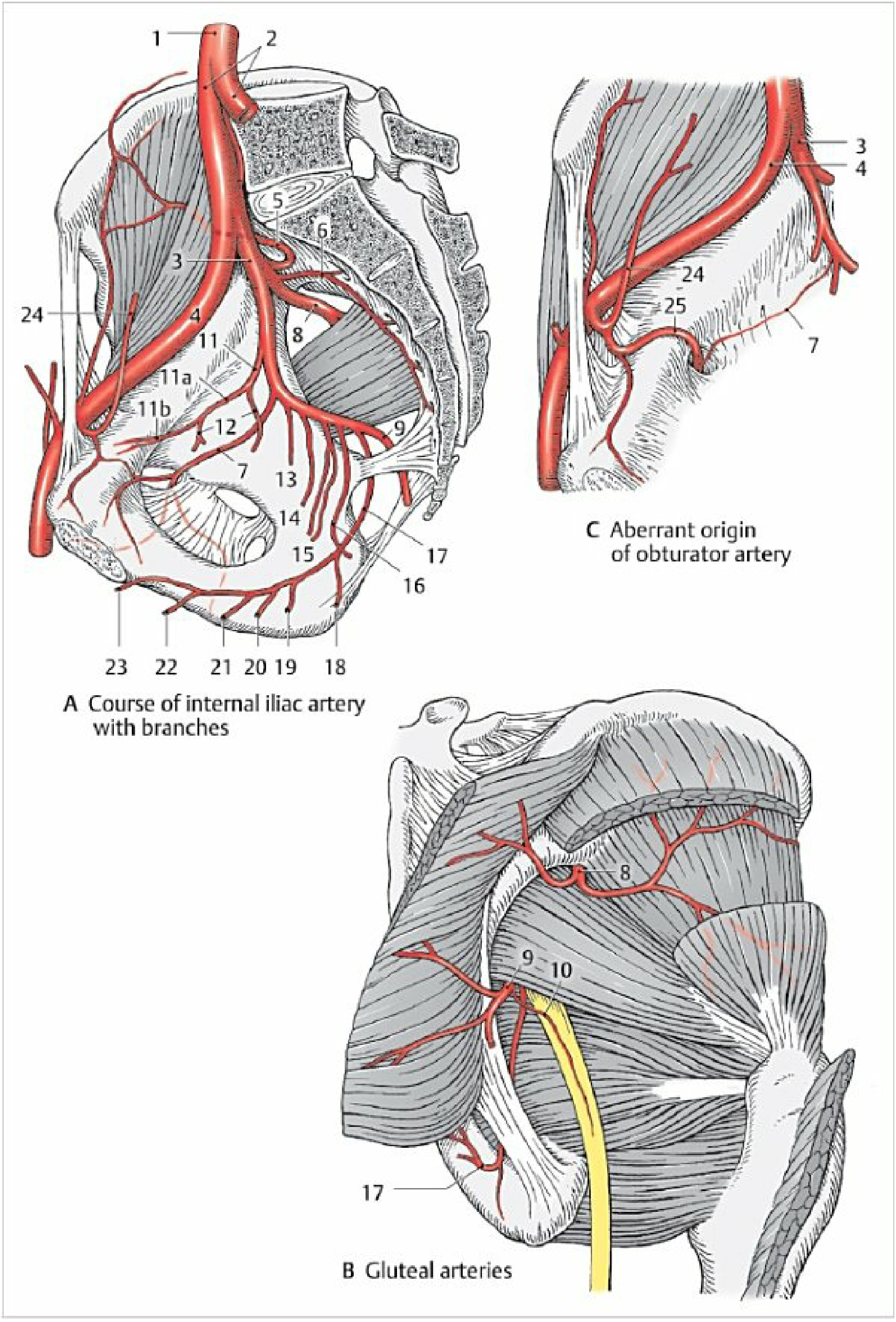
The internal iliac artery (also called the hypogastric artery) arises as one of the two terminal branches of the common iliac artery, at approximately the level of the L5-S1 intervertebral disc, anterior to the sacro-iliac joint. It descends into the lesser pelvis over the pelvic inlet and, at the level of the superior border of the greater sciatic foramen, divides into anterior and posterior trunks.
- Gray's Anatomy for Students, p. 573
Branches
Posterior Trunk
Supplies the posterior pelvic wall, lower posterior abdominal wall, and gluteal region. Its three branches are:
| Branch | Course and Supply |
|---|---|
| Iliolumbar artery | Ascends back out of the pelvic inlet; divides into a lumbar branch (supplies psoas, quadratus lumborum, cauda equina via spinal branch at L5-S1) and an iliac branch (supplies iliac fossa muscles and bone) |
| Lateral sacral arteries (usually 2) | Pass medially and inferiorly along the posterior pelvic wall; enter anterior sacral foramina to supply bone, soft tissue, and structures within the sacral canal |
| Superior gluteal artery | The largest branch of the internal iliac artery and terminal continuation of the posterior trunk; passes between the lumbosacral trunk and S1, exits through the greater sciatic foramen above piriformis to supply gluteal muscles and skin |
Anterior Trunk
Supplies the pelvic viscera, perineum, gluteal region, adductor region of the thigh, and (in fetal life) the placenta. Its branches:
| Branch | Course and Supply |
|---|---|
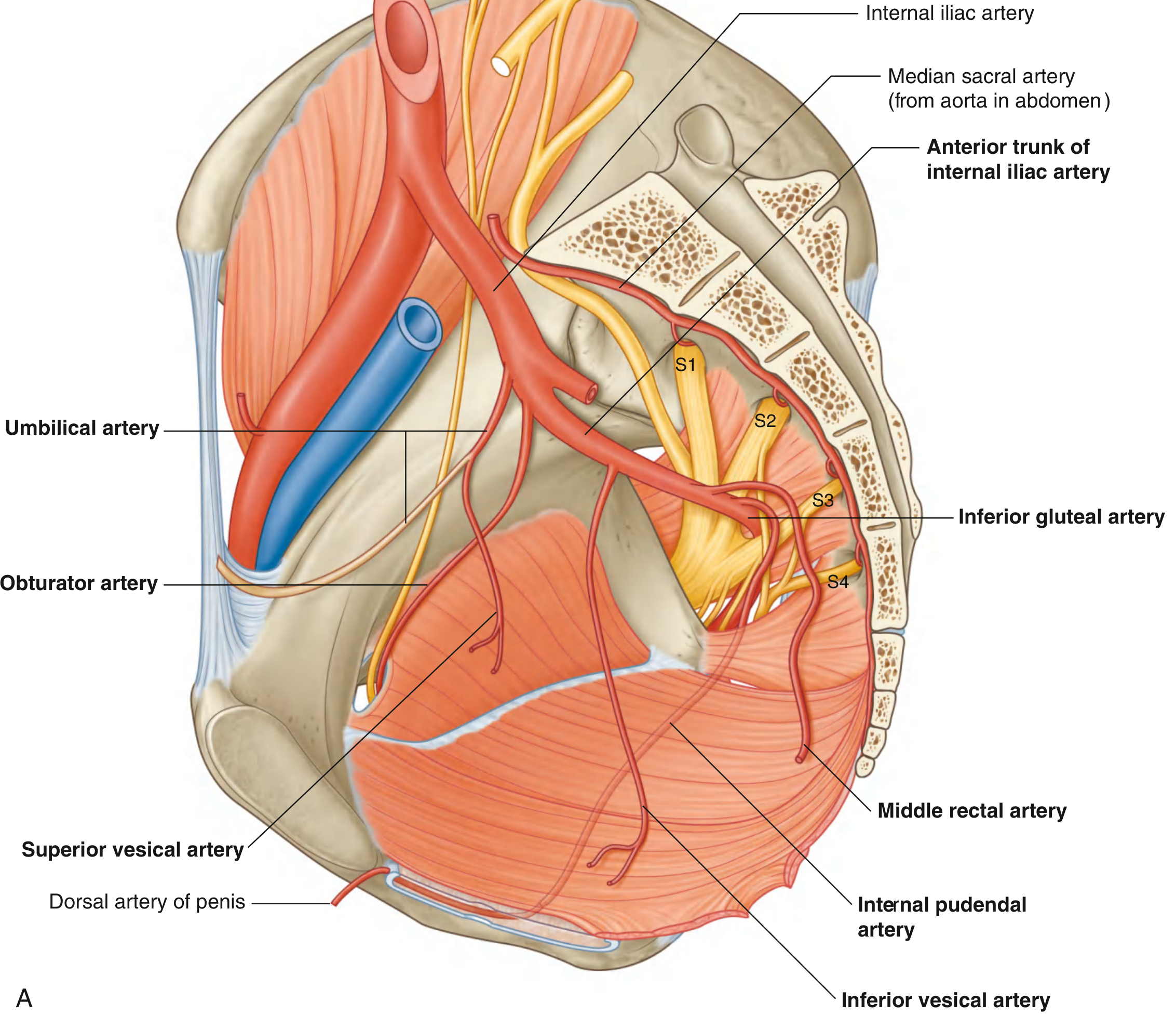
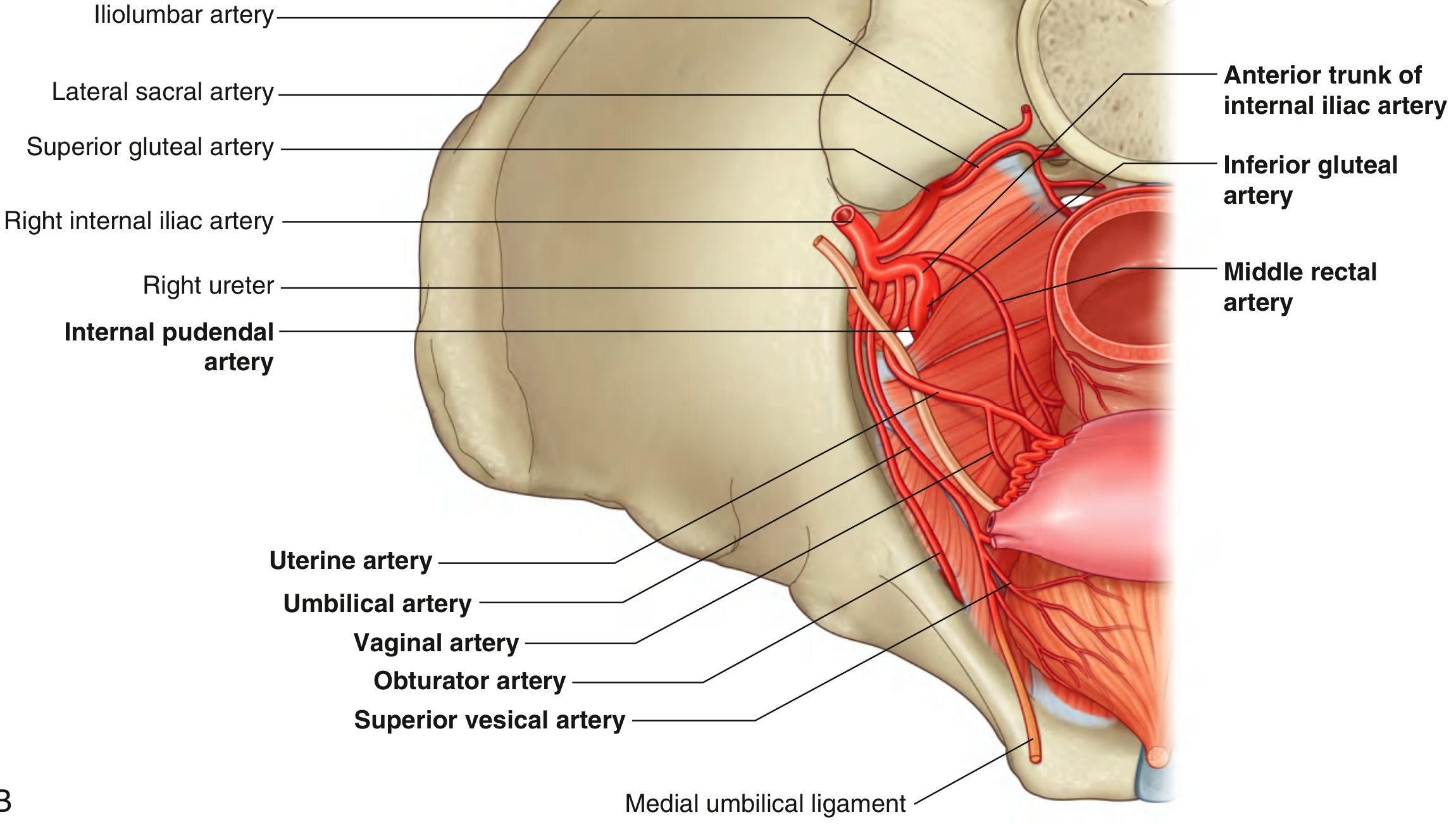
| Umbilical artery | First branch; gives rise to the superior vesical artery, then travels to the umbilicus. After birth, closes distally → becomes the medial umbilical ligament (raises the medial umbilical fold of peritoneum) |
| Superior vesical artery | From the root of the umbilical artery; supplies superior bladder and distal ureter; in men may give rise to artery to ductus deferens |
| Inferior vesical artery (men) / Vaginal artery (women) | Supplies bladder, ureter, seminal vesicle, prostate (men); or vagina (women) |
| Middle rectal artery | Courses medially to rectum; anastomoses with superior rectal artery (from IMA) and inferior rectal artery (from internal pudendal) |
| Uterine artery (women) | Courses in base of broad ligament; crosses the ureter ("water under the bridge") anterosuperiorly near the cervix; ascends lateral to uterus and anastomoses with the ovarian artery |
| Obturator artery | Runs anteriorly along the pelvic wall, exits via the obturator canal with the obturator nerve; supplies adductor region of the thigh; gives a pubic branch that anastomoses with the inferior epigastric artery |
| Internal pudendal artery | Exits through greater sciatic foramen below piriformis, loops around ischial spine, re-enters through lesser sciatic foramen into the perineum; main artery of the perineum; supplies erectile tissue of the penis/clitoris |
| Inferior gluteal artery | Large terminal branch; passes between S1-S2 or S2-S3 of sacral plexus, exits through greater sciatic foramen below piriformis; supplies gluteal region and anastomoses around hip joint |
- Gray's Anatomy for Students, pp. 573-574
- Color Atlas of Human Anatomy Vol. 2, pp. 114-115
Diagrams
Course of the internal iliac artery and its branches (Color Atlas of Human Anatomy):
Anterior trunk branches - Male (Gray's Anatomy for Students, Fig. 5.66A):
Anterior trunk branches - Female (Gray's Anatomy for Students, Fig. 5.66B):
Key Relations
- The ureter crosses anterior to the internal iliac artery at the pelvic brim
- The internal iliac artery and its divisions lie in close relation to the sacroiliac joint - the bifurcation, iliolumbar artery, and superior gluteal artery are all at risk during anterior approaches to the SI joint
- The superior gluteal artery passes between the lumbosacral trunk and S1 before exiting the greater sciatic notch
- Imaging Anatomy Vol. 3, pp. 2710-2711
Clinical Points
Corona Mortis ("Crown of Death")
The pubic branch of the obturator artery anastomoses with the inferior epigastric artery. When this anastomosis is large, or when the obturator artery itself arises from the inferior epigastric artery (an aberrant obturator artery), it crosses the superior pubic ramus and is at risk of injury during inguinal/femoral hernia repair - potentially causing severe hemorrhage. - Color Atlas of Human Anatomy Vol. 2, p. 115
Uterine Artery and the Ureter
The uterine artery crosses superior to the ureter ("water runs under the bridge") near the cervix. This relationship is critical during hysterectomy - the ureter can be inadvertently ligated along with the uterine artery.
Ligation in Obstetric Hemorrhage
Internal iliac (hypogastric) artery ligation is a surgical option in refractory postpartum hemorrhage. Bilateral ligation reduces pulse pressure in distal vessels by ~85%, allowing hemostasis, while collateral flow usually preserves pelvic viability.
Iliac Aneurysms
Internal iliac artery aneurysms are typically treated by exclusion (endovascular embolization or open ligation), since rupture risk is significant. Endovascular approaches are generally preferred. - Mulholland and Greenfield's Surgery 7e
Kidney Transplant
The donor renal artery is anastomosed end-to-side to the recipient's external iliac artery, or end-to-end to the internal iliac artery, in the iliac fossa. - Comprehensive Clinical Nephrology 7e
Summary Table of Branches
| Trunk | Branches |
|---|---|
| Posterior | Iliolumbar, Lateral sacral (x2), Superior gluteal |
| Anterior | Umbilical (→ superior vesical), Inferior vesical (M) / Vaginal (F), Middle rectal, Uterine (F), Obturator, Internal pudendal, Inferior gluteal |
Mnemonic
Mnemonic for Internal Iliac Artery Branches
Posterior Trunk — "I Like Standing"
| Letter | Branch |
|---|---|
| I | Iliolumbar |
| L | Lateral sacral |
| S | Superior gluteal |
Anterior Trunk — "2 UP, 2 In, 2 Out" logic
Or use this sentence:
"U Smell Very Offensive, U Idiot! Put It Back!"
| Letter | Branch |
|---|---|
| U | Umbilical (→ superior vesical) |
| S | Superior vesical |
| V | (Inferior) Vesical / Vaginal |
| O | Obturator |
| U | Uterine (females) |
| I | Internal pudendal |
| P | Internal Pudendal ← (alt position) |
| I | Inferior gluteal |
| B | (middle rectal = Bowel supply) |
Cleaner All-in-One Mnemonic
Posterior: "I LS G" → "I LiSten to Glutes"
Iliolumbar, Lateral Sacral, Superior Gluteal
Anterior: "U MUSIC, Guys!"
| Letter | Branch |
|---|---|
| U | Umbilical |
| M | Middle rectal |
| U | Uterine / (inferior vesical in males) |
| S | Superior vesical |
| I | Internal pudendal |
| C | (obturator = Canal exit) |
| G | Inferior Gluteal |
The Classic One-Liner
"I Love Sex, Often Using Muscles, Vaginas, and Internal Pudendal Go Inferiorly"
Mapping it out:
| Word | Branch |
|---|---|
| I | Iliolumbar (posterior) |
| L | Lateral sacral (posterior) |
| S | Superior gluteal (posterior) |
| O | Obturator |
| U | Umbilical |
| M | Middle rectal |
| V | (inferior) Vesical / Vaginal |
| I | Internal pudendal |
| G | Inferior gluteal |
Quick Recall Tip
- Posterior trunk = 3 branches only (ILS - easy to remember as a group)
- Anterior trunk = everything else (visceral + perineal + gluteal)
- The superior gluteal exits above piriformis; the inferior gluteal and internal pudendal both exit below piriformis
In order and way to remember course easily
Internal Iliac Artery — Branches In Order, Easy to Remember
The Core Logic First
Think of the internal iliac artery as a tree splitting into two trunks, and each trunk sending branches to a logical territory. If you understand the territory, the order makes sense automatically.
POSTERIOR TRUNK — "Go Backwards and Up"
Posterior trunk branches all go posteriorly / superiorly - back toward the abdominal wall, sacrum, and gluteal region.
Order (proximal → distal):
Posterior trunk
│
├── 1. Iliolumbar artery → goes UP and BACK (to lumbar/iliac region)
├── 2. Lateral sacral artery → goes MEDIALLY (to sacral foramina)
└── 3. Superior gluteal artery → terminal branch, exits ABOVE piriformis
Memory hook:
"I Left Straight away" — Iliolumbar → Lateral sacral → Superior gluteal
The posterior trunk is short and ends quickly — just 3 branches, done.
ANTERIOR TRUNK — Follow the Logic of Territory
Think of the anterior trunk traveling downward and forward through the pelvis, giving branches as it goes. Organize by territory visited, top to bottom:
Anterior trunk
│
├── 1. Umbilical artery ──────── (fetal remnant; goes to anterior abdominal wall)
│ └── Superior vesical (bladder top = first thing it supplies)
│
├── 2. Inferior vesical (M) (bladder bottom + prostate)
│ / Vaginal artery (F)
│
├── 3. Uterine artery (F only) (uterus — crosses ureter here!)
│
├── 4. Middle rectal artery (rectum — posterior pelvic viscera)
│
├── 5. Obturator artery (exits obturator canal → thigh)
│
├── 6. Internal pudendal artery (exits BELOW piriformis → perineum)
│
└── 7. Inferior gluteal artery (terminal branch; exits BELOW piriformis → gluteal)
The Territory-Based Story
Read this once and the order sticks:
The anterior trunk first deals with the bladder (top → bottom: superior vesical via umbilical, then inferior vesical). In women it then sends the uterine artery (which famously crosses the ureter). Next it supplies the rectum (middle rectal). Then it sends the obturator artery out through the obturator canal to the thigh. Finally, two big branches head out the greater sciatic foramen below piriformis — the internal pudendal (to the perineum) and the inferior gluteal (to the buttock).
Bladder → Uterus/Prostate → Rectum → Thigh → Perineum → Buttock
One Sentence Mnemonic (Anterior Trunk, in order)
"Uncle Sam's Very Ugly Moustache — Over It, Put Glue"
| Word | Branch |
|---|---|
| Uncle | Umbilical (→ superior vesical) |
| Sam's | Superior vesical |
| Very | (inferior) Vesical / Vaginal |
| Ugly | Uterine |
| Moustache | Middle rectal |
| Over | Obturator |
| It | Internal pudendal |
| Glue | Inferior Gluteal |
The "Exits" Rule — Never Confuse Superior vs Inferior Gluteal Again
| Artery | Exits via | Relation to Piriformis |
|---|---|---|
| Superior gluteal | Greater sciatic foramen | Above piriformis |
| Inferior gluteal | Greater sciatic foramen | Below piriformis |
| Internal pudendal | Greater sciatic foramen → loops around ischial spine → lesser sciatic foramen | Below piriformis |
Memory: "Superior = Superpiriformis (above). Inferior and Internal pudendal = both below."
Full Branch List at a Glance
INTERNAL ILIAC ARTERY
│
├── POSTERIOR TRUNK
│ ├── Iliolumbar
│ ├── Lateral sacral
│ └── Superior gluteal ← TERMINAL (exits ABOVE piriformis)
│
└── ANTERIOR TRUNK
├── Umbilical → Superior vesical
├── Inferior vesical (M) / Vaginal (F)
├── Uterine (F)
├── Middle rectal
├── Obturator
├── Internal pudendal ← exits BELOW piriformis → perineum
└── Inferior gluteal ← TERMINAL (exits BELOW piriformis)

photo-1784659644125.jpg
Give me the course short and for exam
Internal Iliac Artery — Course (Exam Format)
Origin
- Smaller terminal branch of the common iliac artery
- Origin: opposite the lumbosacral disc (L5-S1), in front of the sacroiliac joint
Course
- Passes downward and backward into the pelvis
- Crosses the pelvic inlet (linea terminalis)
- Reaches the upper margin of the greater sciatic foramen
- Divides into anterior and posterior divisions
One-Line Exam Answer
"The internal iliac artery arises from the common iliac artery at the level of the lumbosacral disc, descends into the lesser pelvis, and divides into anterior and posterior divisions at the upper margin of the greater sciatic foramen."
Divisions & Branches (from your textbook diagram)
Posterior Division — "I Love Superior"
| # | Branch | Key fact |
|---|---|---|
| 1 | Iliolumbar | Goes up across sacroiliac joint |
| 2 | Lateral sacral | Usually 2 (upper & lower) |
| 3 | Superior gluteal | Largest; exits above piriformis |
Anterior Division — "Some Opposing Ugly Men Mostly Ignore Vaginas"
| # | Branch | Key fact |
|---|---|---|
| 1 | Superior vesical | From umbilical artery |
| 2 | Obturator | Parietal; exits obturator canal |
| 3 | Uterine (F) / artery to vas deferens (M) | Crosses ureter superiorly |
| 4 | Middle rectal | Small branch to rectum |
| 5 | Mostly = Inferior vesical (M) / Vaginal (F) | Base of bladder, prostate |
| 6 | Inferior gluteal | Largest anterior branch; exits below piriformis |
| 7 | Internal pudendal | Principal artery of perineum; exits below piriformis → around ischial spine → lesser sciatic foramen |
The ONE Exam Note (from your textbook NB box)
All anterior division branches are VISCERAL — except inferior gluteal and obturator, which are parietal.
Exits Rule (1 mark question)
| Artery | Exits | Relation to piriformis |
|---|---|---|
| Superior gluteal | Greater sciatic foramen | Above |
| Inferior gluteal | Greater sciatic foramen | Below |
| Internal pudendal | Greater sciatic foramen → ischial spine → lesser sciatic foramen | Below |
This is a shared conversation. Sign in to Orris to start your own chat.