
Write a five mark short note on Srb 505 - quadrulpe assesment of thyroid Make it compatible, compact but high yielding. So that... I can easily remember and, uh, write it in a... Systematic way being a 2nd year resident. make it in a way its interesting and easy to learn visually and Create a high density, high yielding image based(generate image) Flashcard I can use Before exam to revise and remember all the important points regarding this short-note. but it should be in a way so its easy to understand and remember also use flowcharts or mindmaps in the response wherever possible dont use code
SRB surgery quadruple assessment thyroid 505 FNAC clinical examination
SRB manual surgery thyroid quadruple assessment clinical FNAC ultrasound isotope scan four steps
https://dokumen.pub/srbs-manual-of-surgery-6nbsped-935270907…
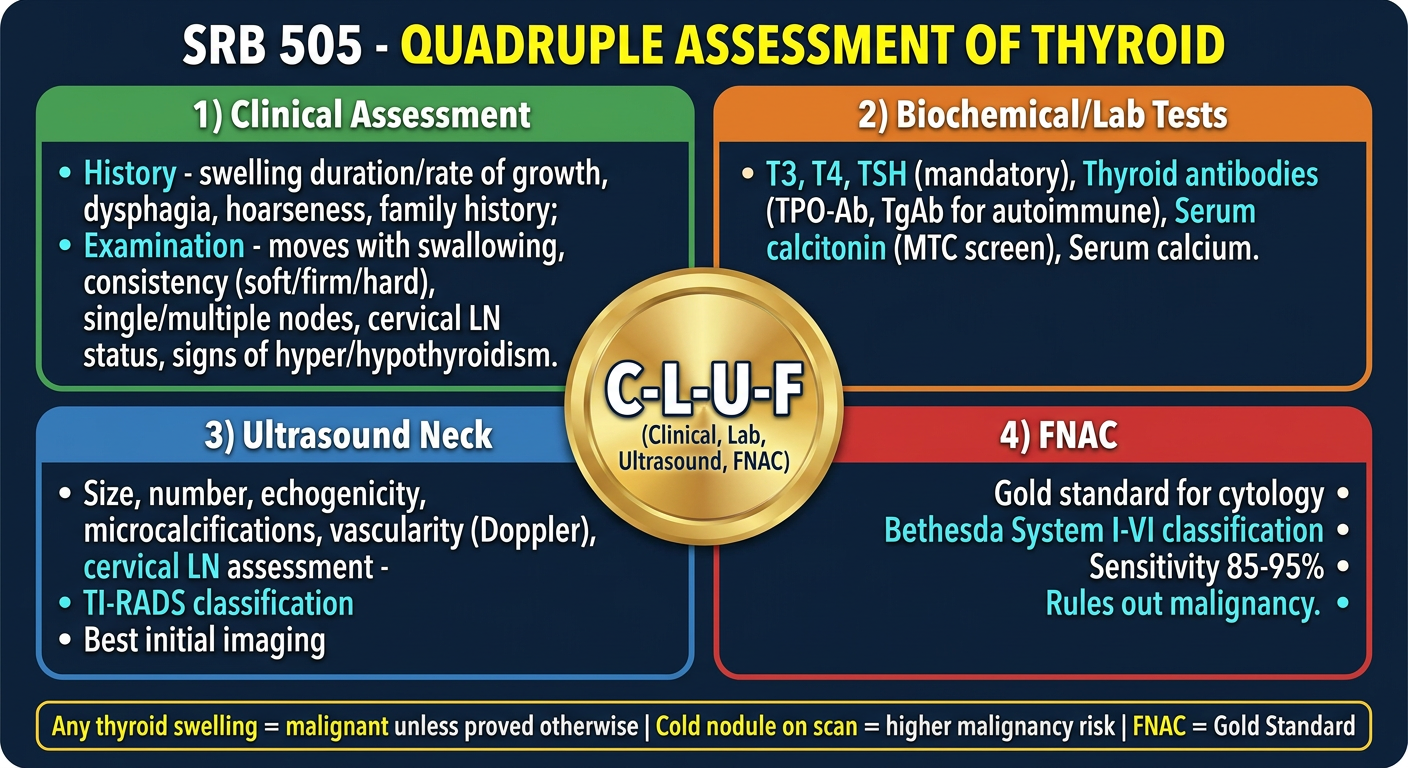
A high-density medical exam flashcard titled "SRB 505 - QUADRUPLE ASSESSMENT OF THYROID" with a dark navy blue background and bright white/yellow/cyan text. The card is divided into 4 color-coded quadrants representing the 4 assessment pillars: 1) Clinical Assessment (top-left, green) with bullet points: History - swelling duration/rate of growth, dysphagia, hoarseness, family history; Examination - moves with swallowing, consistency (soft/firm/hard), single/multiple nodes, cervical LN status, signs of hyper/hypothyroidism. 2) Biochemical/Lab Tests (top-right, orange): T3, T4, TSH (mandatory), Thyroid antibodies (TPO-Ab, TgAb for autoimmune), Serum calcitonin (MTC screen), Serum calcium. 3) Ultrasound Neck (bottom-left, blue): Size, number, echogenicity, microcalcifications, vascularity (Doppler), cervical LN assessment - TI-RADS classification - Best initial imaging. 4) FNAC (bottom-right, red): Gold standard for cytology, Bethesda System I-VI classification, Sensitivity 85-95%, Rules out malignancy. A central golden badge shows the mnemonic "C-L-U-F" (Clinical, Lab, Ultrasound, FNAC). Bottom footer shows key exam pearls in yellow: "Any thyroid swelling = malignant unless proved otherwise | Cold nodule on scan = higher malignancy risk | FNAC = Gold Standard". Clean medical textbook style, easy to read, visually organized.
SRB 505 - Quadruple Assessment of Thyroid
Core Principle: "Any thyroid swelling must be considered malignant unless proved otherwise." - SRB
🔑 MNEMONIC: C-L-U-F
MIND MAP - The 4 Pillars
                    QUADRUPLE ASSESSMENT
                           |
        ┌──────────────────┼──────────────────┐
        |                  |                  |
   1. CLINICAL        2. LABS/           3. ULTRASOUND
   ASSESSMENT         BIOCHEMICAL            NECK
        |              TESTS                  |
   ┌────┴────┐          |             ┌───────┴──────┐
History  Exam      T3, T4, TSH      TI-RADS      Doppler
                    Antibodies      Echogenicity  LN status
                    Calcitonin
                               ↓
                         4. FNAC
                    (Bethesda I-VI)
📋 THE FOUR ASSESSMENTS IN DETAIL
1. ✅ CLINICAL ASSESSMENT
- Duration and rate of growth (rapid growth = alarm sign)
- Dysphagia, hoarseness (RLN involvement = malignancy)
- Dyspnea/stridor (tracheal compression)
- Family history (MEN 2 → Medullary Carcinoma)
- Palpitations, weight loss, heat intolerance (hyperthyroidism)
| Step | What to Check | Significance |
|---|---|---|
| Inspection | Moves with swallowing | Confirms thyroid origin |
| Palpation | Consistency, surface, borders | Hard/stony = malignancy |
| Lymph nodes | Cervical LN status | Metastasis screen |
- Hard consistency, irregular surface
- Fixity to adjacent structures
- Hoarseness (RLN palsy)
- Cervical lymphadenopathy
- Positive Berry's sign (absent carotid pulsation)
2. 🧪 BIOCHEMICAL / LAB TESTS
| Test | Purpose |
|---|---|
| T3, T4, TSH | Mandatory - functional status |
| TPO-Ab, TgAb | Hashimoto's / autoimmune |
| Serum Calcitonin | Medullary carcinoma screen |
| Serum Calcium | Parathyroid co-pathology |
| ESR | De Quervain's thyroiditis (>90 mm/hr) |
| CEA | Raised in Medullary Carcinoma |
Exam pearl: TSH low + hot nodule on scan = autonomous functioning nodule, less likely malignant. TSH high or normal + cold nodule = higher malignancy risk.
3. 🔊 ULTRASOUND NECK
USG THYROID
├── Size and number of nodules
├── Echogenicity (hypoechoic = suspicious)
├── Margins (irregular = malignant)
├── Microcalcifications (hallmark of Papillary Ca)
├── Vascularity (Color Doppler)
├── Cervical lymph nodes
└── TI-RADS Classification (1-5)
- TI-RADS 1-2 = Benign, no FNAC needed
- TI-RADS 3 = Mildly suspicious, follow-up
- TI-RADS 4-5 = FNAC mandatory
SRB pearl: USG also guides FNAC (USG-guided FNAC improves accuracy)
4. 🔬 FNAC (Fine Needle Aspiration Cytology)
Bethesda I   → Unsatisfactory / Non-diagnostic   → Repeat FNAC
Bethesda II  → Benign                             → Follow-up
Bethesda III → AUS / FLUS (atypia, uncertain)     → Repeat / Molecular test
Bethesda IV  → Follicular Neoplasm                → Lobectomy
Bethesda V   → Suspicious for Malignancy          → Surgery
Bethesda VI  → Malignant                          → Definitive Surgery
- Sensitivity: 85-95%
- Specificity: ~99%
- False negative rate: ~5%
- Limitation: Cannot distinguish follicular adenoma vs follicular carcinoma (capsular invasion needed - only on histology)
⚡ HIGH-YIELD EXAM PEARLS
| Point | Fact |
|---|---|
| Gold standard for cytology | FNAC (Bethesda) |
| Best initial imaging | Ultrasound |
| Malignancy risk - solitary cold nodule | ~20% |
| FNAC cannot differentiate | Follicular adenoma vs carcinoma |
| Mandatory test in all thyroid swellings | T3, T4, TSH + USG |
| Calcitonin elevated in | Medullary Carcinoma of Thyroid |
| Berry's sign | Positive in Riedel's thyroiditis & Anaplastic Ca |
| Hot nodule malignancy risk | Very low (<1%) |
| Cold nodule malignancy risk | ~20% |
📊 FLOWCHART - Clinical Decision Using Quadruple Assessment
THYROID SWELLING DETECTED
         |
         ▼
  CLINICAL ASSESSMENT
  (History + Examination)
         |
    ┌────┴────┐
  No red    Red flags
  flags     present
    |            |
    ▼            ▼
  T3/T4/TSH   Urgent
  + USG       workup
    |
    ▼
  USG FINDINGS
    |
    ├─── TI-RADS 1-2 → Monitor (6-12 months)
    ├─── TI-RADS 3   → Repeat USG (6-12 months)
    └─── TI-RADS 4-5 → FNAC
                           |
                    ┌──────┴──────┐
                Bethesda      Bethesda
                I-II           III-VI
                    |              |
                 Follow-up      Surgery /
                                Lobectomy /
                               Total Thyroidectomy
🃏 REVISION FLASHCARD
✍️ HOW TO WRITE THIS IN 5 MARKS (Template)
Quick recall trick before exam: Draw 4 boxes, label them C-L-U-F, and fill in 3 key bullet points each. You'll never miss marks on this topic!