
Kobeners phenomena in psoriasis
Reading File
The Koebner phenomenon (isomorphic response) in psoriasis refers to the appearance of new psoriatic lesions at sites of skin trauma or injury in a patient who already has psoriasis.
Searching sources...
Finding Sources
Searching PubMed
Koebner phenomenon psoriasis isomorphic response
Reading File
Reading File
Loading Image
Finding Sources
Here is a detailed breakdown of the Koebner (isomorphic) phenomenon in psoriasis, drawn from authoritative dermatology textbooks.
Koebner Phenomenon in Psoriasis
Definition
The Koebner phenomenon (also called the isomorphic response) is the appearance of typical psoriatic lesions at sites of skin trauma or injury in a patient with pre-existing psoriasis. The lesions that develop at the trauma site are identical histologically and clinically to those found elsewhere on the patient.
The term "isomorphic" means the new lesions are of the same form as the patient's existing disease - not just any reaction, but specifically the patient's own skin disease reproduced at the site of injury.
Clinical Image
Below is a classic example: psoriatic plaques developing along a linear scratch/scar line on the lower leg.
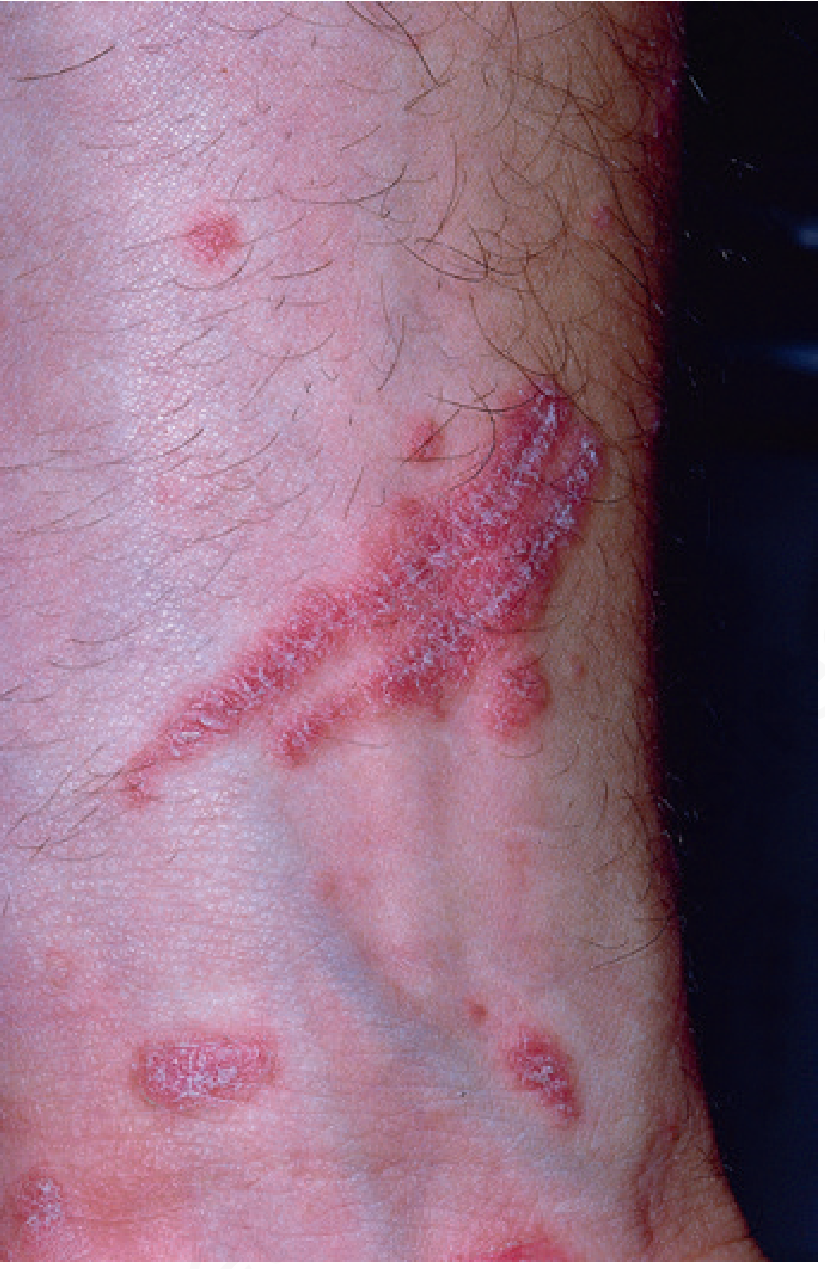
Fig. 10.12 - Koebner phenomenon in psoriasis (Andrews' Diseases of the Skin)
Key Facts
| Feature | Detail |
|---|---|
| Frequency | ~25% of psoriasis patients |
| Lag time (trauma to lesion) | 2-6 weeks |
| Status variability | A patient can be "Koebner-negative" at one time and "Koebner-positive" later |
| Significance | Indicates psoriasis is a generalized skin disease that can be triggered locally |
Triggers That Cause the Koebner Response
Any form of skin injury can provoke it:
- Physical trauma - scratches, cuts, incisions, burns, abrasions, surgical scars
- Sunburn (including severe erythema from phototherapy)
- Morbilliform drug eruptions
- Viral exanthems (e.g., after varicella, pityriasis rosea)
- Laser procedures (laser-induced Koebner reactions are a recognized clinical concern)
Clinical Significance
-
Disease course - It is one of the hallmark features of psoriasis, along with its tendency to recur and persist. It explains why patients often develop new plaques along scratch lines, tattoo sites, vaccination sites, or surgical wounds.
-
Linear psoriasis - Psoriasis following lines of Blaschko must be distinguished from Koebner-induced linear lesions, where the linear pattern is imposed by an exogenous injury (both can coexist).
-
Psoriatic arthritis (PsA) risk - The Koebner phenomenon is listed as a risk factor for transition from psoriasis to psoriatic arthritis, alongside obesity, nail psoriasis, and scalp involvement. Physical trauma (Koebner) has been described as an environmental trigger in this transition.
-
Disease memory - Psoriasis frequently relapses at previously affected body sites even after treatment, suggesting a phenomenon of epidermal and immune "memory" (involving tissue-resident memory T cells and epithelial stem cells) that is conceptually related to the Koebner response.
-
Phototherapy caution - The isomorphic response can occur if psoriatic lesions are severely burned during phototherapy (UV overdose). Reducing the light dose resolves the erythema and the plaques clear.
Pathophysiological Basis
Trauma disrupts the skin barrier and triggers keratinocyte activation, releasing pro-inflammatory cytokines (IL-1, IL-6, IL-8, TNF) and antimicrobial peptides (LL-37, beta-defensins). In a genetically predisposed individual, this innate immune activation initiates the psoriatic inflammatory cascade - recruiting dendritic cells, T cells, and neutrophils - producing a full psoriatic plaque at the site of injury.
Other Diseases Showing the Koebner Phenomenon
The Koebner phenomenon is not exclusive to psoriasis. Other conditions that exhibit it include:
- Lichen planus (classic)
- Vitiligo
- Verrucae (autoinoculation)
- Reactive perforating collagenosis
Sources:
- Dermatology 2-Volume Set 5e (Elsevier), External triggering factors section, p. 3512
- Andrews' Diseases of the Skin - Clinical Dermatology, Course section, p. 233
Pup tent sign
The "pup tent sign" is a radiological sign seen on lateral chest X-ray, associated with constrictive pericarditis, where the pericardium forms a triangular/tent-like configuration.
Searching sources...
Finding Sources
Searching the Web
pup tent sign radiology constrictive pericarditis
Interesting - the textbook database returned a dermatology result. Let me read that and also search more specifically.
Reading File
Finding Sources
Searching the Web
pup tent sign nail lichen planus dermatology pterygium
Reading File
Pup Tent Sign
The pup tent sign is a dermatological sign seen in nail lichen planus (LP), not a radiological sign.
What It Is
In nail lichen planus, discrete red or violaceous papules in the nail bed can lift and longitudinally split the overlying nail plate. The split lateral edges of the nail plate angle forward (tilt outward), creating a shape resembling a pup tent (a small A-frame camping tent) when the nail is viewed en face (straight on from above).
This is closely related to, but distinct from, the "angel's wings" deformity - where the same process of nail plate fissuring plus atrophy is viewed from the side.
Mechanism
The sequence of events:
- Lichen planus inflammation targets the nail bed (rather than the nail matrix)
- Inflammatory papules in the nail bed push upward against the nail plate
- The nail plate is lifted and split longitudinally at the point of papule contact
- The two split edges of the nail plate angle laterally and forward, like the sloping sides of a tent
- Viewed en face, this creates the characteristic inverted V / tent shape - the pup tent sign
Context in Nail Lichen Planus
Nail LP produces two main categories of changes depending on which part of the nail unit is affected:
| Part Affected | Changes |
|---|---|
| Nail matrix | Nail plate thinning, longitudinal ridging/striations, pterygium formation |
| Nail bed | Onycholysis, pup tent sign, longitudinal melanonychia |
The dorsal pterygium (V-shaped scar where the proximal nail fold adheres to the nail bed due to matrix destruction) is the most pathognomonic sign of nail LP. The pup tent sign is a nail bed sign that can be detected on dermoscopy and confirms LP involvement.
Dermoscopic Detection
On onychoscopy (nail dermoscopy), the pup tent sign is described as:
"Nail plate separated from the nail bed with sloping lateral edges"
It is a useful non-invasive diagnostic clue, particularly when the patient declines nail biopsy (the gold standard).
Other Nail Signs in Lichen Planus
- Dorsal pterygium - pathognomonic; V-shaped proximal nail fold extension onto nail bed
- Angel's wings deformity - nail plate fissuring and atrophy viewed laterally
- Pup tent sign - nail bed papule lifting/splitting the nail plate viewed en face
- Trachyonychia - rough, sandpapered-looking nails (also in alopecia areata, psoriasis)
- Onychorrhexis - longitudinal ridging/splitting
- Erythronychia - red streaks from nail bed involvement
Source: Dermatology 2-Volume Set 5e (Elsevier), Nail Lichen Planus section, p. 389 | JCAD dermoscopy study on nail LP
This is a shared conversation. Sign in to Orris to start your own chat.