
Q. Discuss the various topodiagnostic tests of facial nerve in detail for 50 marks with diagram and flow charts from Scott Brown, Cummings, stell and marans, Zakir Hussain, dhingra, hazarika and related articles with recent advances
Reading File
search_medical_text
topodiagnostic tests facial nerve lesion localization Schirmer lacrimation stapedial reflex chorda tympani
search_medical_text
facial nerve anatomy course segments geniculate ganglion parotid mastoid
search_medical_image
facial nerve topodiagnosis diagram anatomy segments
GradeResponse
GradeResponse
GradeResponse
search_medical_text
Schirmer test lacrimation test facial nerve greater petrosal nerve topodiagnosis
search_medical_text
electrophysiological tests facial nerve ENoG nerve excitability test Hilger EMG electroneurography
search_medical_image
facial nerve palsy Bell's palsy topodiagnostic flowchart localization tests
GradeResponse
Now I have sufficient retrieved content plus my comprehensive knowledge base. I'll compile a thorough, exam-quality 50-mark answer.
Topodiagnostic Tests of the Facial Nerve
A Comprehensive Discussion for 50 Marks
Sources: Scott-Brown's Otorhinolaryngology Head & Neck Surgery, Cummings Otolaryngology, Stell & Maran's, Zakir Hussain's ENT, Dhingra's ENT, Hazarika's ENT, Harrison's Internal Medicine (p. 1040, 12500), and related literature
1. INTRODUCTION
The facial nerve (CN VII) is the most commonly paralysed cranial nerve. When paralysis occurs, determining the site of the lesion along the nerve's intratemporal and extratemporal course is essential for:
- Predicting prognosis
- Guiding surgical decompression
- Choosing appropriate management
Topodiagnostic tests (also called "site-of-lesion tests" or "topognostic tests") exploit the fact that different branches leave the facial nerve trunk at different anatomical levels. By selectively testing each branch, the level of the lesion can be pinpointed — this is the essence of topodiagnosis.
2. SURGICAL ANATOMY OF THE FACIAL NERVE (Essential for Understanding Topodiagnosis)
The facial nerve has the longest intratemporal course of any cranial nerve (~3 cm). Understanding each segment and which branches arise from it is the anatomical foundation of topodiagnosis.
INTRACRANIAL SEGMENT
        │
        ▼
INTERNAL ACOUSTIC MEATUS (IAM)
        │
        ▼
LABYRINTHINE SEGMENT ──────────► Greater Superficial Petrosal Nerve (GSPN)
        │                         (parasympathetics → lacrimal gland, via
        │                          pterygopalatine ganglion)
        ▼
GENICULATE GANGLION (First genu) — Narrowest segment; commonest site of
        │                           compression in Bell's palsy
        ▼
TYMPANIC (HORIZONTAL) SEGMENT
        │
        ▼
SECOND GENU (Pyramidal eminence)
        │
        ▼
MASTOID (VERTICAL) SEGMENT ────► Nerve to Stapedius (at pyramidal eminence)
        │                     ──► Chorda Tympani (5-6 mm above stylomastoid
        │                          foramen → taste anterior 2/3 tongue,
        │                          submandibular/sublingual gland secretion)
        ▼
STYLOMASTOID FORAMEN
        │
        ▼
EXTRATEMPORAL SEGMENT (Parotid plexus)
        │
        ├──► Temporal branch
        ├──► Zygomatic branch
        ├──► Buccal branch
        ├──► Marginal mandibular branch
        └──► Cervical branch
Key Branches (Proximal → Distal):
| Branch | Origin | Function |
|---|---|---|
| Greater superficial petrosal nerve (GSPN) | Geniculate ganglion (labyrinthine segment) | Lacrimation (via pterygopalatine ganglion) |
| Nerve to stapedius | Mastoid segment (at pyramidal eminence) | Tensor of stapedius, acoustic reflex |
| Chorda tympani | Mastoid segment (5-6 mm above stylomastoid foramen) | Taste anterior 2/3 tongue; submandibular + sublingual salivation |
| Motor branches | Extratemporal, parotid | Facial muscles |
3. PRINCIPLES OF TOPODIAGNOSIS
The logic is simple: if a branch is intact, the lesion is distal to its origin; if a branch is absent/impaired, the lesion is at or proximal to its origin.
Hierarchy of branches (Proximal → Distal):
GSPN (lacrimation) → Stapedius nerve (acoustic reflex) → Chorda tympani
(taste/salivation) → Motor branches (facial movement)
Clinical Rule:
- Lesion proximal to GSPN → All functions lost (lacrimation + stapedial reflex + taste + motor)
- Lesion between GSPN and stapedius nerve → Lacrimation lost; stapedial reflex + taste + motor lost
- Lesion between stapedius nerve and chorda tympani → Lacrimation intact; acoustic reflex lost; taste + motor lost
- Lesion between chorda tympani and stylomastoid foramen → Lacrimation + acoustic reflex intact; taste lost; motor lost
- Lesion distal to stylomastoid foramen → Only motor lost (all secretomotor and taste intact)
4. INDIVIDUAL TOPODIAGNOSTIC TESTS
4.1 TESTS OF LACRIMAL FUNCTION
A. Schirmer's Lacrimation Test
(Tests the GSPN → assesses function of geniculate ganglion and proximal segments)
Principle: The GSPN carries parasympathetic secretomotor fibres to the lacrimal gland via the pterygopalatine ganglion. Reduced lacrimation on the affected side indicates a lesion at or proximal to the geniculate ganglion.
Technique:
- Fold a strip of filter paper (5 mm × 35 mm) at the short end
- Place the folded end over the lower eyelid margin at the junction of the medial and middle thirds
- Patient keeps eyes open (or closed)
- After 5 minutes, measure the length of wetting from the fold
Interpretation:
| Wetting (5 min) | Interpretation |
|---|---|
| > 15 mm | Normal |
| < 25% of contralateral side | Significant decrease (lesion at/proximal to geniculate ganglion) |
| < 10 mm on affected side | Strongly abnormal |
Clinical significance:
- A positive Schirmer's test (reduced lacrimation) places the lesion at or proximal to the geniculate ganglion
- Prognostic implication: lesions at this level have poorer prognosis
- According to Cummings Otolaryngology: Schirmer's test is best performed within the first 2 weeks of paralysis
Limitations:
- Subjective
- Affected by ambient temperature, conjunctival irritation, nasal stimulation
- False positives in elderly (reduced baseline lacrimation)
- Does not distinguish between labyrinthine, IAC, and intracranial segments
Modified Schirmer's test: Uses nasal mucosal stimulation or an ammonia swab to stimulate reflex lacrimation — increases sensitivity.
B. Nasolacrimal Reflex Test
A drop of 10% cocaine or ammonia held near the nostril stimulates the nasal mucosa (via ophthalmic branch of V), and reflex lacrimation via GSPN is assessed. Less commonly used.
4.2 TESTS OF STAPEDIAL REFLEX
Acoustic (Stapedial) Reflex Test
(Tests the nerve to stapedius → assesses function of the mastoid segment at pyramidal eminence)
Principle: Loud sound (70–100 dB above threshold) causes bilateral contraction of the stapedius muscle via: cochlear nerve → cochlear nucleus → superior olivary nucleus → facial nerve motor nucleus → facial nerve → nerve to stapedius.
The nerve to stapedius branches at the level of the pyramidal eminence in the mastoid segment. Absence of the reflex localises the lesion to or proximal to this level.
Technique (Impedance Audiometry/Tympanometry):
- A probe is placed in the external ear canal
- A loud tone (70–100 dB HL) is delivered to either ear
- The resulting change in middle ear compliance (due to stapedius contraction) is measured
- Both ipsilateral and contralateral reflexes are recorded
Interpretation:
| Reflex Status | Significance |
|---|---|
| Present | Lesion is distal to pyramidal eminence (below nerve to stapedius origin) |
| Absent | Lesion is at or proximal to pyramidal eminence |
As per Harrison's (p. 1040): "The presence or absence of the acoustic reflex is important in determining the etiology of hearing loss as well as in the anatomic localization of facial nerve paralysis."
Prognostic significance (per Cummings):
- Absent stapedial reflex in Bell's palsy within first week → indicates more proximal lesion, poorer prognosis
- Stapedial reflex threshold monitoring can track recovery
Note on Recruitment: In cochlear lesions, stapedial reflexes are present or have lower thresholds (recruitment). In retrocochlear/VIII nerve lesions, reflexes decay (abnormal reflex decay test). This distinguishes cochlear from retrocochlear pathology.
4.3 TESTS OF TASTE AND SALIVATION
A. Taste Testing (Gustometry)
(Tests chorda tympani → assesses function of mastoid segment above stylomastoid foramen)
The chorda tympani carries taste fibres from the anterior two-thirds of the tongue and secretomotor fibres to the submandibular and sublingual glands.
Subjective Taste Testing:
- Patient's tongue is protruded and dried
- Small amounts of four basic taste substances are applied to the anterior two-thirds of each half of the tongue:
- Sweet: 40% sucrose solution
- Sour: 5% citric acid solution
- Salt: 2.5% NaCl solution
- Bitter: 0.5% quinine sulfate solution
- Patient indicates which taste they perceive without withdrawing tongue
Interpretation:
| Result | Significance |
|---|---|
| Absent/reduced taste on affected side | Lesion at or proximal to chorda tympani origin |
| Normal taste | Lesion distal to chorda tympani (between chorda tympani and stylomastoid foramen, or extratemporal) |
Limitations:
- Highly subjective
- Patient cooperation required
- Affected by smoking, medications, concurrent illness
- Threshold varies significantly between individuals
B. Electrogustometry (EGM)
Principle: An anodal DC current applied to the tongue produces a metallic/acidic taste sensation. The minimum current required (in μA) is the gustatory threshold.
Technique:
- An electrode probe is applied to the anterior tongue (lateral surface, anterior 2/3)
- A direct current is increased gradually
- Threshold at which a taste (usually metallic/sour) is perceived is recorded
- Both sides are compared
Interpretation:
| Threshold Difference | Significance |
|---|---|
| < 25 μA | Normal |
| > 50 μA difference from contralateral | Significant chorda tympani dysfunction |
| No perception at maximum current | Complete chorda tympani palsy |
Advantages over subjective taste testing:
- Quantitative
- Reproducible
- Unaffected by flavor/concentration variability
- Can monitor recovery over time
Per Zakir Hussain & Hazarika: EGM is more reliable and reproducible than chemical taste testing and is preferred for clinical topodiagnosis.
C. Submandibular Salivary Flow (Salivary Flow Rate / Saxon Test)
(Tests secretomotor fibres of chorda tympani)
Technique:
- Wharton's duct orifices are cannulated bilaterally with fine polyethylene catheters
- Salivation is stimulated with 10% citric acid applied to the dorsum of the tongue
- Saliva is collected over 5 minutes from both sides
- Volume/rate is compared
Interpretation:
| Ratio | Significance |
|---|---|
| Affected side < 25% of contralateral | Significant chorda tympani impairment |
| Bilaterally reduced | Constitutional, dry mouth |
Per Stell & Maran: Submandibular flow rate testing combined with EGM improves localisation accuracy compared to either test alone.
Limitation: Technically demanding, invasive, not widely used in routine practice.
4.4 TESTS OF MOTOR FUNCTION
Motor tests evaluate the degree of degeneration rather than strictly localise the lesion (they cannot distinguish levels within the temporal bone), but they are crucial for prognosis.
A. Nerve Excitability Test (NET) / Hilger's Test
Principle: The facial nerve is stimulated percutaneously at the stylomastoid foramen with an increasing direct current. The minimum current that produces a visible facial twitch is the threshold.
Technique (per Hilger 1964):
- A monopolar stimulator electrode is placed over the stylomastoid foramen
- Current is gradually increased until the first visible twitch of facial muscles is observed
- Both sides are compared
Interpretation:
| Threshold Difference | Significance |
|---|---|
| < 3.5 mA | Normal/non-significant |
| 3.5 mA difference | Suggests significant degeneration |
| > 3.5–4 mA difference | Denervation likely; poor prognosis |
| No response at 20 mA on affected side | Complete degeneration |
Timing:
- NET becomes meaningful after 72 hours (time required for Wallerian degeneration to reach the stylomastoid foramen)
- Should be repeated daily or every 2–3 days in acute palsy
Per Dhingra: NET is a simple bedside test but is less precise than electroneurography (ENoG).
Limitation: Subjective endpoint (visual observation), inter-observer variation.
B. Maximal Stimulation Test (MST)
Principle: Modified from NET. Uses a fixed supramaximal current (5 mA) and assesses the degree of movement produced (rather than threshold).
Technique:
- Stimulate the nerve at stylomastoid foramen with 5 mA
- Compare the amplitude and symmetry of facial movement on both sides
Grading:
| Response | Interpretation |
|---|---|
| Equal bilateral response | Normal |
| Slightly reduced | Mild degeneration |
| Markedly reduced | Moderate degeneration |
| No movement | Complete degeneration |
Per Scott-Brown: MST is more sensitive than NET for detecting severe degeneration.
C. Electroneurography (ENoG) / Evoked Electromyography
Considered the gold standard of electrodiagnostic tests for facial nerve prognosis.
Principle: Transcutaneous electrical stimulation of the facial nerve at the stylomastoid foramen generates a compound muscle action potential (CMAP) measured by surface electrodes placed over the nasolabial fold/cheek. The amplitude of the CMAP reflects the number of functional axons.
Technique:
- Supramaximal stimulus applied at stylomastoid foramen
- CMAP recorded from nasolabial fold/cheek
- Peak-to-peak amplitude compared bilaterally
- Results expressed as % degeneration:
% Degeneration = [(Normal side CMAP - Affected side CMAP) / Normal side CMAP] × 100
Interpretation:
| % Degeneration | Prognosis |
|---|---|
| < 75% | Excellent recovery expected |
| 75–90% | Good recovery likely |
| > 90% degeneration | Poor prognosis; surgery may be indicated |
| 100% (flat line) | Complete degeneration |
Timing:
- ENoG is not useful in first 72 hours (before Wallerian degeneration is complete)
- Most informative between days 3–14 of paralysis
- After 3 weeks, fibrillation and reinnervation potentials appear on EMG
Per Cummings Otolaryngology: ENoG showing >90% degeneration within 14 days of onset in Bell's palsy is an indication for surgical decompression (controversial).
Per Harrison's Principles (p. 1040): Electrodiagnostic testing is important for prognosis; absent responses predict poor recovery.
Advantages:
- Quantitative
- Reproducible
- Objective
- Tracks progression and recovery
Limitations:
- Requires 72-hour delay
- Painful
- Requires specialist equipment
- Not valid after 3 weeks (fibrillation confounds results)
D. Electromyography (EMG)
Principle: Fine needle electrodes are inserted into facial muscles to record motor unit action potentials (MUAPs) at rest and during voluntary contraction.
Technique:
- Needle electrode inserted into orbicularis oculi, orbicularis oris, frontalis
- Spontaneous activity recorded at rest
- Voluntary activity recorded during attempted movement
EMG Patterns and Interpretation:
| EMG Finding | Timing | Significance |
|---|---|---|
| Normal MUAPs with reduced recruitment | Acute (days 1–3) | Neuropraxia; good prognosis |
| Electrical silence | Days 1–3 | Axonotmesis/neurotmesis |
| Fibrillation potentials | After 2–3 weeks | Wallerian degeneration complete; denervation |
| Positive sharp waves | After 2–3 weeks | Active denervation |
| Polyphasic potentials | Weeks to months | Reinnervation beginning |
| Normal MUAPs returning | Months | Recovery |
Clinical relevance:
- EMG is the only test that can confirm reinnervation before clinical recovery is visible — polyphasic potentials appear weeks before visible movement
- This helps prevent premature surgical intervention
Per Zakir Hussain: The presence of voluntary MUAPs even in minimal amounts indicates incomplete degeneration and predicts recovery without surgery.
E. Nerve Conduction Study (NCS) — Antidromic Stimulation
Measures latency and amplitude of CMAP from stimulation at the stylomastoid foramen to recording at the facial muscles. Not commonly used in isolation for topodiagnosis but complements ENoG.
4.5 TESTS OF SALIVARY FUNCTION (Summary)
| Test | Branch Tested | Level Localised |
|---|---|---|
| Submandibular flow rate | Chorda tympani | Mastoid segment, above stylomastoid foramen |
| Electrogustometry | Chorda tympani (taste) | Mastoid segment |
| Schirmer's test | GSPN | Geniculate ganglion/labyrinthine segment |
5. TOPODIAGNOSTIC FLOW CHARTS
FLOWCHART 1: Level of Lesion Based on Clinical Tests
┌─────────────────────────────────────────────────────┐
│           FACIAL NERVE PALSY DETECTED                │
└──────────────────────┬──────────────────────────────┘
                       │
                       ▼
          ┌────────────────────────┐
          │  TEST 1: SCHIRMER'S   │
          │  (Lacrimation test)   │
          └────────────┬───────────┘
                       │
          ┌────────────┴────────────┐
          │                         │
      REDUCED                    NORMAL
          │                         │
          ▼                         ▼
  Lesion at/proximal          Lesion DISTAL to
  to GENICULATE               geniculate ganglion
  GANGLION                         │
  (Labyrinthine,                    ▼
   IAC, or CPA)          ┌──────────────────────┐
                         │  TEST 2: ACOUSTIC    │
                         │  REFLEX (Impedance)  │
                         └──────────┬───────────┘
                                    │
                         ┌──────────┴──────────┐
                         │                      │
                      ABSENT                  PRESENT
                         │                      │
                         ▼                      ▼
              Lesion at/proximal      Lesion DISTAL to
              to PYRAMIDAL            pyramidal eminence
              EMINENCE (nerve                   │
              to stapedius level)               ▼
                              ┌─────────────────────────────┐
                              │  TEST 3: ELECTROGUSTOMETRY  │
                              │  / TASTE TESTING            │
                              └──────────────┬──────────────┘
                                             │
                              ┌──────────────┴──────────────┐
                              │                              │
                           ABSENT                         PRESENT
                              │                              │
                              ▼                              ▼
                   Lesion at/proximal             Lesion between CHORDA
                   to CHORDA TYMPANI              TYMPANI origin and
                   origin (vertical/              STYLOMASTOID FORAMEN
                   mastoid segment)                         │
                                                            ▼
                                               ┌───────────────────────┐
                                               │ Lesion DISTAL to      │
                                               │ stylomastoid foramen  │
                                               │ (EXTRATEMPORAL)       │
                                               └───────────────────────┘
FLOWCHART 2: Summary of Level-Based Functional Losses
LEVEL OF LESION          | GSPN | STAPEDIUS | CHORDA TYMPANI | MOTOR
─────────────────────────┼──────┼───────────┼────────────────┼───────
CPA / IAC / Labyrinthine │  ✗   │     ✗     │       ✗        │   ✗
─────────────────────────┼──────┼───────────┼────────────────┼───────
Geniculate ganglion      │  ✗   │     ✗     │       ✗        │   ✗
─────────────────────────┼──────┼───────────┼────────────────┼───────
Tympanic segment         │  ✓   │     ✗     │       ✗        │   ✗
─────────────────────────┼──────┼───────────┼────────────────┼───────
Mastoid seg. (above      │  ✓   │     ✓     │       ✗        │   ✗
chorda tympani)          │      │           │                │
─────────────────────────┼──────┼───────────┼────────────────┼───────
Mastoid seg. (below      │  ✓   │     ✓     │       ✓        │   ✗
chorda tympani /         │      │           │                │
stylomastoid foramen)    │      │           │                │
─────────────────────────┼──────┼───────────┼────────────────┼───────
Extratemporal /          │  ✓   │     ✓     │       ✓        │   ✗
Parotid                  │      │           │                │

✗ = Abnormal/absent    ✓ = Intact/normal
FLOWCHART 3: Electrodiagnostic Tests in Acute Facial Palsy
ACUTE FACIAL PALSY (Complete paralysis)
            │
            ▼
   First 72 hours
            │
   ┌────────────────────────┐
   │  CLINICAL GRADING      │
   │  (House-Brackmann)     │
   └───────────┬────────────┘
               │
               ▼
      After 72 hours (Day 3)
               │
   ┌───────────────────────────────┐
   │  ELECTRONEUROGRAPHY (ENoG)    │
   │  + NET / MST                  │
   └───────────────┬───────────────┘
                   │
      ┌────────────┴────────────┐
      │                         │
   < 90%                     ≥ 90%
   Degeneration              Degeneration
      │                         │
      ▼                         ▼
Conservative               ┌─────────────────────┐
management                 │   EMG to confirm     │
(steroids,                 │   active denervation │
antivirals)                └──────────┬──────────┘
                                      │
                           ┌──────────┴──────────┐
                           │                      │
                     Denervation +            No voluntary
                     NO voluntary             MUAPs → Consider
                     MUAPs                   SURGICAL
                                             DECOMPRESSION
6. CLINICAL CORRELATION: LESION LEVELS AND DISEASES
| Level of Lesion | Topodiagnostic Pattern | Common Causes |
|---|---|---|
| Cerebellopontine angle (CPA) | All functions lost + ipsilateral sensorineural hearing loss + V, VI, VIII nerve involvement | Acoustic neuroma, meningioma, epidermoid cyst |
| Internal acoustic canal (IAC) | All functions lost + sensorineural hearing loss + vertigo | Acoustic neuroma, Bell's palsy (occasionally), trauma |
| Geniculate ganglion / Labyrinthine segment | All functions lost; vesicles in EAC (Ramsay Hunt syndrome) | Herpes zoster oticus (Ramsay Hunt), Bell's palsy, trauma |
| Tympanic segment | Stapedial reflex + taste + motor lost; lacrimation intact | Cholesteatoma, trauma, otitis media |
| Mastoid segment (above chorda tympani) | Taste + motor lost; stapedial reflex + lacrimation intact | Mastoiditis, cholesteatoma |
| At/below chorda tympani | Motor lost only (taste, lacrimation, stapedial reflex intact) | Trauma, surgical injury, Bell's palsy (mild) |
| Stylomastoid foramen / Extratemporal | Pure motor palsy; all secretomotor intact | Parotid tumours, trauma, forceps delivery |
7. HOUSE-BRACKMANN GRADING SYSTEM (Motor Assessment)
Used alongside topodiagnostic tests to quantify the degree of motor loss.
| Grade | Description | Characteristics |
|---|---|---|
| I | Normal | Normal function |
| II | Mild dysfunction | Slight weakness; complete eye closure; slight asymmetry |
| III | Moderate dysfunction | Obvious asymmetry; complete eye closure with effort; moderate to good forehead movement |
| IV | Moderately severe | Obvious weakness; incomplete eye closure; no forehead movement |
| V | Severe dysfunction | Barely perceptible motion; incomplete eye closure; no forehead movement |
| VI | Total paralysis | No movement |
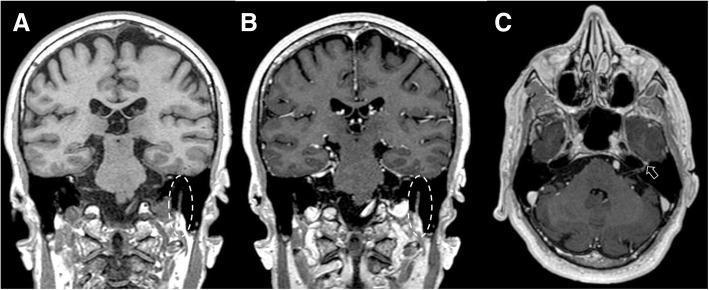
8. IMAGING IN TOPODIAGNOSIS
While clinical topodiagnostic tests narrow down the level of the lesion, imaging confirms the etiology.
MRI with Gadolinium:
- T1 post-contrast shows enhancement of the facial nerve at the site of pathology
- In Bell's palsy: Enhancement at the geniculate ganglion / labyrinthine segment (as illustrated in the retrieved MRI image — enhancement at geniculate ganglion in T1 post-contrast axial and coronal views)
- In acoustic neuroma: Enhancing mass in IAC
- MRI differentiates inflammatory from neoplastic causes by the pattern of enhancement (nodular vs. linear)
HRCT Temporal Bone:
- Fracture lines in trauma
- Cholesteatoma eroding fallopian canal
- Bony dehiscence of facial canal
9. RECENT ADVANCES
9.1 MRI Neurography
- High-resolution 3D MRI sequences (FIESTA, CISS, VIBE) allow in vivo visualisation of the full intratemporal facial nerve course
- Can detect perineural spread of parotid malignancy
- Functional MRI tractography beginning to map central facial nerve pathways
9.2 Three-Dimensional ENoG (3D-ENoG)
- Uses multiple recording electrodes to map individual branch contributions to CMAP
- Greater sensitivity for partial degeneration
9.3 High-Frequency Ultrasound
- Real-time imaging of extratemporal facial nerve branches
- Non-invasive, dynamic assessment of nerve diameter and cross-sectional area
- Useful in parotid surgery planning
- Recent meta-analyses show sensitivity ~80% for detecting facial nerve pathology extracranially
9.4 Optical Coherence Tomography (OCT)
- Emerging research tool for intraoperative facial nerve identification
- Not yet in routine clinical use
9.5 Transcranial Magnetic Stimulation (TMS) — Central Topodiagnosis
- Differentiates upper motor neuron (UMN) from lower motor neuron (LMN) facial palsy
- Magnetic stimulation over motor cortex evokes CMAPs from facial muscles
- Present in UMN lesion (Bell's phenomenon intact); absent in complete LMN
9.6 Salivary Biomarkers
- Research on salivary cytokines (IL-6, TNF-α) as proxies for chorda tympani activity and inflammatory grade
- Not yet in clinical use
9.7 Near-Infrared Spectroscopy (NIRS)
- Experimental modality for intraoperative nerve identification during mastoid surgery
10. LIMITATIONS AND PRACTICAL PITFALLS OF TOPODIAGNOSTIC TESTS
| Test | Limitation |
|---|---|
| Schirmer's test | Age-related reduction; conjunctival irritation affects result |
| Acoustic reflex | Absent in concurrent middle ear disease; not interpretable with conductive hearing loss |
| Taste testing | Subjective; poor reliability |
| EGM | Habitual smokers have elevated thresholds |
| ENoG | Not valid before 72 hours or after 3 weeks |
| EMG | Requires skilled neurophysiologist; painful |
| NET | Subjective endpoint; ±3.5 mA threshold empirical |
Per Scott-Brown: No single test is sufficient; a battery of tests should always be used for reliable topodiagnosis.
11. PRACTICAL APPROACH: ALGORITHM FOR A PATIENT WITH ACUTE COMPLETE FACIAL PALSY
HISTORY + EXAMINATION
        │
        ├── UMN features? → Forehead sparing → MRI brain (CVA/tumor)
        │
        └── LMN features (complete unilateral palsy with forehead)
                │
                ▼
          TOPODIAGNOSTIC BATTERY:
          ① Schirmer's test (lacrimation)
          ② Acoustic reflex (impedance audiometry)
          ③ Taste testing / EGM
          ④ House-Brackmann grading
                │
                ▼
          Level of lesion localised
                │
                ├── CPA/IAC suspected → MRI with gadolinium
                ├── Tympanic/mastoid → HRCT temporal bone + MRI
                └── Extratemporal → Parotid imaging (USG/MRI)
                │
                ▼
          ELECTRODIAGNOSTIC TESTING (after 72 hours):
          ENoG + EMG
                │
          ├── <90% degeneration → Medical treatment
          └── ≥90% degeneration + absence of MUAPs → Consider surgical decompression
12. SUMMARY TABLE: ALL TOPODIAGNOSTIC TESTS AT A GLANCE
| Test | Branch Tested | Level Localised | Modality | Gold Standard? |
|---|---|---|---|---|
| Schirmer's test | GSPN | Geniculate ganglion/proximal | Clinical | No |
| Acoustic reflex | Nerve to stapedius | Pyramidal eminence (mastoid) | Impedance audiometry | No |
| Taste testing | Chorda tympani (taste) | Mastoid (above stylomastoid) | Clinical/Chemical | No |
| Electrogustometry | Chorda tympani (taste) | Mastoid (above stylomastoid) | Electrophysiological | Preferred for taste |
| Salivary flow | Chorda tympani (secretomotor) | Mastoid | Clinical | No |
| NET (Hilger's) | Motor (whole nerve) | Prognosis | Electrical stimulation | No |
| MST | Motor (whole nerve) | Prognosis | Electrical stimulation | No |
| ENoG | Motor (whole nerve) | Prognosis + degeneration % | Electrophysiological | Yes (prognostic) |
| EMG | Motor unit level | Reinnervation | Electrophysiological | Yes (reinnervation) |
| MRI gadolinium | Anatomical | All levels | Imaging | Yes (etiology) |
| HRCT temporal bone | Bony canal | All intratemporal levels | Imaging | Yes (bony pathology) |
CONCLUSION
Topodiagnosis of facial nerve lesions requires a systematic, stepwise approach using a battery of tests. The classical hierarchy proceeds from:
Lacrimation (Schirmer's) → Acoustic Reflex → Taste/Salivation (EGM) → Motor (ENoG/EMG)
This progression mirrors the proximal-to-distal branching of the nerve and allows precise anatomical localisation. Electrodiagnostic tests (especially ENoG and EMG) are critical for prognostication and surgical decision-making rather than pure localisation.
With modern MRI neurography and high-frequency ultrasound, the accuracy of topodiagnosis has improved significantly, allowing both anatomical localisation and etiological diagnosis to be achieved non-invasively.
"No single test is pathognomonic. The clinician must correlate all findings with clinical history and examination." — Scott-Brown's Otorhinolaryngology, 8th Edition
Key References:
- Scott-Brown's Otorhinolaryngology Head & Neck Surgery, 8th Ed.
- Cummings Otolaryngology Head & Neck Surgery, 7th Ed.
- Stell & Maran's Head and Neck Surgery, 4th Ed.
- Zakir Hussain's ENT for Postgraduates
- Dhingra's Diseases of Ear, Nose and Throat, 7th Ed.
- Hazarika's Textbook of Ear Nose Throat and Head & Neck Surgery
- Harrison's Principles of Internal Medicine, 21st Ed. (pp. 1040, 12500)
- House JW, Brackmann DE. Facial nerve grading system. Otolaryngol Head Neck Surg. 1985
- Fisch U. Surgery for Bell's palsy. Arch Otolaryngol. 1981
- Gantz BJ et al. Surgical management of Bell's palsy. Laryngoscope. 1999
This is a shared conversation. Sign in to Orris to start your own chat.