
Blood supply of heart
Reading File
Searching for cardiac blood supply anatomy and imaging in parallel.
search_medical_text
blood supply of the heart coronary arteries anatomy
Harrison's Principles of Internal Medicine, Twenty First Edition
Page 7483
search_medical_image
coronary artery anatomy diagram blood supply of heart
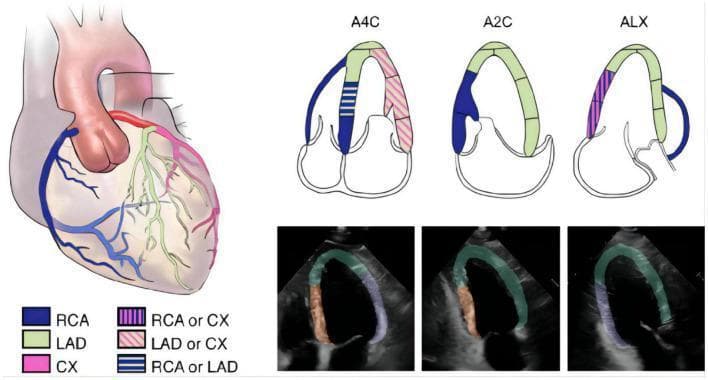
Hugging Face pmc clinical VQA raw
Page 0
GradeResponse
GradeResponse
Blood Supply of the Heart
The heart receives its blood supply from the right and left coronary arteries, which arise from the root of the aorta just above the aortic valve cusps (sinuses of Valsalva). These arteries and their branches constitute the epicardial coronary circulation, supplying the myocardium via penetrating branches down to the subendocardium.
Coronary Artery Anatomy
1. Left Coronary Artery (LCA)
Arises from the left aortic sinus. The short left main (left main coronary artery, LMCA) divides into:
| Branch | Course | Territory Supplied |
|---|---|---|
| Left Anterior Descending (LAD) | Runs in the anterior interventricular groove toward the apex | Anterior LV wall, anterior 2/3 of interventricular septum, apex, anterior papillary muscle |
| Left Circumflex (LCx) | Runs in the left AV groove | Lateral and posterior LV wall, SA node (in ~40%) |
Major LAD branches:
- Diagonal branches (D1, D2) — supply the anterolateral LV wall
- Septal perforators — supply the anterior septum
Major LCx branches:
- Obtuse marginal branches (OM1, OM2) — supply the lateral wall
2. Right Coronary Artery (RCA)
Arises from the right aortic sinus, runs in the right AV groove.
| Branch | Territory Supplied |
|---|---|
| SA nodal artery | SA node (~60% of people) |
| Right marginal branch | Right ventricle (RV) |
| Posterior Descending Artery (PDA) | Posterior 1/3 of septum, inferior LV wall, AV node |
| AV nodal artery | AV node (in right-dominant hearts) |
Coronary Dominance
Dominance is determined by which artery gives rise to the Posterior Descending Artery (PDA):
| Type | Frequency | PDA Origin |
|---|---|---|
| Right dominant | ~70% | RCA |
| Left dominant | ~10% | LCx |
| Co-dominant | ~20% | Both RCA and LCx |
Regional Myocardial Supply (per 2015 ASE Guidelines)
The diagram below maps the three coronary territories to LV myocardial segments in standard echocardiographic views:
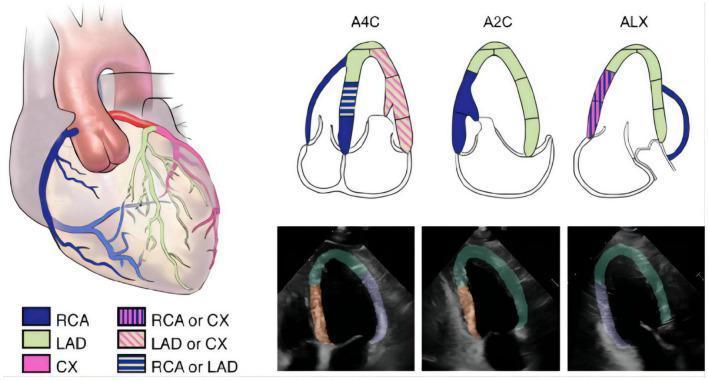
| Coronary Artery | LV Segments |
|---|---|
| LAD (green) | Anterior, anteroseptal, apical segments |
| RCA (blue) | Inferior, inferoseptal segments |
| LCx (pink) | Anterolateral, inferolateral segments |
Microcirculation
Beyond the epicardial vessels, blood flows through pre-arterioles → arterioles → capillaries. Each layer serves a distinct function (Harrison's, p. 7483):
- Epicardial arteries — low resistance conduit vessels; site of atherosclerosis
- Pre-arterioles — regulate pressure drop; respond to flow and myogenic stimuli
- Arterioles / microvascular bed — primary resistance vessels; regulate blood flow to match metabolic demand (metabolic vasomotion)
Microvascular dysfunction is increasingly recognized as a cause of ischemia even in the absence of obstructive epicardial coronary disease.
Venous Drainage
| Vessel | Drains Into |
|---|---|
| Great cardiac vein → coronary sinus | Right atrium |
| Middle cardiac vein → coronary sinus | Right atrium |
| Small cardiac vein → coronary sinus | Right atrium |
| Anterior cardiac veins (small) | Directly into right atrium |
| Thebesian veins | Directly into cardiac chambers |
The coronary sinus (running in the posterior AV groove) collects ~75% of coronary venous return and drains into the right atrium.
Clinical Correlations
- LAD occlusion → Anterior MI; risk of LV dysfunction, septal rupture, LBBB
- RCA occlusion → Inferior MI; risk of heart block (SA/AV node ischemia), RV infarction
- LCx occlusion → Lateral/posterior MI; often "electrically silent" (no ST changes in standard leads)
- Left main disease → Critical: jeopardizes >75% of LV myocardium
This is a shared conversation. Sign in to Orris to start your own chat.