
Taurine and Acetylcysteine Complete information
Reading File
Now I'll search the medical library and PubMed in parallel for both Taurine and Acetylcysteine (N-acetylcysteine).
Finding Sources
Finding Sources
Searching PubMed
taurine supplementation clinical effects
Searching PubMed
N-acetylcysteine clinical applications antioxidant
The acetylcysteine query had a syntax error. Let me fix that and read the key taurine sections, plus search more deeply for both compounds.
Finding Sources
Reading File
Searching PubMed
acetylcysteine[MeSH Terms] AND clinical outcomes
Searching the Web
taurine acetylcysteine pharmacology clinical uses mechanisms 2024 2025
Now let me read the detailed acetylcysteine section from Tintinalli's and more taurine biochemistry content.
Reading File
Finding Sources
Finding Sources
Now let me read the key pharmacology sections from Goodman & Gilman and Lippincott, and also the taurine content from key sources.
Reading File
Reading File
Reading File
Loading Image
I now have comprehensive information to provide a detailed answer on both compounds. Let me compile everything into a thorough, well-structured response.
Taurine and N-Acetylcysteine (NAC) — Complete Overview
PART I: TAURINE
1. Chemistry & Biochemical Identity
Taurine (2-aminoethanesulfonic acid) is a sulfur-containing β-amino acid — strictly speaking, not a true amino acid because it lacks a carboxyl group (it has a sulfonic acid group instead). It is an endogenous, non-proteinogenic amino acid distributed at high concentrations in many tissues. Plasma levels are ~50 μM.
Molecular formula: NH₂–CH₂–CH₂–SO₃H
2. Biosynthesis
Taurine is synthesized from cysteine in a 3-step pathway:
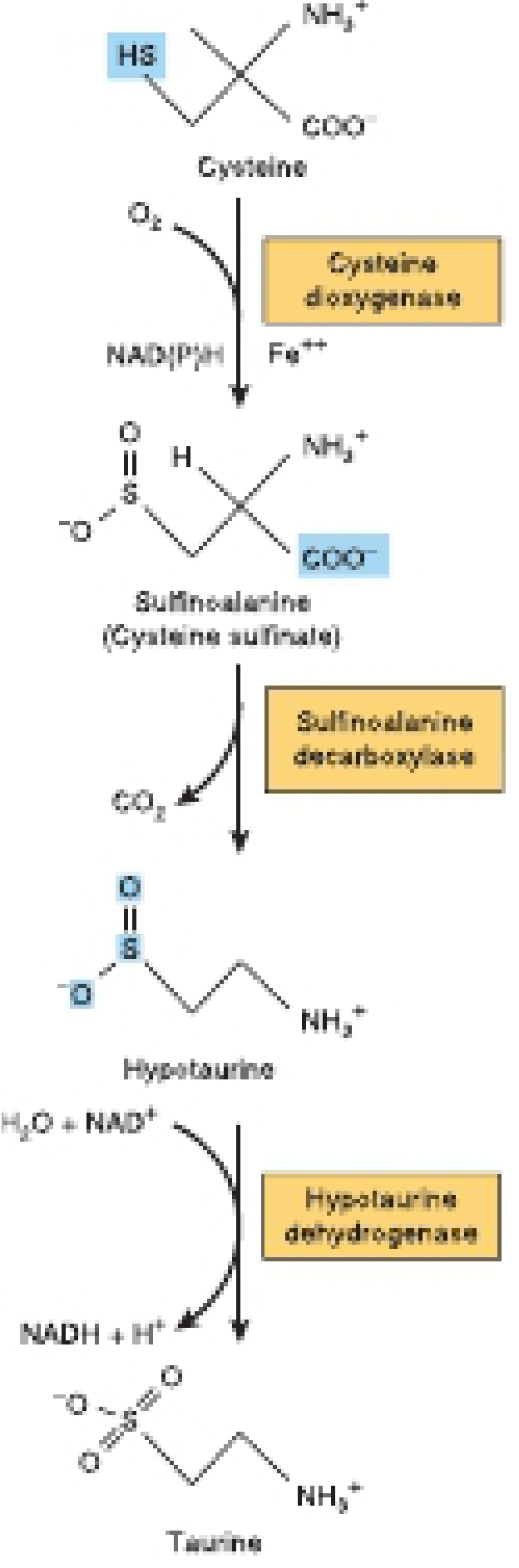
Conversion of cysteine to taurine — Harper's Illustrated Biochemistry, 32nd Ed.
- Cysteine → Cysteinesulfinate — catalyzed by cysteine dioxygenase (nonheme Fe²⁺ enzyme, EC 1.13.11.20)
- Cysteinesulfinate → Hypotaurine — catalyzed by sulfinoalanine decarboxylase (EC 4.1.1.29), releasing CO₂
- Hypotaurine → Taurine — catalyzed by hypotaurine dehydrogenase (EC 1.8.1.3)
Taurine is an end-metabolite — it is excreted without further metabolism.
- Harper's Illustrated Biochemistry, 32nd Ed., p. 319
- Biochemistry, 8th ed (Lippincott Illustrated Reviews)
3. Dietary Sources & Absorption
- Taurine is abundant in seafood, meat, and dairy
- Absorbed via specialized β-amino acid transporters at the apical brush border (shared with β-alanine and GABA)
- Plasma concentration ~50 μM; intracellular concentrations are far higher (e.g., in heart, skeletal muscle, retina, brain, leukocytes)
- Brenner and Rector's The Kidney, 2-Volume Set
4. Physiological Functions
| System | Role |
|---|---|
| Bile acid conjugation | Conjugates with primary bile acids (cholic acid, chenodeoxycholic acid) to form taurocholic acid / taurochenodeoxycholic acid, enhancing aqueous solubility and intestinal lipid absorption; in adults glycine conjugates predominate (glycine:taurine = 3:1); in infancy taurine conjugates predominate (80%) |
| Antioxidant | Acts as a low-molecular-weight non-enzymatic antioxidant in the lung; scavenges hypochlorous acid (HOCl) generated by myeloperoxidase, forming taurine chloramine (a less reactive species) |
| Osmoregulation | Functions as a primary organic osmolyte in many tissues, protecting cells under osmotic stress |
| Neuromodulation | Acts as a neuromodulatory molecule in the CNS; modulates GABA-A and glycine receptors |
| Calcium homeostasis | Modulates intracellular Ca²⁺ flux, protecting against cytotoxic Ca²⁺ overload (important in ischemia/reperfusion) |
| ER stress attenuation | Attenuates endoplasmic reticulum (ER) stress by preventing unfolded protein accumulation and reducing activation of PERK, ATF6, and IRE1 stress sensors |
| Reproductive | Present at high concentrations in seminal fluid as an antioxidant alongside hypotaurine and tyrosine — protects sperm |
| Pulmonary | Among the first-line low-molecular-weight antioxidants in the lung lining fluid |
- Fishman's Pulmonary Diseases and Disorders, p. 390
- Campbell Walsh Wein Urology, p. 2249–2250
- Mulholland and Greenfield's Surgery, p. 297
5. Clinical/Therapeutic Relevance
a. Hepatobiliary disease
Conjugation with bile acids is essential for micelle formation and fat-soluble vitamin absorption. Defects in bile acid-CoA:amino acid N-acyltransferase (BAAT) impair taurine conjugation. — Yamada's Textbook of Gastroenterology
b. Chronic Kidney Disease / Microalbuminuria
Taurine + NAC combination (Nefrosave®, NAC 150 mg + Taurine 500 mg) has been studied in type 2 diabetic nephropathy:
- Attenuates urinary albumin:creatinine ratio (UACR)
- Reduces serum cystatin C levels (~21.89% overall; 31.38% in Stage 3 CKD, p<0.05)
- Reduces serum TGF-β1 levels
c. Muscle cramps in cirrhosis
Taurine has been evaluated in randomized controlled trials for muscle cramps in cirrhotic patients — systematic review, 2025 (PMID: 39548657).
d. Uremia / Oxidative stress
In uremia, homocysteine and cysteine accumulate in oxidized forms; taurine levels may be perturbed; linked to cardiovascular disease progression. — Brenner and Rector's The Kidney
e. Autoimmune disease (emerging)
Recent systematic review (2026) on taurine in preclinical models of systemic lupus erythematosus (SLE), showing beneficial effects on clinical outcomes and underlying mechanisms [PMID: 41874670].
f. Energy drinks
Taurine is a widely used supplement in energy drinks; physiological effects at high supplemental doses remain an active area of investigation.
6. Deficiency / Essentiality
- Taurine is conditionally essential in preterm neonates (limited synthetic capacity), cats (obligate dietary requirement), and in prolonged total parenteral nutrition (TPN) without supplementation
- Deficiency leads to: retinal degeneration (cats), cardiomyopathy, impaired bile acid conjugation
PART II: N-ACETYLCYSTEINE (NAC / Acetylcysteine)
1. Chemistry
N-Acetylcysteine is the N-acetyl derivative of the amino acid L-cysteine.
Molecular formula: C₅H₉NO₃S
Key structural feature: Free sulfhydryl (–SH) group responsible for reducing and mucolytic actions; the acetyl group protects against rapid oxidation and reduces toxicity vs. free cysteine.
Key structural feature: Free sulfhydryl (–SH) group responsible for reducing and mucolytic actions; the acetyl group protects against rapid oxidation and reduces toxicity vs. free cysteine.
2. Mechanisms of Action
NAC operates through multiple mechanisms:
| Mechanism | Effect |
|---|---|
| Glutathione (GSH) precursor | Provides cysteine, the rate-limiting substrate for glutathione synthesis; replenishes intracellular GSH |
| Direct reducing agent | Donates –SH electrons, directly reducing NAPQI back to acetaminophen and reducing disulfide bonds in mucoproteins |
| Sulfate precursor | In acetaminophen overdose, provides inorganic sulfate for the sulfation detoxification pathway |
| Direct antioxidant | Scavenges reactive oxygen species (ROS) and reactive nitrogen species (RNS); restores oxidized GSH |
| Mucolytic | Cleaves disulfide bonds in the mucin polymer network, reducing sputum/mucus viscosity |
| Anti-inflammatory | Attenuates NF-κB signaling; reduces neutrophil infiltration and pro-inflammatory cytokine production |
| Vasodilatory / microcirculatory | Improves microcirculatory blood flow and tissue oxygen delivery in hepatic injury |
- Tintinalli's Emergency Medicine, p. 1297–1298
- Mulholland and Greenfield's Surgery, p. 297
3. Clinical Indications
a. Acetaminophen (Paracetamol) Overdose — Primary Indication
- Mechanism of toxicity: Acetaminophen is metabolized to the toxic metabolite NAPQI (N-acetyl-p-benzoquinone imine), which depletes hepatic glutathione and binds hepatic macromolecules
- NAC action (early, <8 hrs): Acts as GSH precursor/substitute and sulfate precursor; prevents NAPQI binding
- NAC action (late, >24 hrs): Acts as antioxidant; decreases neutrophil infiltration; improves microcirculation
- Efficacy: Given within 8 hours of ingestion → nearly 100% effective in preventing hepatotoxicity
- Even delayed administration (up to 24 hrs) reduces hepatotoxicity vs. historical controls
- Used in pregnancy: safe and efficacious; delay in treatment associated with fetal demise
IV vs. Oral route:
- IV NAC has supplanted oral administration: easier to give, better patient acceptance, equivalent efficacy, shorter treatment duration
- Anaphylactoid reactions (IV): occur in 4–17% of patients, mostly in first 2 hours; treat mild cases with diphenhydramine; temporarily slow/stop infusion; asthmatics at higher risk
- Reinitiate at slower rate after diphenhydramine in asymptomatic patients
- High acetaminophen concentrations are protective against anaphylactoid reaction
- Oral NAC: loading dose 140 mg/kg, then 70 mg/kg every 4 hrs × 17 doses (72-hour protocol)
- Standard IV regimen: 3-bag 21-hour protocol (150 mg/kg over 1 hr → 50 mg/kg over 4 hrs → 100 mg/kg over 16 hrs)
- Current guidelines recommend extracorporeal treatment only if: altered mental status + metabolic acidosis + elevated lactate + acetaminophen level >900 mg/L
- Tintinalli's Emergency Medicine
b. Mucolytic — Respiratory Disease
| Application | Detail |
|---|---|
| COPD | Oral NAC (600–1200 mg/day) — mixed evidence on FEV₁ decline; may reduce exacerbations; NOT currently recommended as first-line |
| Cystic fibrosis | Inhaled NAC no longer recommended (risk of reflex bronchospasm); recombinant DNase (dornase alfa) preferred |
| VKC (vernal keratoconjunctivitis) | Topical acetylcysteine as mucolytic for dissolving mucus filaments and deposits |
| Mucus hypersecretion | Recent systematic review (2024, PMID: 39493366) confirms benefit for mucus hypersecretion in airways |
- Fishman's Pulmonary Diseases, Murray & Nadel's Respiratory Medicine, K.J. Lee's Otolaryngology, Kanski's Clinical Ophthalmology
- NAC has a strong unpleasant sulfurous odor (rotten eggs) — mix with cola or fruit juice for oral dosing
- Lippincott Illustrated Reviews: Pharmacology
c. Contrast-Induced Nephropathy (CIN) Prophylaxis
- Proposed mechanism: antioxidant protection of renal tubular cells; improves renal medullary perfusion
- Evidence is conflicting — clinical efficacy remains debated despite theoretical rationale
- Some guidelines have stepped back from recommending routine use
- Mulholland and Greenfield's Surgery; Brenner and Rector's The Kidney
d. CKD / Diabetic Nephropathy (combination with Taurine)
- NAC + Taurine (Nefrosave®): statistically significant reduction in UACR (microalbuminuria) and serum cystatin C in Type 2 DM + CKD (p<0.05)
- DELAY-CKD double-blind multicenter placebo-controlled trial
e. Psychiatric / Addiction Medicine (Emerging)
- Substance use cravings: Meta-analysis (2024, PMID: 39556483) — NAC significantly reduces cravings across multiple substances (cannabis, cocaine, nicotine); mechanism via glutamate homeostasis modulation in nucleus accumbens
- Being investigated in OCD, bipolar disorder, trichotillomania, ADHD
f. PCOS
- Recent systematic review (2024, PMID: 39039898) supports NAC in polycystic ovary syndrome — improves insulin sensitivity, hormonal profiles, and reduces oxidative stress
g. Tuberculosis
- NAC (with glutathione) shows synergistic anti-mycobacterial activity via GSH augmentation — systematic review (2025, PMID: 40155786)
h. Phosphide Poisoning
- NAC used as an adjunct antioxidant therapy in acute phosphide (aluminum/zinc phosphide) poisoning — systematic review (2023, PMID: 37387512)
i. Aminoglycoside Ototoxicity Prevention
- Antioxidant therapies including NAC investigated for aminoglycoside-induced ototoxicity — meta-analysis (2025, PMID: 39530276)
4. Adverse Effects
| Route | Adverse Effects |
|---|---|
| Oral | Nausea, vomiting, stomatitis; offensive sulfurous odor |
| IV | Anaphylactoid reactions (4–17%); rash, urticaria, angioedema; bronchospasm (especially asthmatics); rarely hypotension |
| Inhaled | Reflex bronchospasm — no longer recommended for COPD/CF |
5. Pharmacokinetics
- Oral bioavailability: ~10% (significant first-pass metabolism)
- IV: 100% bioavailability
- Protein binding: ~50%; Volume of distribution: ~0.6 L/kg
- Half-life: ~6.25 hours (adults); prolonged in hepatic failure
- Metabolized via deacetylation to cysteine; further metabolized to GSH, taurine (ironically), and sulfate
PART III: Shared Properties & Combined Use
| Property | Taurine | NAC |
|---|---|---|
| Sulfur-containing | ✓ (sulfonic acid) | ✓ (sulfhydryl group) |
| Antioxidant | ✓ (HOCl scavenger, ER stress) | ✓ (GSH precursor, direct ROS scavenging) |
| Cysteine-derived | ✓ (end metabolite of cysteine) | ✓ (N-acetyl form of cysteine) |
| Hepatoprotective | ✓ | ✓ (primary use in paracetamol OD) |
| Nephroprotective | ✓ | ✓ (CIN, CKD) |
| Anti-inflammatory | ✓ | ✓ |
| Mucolytic | ✗ | ✓ |
| Antidote | ✗ | ✓ (acetaminophen) |
Combined product Nefrosave® (NAC 150 mg + Taurine 500 mg) has demonstrated synergistic nephroprotective effects in Type 2 DM with CKD, reducing both albuminuria and serum cystatin C.
Key References (Textbook)
- Harper's Illustrated Biochemistry, 32nd Ed. — Cysteine/Taurine biosynthesis
- Tintinalli's Emergency Medicine — NAC in acetaminophen toxicity
- Fishman's Pulmonary Diseases and Disorders — Taurine and NAC as pulmonary antioxidants
- Lippincott Illustrated Reviews: Pharmacology — Acetylcysteine as mucolytic
- Mulholland and Greenfield's Surgery — NAC, taurine in oxidative stress and inflammation
- Sleisenger and Fordtran's GI and Liver Disease — Taurine in bile acid conjugation
- Brenner and Rector's The Kidney — Taurine transporters, NAC in CIN
Recent Evidence (PubMed 2023–2026)
- PMID 38165196 — Systematic review: 2-bag IV NAC regimens for acetaminophen poisoning (2023)
- PMID 39493366 — NAC and mucus hypersecretion in airways (2024)
- PMID 39556483 — Meta-analysis: NAC for substance use cravings (2024)
- PMID 39530276 — Antioxidants (incl. NAC) for aminoglycoside ototoxicity (2025)
- PMID 40155786 — GSH + NAC in tuberculosis management (2025)
- PMID 41874670 — Taurine supplementation in SLE (2026)
- PMID 39039898 — NAC in PCOS (2024)
- PMID 39548657 — Taurine for muscle cramps in cirrhosis (2025)
This is a shared conversation. Sign in to Orris to start your own chat.