
Describe all the pathways of soma psyche interactions as well as explain them in detail
soma psyche interaction pathways psychosomatic medicine detailed mechanisms
https://pmc.ncbi.nlm.nih.gov/articles/PMC3146208
soma psyche interaction psychosomatic pathways mechanisms
psychoneuroimmunology mind body pathways mechanisms review
Soma-Psyche Interactions: All Pathways Explained in Detail
1. The Neuroendocrine Pathway (HPA Axis)
Mechanism
- The hypothalamus detects psychological or physical stress and releases Corticotropin-Releasing Hormone (CRH) into the hypophysial-portal system.
- CRH acts on the anterior pituitary, triggering release of Adrenocorticotrophic Hormone (ACTH).
- ACTH travels to the adrenal cortex, stimulating synthesis and release of glucocorticoids (primarily cortisol).
- Cortisol then exerts widespread systemic effects: promotes energy mobilisation (gluconeogenesis), increases cardiovascular activity (supporting fight-or-flight), and suppresses immune function, growth, and reproduction.
Feedback regulation
- The anterior pituitary (cortisol inhibits ACTH release)
- The hypothalamus (cortisol inhibits CRH release)
- The hippocampus (densely populated with glucocorticoid receptors; chronic stress actually causes hippocampal neuronal atrophy, impairing this feedback loop)
Psyche → Soma implications
- Psychological stressors (embarrassment, work stress, grief) engage the amygdala, hippocampus, and prefrontal cortex, which in turn activate the hypothalamus to fire the HPA axis.
- Chronic HPA activation produces hypercortisolaemia, leading to insulin resistance, hypertension, immune suppression, visceral obesity, and cardiovascular disease.
- Depression is strongly associated with HPA dysregulation, with persistently elevated cortisol levels found in melancholic depression.
Soma → Psyche implications
- Cushing's syndrome (excess cortisol) produces depression, cognitive impairment, and psychosis.
- Adrenal insufficiency (Addison's disease) produces fatigue, depression, and apathy.
2. The Autonomic Nervous System Pathway (Sympatho-Adrenomedullary Axis)
Mechanism
- Psychological stressors activate the locus coeruleus (brainstem noradrenergic nucleus) and the sympathetic chain.
- Catecholamines - noradrenaline (NA) and adrenaline - are released from sympathetic nerve terminals and the adrenal medulla.
- Effects: tachycardia, increased cardiac output, hypertension, bronchodilation, pupil dilation, and inhibition of digestion.
- Walter Cannon (1930s) was the first to demonstrate that fear and stress could produce cardiac symptoms via this pathway.
- Mediated by the vagus nerve, it conserves body resources and restores homeostasis.
- The vagal tone directly influences heart rate variability (HRV), a measurable index of psychophysiological regulation.
Neurotransmitter specifics (Kaplan & Sadock)
- Physical stressors (blood loss, trauma, hypothermia) → recruit the brainstem and hypothalamus
- Psychological stressors (embarrassment, work pressure) → engage the amygdala (emotion), hippocampus (memory), and prefrontal cortex (decision-making)
Psyche → Soma implications
- Acute emotional distress triggers sympathetic surges that can precipitate Takotsubo (stress) cardiomyopathy ("broken heart syndrome").
- Hostility, anger, and chronic anxiety are independent risk factors for coronary artery disease through sustained sympathetic activation.
- Panic attacks represent an extreme, pathological activation of the sympatho-adrenomedullary axis triggered purely by psyche.
Soma → Psyche implications
- Cardiac disease, chronic pain, and endocrine disorders alter ANS tone and feed back to alter mood, cognition, and anxiety levels.
- Propranolol (beta-blocker) dampens peripheral adrenergic signalling and has demonstrable anxiolytic effects, illustrating soma-to-psyche feedback.
3. The Psychoneuroimmunological (PNI) Pathway
Mechanism
- The HPA axis produces glucocorticoids that are profoundly immunosuppressive (suppress T-cell proliferation, reduce cytokine production, induce lymphocyte apoptosis).
- The sympathetic nervous system directly innervates primary and secondary lymphoid organs (thymus, spleen, lymph nodes), releasing NA that acts on adrenergic receptors on immune cells.
- The vagus nerve mediates the cholinergic anti-inflammatory reflex - acetylcholine inhibits macrophage production of TNF-alpha, IL-1, and IL-6.
- Neuropeptides (substance P, VIP, CRH, endorphins) act directly on immune cells.
Cytokine-to-brain communication (Soma → Psyche)
- Fatigue and lethargy
- Anhedonia and social withdrawal
- Hypersomnia
- Cognitive slowing ("brain fog")
- Anorexia
- Hyperalgesia (lowered pain threshold)
Psyche → Soma immune implications
- Stress and depression suppress natural killer (NK) cell activity, reduce antibody titres after vaccination, and slow wound healing.
- Chronic stress increases proinflammatory cytokines (IL-6, TNF-α), promoting atherosclerosis, metabolic syndrome, and autoimmune flares.
- Rheumatoid arthritis patients show relative hypofunctioning of the HPA axis despite high-grade inflammation, suggesting impaired psychoneuroimmune regulation.
- Latent herpes simplex virus (HSV) reactivates under psychological stress via PNI-mediated immune suppression.
- HIV disease progression is influenced by psychosocial factors through PNI mechanisms, with biological signalling pathways from psychosocial factors to cellular viral pathogenesis now better defined.
4. The Neurotransmitter / Monoamine Pathway
Mechanism
- Serotonin (5-HT): Regulates mood, sleep, appetite, and gastrointestinal motility. Approximately 90% of serotonin is located in the gut (enteric nervous system). Dysregulation contributes to depression, anxiety, irritable bowel syndrome (IBS), and fibromyalgia simultaneously.
- Noradrenaline (NE): Central NE circuits (locus coeruleus projecting to prefrontal cortex) regulate attention, arousal, and threat response. Peripheral NE drives the sympathetic stress response. Dysregulation mediates both PTSD/anxiety (central) and hypertension/tachycardia (peripheral).
- Dopamine: Regulates reward, motivation, and movement. Dopaminergic dysregulation underlies both psychiatric illness (psychosis, depression) and somatic motor disorders (Parkinson's disease).
- CRH: Functions both as a hypothalamic hormone and as a central neurotransmitter in the amygdala and prefrontal cortex, linking stress appraisal directly to neuroendocrine output.
Epigenetic modulation
- DNA methylation, histone modifications, and microRNA activity mediate molecular adaptations of the CNS to chronic stressors.
- Early life stress causes persistent changes in prefrontal cortex catecholamine responses through adulthood - a clear psyche-to-soma pathway operating across development.
- Sex-specific effects exist: male and female animals (and humans) show different neurotransmitter responses to identical stressors, with implications for sex differences in depression and anxiety.
5. The Gut-Brain Axis
Mechanism
- The vagus nerve (80% afferent, 20% efferent - meaning most signals go FROM gut TO brain)
- The HPA axis
- Gut microbiome metabolites (short-chain fatty acids, tryptophan metabolites → serotonin precursors)
- Immune signalling (gut-associated lymphoid tissue, GALT)
Psyche → Soma
- Functional gastrointestinal disorders (IBS, functional dyspepsia) are driven by psychological distress, with the brain altering gut motility, secretion, and visceral sensitivity via descending ANS and HPA pathways.
- Neuroimaging shows: anticipation of pain in IBS patients increases activity in the insula and anterior cingulate cortex (ACC), with dysfunctional inhibitory control by the medial prefrontal cortex (mPFC) leading to ANS and neuroendocrine hyperactivation (via CRH).
Soma → Psyche
- Gut inflammation (IBD) produces neuropsychiatric symptoms via cytokine and vagal afferent signalling.
- Probiotic interventions that alter gut microbiome composition measurably reduce anxiety and depression scores in clinical trials.
6. The Psyche-to-Soma Pathway via Behaviour and Lifestyle
Mechanism
- Depression and anxiety drive health-risk behaviours: smoking, alcohol use, physical inactivity, poor sleep, unhealthy diet, medication non-adherence.
- These behaviours independently damage cardiovascular, metabolic, immune, and musculoskeletal systems.
- Allostatic load is the cumulative somatic damage from prolonged psychological stress, mediated both directly (HPA, ANS) and indirectly (behaviour).
7. The Neuroimmune/Neuroinflammatory Pathway (CNS-Specific)
Mechanism
- Peripheral cytokines activate microglia, which produce neuroinflammation.
- Neuroinflammation alters synaptic plasticity, neurogenesis (especially in the hippocampus), and neurotransmitter metabolism.
- Activated microglia divert tryptophan away from serotonin synthesis toward the kynurenine pathway, producing neurotoxic quinolinic acid - a glutamate NMDA receptor agonist linked to depression and cognitive impairment.
Key neural structures in soma-psyche CNS mediation:
- Amygdala: processes emotional responses and emotional memory; hyper-reactivity produces anxiety disorders and PTSD.
- Anterior cingulate cortex (ACC): integrates pain, emotion, and autonomic regulation; dysregulation underlies functional pain syndromes and depression.
- Prefrontal cortex (PFC): exerts top-down inhibitory control over amygdala and stress systems; reduced PFC-to-amygdala connectivity is a hallmark of stress-related psychopathology.
- Hippocampus: critical for HPA feedback regulation; chronic glucocorticoid exposure causes hippocampal volume loss, impairing stress regulation.
- Insula: processes interoception (bodily feelings); hyperactive in somatic symptom disorders and pain.
8. The Cognitive Appraisal Pathway (Psyche → Soma via Perception)
Mechanism
-
Primary appraisal: The individual evaluates whether an event is harmful, threatening, or a loss. The same objective event (e.g., a diagnosis of rheumatoid arthritis) appraised as catastrophic ("I will never do anything I care about") produces a far greater HPA and ANS response than one appraised as a challenge.
-
Secondary appraisal: The individual evaluates available coping resources. A sense of helplessness or lack of mastery amplifies stress physiology; a sense of self-efficacy dampens it.
9. The Somatisation and Conversion Pathway (Psyche → Soma via Symptom Generation)
Mechanism
- Altered central pain processing (central sensitisation)
- Heightened interoceptive awareness (insula hyperactivation)
- Top-down amplification of normal bodily signals by hyperactive attentional and emotional systems
- Dissociative mechanisms in conversion disorder, where neural pathways producing motor or sensory function are inhibited by psychological conflict
Summary Table
| Pathway | Direction | Key Mediators | Clinical Example |
|---|---|---|---|
| HPA Axis | Both | CRH, ACTH, cortisol | Depression, Cushing's |
| Sympatho-adrenomedullary | Both | Adrenaline, NA, catecholamines | Takotsubo cardiomyopathy |
| Psychoneuroimmunology | Both | Cytokines, NK cells, antibodies | Depression in RA, sickness behaviour |
| Neurotransmitter/Monoamine | Both | Serotonin, NE, dopamine | IBS, fibromyalgia, depression |
| Gut-Brain Axis | Both | Vagus, microbiome, ENS | IBS, depression in IBD |
| Behavioural/Lifestyle | Psyche → Soma | Smoking, inactivity, alcohol | CAD in depression |
| Neuroinflammatory | Both | Microglia, kynurenine, NMDA | Treatment-resistant depression |
| Cognitive Appraisal | Psyche → Soma | Prefrontal-amygdala, HPA | CBT reducing cortisol |
| Somatisation/Conversion | Psyche → Soma | Insula, ACC, top-down inhibition | Functional neurological disorder |
- Kaplan & Sadock's Comprehensive Textbook of Psychiatry (Sections 27.10: Stress, Psychoneuroimmunology, and Psychosomatic Medicine)
- Psyche and soma: New insights into the connection - PMC
- Psychosomatics: CNS communication through tissues, organs, and cells - Clinical Psychopharmacology and Neuroscience
Create a visual flowchart poster of these 9 soma-psyche pathways
A detailed medical science poster titled "The 9 Pathways of Soma-Psyche Interaction" with a dark navy blue background. At the top center, two large interconnected circles labeled "PSYCHE (Mind)" in purple/violet and "SOMA (Body)" in teal/green with a double-headed arrow between them. Below, 9 numbered pathway boxes arranged in a 3x3 grid, each with a distinct color, icon, and brief description: 1. HPA Axis (gold) - brain icon - "Hypothalamus → CRH → Pituitary → ACTH → Adrenal Cortex → Cortisol | Bidirectional | Depression, Cushing's" 2. Sympatho-Adrenomedullary (orange) - lightning bolt - "Locus Coeruleus → SNS → Adrenaline/NA | Fight-or-Flight | Takotsubo Cardiomyopathy" 3. Psychoneuroimmunology (cyan) - shield icon - "HPA + SNS → Immune Suppression | Cytokines → Sickness Behaviour | RA, HIV, Depression" 4. Neurotransmitter/Monoamine (pink) - molecule icon - "Serotonin, Noradrenaline, Dopamine | Epigenetic changes | IBS, Fibromyalgia" 5. Gut-Brain Axis (green) - gut icon - "Vagus Nerve (80% afferent) + Microbiome + ENS | IBS, IBD-related Depression" 6. Behavioural/Lifestyle (yellow) - person running - "Depression → Smoking, Inactivity, Alcohol → CAD | Allostatic Load" 7. Neuroinflammatory (red) - flame/brain - "Microglia + Kynurenine Pathway → NMDA Activation | Treatment-Resistant Depression" 8. Cognitive Appraisal (light blue) - thought bubble - "PFC-Amygdala Axis | Primary + Secondary Appraisal → HPA Modulation | CBT reduces cortisol" 9. Somatisation/Conversion (lavender) - body silhouette - "Insula + ACC hyperactivation | Top-down amplification | Functional Neurological Disorder" Arrows connect each pathway box back to both the PSYCHE and SOMA circles with direction labels. Bottom of poster has a small legend showing bidirectional arrows in different colors. Clean, professional medical infographic style with white text labels, subtle gradient boxes, and clear hierarchy. Academic poster layout.
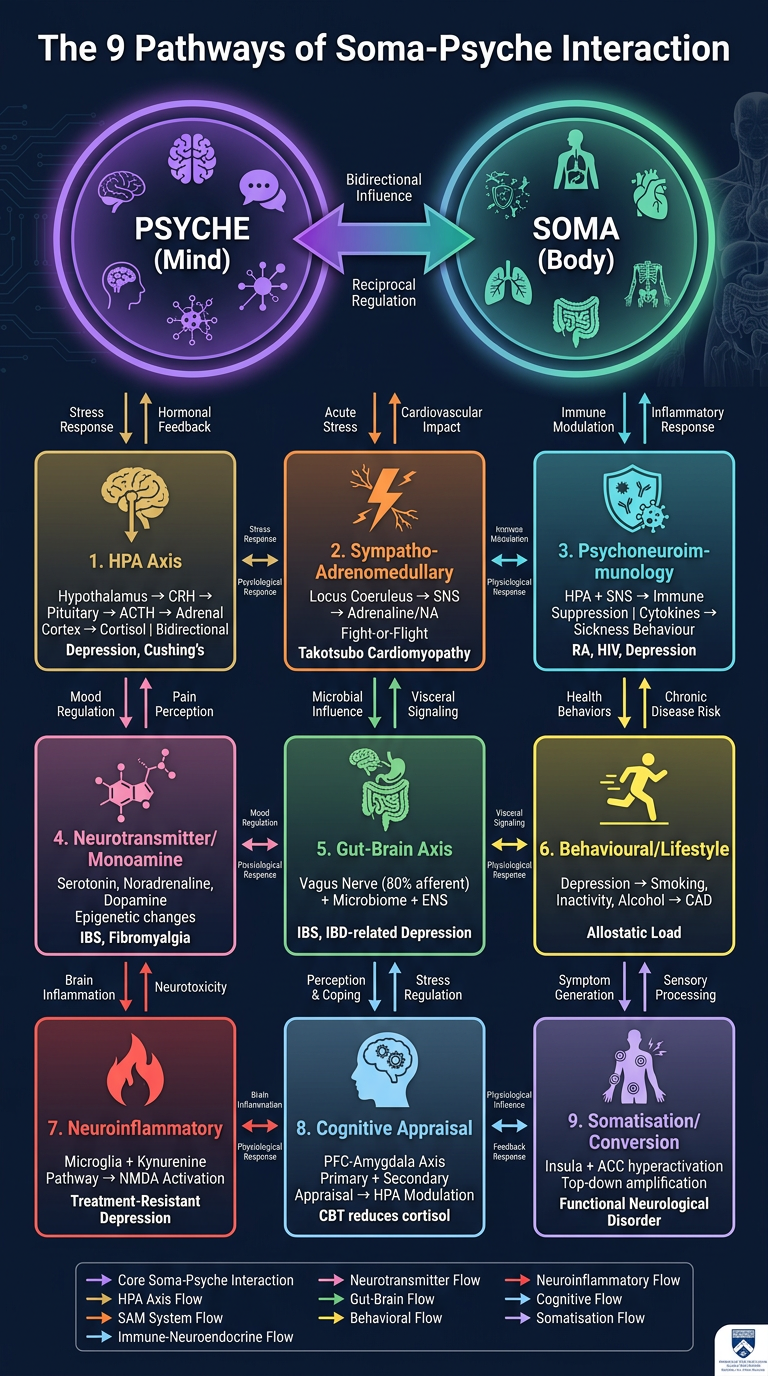
- PSYCHE and SOMA as the two central nodes at the top, connected by a bidirectional arrow
- Each of the 9 pathways in its own colour-coded panel with the key mediators and a clinical example
- Direction of interaction indicated for each pathway (bidirectional, psyche→soma, or soma→psyche)