
Equilibirium potential
The equilibrium potential (also called the Nernst potential) for an ion is the membrane voltage at which the electrical gradient exactly balances the concentration gradient for that ion, producing zero net ion flow.
Nernst Equation:
E_ion = (RT/zF) × ln([ion]_out / [ion]_in)
At 37°C, this simplifies to:
E_ion = (61.5 mV / z) × log([ion]_out / [ion]_in)
Where R = gas constant, T = temperature (Kelvin), z = ion valence, F = Faraday's constant.
Typical values in neurons:
| Ion | Equilibrium Potential |
|---|---|
| Na⁺ | +60 to +70 mV |
| K⁺ | -80 to -90 mV |
| Ca²⁺ | +120 to +130 mV |
| Cl⁻ | -65 to -70 mV |
Searching sources...
Reading File
Finding Sources
Finding Sources
Reading File
Reading File
Reading File
Reading File
Loading Image
Finding Sources
Reading File
Reading File
Here is a complete breakdown of equilibrium potential from the textbooks:
Equilibrium Potential (Nernst Potential)
Definition
The equilibrium potential (E_ion) for a given ion is the membrane voltage at which the electrical driving force exactly opposes the concentration (chemical) driving force for that ion, resulting in zero net ion movement - even if the membrane is freely permeable to it. It represents the membrane potential an ion "wants" to achieve.
- Costanzo Physiology 7th Edition: "The potential difference that exactly balances the tendency of Na⁺ to diffuse down its concentration gradient is the Na⁺ equilibrium potential."
- Neuroscience: Exploring the Brain 5th Ed: "E_ion is the membrane potential that would just balance the ion's concentration gradient, so that no net ionic current would flow if the membrane were permeable to that ion."
How It Develops - The Concept
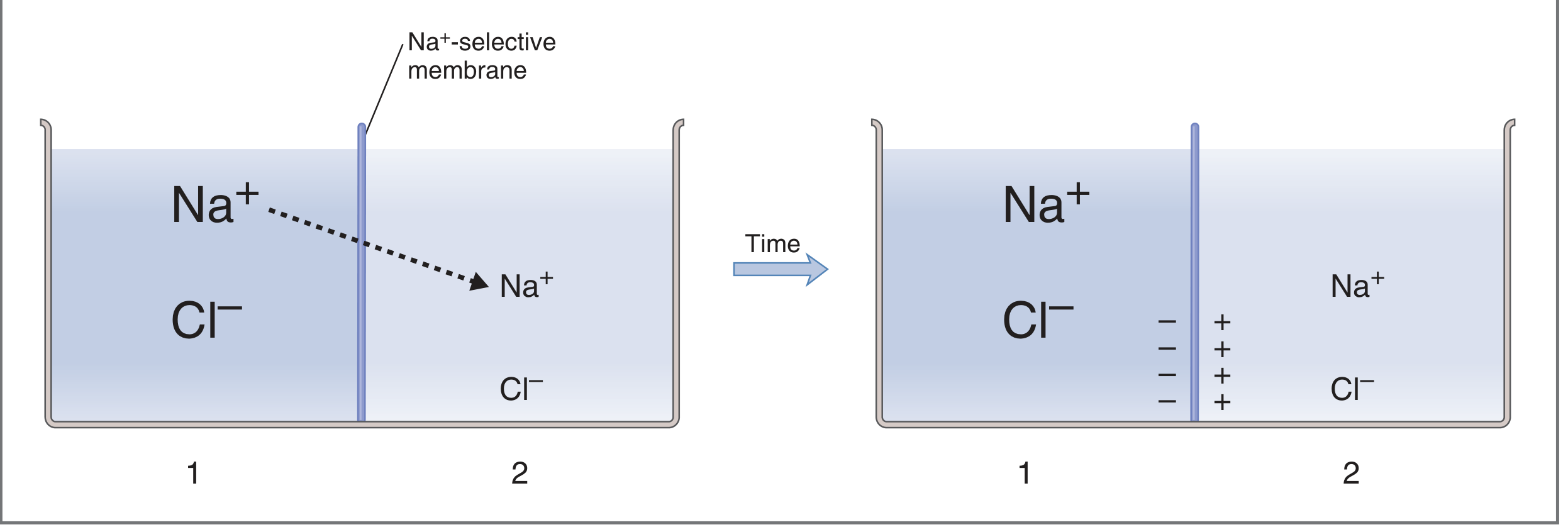
(Fig. 1.11 - Costanzo Physiology: Generation of an Na⁺ diffusion potential)
As illustrated above, when only Na⁺ can cross a membrane (Cl⁻ cannot), Na⁺ diffuses from high to low concentration. This separates charge, building an electrical potential that opposes further diffusion. When the two forces balance, electrochemical equilibrium is reached - that voltage is the equilibrium potential.
For an anion like Cl⁻, the same logic applies but the polarity reverses: Cl⁻ diffuses toward the low-concentration side, making that side negative. The equilibrium potential is negative.
The Nernst Equation
$$E_{ion} = \frac{-2.3RT}{zF} \log_{10} \frac{[C_i]}{[C_e]}$$
Or equivalently (as written in Neuroscience: Exploring the Brain):
$$E_{ion} = 2.303 \cdot \frac{RT}{zF} \cdot \log \frac{[ion]_o}{[ion]_i}$$
Variables:
| Symbol | Meaning |
|---|---|
| R | Gas constant (8.314 J/mol·K) |
| T | Absolute temperature (Kelvin) |
| z | Valence/charge of the ion |
| F | Faraday's constant (96,485 C/mol) |
| [ion]_o | Extracellular ion concentration |
| [ion]_i | Intracellular ion concentration |
At 37°C, the equation simplifies to 61.5 mV / z:
| Ion | Simplified Nernst Equation |
|---|---|
| K⁺ | E_K = (61.54 mV) × log [K⁺]_o / [K⁺]_i |
| Na⁺ | E_Na = (61.54 mV) × log [Na⁺]_o / [Na⁺]_i |
| Cl⁻ | E_Cl = (-61.54 mV) × log [Cl⁻]_o / [Cl⁻]_i |
| Ca²⁺ | E_Ca = (30.77 mV) × log [Ca²⁺]_o / [Ca²⁺]_i |
Note: z = -1 for anions (Cl⁻), which flips the sign. For divalent cations (Ca²⁺, z = +2), the factor halves to ~30.77 mV.
Typical Equilibrium Potential Values (Skeletal Muscle)
(Costanzo Physiology 7th Ed, p.25)
| Ion | E_ion |
|---|---|
| Na⁺ | +65 mV |
| Ca²⁺ | +120 mV |
| K⁺ | -95 mV |
| Cl⁻ | -90 mV |
The resting membrane potential of a typical neuron (~-65 to -70 mV) is far from E_Na and E_Ca, so these ions have a large inward driving force. It is close to E_K, meaning K⁺ is nearly at equilibrium at rest.
Driving Force
The actual force on an ion at any moment is the difference between the real membrane potential (E_m) and the ion's equilibrium potential:
$$\text{Driving Force} = E_m - E_x$$
- If E_m is more negative than E_x, a cation enters the cell (driving force negative = inward current)
- If E_m is more positive than E_x, a cation leaves the cell
- If E_m equals E_x, driving force = 0, no net movement
This also gives us ionic current:
$$I_x = G_x(E_m - E_x)$$
where G_x is the ion's conductance (channels open). This is just Ohm's Law rearranged.
(Costanzo Physiology 7th Ed, pp.25-26)
Goldman Equation - Real Membranes
Because real membranes are permeable to multiple ions simultaneously, no single ion's equilibrium potential is reached. Instead, the Goldman-Hodgkin-Katz (GHK) equation calculates the actual resting membrane potential by weighting each ion's contribution by its relative permeability:
$$V_m = (61.54\text{ mV}) \log \frac{P_K[K^+]o + P{Na}[Na^+]_o}{P_K[K^+]i + P{Na}[Na^+]_i}$$
Example: If P_K : P_Na = 40 : 1 (resting neuron), using typical concentrations:
- V_m = 61.54 × log(350/4015) = -65 mV - a realistic resting potential
This explains why the resting potential (-65 mV) is close to E_K (-80 mV) but not equal to it - the small but significant Na⁺ permeability at rest shifts V_m positive of E_K.
(Neuroscience: Exploring the Brain 5th Ed, pp.70, 301-302; Costanzo Physiology 7th Ed)
Key Points to Remember
- E_ion is calculated for ONE ion at a time, assuming the membrane is only permeable to that ion
- No permeability term appears in the Nernst equation - it only requires concentrations
- Ion pumps (Na⁺/K⁺-ATPase) maintain the concentration gradients that make these potentials meaningful - without them, gradients would dissipate and no resting potential would exist
- Increasing temperature increases E_ion (more thermal energy drives diffusion, requiring more voltage to counterbalance)
- Higher ion charge (z) decreases E_ion magnitude (less voltage needed to balance diffusion of a more charged particle)
This is a shared conversation. Sign in to Orris to start your own chat.