
Pronated and supination movment
Reading File
Pronation and supination are rotational movements of the forearm (and foot). Let me pull authoritative textbook content now.
Searching sources...
Finding Sources
Finding Sources
Reading File
Reading File
Reading File
Reading File
Loading Image
Let me also get the range of motion data:
Reading File
Reading File
Here is a complete, well-sourced explanation of pronation and supination:
Pronation and Supination
Definition
Supination - rotation of the forearm so that the palm faces anteriorly (upward when the elbow is flexed). The radius and ulna lie parallel to each other.
Pronation - rotation of the forearm so that the palm faces posteriorly (downward when the elbow is flexed). The radius crosses over the ulna.
These are rotational movements that occur entirely in the forearm and are produced at two linked joints acting as one functional unit.
Joints Involved
Pronation and supination require simultaneous movement at two joints:
| Joint | What happens |
|---|---|
| Proximal radioulnar joint | The superior articular surface of the radial head spins on the capitulum of the humerus; the rim of the radial head slides within the radial notch of the ulna and the annular ligament |
| Distal radioulnar joint | The ulnar notch of the radius slides anteriorly over the convex head of the ulna |
The two joints are functionally interlinked by the interosseous membrane - movement of one necessarily produces movement of the other.
Axis of movement: Runs obliquely from the center of the radial head (capitulum) down to the styloid process of the ulna.
What Actually Moves
The ulna is fixed - it is the primary load-bearing bone of the forearm. The radius rotates around the ulna:
- In supination: radius and ulna are parallel; styloid process of ulna moves to the dorsal side
- In pronation: radius crosses over the ulna; styloid process of ulna rolls to the palmar side
Because the hand articulates predominantly with the radius, rotation of the distal radius over the ulna moves the hand from palm-anterior (supinated) to palm-posterior (pronated).
Muscles
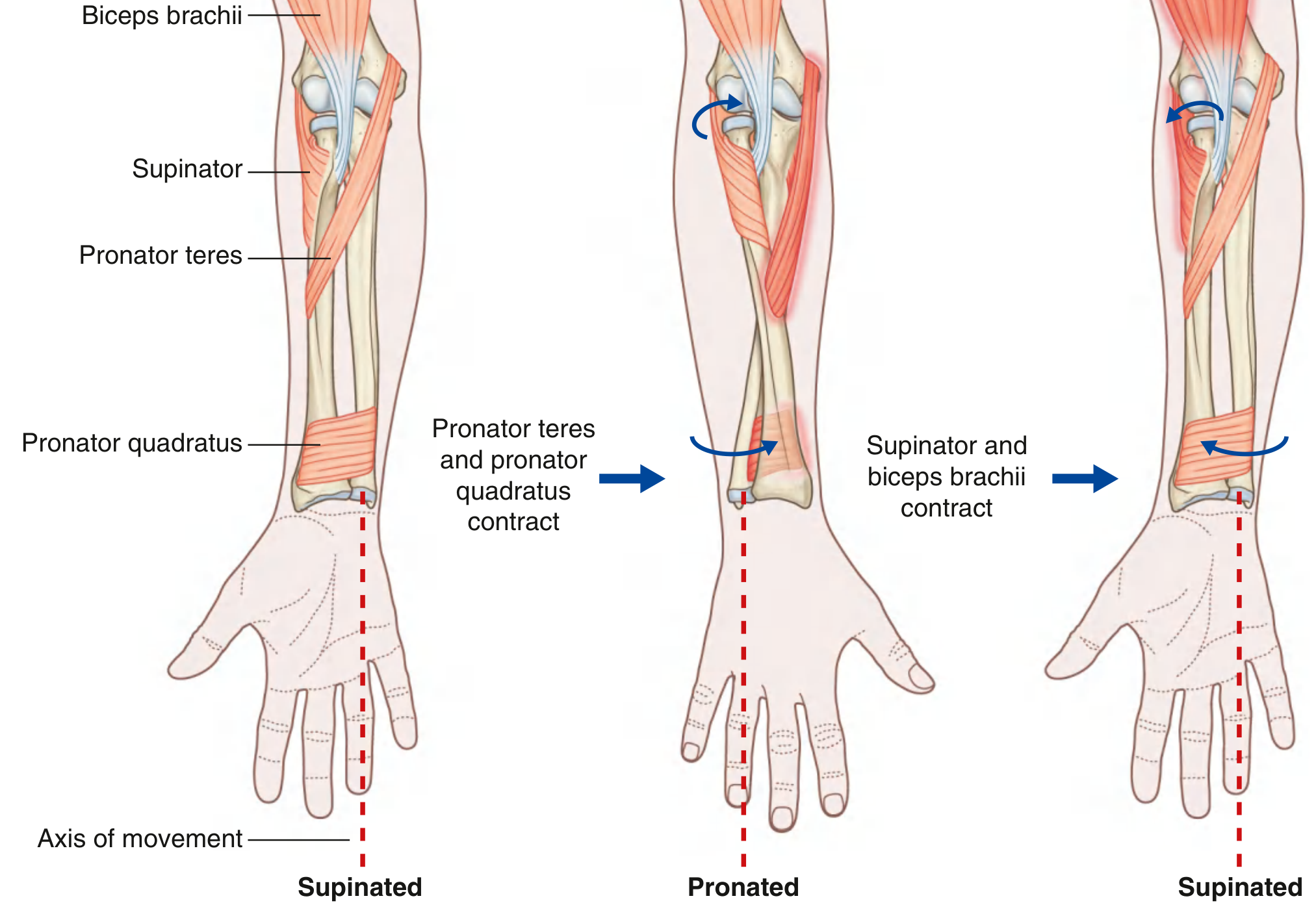
Supination (2 muscles)
-
Biceps brachii - the largest and most powerful supinator; most effective when the elbow is flexed. Both the biceps tendon and supinator wrap around the proximal radius during pronation; when they contract, they unwrap from the bone, producing supination.
-
Supinator muscle - located in the posterior compartment; originates from the supinator crest of the ulna and lateral epicondyle of the humerus and curves around the posterior and lateral surface of the upper third of the radius.
Pronation (2 muscles)
-
Pronator teres - runs from the medial epicondyle of the humerus to the lateral surface of the radius (midshaft). More active at faster speeds.
-
Pronator quadratus - flat, deep muscle connecting the anterior surfaces of the distal radius and ulna. The primary pronator - active in all pronation movements.
Accessory role
Anconeus - during pronation, also produces slight abduction of the distal ulna to maintain the position of the palm over the central axis.
Range of Motion
| Movement | Range |
|---|---|
| Supination | ~90° from neutral |
| Pronation | ~90° from neutral |
| Total arc | ~180° (forearm alone); adding shoulder rotation gives ~270° total rotation of the upper limb |
The neutral (0°) position is also called semi-pronation (the thumb-up position, like a handshake).
Stabilizing Structures
Three structures hold the radius and ulna together during these movements:
- Annular ligament at the proximal radioulnar joint
- Interosseous membrane along the shaft (also prevents proximal radius migration; increases ulnar variance in pronation)
- Articular disc (triangular fibrocartilage complex - TFCC) at the distal radioulnar joint
Foot Pronation and Supination
These terms are also applied to the foot, where:
- Pronation = eversion + abduction + dorsiflexion (foot rolls inward/flat)
- Supination = inversion + adduction + plantarflexion (foot rolls outward/high arch)
This occurs primarily at the subtalar (talocalcaneal) and transverse tarsal joints.
Sources: Gray's Anatomy for Students, pp. 895-896 | THIEME Atlas of Anatomy - General Anatomy and Musculoskeletal System, pp. 301-304 | Imaging Anatomy: Bones, Joints, Vessels and Nerves, p. 2330-2332
This is a shared conversation. Sign in to Orris to start your own chat.