
escheria coli mivmicrobioor
Escherichia coli is a gram-negative, facultative anaerobic, rod-shaped bacterium belonging to the Enterobacteriaceae family. It normally colonizes the human gut but certain pathogenic strains cause urinary tract infections, diarrhea, sepsis, and meningitis. Key features include lactose fermentation, oxidase-negative reaction, and the presence of O, H, and K antigens for serotyping.
Searching sources...
Reading File
Searching the Web
Escherichia coli microbiology characteristics pathogenesis 2025
Now let me search the textbook library for comprehensive E. coli content:
Finding Sources
Searching PubMed
"Escherichia coli"[MeSH Terms] AND pathogenesis
Reading File
Reading File
Reading File
Reading File
Reading File
Loading Image
Here is a comprehensive overview of Escherichia coli microbiology, drawn from Medical Microbiology 9e, Sherris & Ryan's Medical Microbiology 8e, and supplementary sources.
Escherichia coli - Microbiology
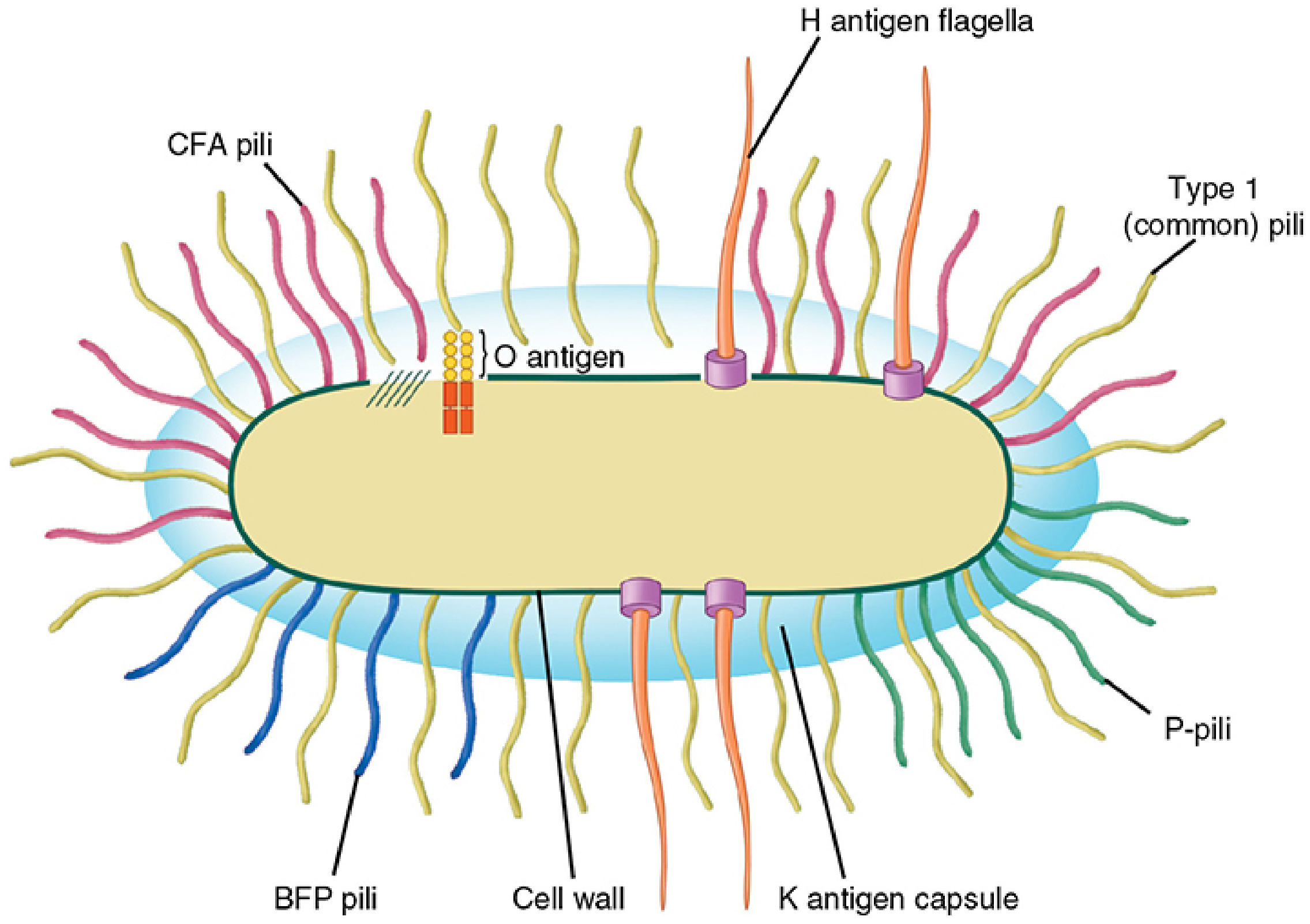
Antigenic Structure
Basic Biology
| Property | Detail |
|---|---|
| Morphology | Gram-negative, facultative anaerobic rod (bacillus) |
| Family | Enterobacteriaceae |
| Metabolism | Fermenter (including lactose); oxidase-negative |
| Motility | Peritrichous flagella (H antigen) |
| Spores | None |
| Cell wall | LPS with O polysaccharide, core polysaccharide, and lipid A (endotoxin) |
Antigenic formula is written as O:K:H (e.g., O18:K1:H7). Over 150 distinct O antigens exist plus numerous K and H antigens for serotyping. In the genomic era, sequence typing is also used (e.g., E. coli ST131, a major drug-resistant clone).
- Sherris & Ryan's Medical Microbiology 8e, p. 1282
Epidemiology
- Most common aerobic gram-negative rod in the human gastrointestinal tract
- Most extraintestinal infections are endogenous (from the patient's own flora); gastroenteritis strains are usually acquired exogenously
- E. coli is the most common gram-negative pathogen in sepsis, responsible for >80% of community-acquired UTIs, and a leading cause of gastroenteritis worldwide
- Medical Microbiology 9e
Virulence Factors
Virulence factors fall into two major categories: adhesins and exotoxins.
Pili (Adhesins)
| Pili type | Receptor | Role |
|---|---|---|
| Type 1 (common) pili | D-mannose on epithelial surfaces | Broad attachment, periurethral/bladder colonization |
| P pili | Digalactoside (Gal-Gal) on kidney/RBC P blood group | Pyelonephritis - present in 70% of pyelonephritis isolates |
| CFA (Colonization Factor Antigens) | Enterocytes | ETEC attachment to small intestine |
| Bundle-forming pili (BFP) | Enterocytes | EPEC/STEC attachment |
| Aggregative adherence fimbriae (AAF) | Enterocytes | EAEC |
- Sherris & Ryan's Medical Microbiology 8e, p. 1283
Pathogenic Groups and Diseases
1. Intestinal Pathotypes (Gastroenteritis)
| Pathotype | Full Name | Mechanism | Disease |
|---|---|---|---|
| ETEC | Enterotoxigenic E. coli | LT (heat-labile, activates adenylate cyclase -> cAMP) + ST (heat-stable, activates guanylate cyclase -> cGMP) | Traveler's diarrhea, watery diarrhea |
| EPEC | Enteropathogenic | Bundle-forming pili + intimin -> attaching/effacing (A/E) lesion | Infantile diarrhea (developing countries) |
| STEC | Shiga toxin-producing (= EHEC, VTEC) | Shiga toxins Stx1 + Stx2; intimin; A/E lesion | Hemorrhagic colitis, HUS (especially O157:H7) |
| EIEC | Enteroinvasive | pInv plasmid genes -> invasion of colonic epithelium + actin tail movement (like Shigella) | Dysentery-like illness (bloody diarrhea, fever) |
| EAEC | Enteroaggregative | AAF fimbriae + plasmid-encoded toxin + heat-stable toxin | Persistent diarrhea |
| DAEC | Diffusely adherent | Afa-Dr fimbriae, abolish microvilli | Diarrhea, mostly children |
Shiga Toxin Mechanism (STEC/HUS)
Stx1 and Stx2 are bacteriophage-encoded. Each toxin has 1 A subunit + 5 B subunits. The B subunits bind globotriaosylceramide (Gb3), abundant on intestinal villi and renal endothelial cells. The A1 fragment cleaves 28S rRNA, halting protein synthesis. Stx2 is more strongly associated with HUS (acute renal failure + thrombocytopenia + microangiopathic hemolytic anemia), occurring in 5-10% of infected children under 10. Mortality in HUS is 3-5%, with serious sequelae (renal impairment, hypertension, CNS) in up to 30%.
- Medical Microbiology 9e
2. Extraintestinal Infections (ExPEC)
Urinary Tract Infection (UTI)
- E. coli causes >90% of community-acquired cystitis cases and is the leading cause of pyelonephritis
- Reservoir: patient's own intestinal flora colonizing the perineum and urethra
- Uropathogenic E. coli (UPEC): fewer than 10 clones account for most UTI cases
- Key virulence factors:
- Type 1 pili - bind uroplakins (mannose moieties) in bladder transitional epithelium
- P pili - bind Gal-Gal on renal cells; present in 70% of pyelonephritis strains
- Hemolysin HlyA - lyses RBCs and other cells, stimulates inflammatory cytokine release
- UPEC can invade superficial bladder epithelial cells to persist against bladder flushing
Neonatal Meningitis
- E. coli K1 strains (K1 capsule mimics host tissue, evades immune attack) are a major cause of neonatal meningitis
- Serotype K1 polysaccharide is antigenically similar to host neural tissue - impairs opsonization
Bacteremia / Sepsis
- Most common gram-negative rod in bacteremia
- Especially common in urosepsis and cholangiosepsis, particularly in the elderly
Intraabdominal Infections
- Endogenous infection following bowel perforation or surgery
Diagnosis
- Grows rapidly on standard media (blood agar, MacConkey agar)
- Lactose fermenter (pink colonies on MacConkey)
- Enteric multiplex NAATs are considered the gold standard for gastroenteritis pathogens
- STEC: specific culture on sorbitol-MacConkey (O157:H7 does not ferment sorbitol); ELISA/PCR for Shiga toxins
- Serotyping by O, K, H antigens; molecular typing (MLST/WGS) increasingly used
Treatment, Prevention, and Control
| Situation | Approach |
|---|---|
| Gastroenteritis (uncomplicated) | Symptomatic (oral rehydration); antibiotics generally avoided in STEC (can trigger Stx release and worsen HUS) |
| UTI / pyelonephritis | Guided by in vitro susceptibility; resistance via ESBLs (extended-spectrum beta-lactamases) is a growing concern |
| Bacteremia/meningitis | IV antibiotics per susceptibility; carbapenems for ESBL-producers |
| Prevention | Proper beef cooking (STEC), hand hygiene, infection control, restrict unnecessary catheter use, high sanitation standards |
Key Clinical Points to Remember
- STEC O157:H7 - most important cause of hemorrhagic colitis and HUS in the US; do NOT give antibiotics (induces phage-mediated Stx production)
- ETEC - #1 cause of traveler's diarrhea; mediated by LT (cAMP) and ST (cGMP) toxins
- UPEC - responsible for most UTIs; type 1 pili for bladder, P pili for pyelonephritis
- K1 capsule - the signature of neonatal meningitis strains
- ESBL resistance - major clinical challenge with UTI and hospital-acquired E. coli infections
- Medical Microbiology 9e (Murray et al.)
- Sherris & Ryan's Medical Microbiology 8e, pp. 1282-1289
This is a shared conversation. Sign in to Orris to start your own chat.