
Coronary circulation and Anesthesia
Reading File
Now let me search the library for coronary circulation and anesthesia content in parallel.
Finding Sources
Finding Sources
Searching PubMed
"coronary circulation" AND "anesthesia"
Excellent - Miller's Anesthesia has a dedicated section. Let me read it alongside the physiology sources in parallel.
Reading File
Reading File
Reading File
Good content from Guyton & Hall and Miller's. Now let me get more from the Miller's Anesthesia section (the main anesthesia-specific content) and Guyton (autoregulation, control), and also look for the broader Miller's section on coronary circulation.
Finding Sources
Reading File
Now let me get the broader Miller's Anesthesia content on coronary circulation - I need to find the section that precedes the opioid section (which is what we saw), to cover the full anesthesia-coronary content.
Finding Sources
Reading File
Let me search specifically in Miller's for coronary circulation, steal, and volatile anesthetics content:
Finding Sources
Finding Sources
Excellent - found dedicated sections in Barash and Miller's. Let me read those now in parallel:
Reading File
Reading File
Now let me get the key Barash section on "Coronary Steal, Myocardial Ischemia, and Cardiac Outcome" and also search for autoregulation and ischemic preconditioning in anesthesia:
Reading File
Finding Sources
I now have rich content. Let me fetch the key coronary anatomy diagram and read a bit more of the Barash section on cardioprotection:
Reading File
Loading Image
I now have comprehensive content from multiple authoritative sources. Let me compile the full, detailed answer.
Coronary Circulation and Anesthesia
1. Anatomical Overview
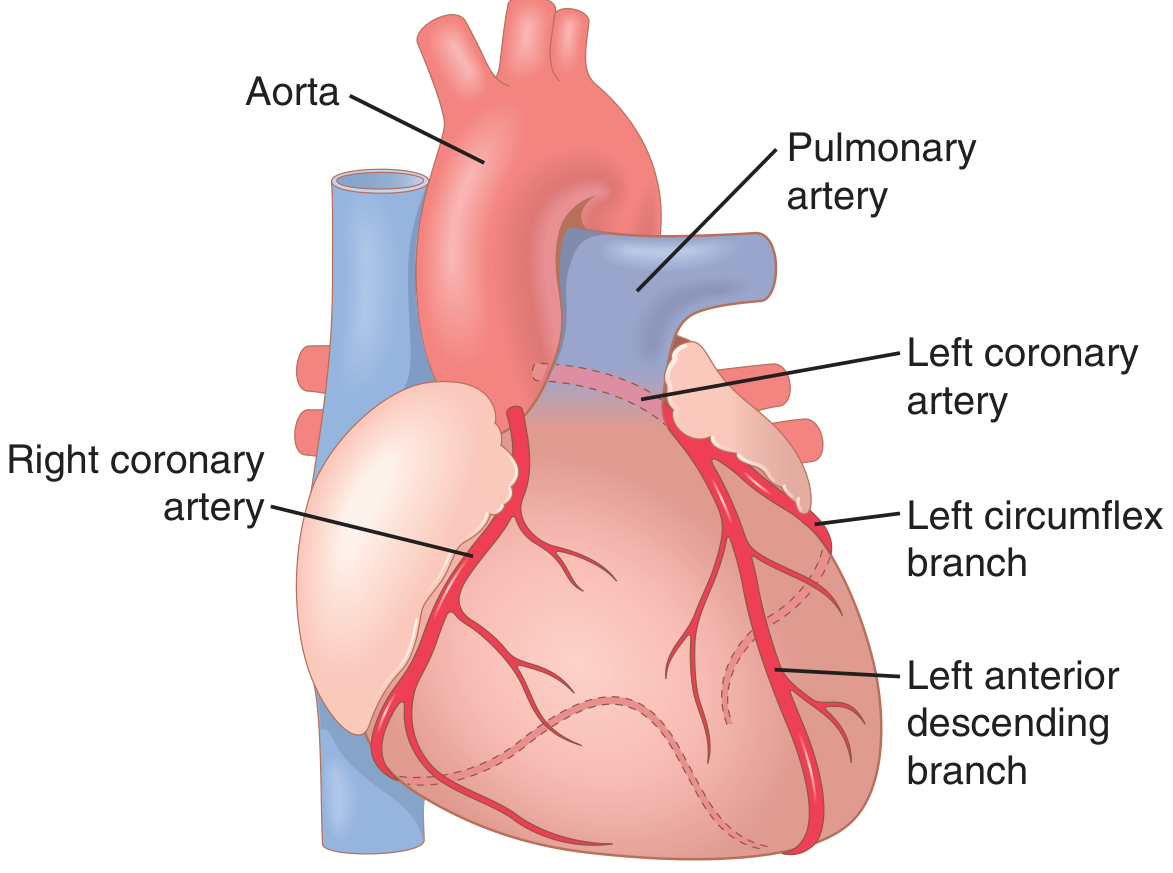
The coronary arteries arise from the aortic sinuses immediately above the aortic valve and lie on the epicardial surface of the heart before penetrating into the myocardium.
-
Left coronary artery (LCA): Divides into the left anterior descending (LAD) and left circumflex (LCx). Supplies the anterior and left lateral left ventricle (LV).
-
Right coronary artery (RCA): Supplies most of the right ventricle (RV) and the posterior LV in 80-90% of people (right dominance).
-
Venous drainage: ~75% of LV coronary venous blood returns via the coronary sinus to the right atrium. RV venous blood drains via anterior cardiac veins. A small amount drains through Thebesian veins directly into cardiac chambers.
-
Only the inner 0.1 mm of the endocardium can be nourished directly from intracavitary blood; the rest depends entirely on coronary flow.
-
Guyton and Hall Textbook of Medical Physiology, p. 268
2. Normal Coronary Blood Flow
- Resting flow: ~70 mL/min/100 g of heart weight (~225 mL/min total), approximately 4-5% of cardiac output.
- During strenuous exercise, cardiac work increases 6- to 9-fold; coronary flow increases only 3- to 4-fold, necessitating increased metabolic efficiency.
- Guyton and Hall, p. 268
Phasic Flow (Systole vs. Diastole)
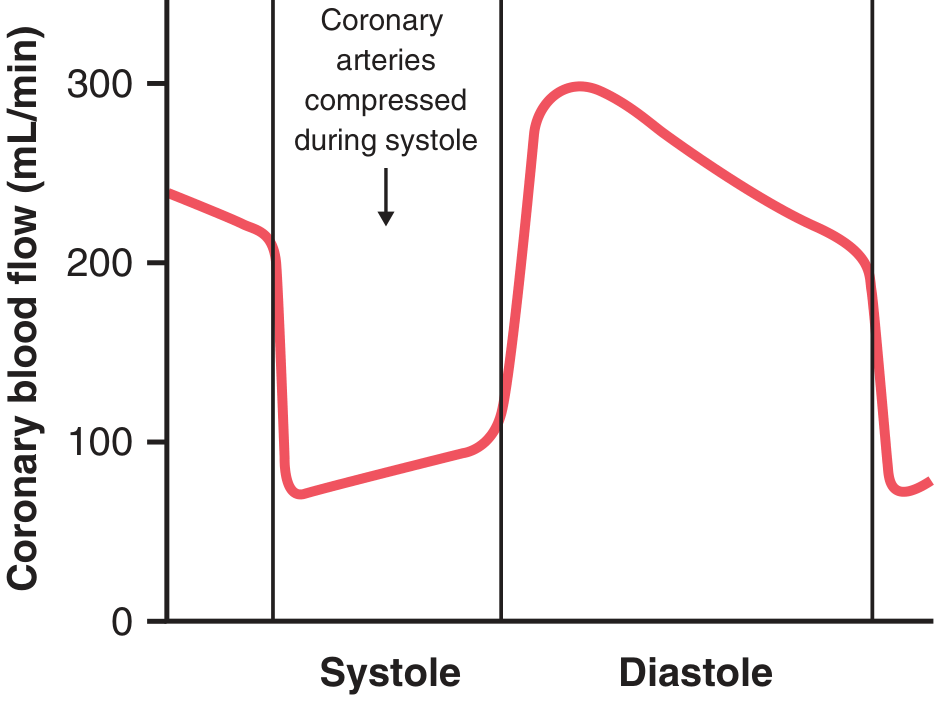
A unique feature of the coronary circulation is the mechanical compression effect:
- Left ventricle: During systole, intramuscular blood vessels are compressed, causing a fall in coronary capillary blood flow - the opposite of other vascular beds. Blood flow is predominantly diastolic in the left coronary system.
- Right ventricle: Because RV contraction is weaker, phasic compression is only partial; flow occurs in both systole and diastole.
- Subendocardial vulnerability: During systole, the subendocardial plexus is most compressed (highest intramyocardial pressure). This is compensated by a rich subendocardial arterial plexus. In pathological states (e.g., LV hypertrophy, tachycardia, raised LVEDP), subendocardial ischemia is the first to occur.
3. Control of Coronary Blood Flow
Local Metabolic Control (Primary)
Blood flow is regulated almost entirely by local arteriolar vasodilation driven by myocardial metabolic demand. Key mediators:
- Adenosine - released when ATP is hydrolyzed during hypoxia; most potent coronary vasodilator
- Hypoxia itself - directly dilates arterioles
- CO2 and H+ - vasodilators, though less important here than in cerebral circulation
- K+ ions, lactate, prostaglandins - also contribute
Mechanism: When myocardial O₂ demand rises (e.g., increased contractility), local hypoxia causes arteriolar vasodilation → increased coronary flow (active hyperemia). This is the dominant mechanism.
Autoregulation
Coronary blood flow is autoregulated between mean arterial pressures of approximately 60-140 mmHg - flow remains relatively constant despite changes in perfusion pressure within this range.
Sympathetic and Neural Influences
Sympathetic innervation plays only a minor role compared to local metabolic control. Alpha-1 receptors cause vasoconstriction; beta-2 receptors cause vasodilation. However, the net effect of sympathetic activation is usually increased flow because of the dominant effect of metabolic vasodilation from increased cardiac work.
- Costanzo Physiology 7th Edition; Guyton and Hall, p. 268-269
4. Myocardial Oxygen Supply-Demand Balance
This is the central concept in anesthetic management of cardiac patients.
Determinants of O₂ Supply
| Factor | Notes |
|---|---|
| Coronary blood flow | Primarily diastolic (especially LV); depends on diastolic BP and diastolic time |
| Diastolic blood pressure | Main driver of coronary perfusion pressure |
| Heart rate | Tachycardia reduces diastolic time → reduces LV perfusion |
| Coronary vascular resistance | Autoregulation, vasodilators |
| Arterial O₂ content | Hematocrit, SpO₂ |
Determinants of O₂ Demand (MVO₂)
| Factor | Notes |
|---|---|
| Heart rate | Single most important determinant |
| Wall tension | Related to preload (LVEDP) and afterload (aortic pressure) |
| Contractility | Inotropy increases MVO₂ |
| Basal metabolism | Fixed component |
Anesthetic goal: Maintain a favorable supply/demand ratio - preserve diastolic BP and oxygenation while avoiding tachycardia, excessive preload, and hypertension.
- Miller's Anesthesia, 10th ed.
5. Effects of Anesthetic Agents on Coronary Circulation
Volatile (Inhalational) Anesthetics
Cardiovascular effects of isoflurane, sevoflurane, desflurane:
- All three produce dose-dependent reductions in systemic vascular resistance and blood pressure (vasodilation)
- Dose-dependent reduction in myocardial contractility (negative inotropy), though functional cardiac reserve is preserved
- Heart rate: sevoflurane has minimal HR effect at ~1 MAC; isoflurane and desflurane cause 5-10% HR increases
Coronary steal - isoflurane:
Early concerns existed that isoflurane's potent coronary vasodilation might cause coronary steal (diverting blood from collateral-dependent regions via vasodilation of non-stenosed vessels). However:
"Clinical outcome studies have been unable to find an association between the use of isoflurane in patients undergoing CABG operations with an increased incidence of myocardial infarction or perioperative death."
In animal models with multivessel coronary obstruction, none of isoflurane, sevoflurane, or desflurane at up to 1.5 MAC caused abnormal collateral coronary flow redistribution - whereas adenosine clearly did.
- Barash Clinical Anesthesia, 9th ed., p. 1427-1428
Desflurane specific concern:
Rapid increases in inspired desflurane concentration (>5-6%) trigger significant sympathetic activation - hypertension, tachycardia, and 15-20-fold increases in plasma norepinephrine/epinephrine. This is harmful in patients with coronary artery disease (CAD). Pretreatment with opioids or an α₂-agonist attenuates this response.
Anesthetic Preconditioning (Cardioprotection)
Volatile anesthetics can mimic ischemic preconditioning - one of the most clinically important phenomena in cardiac anesthesia:
Mechanism:
- Volatile anesthetics diffuse into myocardial cell membranes and alter mitochondrial electron transport → generate reactive oxygen species (ROS)
- ROS trigger protein kinase C (PKC) activation → opens K_ATP channels
- ~30-40% of cardioprotection comes from reduced calcium loading into myocardial cells during ischemia
- Improved mitochondrial membrane permeability to ATP precursors → better recovery of contractile function after reperfusion
Preconditioning: Drug given before ischemia protects against subsequent ischemic injury
Postconditioning: Drug given at the time of reperfusion also reduces reperfusion injury
Meta-analyses confirm volatile anesthetic cardioprotection can reduce myocardial damage and improve cardiac outcomes in on-pump and off-pump CABG. However, a 2019 multicenter pragmatic trial did not find reduced ischemia or 1-year survival with volatile vs. TIVA in elective CABG, and a retrospective study found TIVA associated with better 3-year survival after CABG - the debate remains ongoing.
- Barash Clinical Anesthesia, 9th ed., p. 1428-1429
Opioids
-
Opioids have no significant effect on coronary vasomotion or myocardial metabolism at standard doses
-
Do not produce coronary steal
-
Do not diminish the ability of large coronary arterioles to respond to vasoactive agents
-
Fentanyl at low concentrations (1-2 ng/mL) enhances baroreflex control of coronary conductance; at higher concentrations it depresses baroreflex control
-
Opioids mimic ischemic preconditioning: Stimulation of cardiac κ- and δ-opioid receptors reduces infarct size in animal models; remifentanil also has protective effects partly via μ-agonism outside the heart
-
Remote preconditioning (brief ischemia of limb, kidney, intestine) is mediated by myocardial κ-opioid receptors
-
Clinically: high-dose opioid-based anesthesia maintains myocardial perfusion and O₂ supply/demand ratio as well or better than inhalation techniques for CABG
-
Miller's Anesthesia, 10th ed., p. 2769-2770
Propofol (TIVA)
- Reduces systemic vascular resistance and blood pressure (vasodilatory), but does not cause coronary steal
- Provides cerebral and coronary protection through antioxidant properties at clinical concentrations
- Does not mimic ischemic preconditioning to the same degree as volatile anesthetics (controversial)
- Provides similar hemodynamic stability vs. volatile agents when carefully titrated
Nitrates and Vasodilators in Coronary Context
- Nitroglycerin: Beneficial in CAD - primarily a venodilator reducing preload; dilates large epicardial coronary arteries; does not cause steal
- Sodium nitroprusside: Can cause coronary steal phenomenon - its potent arteriolar vasodilation preferentially dilates non-stenotic vessels, diverting blood from collateral-dependent ischemic zones
- Morgan and Mikhail's Clinical Anesthesia, 7th ed.
6. Anesthetic Management in Patients with CAD
The core principle is maintaining a favorable myocardial O₂ supply/demand ratio:
| Goal | Strategies |
|---|---|
| Maintain coronary perfusion pressure | Preserve diastolic BP (vasopressors if needed) |
| Avoid tachycardia | Beta-blockers perioperatively; opioids; avoid rapid desflurane uptitraton |
| Optimize O₂ delivery | Maintain Hb, SpO₂, avoid anemia |
| Reduce O₂ demand | Adequate analgesia; avoid hypertension; avoid excess contractility stimulation |
| Avoid coronary vasodilation that causes steal | Avoid high-dose nitroprusside |
Thoracic epidural analgesia (TEA): Cervicothoracic epidural analgesia blocks cardiac sympathetic fibers (T1-T4), reduces HR and myocardial O₂ demand, and improves the supply/demand ratio in patients with CAD undergoing thoracic or major surgery.
7. Summary Table: Anesthetic Agents and Coronary Effects
| Agent | HR | Contractility | Coronary Vasodilation | Steal Risk | Cardioprotection |
|---|---|---|---|---|---|
| Isoflurane | ↑ (mild) | ↓↓ | ++ | Theoretical, not clinical | Yes (preconditioning) |
| Sevoflurane | ~ | ↓↓ | + | No | Yes |
| Desflurane | ↑ (rapid ↑ can cause ++) | ↓↓ | + | No | Yes |
| Fentanyl/opioids | ↓ or ~ | ~ | None significant | No | Yes (preconditioning) |
| Propofol | ↓ (mild) | ↓ | + | No | Minimal |
| Nitroglycerin | ~ | None | ++ (epicardial) | No | No |
| Nitroprusside | ~ | None | ++ (arteriolar) | Yes | No |
Sources:
- Guyton and Hall Textbook of Medical Physiology (Ch. 21)
- Costanzo Physiology 7th Edition (Ch. on Special Circulations)
- Barash, Cullen & Stoelting's Clinical Anesthesia, 9th ed. (Ch. 18: Volatile Anesthetics)
- Miller's Anesthesia, 10th ed. (Ch. 22: Opioids; Ch. 49: Thoracic Anesthesia)
- Morgan and Mikhail's Clinical Anesthesiology, 7th ed.
This is a shared conversation. Sign in to Orris to start your own chat.