
Erythropoies
I'll look up erythropoiesis from the medical library right away.
Reading File
Searching sources...
Finding Sources
Searching the Web
erythropoiesis process steps regulation
Good results. Let me read the most relevant textbook sections in parallel.
Reading File
Reading File
Reading File
Reading File
Excellent content. Let me also fetch the diagram image and get additional detail on the erythroblast stages.
Loading Image
Finding Sources
Now let me get the histology plate content for the detailed erythroblast stages and the EPO mechanism section.
Reading File
Reading File
I now have comprehensive information from multiple authoritative textbooks. Here is a full, well-structured answer:
Erythropoiesis
Erythropoiesis is the process by which red blood cells (erythrocytes) are produced and maintained in the circulation. Under normal conditions, roughly 1% of circulating erythrocytes is replaced daily - about 250 billion cells, or 2.5-3 million erythrocytes per second.
- Brenner and Rector's The Kidney, p. 2465
- Histology: A Text and Atlas, p. 746
Sites of Production
- Fetus/newborn: liver, spleen, yolk sac (primitive erythropoiesis)
- Children: bone marrow of most bones
- Adults: axial skeleton (vertebrae, sternum, pelvis, proximal long bones)
Cell Lineage - From Stem Cell to Mature RBC
The erythroid pathway proceeds stepwise through the bone marrow:
| Stage | Key Features |
|---|---|
| Pluripotent stem cell | Self-renewing; gives rise to all blood lines |
| CFU-GEMM | Mixed myeloid progenitor (granulocyte, erythroid, monocyte, megakaryocyte) |
| BFU-E (burst-forming unit - erythroid) | Early committed erythroid progenitor; EPO-responsive |
| CFU-E (colony-forming unit - erythroid) | Highly EPO-sensitive; commits fully to red cell lineage |
| Proerythroblast | First morphologically recognizable RBC precursor; large cell, basophilic cytoplasm, prominent nucleoli, no hemoglobin yet |
| Basophilic erythroblast | Smaller; strong cytoplasmic basophilia from ribosomes actively synthesizing hemoglobin |
| Polychromatophilic erythroblast | Hemoglobin accumulates; cytoplasm shifts from blue-gray to more eosinophilic; last stage where mitosis occurs |
| Orthochromatic erythroblast (Normoblast) | Extremely condensed, small nucleus; nearly full hemoglobin load; incapable of further division |
| Reticulocyte | Nucleus extruded; still contains ribosomes and mRNA capable of hemoglobin synthesis; released from bone marrow; circulates 1-2 days before maturing in spleen |
| Mature erythrocyte | Biconcave disc; no nucleus or organelles; lifespan ~120 days |
Each normoblast undergoes 4 more cell divisions after formation, with progressive nuclear condensation at each step. The whole process from basophilic erythroblast to circulation takes approximately one week.
- Basic Medical Biochemistry, p. 1536
- Histology: A Text and Atlas, pp. 775-777
Regulation - The EPO Feedback Loop
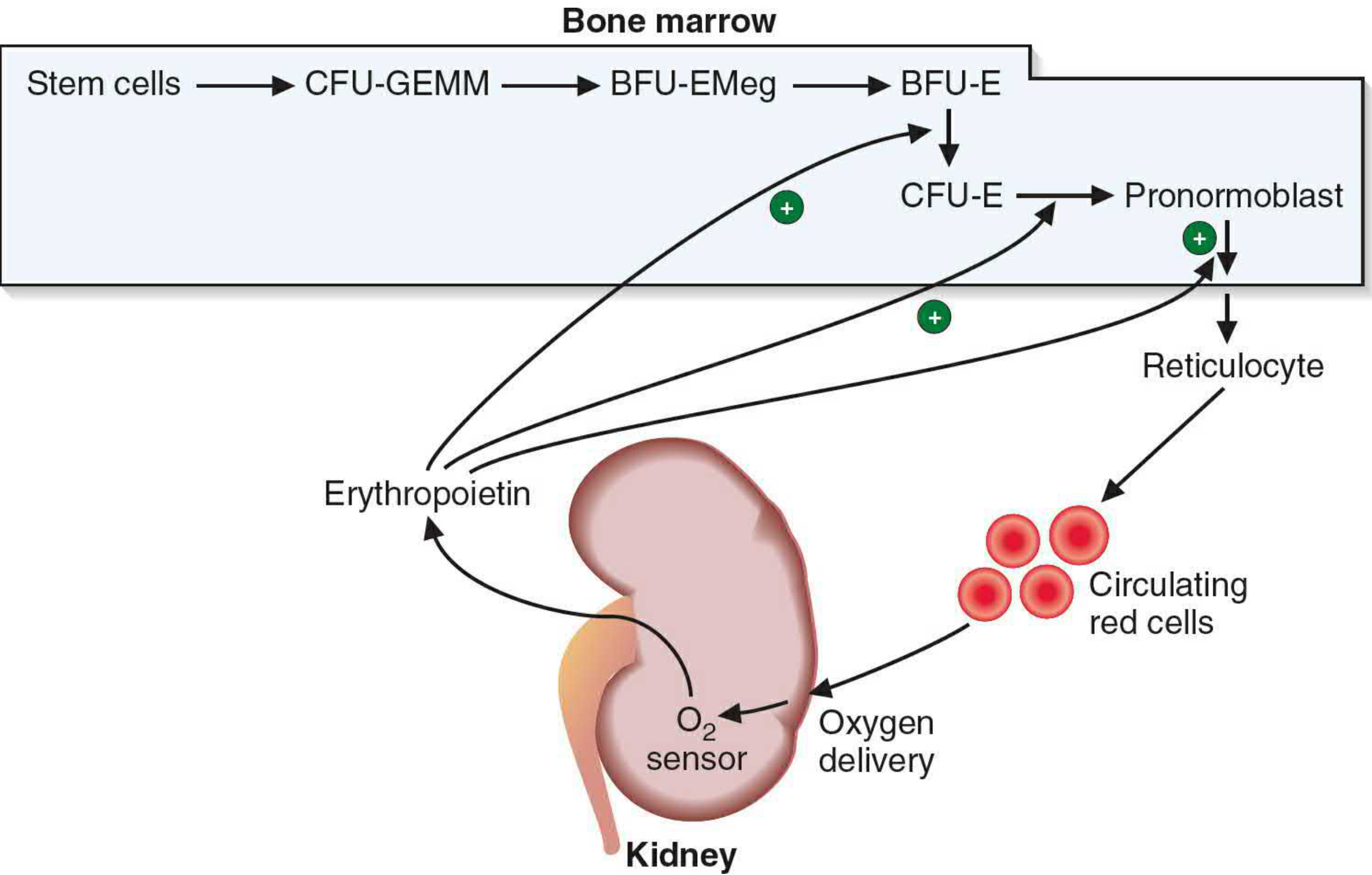
Fig. Erythropoietin stimulation of erythrocyte maturation - Basic Medical Biochemistry, p. 1536
Control of red cell mass operates through a classic negative feedback loop:
- Oxygen sensor: Peritubular fibroblasts in the renal cortex detect reduced oxygen delivery (hypoxia, anemia, blood loss)
- EPO release: These cells upregulate production of erythropoietin (EPO) - a 30.4 kDa glycoprotein
- Bone marrow stimulation: EPO binds EPO receptors (EPO-Rs) on erythroid progenitors (particularly CFU-E and BFU-E), driving proliferation and maturation
- Rising RBC mass: As RBC numbers increase, oxygen delivery improves, shutting off EPO production
EPO rises within 24-48 hours of a hypoxic stimulus and declines over ~3 weeks as hematocrit normalizes.
Required cofactors
For erythropoiesis to proceed normally, several cofactors must be available:
- Iron - for heme synthesis
- Vitamin B12 - for DNA synthesis (nuclear maturation)
- Folate - for DNA synthesis
- Intrinsic factor - for B12 absorption
Deficiency of any of these causes distinct anemias (iron-deficiency anemia, megaloblastic anemia, etc.).
- Brenner and Rector's The Kidney, pp. 2465-2466
RBC Life Cycle Completion
After ~120 days, senescent erythrocytes are phagocytosed by macrophages in the spleen, bone marrow, and liver. The breakdown products are recycled:
-
Globin → hydrolyzed to amino acids → metabolic pool
-
Iron → stored as ferritin/hemosiderin in spleen → reused for hemoglobin synthesis
-
Heme ring → converted to bilirubin → bound to albumin → transported to liver → conjugated → excreted in bile
-
Histology: A Text and Atlas, p. 746
Clinical Relevance
| Condition | Mechanism |
|---|---|
| Renal anemia | Damaged kidneys produce insufficient EPO |
| Polycythemia vera | Dysregulation at the hematopoietic stem cell level; EPO-independent proliferation |
| High-altitude erythrocytosis | Sustained hypoxia → elevated EPO → increased RBC mass; hematocrit >60% impairs oxygen delivery via hyperviscosity |
| Iron-deficiency anemia | Insufficient iron for hemoglobin synthesis |
| Megaloblastic anemia | B12/folate deficiency impairs DNA synthesis; large, immature RBCs |
| Erythropoiesis-stimulating agents (ESAs) | Recombinant EPO used in renal anemia and chemotherapy-related anemia |
This is a shared conversation. Sign in to Orris to start your own chat.