
Mets for 5 marks
Asking for Preferences
What subject area does 'Mets' refer to in your question?
Metabolic Equivalents (METs) is a standard physiology/exercise topic. Let me pull authoritative content from the medical library.
Searching sources...
Reading File
Finding Sources
Finding Sources
Good results. Let me now read the key sections from Sabiston, Bailey & Love, and Harper's for a thorough answer.
Reading File
Reading File
Reading File
Let me also read the full MET table from Bailey & Love and fetch the MET figure from Sabiston.
Reading File
Loading Image
I now have all the content needed for a complete 5-mark answer. Here it is:
Metabolic Equivalents (METs)
Definition
A Metabolic Equivalent of Task (MET) is a unit that expresses the energy cost of a physical activity as a multiple of the resting metabolic rate. One MET is defined as the oxygen consumption of an adult at rest in a sitting position, equal to approximately 3.5 mL O2/kg/min (or ~1.2 kcal/min for a 70-kg person). It is also expressed as the Physical Activity Ratio (PAR) in nutritional physiology. - Harper's Illustrated Biochemistry, 32nd Ed.
Clinical Significance
METs are used to assess a patient's functional capacity - i.e., how much cardiovascular and musculoskeletal work they can sustain. In the perioperative setting, METs are used to predict surgical risk. Patients unable to perform >4 METs of activity are considered to have poor functional status and are at increased risk for perioperative morbidity and mortality. - Sabiston Textbook of Surgery
A meta-analysis showed that each additional MET a healthy individual can generate correlates with a 13% decrease in all-cause mortality and a 15% decrease in the risk of long-term coronary/cardiovascular events.
MET Scale and Corresponding Activities
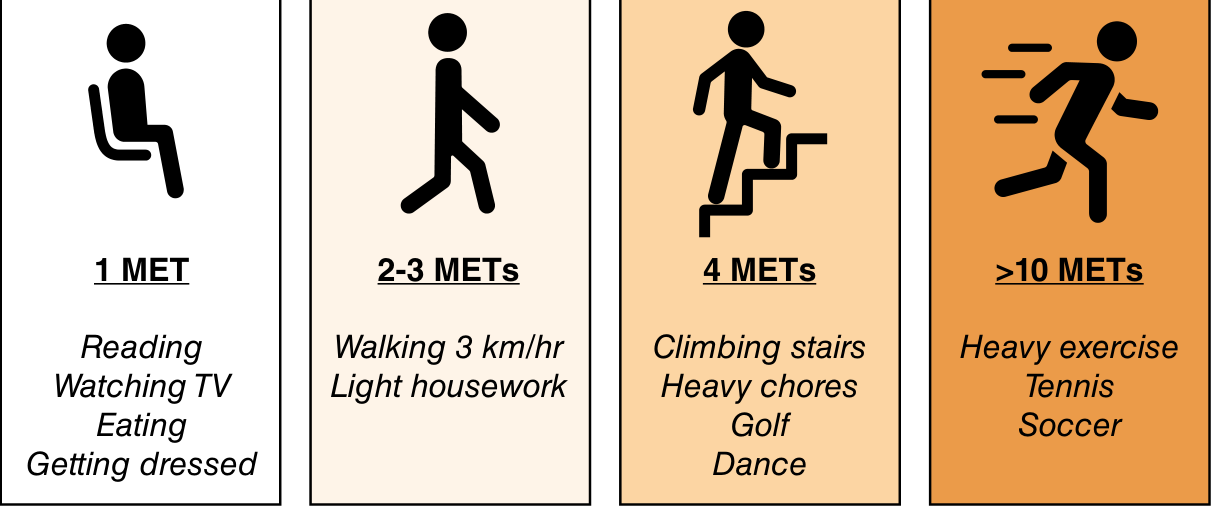
| METs | Activity Examples |
|---|---|
| 1 MET | Resting, eating, getting dressed, reading, watching TV |
| 2-3 METs | Walking at 3 km/hr, light housework |
| 4 METs | Climbing one or two flights of stairs, golf, dance, heavy chores |
| 6 METs | Short run |
| >10 METs | Heavy exercise, tennis, soccer, strenuous sport |
(Bailey and Love's Short Practice of Surgery, 28th Ed., Table 21.5)
The 4-MET Threshold
- Patients who can perform >4 METs (e.g., climb at least one flight of stairs) are generally accepted to proceed for low-risk surgery in both the USA and Europe.
- Patients falling below this threshold may require further evaluation - cardiology or pulmonology consultation, or formal Cardiopulmonary Exercise Testing (CPET).
Assessment Methods
- Clinical history - Simply asking about daily activities (most practical, though subject to patient overestimation).
- Duke Activity Status Index (DASI) - A less subjective patient questionnaire that estimates peak VO2.
- CPET (Cardiopulmonary Exercise Testing) - Gold standard; measures VO2 and VCO2 during incremental exercise. Patients with:
- Anaerobic threshold (AT) <11 mL/kg/min, or
- VO2 peak <15 mL/kg/min ...are at higher risk of morbidity and mortality after major surgery.
- Incremental Shuttle Walk Test (ISWT) - Low-cost alternative; failure to achieve 350 metres indicates high risk.
Summary
METs provide a simple, practical way to quantify exercise tolerance. The key clinical cut-off is 4 METs - below which surgical risk rises significantly and further workup is warranted.
Mets for 5 marks anesthesia residency
Searching sources for an anesthesia-focused METs answer...
Finding Sources
Finding Sources
Excellent hits from Miller's Anesthesia and Barash. Let me read all the key anesthesia sections in parallel.
Reading File
Reading File
Reading File
Now let me read more from Miller's block 10 for the ACC/AHA algorithm and the Morgan & Mikhail section.
Reading File
Reading File
I now have comprehensive anesthesia-specific content from Miller's, Barash, and Morgan & Mikhail. Let me also fetch the MET figure.
Loading Image
Here is a complete anesthesia residency-focused answer on METs:
Metabolic Equivalents of Task (METs) - Anesthesia Preoperative Assessment
1. Definition
A Metabolic Equivalent of Task (MET) quantifies the energy cost of a physical activity relative to resting metabolic rate. 1 MET = 3.5 mL O2/kg/min - the oxygen consumption of an adult at rest in a sitting position (approximately 1.2 kcal/min for a 70 kg person).
Functional capacity expressed in METs is one of the most important determinants of perioperative cardiac risk. - Miller's Anesthesia, 10th Ed.
2. MET Scale and Activity Equivalents
| METs | Activity | Clinical Implication |
|---|---|---|
| 1 | Eating, dressing, watching TV, resting | Severely limited |
| 2 | Walking indoors slowly | Poor capacity |
| 2-3 | Light housework, walking at 3 km/hr | Poor capacity |
| 4 | Climbing one flight of stairs, walking at 4 mph, golf, dancing | Key clinical threshold |
| 5-6 | Short run, heavy housework, recreational swimming | Moderate capacity |
| 7-8 | Jogging, carrying loads upstairs, recreational tennis/soccer | Good capacity |
| >10 | Strenuous sport - singles tennis, football, skiing | Excellent capacity |
(Morgan & Mikhail's Clinical Anesthesiology, 7th Ed., Table 21-1)
3. The Critical 4-MET Threshold (ACC/AHA Guideline)
The ACC/AHA 2014 Perioperative Cardiovascular Evaluation Guidelines use METs as the central decision point in preoperative workup for noncardiac surgery:
- ≥4 METs (moderate-to-excellent functional capacity): Patient may proceed to surgery without further cardiac testing, regardless of the number of clinical risk factors.
- <4 METs or unknown functional capacity (poor capacity): Further evaluation is required - either stress testing or cardiac catheterization - if the results will change management.
- Inability to climb a flight of stairs (~4 METs) is highly predictive (89%) of a postoperative cardiopulmonary complication. - Miller's Anesthesia
4. How to Assess METs in the Preoperative Clinic
Three methods are used, in increasing order of objectivity:
(a) Unstructured Clinical Interview (Subjective)
The anesthesiologist asks the patient about daily activities and makes a subjective MET estimate. Major limitation: sensitivity for identifying inability to attain ≥4 METs is only 19% (though specificity is 95%). It does not meaningfully improve prediction of postoperative mortality. - Miller's Anesthesia
(b) Validated Questionnaires (Structured - Preferred)
- DASI (Duke Activity Status Index) - 12-item questionnaire; DASI score ≤25 is associated with clinically meaningful increased risk of MI and major complications after noncardiac surgery.
- MET-REPAIR Questionnaire (MET: REvaluation for Perioperative cArdIac Risk) - patients self-report activities from the last month; each item is pre-assigned a MET value. The highest activity the patient can perform determines estimated functional capacity. Both are correlated with gold-standard CPET. - Miller's Anesthesia, Table 28.2 & 28.3
(c) Objective Testing (Gold Standard)
- CPET (Cardiopulmonary Exercise Testing): Measures VO2 and VCO2 during incremental exercise. High risk is defined as:
- Anaerobic threshold (AT) <11 mL/kg/min
- VO2 peak <15 mL/kg/min
- 6-Minute Walk Test / Incremental Shuttle Walk Test: Poor performance on these is associated with increased risk of major postoperative complications.
- Important caveat: Resting LVEF is not a proxy for functional capacity - exercise capacity can vary widely among patients with similar LVEF. - Miller's Anesthesia
5. Perioperative Risk Implications
| Functional Capacity | Perioperative Action |
|---|---|
| >4 METs (moderate to excellent) | Proceed to surgery; no further cardiac testing needed |
| <4 METs (poor) | Risk-stratify with RCRI/ACS-NSQIP calculator; consider stress test if it will change management |
| Unknown | Use DASI/MET-REPAIR questionnaire; CPET if high-risk surgery planned |
Patients with low METs may benefit from:
- Prehabilitation - supervised exercise 4-6 weeks pre-op to improve AT and reduce risk
- Specialty consultation - cardiology or pulmonology
- Medical optimization before elective surgery - Barash's Clinical Anesthesia, 9th Ed.
6. Limitations of MET Assessment
- Self-reporting bias - patients overestimate their capacity
- Confounders - arthritis or peripheral vascular disease limits mobility independent of cardiovascular fitness (a vascular surgery patient may have <4 METs due to claudication, not cardiac disease)
- Subjective interview has poor sensitivity (19%) for detecting true functional impairment
- For high-risk surgery, objective CPET is preferred over subjective estimates
Key exam point: The 4-MET threshold is the single most important clinical cut-off. A patient who can climb one flight of stairs or walk briskly on level ground can proceed to most elective noncardiac surgery without further cardiac workup, per ACC/AHA guidelines.
What is METS? What are the recent guidelines for assessment of functional capacity in a patient with coronary stents in-situ and what is the relevant role of cardiac biomarkers in this patient? [2+4+4]
Searching sources...
Finding Sources
Finding Sources
Finding Sources
Excellent hits. Now reading all key sections in parallel.
Reading File
Reading File
Reading File
Excellent content. Let me now read the Miller's section on biomarker thresholds table and the ESC 2022 algorithm, and fetch the coronary stent flowchart.
Reading File
Loading Image
Reading File
Let me now get the biomarker thresholds table and the Harrison's section on stents/functional capacity for completeness.
Finding Sources
Reading File
I now have comprehensive content across all three parts. Here is the complete structured answer:
METs, Functional Capacity Assessment in Coronary Stent Patients, and Cardiac Biomarkers [2+4+4]
PART 1: What is METs? [2 marks]
Metabolic Equivalent of Task (MET) is a unit that expresses the energy cost of a physical activity as a multiple of the resting metabolic rate.
- 1 MET = 3.5 mL O2/kg/min - the resting oxygen consumption of a 40-year-old, 70 kg adult sitting quietly (approximately 1.2 kcal/min)
- It quantifies functional capacity - the maximum sustainable physical work a patient can perform
- Each additional MET generated is associated with a 13% reduction in all-cause mortality and a 15% reduction in long-term cardiovascular events in healthy individuals
MET scale:
| METs | Activity |
|---|---|
| 1 | Resting, eating, dressing, watching TV |
| 2-3 | Walking at 3 km/hr, light housework |
| 4 | Climbing one flight of stairs, golf, dancing - KEY threshold |
| 6 | Short run |
| >10 | Strenuous sport - tennis, football, skiing |
(Sabiston Textbook of Surgery; Morgan & Mikhail, 7th Ed.)
PART 2: Recent Guidelines for Assessment of Functional Capacity in a Patient with Coronary Stents [4 marks]
A. Timing of Surgery After Stent Placement (ACC/AHA 2014)
This is the first decision before any functional assessment:
| Intervention | Minimum Wait Before Elective Surgery |
|---|---|
| Balloon angioplasty (no stent) | 14 days |
| Bare Metal Stent (BMS) | 30 days |
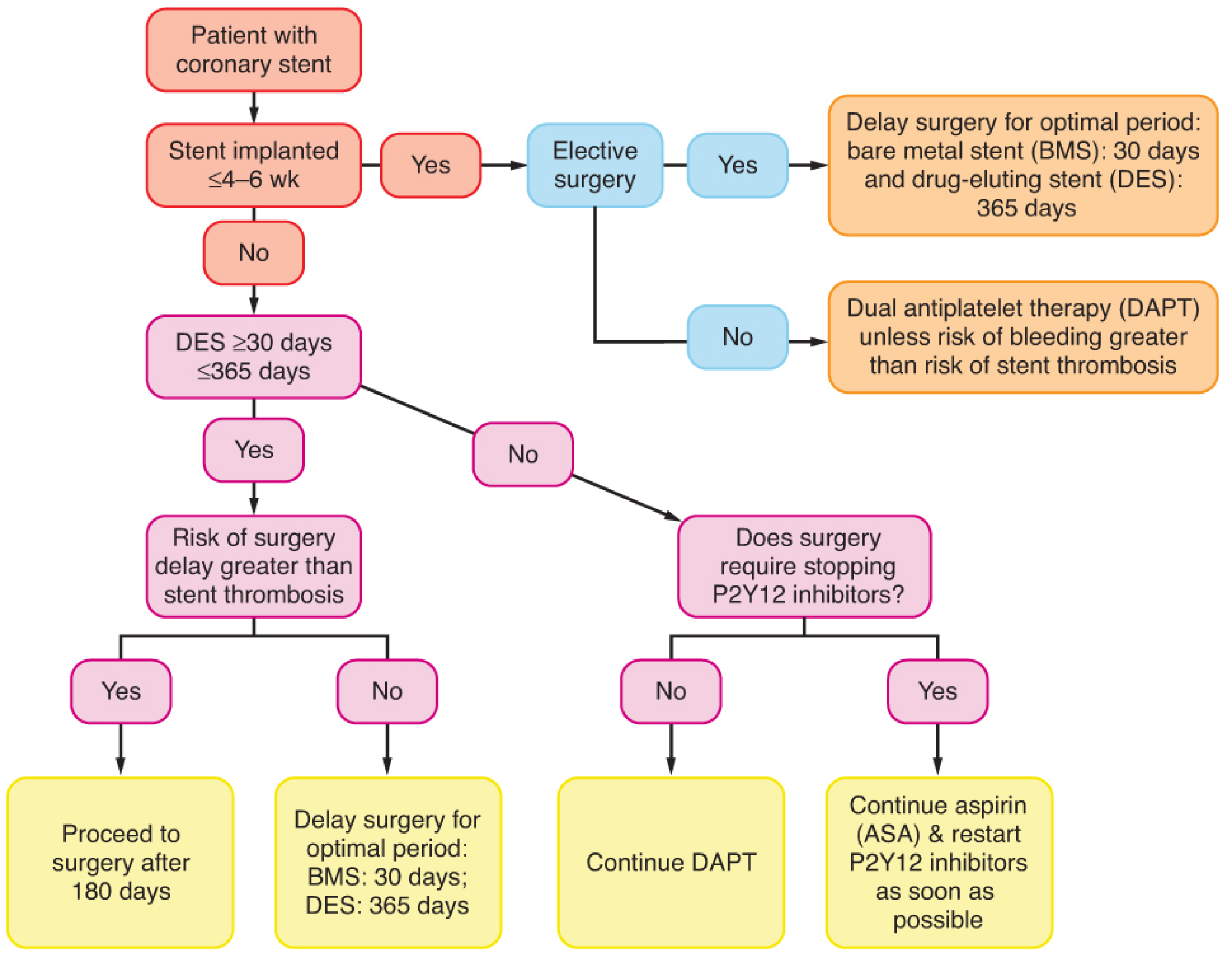
| Drug-Eluting Stent (DES) | 12 months (6 months if risk of delay > risk of MACE) |
Coronary stent placement within 1 year of noncardiac surgery is an independent risk factor for perioperative MACE and bleeding. Early surgery after DES is dangerous due to stent thrombosis risk from premature discontinuation of DAPT in the setting of non-endothelialized stent surfaces. - Barash's Clinical Anesthesia, 9th Ed.
The flowchart below (from Barash) summarizes the perioperative approach:
B. Methods of Functional Capacity Assessment
Once the timing is appropriate, functional capacity is assessed using the following hierarchy (ACC/AHA, CCS, and ESC 2022 guidelines):
1. Subjective Clinical Interview (least accurate)
- Ask about daily activities and estimate METs
- Major limitation: sensitivity for detecting inability to achieve ≥4 METs is only 19% (specificity 95%) - Miller's Anesthesia, 10th Ed.
- Structured questions are better: "Can you climb two flights of stairs?" or "Can you walk four blocks?"
- Inability to climb a flight of stairs (~4 METs) predicts a postoperative cardiopulmonary complication with 89% accuracy
2. Validated Questionnaires (preferred structured approach)
- DASI (Duke Activity Status Index): 12-item self-administered questionnaire; DASI score ≤25 correlates with significantly increased risk of postoperative MI and major complications
- MET-REPAIR questionnaire (MET: REvaluation for Perioperative cArdIac Risk): patients self-report activities from the previous month; the highest activity performed determines the estimated MET level
- Both correlate well with gold-standard CPET; ESC 2022 recommends these over unstructured interviews
3. Objective Exercise Testing
| Test | Threshold for High Risk |
|---|---|
| CPET (Gold Standard) | AT <11 mL/kg/min OR VO2 peak <15 mL/kg/min |
| 6-Minute Walk Test | Poor distance = elevated risk |
| Incremental Shuttle Walk Test | Failure to achieve 350 metres = high risk |
- CPET is recommended for stent patients undergoing high-risk surgery (major vascular, thoracic, abdominal)
- Resting LVEF is NOT a proxy for functional capacity - exercise capacity varies widely even among patients with similar LVEF
4. ACC/AHA Algorithm: The 4-MET Cut-Off
- ≥4 METs (moderate-to-excellent capacity) → Proceed to surgery; no further cardiac testing required
- <4 METs or unknown capacity → Consider stress testing or cardiac catheterization only if results will change management (e.g., revascularization, medical optimization, or choosing a non-surgical alternative)
ESC 2022 adds: For patients with known CVD, risk factors, or age ≥65 undergoing intermediate or high-risk surgery - mandates functional capacity assessment + ECG + cardiac biomarkers together, not functional capacity alone.
PART 3: Role of Cardiac Biomarkers in This Patient [4 marks]
Cardiac biomarkers in a patient with coronary stents serve roles in preoperative risk stratification, intraoperative/postoperative monitoring, and detecting perioperative myocardial injury (MINS).
A. Natriuretic Peptides - BNP and NT-proBNP (Preoperative Role)
Secreted by cardiac ventricles in response to wall stretch and ischemia. They measure a different patient characteristic than functional capacity (only slight-to-fair correlation between natriuretic peptides and exercise capacity). - Miller's Anesthesia
CCS (Canadian Cardiovascular Society) Guidelines recommend BNP/NT-proBNP for preoperative risk stratification when RCRI score is ≥1:
| Biomarker | Low Cardiac Risk | Elevated Cardiac Risk |
|---|---|---|
| BNP | <100 pg/mL | >250 pg/mL |
| NT-proBNP | <100 pg/mL | >200 pg/mL |
- Natriuretic peptides improve risk estimation beyond clinical risk factors alone (RCRI)
- AHA/ACC 2014: BNP measurement is not yet formally recommended as routine; no BNP-based management strategy has been proven to reduce cardiovascular risk in RCTs
- ESC 2022: Recommends preoperative high-sensitivity troponin AND natriuretic peptides for any patient with known CVD or risk factors undergoing intermediate/high-risk surgery - used to trigger echocardiography and stress imaging if elevated
B. Troponin - Preoperative and Postoperative Roles
Preoperative:
- AHA/ACC: Measure troponin only when signs or symptoms suggest myocardial ischemia; routine screening of asymptomatic patients is not recommended
- ESC 2022: Recommends high-sensitivity troponin preoperatively in patients with CVD, risk factors, or age ≥65 undergoing intermediate/high-risk surgery as part of a bundle assessment
Postoperative (CCS Guidelines - Highest Yield):
- Routine troponin surveillance for 48-72 hours postoperatively is recommended for patients not classified as low cardiac risk by preoperative BNP/NT-proBNP
- Myocardial injury after noncardiac surgery (MINS) - troponin elevation even without symptoms - is associated with a significant increase in 30-day mortality
- Peak troponin elevation occurs 1-2 days after surgery, and the majority of patients with perioperative myocardial injury are asymptomatic
C. Special Considerations in Stent Patients
- Perioperative hypercoagulability from surgical stress in the setting of non-endothelialized stent surfaces drives the elevated risk of MACE
- Postoperative MI may present as silent troponin leak (no chest pain) due to analgesia and sedation - making troponin surveillance even more critical
- If surgery must be performed on DAPT, the risk of stent thrombosis vs. bleeding must be individualized; at minimum, aspirin should be continued perioperatively
- P2Y12 inhibitors (clopidogrel, ticagrelor) - if stopped, restart as soon as possible postoperatively
- For nonelective surgery, a multidisciplinary consensus among the anesthesiologist, surgeon, cardiologist, and intensivist is mandatory - Barash's Clinical Anesthesia, 9th Ed.
Summary Table: Biomarkers in a Stent Patient
| Biomarker | When | Purpose |
|---|---|---|
| BNP / NT-proBNP | Preoperative | Risk stratification; low BNP allows proceeding without further testing |
| hs-Troponin | Preoperative (ESC 2022) | Identifies elevated baseline risk; guides echocardiography referral |
| Troponin | Postoperative (48-72 h) | Detects MINS; asymptomatic elevation still predicts 30-day mortality |
(Miller's Anesthesia, 10th Ed.; Barash's Clinical Anesthesia, 9th Ed.; Fuster and Hurst's The Heart, 15th Ed.; Harrison's 22nd Ed.)
This is a shared conversation. Sign in to Orris to start your own chat.