
Nephrotic syndrome
Reading File
Researching nephrotic syndrome across etiology, clinical presentation, diagnosis, management, and associated imaging/histology.
search_medical_text
nephrotic syndrome etiology pathophysiology clinical features diagnosis
Harrison's Principles of Internal Medicine, Twenty First Edition
Page 8392
search_medical_text
nephrotic syndrome management treatment complications
Harrison's Principles of Internal Medicine, Twenty First Edition
Page 8592
GradeResponse
GradeResponse
GradeResponse
Here is a comprehensive overview of nephrotic syndrome:
Nephrotic Syndrome
Definition
Nephrotic syndrome (NS) is defined by the triad of:
- Proteinuria >3.5 g/day (or >3.5 g/1.73 m²/day)
- Hypoalbuminemia (<3.5 g/dL)
- Edema
Frequently accompanied by hyperlipidemia (high LDL, low HDL) and lipiduria (Harrison's, p. 8392).
Etiology
Primary (Idiopathic) Glomerulopathies
| Disease | Key Feature | Common Age |
|---|---|---|
| Minimal Change Disease (MCD) | No light microscopy changes; effacement of foot processes on EM | Children (most common) |
| Focal Segmental Glomerulosclerosis (FSGS) | Segmental scarring of glomeruli | Adults; African Americans |
| Membranous Nephropathy | Subepithelial immune deposits; "spike and dome" on EM | Adults (most common primary NS in adults) |
| Membranoproliferative GN (MPGN) | Mesangial proliferation + GBM thickening | Adolescents/young adults |
Secondary Causes
- Diabetes mellitus — diabetic nephropathy (most common secondary cause worldwide)
- Systemic lupus erythematosus (SLE) — lupus nephritis (especially class V)
- Amyloidosis — AL or AA type
- Infections — HBV, HCV, HIV, malaria, syphilis
- Drugs — NSAIDs, gold, penicillamine, heroin
- Malignancy — solid tumors (membranous), lymphoma (MCD)
- Preeclampsia
Pathophysiology
- Glomerular injury → loss of the glomerular filtration barrier (charge and/or size selectivity)
- Massive proteinuria (especially albumin) → hypoalbuminemia
- Reduced oncotic pressure → fluid shifts into interstitium → edema
- Compensatory hepatic lipoprotein synthesis → hyperlipidemia
- Loss of lipoproteins in urine → lipiduria
- Loss of regulatory proteins → hypercoagulable state (loss of antithrombin III, proteins C and S), increased infection risk (loss of IgG, complement factors), thyroid/endocrine abnormalities
Clinical Features
| Feature | Description |
|---|---|
| Edema | Periorbital (especially morning), pedal, ascites, pleural effusion |
| Frothy urine | Due to heavy proteinuria |
| Pallor | From edema/anemia |
| Signs of complications | DVT/PE, infections, cushingoid features (if on steroids) |
Urinalysis findings:
- Heavy proteinuria (3–4+ on dipstick)
- Oval fat bodies — large tubular epithelial cells engulfed with lipid
- Maltese crosses under polarized light (cholesterol monohydrate crystals)
- Fatty casts
Diagnosis
Initial Workup
- Urine dipstick + microscopy — proteinuria, oval fat bodies, fatty casts
- Spot urine protein:creatinine ratio — >3.5 mg/mg indicates nephrotic-range proteinuria
- 24-hour urine protein — gold standard (>3.5 g/day)
- Serum albumin, lipid panel, BMP/CMP
- Secondary cause workup: ANA, anti-dsDNA, complement (C3/C4), hepatitis B/C serology, HIV, HbA1c, serum protein electrophoresis, cryoglobulins
Kidney Biopsy
Indicated in adults with NS of unclear etiology. Not routinely done in children (MCD presumed and treated empirically with steroids).
Histological patterns:
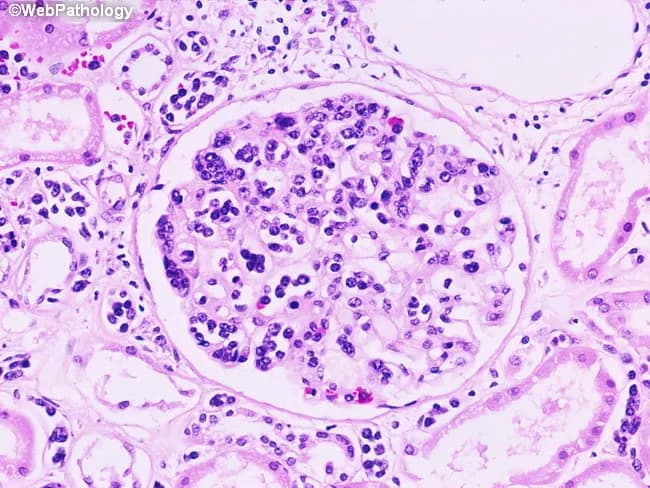
- Light microscopy (LM) — MCD appears normal; FSGS shows segmental sclerosis; membranous shows GBM thickening
- Immunofluorescence (IF) — granular IgG + C3 deposits in membranous; "full house" in lupus
- Electron microscopy (EM) — foot process effacement (all causes), subepithelial deposits (membranous), mesangial deposits (IgA/lupus)
Management
Disease-Specific Therapy
(Harrison's, p. 8592)
| Cause | Treatment |
|---|---|
| MCD | Prednisone (first-line); cyclophosphamide or calcineurin inhibitors for frequent relapse |
| FSGS | High-dose steroids; tacrolimus/cyclosporine for steroid-resistant |
| Membranous | Conservative first; rituximab (now preferred); cyclophosphamide + steroids (Ponticelli) |
| Diabetic nephropathy | ACE inhibitor/ARB; SGLT-2 inhibitors; glycemic control |
| Lupus nephritis | Mycophenolate mofetil + steroids; belimumab/voclosporin for resistant disease |
Supportive Therapy (All Patients)
- Edema — sodium restriction (<2 g/day); loop diuretics (furosemide); avoid aggressive diuresis (risk of intravascular depletion)
- Hyperlipidemia — statins (HMG-CoA reductase inhibitors); all patients with hypercholesterolemia secondary to NS should be treated due to elevated cardiovascular risk (Harrison's, p. 8592)
- Proteinuria reduction — ACE inhibitors or ARBs (reduce intraglomerular pressure and proteinuria, independently of BP)
- Anticoagulation — for venous thromboembolism prophylaxis/treatment; serum albumin <2.5 g/dL is a major risk factor, especially in membranous nephropathy
- Infection prevention — pneumococcal vaccine; immunoglobulin replacement in refractory cases
Complications
| Complication | Mechanism |
|---|---|
| Thromboembolic events (DVT, PE, renal vein thrombosis) | Loss of antithrombin III, protein C/S; platelet hyperactivation |
| Infections (peritonitis, cellulitis, sepsis) | Loss of IgG and complement (opsonins); edema as culture medium |
| Acute kidney injury | Hypovolemia from aggressive diuresis; bilateral renal vein thrombosis |
| Dyslipidemia / accelerated atherosclerosis | Increased hepatic VLDL synthesis; decreased lipoprotein lipase activity |
| Endocrine abnormalities | Loss of thyroid-binding globulin → low total T4 (free T4 normal) |
| Vitamin D deficiency | Loss of vitamin D-binding protein |
| Protein malnutrition | Ongoing urinary protein losses |
Nephrotic vs. Nephritic Syndrome
| Feature | Nephrotic | Nephritic |
|---|---|---|
| Proteinuria | >3.5 g/day | <3.5 g/day (mild-moderate) |
| Hematuria | Absent or minimal | Prominent (RBC casts) |
| Hypertension | Mild or absent | Common |
| Edema | Marked | Mild-moderate |
| Serum complement | Normal (except MPGN, lupus) | Often low |
| Renal function | Usually preserved initially | Often reduced |
Prognosis
Depends heavily on the underlying cause:
- MCD: Excellent — >90% respond to steroids; tendency to relapse in children
- Membranous: ~30% spontaneous remission; ~30% progress to ESRD; rituximab improves outcomes
- FSGS: Poor without treatment; high rate of progression to ESRD, especially steroid-resistant forms
- Diabetic nephropathy: Progressive without aggressive management; SGLT-2 inhibitors (empagliflozin, dapagliflozin) have changed the prognosis significantly
This is a shared conversation. Sign in to Orris to start your own chat.