
Clubbing 4th stage
Reading File
Quick answer: Digital clubbing is graded using Schamroth's sign and a 5-stage classification (Grades 0-4). Grade 4 (the most advanced stage) is characterized by marked drumstick deformity of the digit, loss of the normal angle at the nail base, periosteal new bone formation, and sometimes hypertrophic osteoarthropathy.
Searching sources...
Finding Sources
Finding Sources
Reading File
Finding Sources
Finding Sources
Finding Sources
Reading File
Reading File
Finding Sources
Loading Image
Searching the Web
clubbing finger stages grading system grade 4 clinical features
Here is a complete breakdown of digital clubbing, focusing on Grade/Stage 4:
Digital Clubbing - Grading System
The most widely used clinical grading system has 4 grades:
| Grade | Features |
|---|---|
| Grade 1 | Nail bed fluctuation (increased sponginess/bogginess of the nail bed) |
| Grade 2 | Obliteration of the Lovibond angle (the angle between the proximal nail fold and the nail plate becomes ≥180°) |
| Grade 3 | Parrot beaking - the nail curves downward over the bulbous fingertip, giving a "drumstick" or "parrot beak" appearance; positive Schamroth sign |
| Grade 4 | Hypertrophic Osteoarthropathy (HOA) - the most advanced stage |
Grade 4 Clubbing - Hypertrophic Osteoarthropathy (HOA)
Grade 4 is characterized by extension of the pathological process beyond the nail and soft tissue, to involve the periosteum and skeleton:
Local (digit) features:
- Marked drumstick/parrot beak deformity of the finger and toe tips
- Nail is large, rounded like a watch glass, curved in both the longitudinal and transverse directions
- Enlarged lunula
- Complete obliteration of the Lovibond angle (>180°)
- Positive Schamroth sign (no diamond-shaped window when dorsal surfaces of opposing fingers are placed together)
- Soft tissue of the terminal phalanx is bulbous and mobile on pressure
- Periosteal new bone formation in the phalanges, metacarpals, distal ulna and radius
Systemic (HOA) features:
- Painful periosteal proliferation of long bones (radius, ulna, tibia)
- Arthralgia or joint effusions at ankles, knees, wrists
- Warmth, redness, or brawny edema over the distal long bones (especially the shins)
- Exquisite tenderness of feet, legs, hands, and forearms
- Peripheral neurovascular features: cyanosis, hyperhidrosis, paresthesias, muscle weakness
- Mild fever may accompany
- Symptoms worsen at night and with dependency
Typical underlying cause of Grade 4/HOA:
- Most often seen in men with bronchogenic carcinoma
- Also in other pulmonary malignancies and pleural tumors
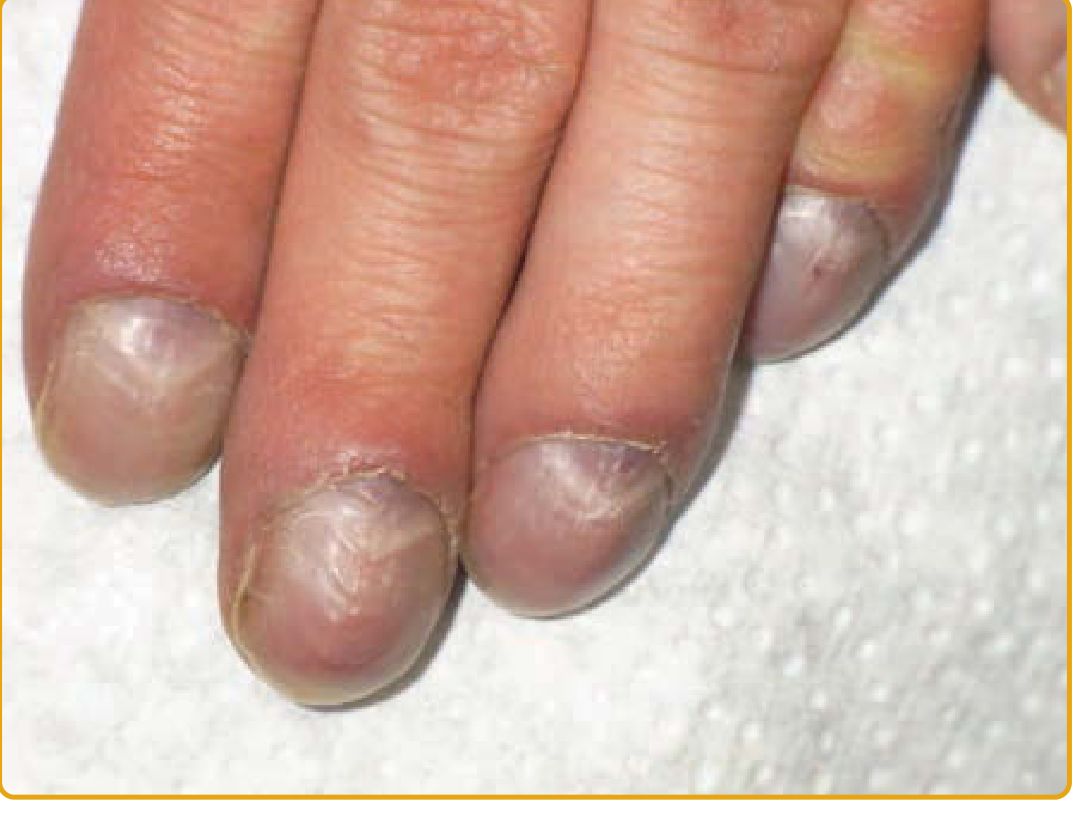
Clubbing in a patient with trisomy 21 and Eisenmenger complex - note the bulbous, rounded fingertips with exaggerated nail curvature (Fitzpatrick's Dermatology)
Key Clinical Tests to Confirm Clubbing
- Lovibond angle >180° (normal ~160°) - definitive clubbing
- Schamroth sign: no diamond-shaped window when opposing fingers are placed together; angle between free nail margins >30°
- Profile sign: the base-to-tip ratio of the digit is increased
- Floating nail sign: nail bed bounces under pressure (earliest sign, Grade 1)
Important Points
- Acquired clubbing is associated with pulmonary disease in ~80% of cases
- Secondary HOA (Grade 4) may precede clinical features of the causative disease by months
- Periostitis with new bone formation is what distinguishes Grade 4 from lower grades - visible on plain X-ray
- Treatment of the underlying cause (e.g., resection of lung cancer) can lead to regression of clubbing if caught early; once chronic collagen deposition occurs, reversal is unlikely
Sources: Andrews' Diseases of the Skin, 13e | Fitzpatrick's Dermatology, 9e | Dermatology 2-Volume Set, 5e | IJCDW - Grading of Clubbing | NCBI Clinical Methods - Clubbing
This is a shared conversation. Sign in to Orris to start your own chat.