

What is dermatological diagnosis?
Reading File
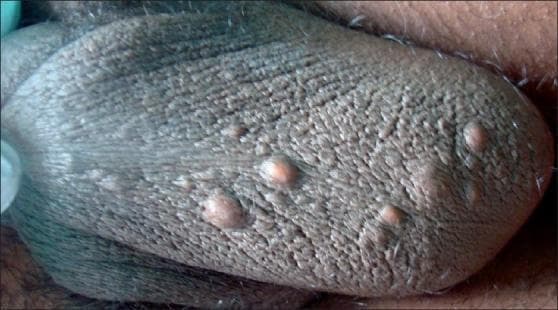
I will research the dermatological findings visible in this image — multiple smooth, dome-shaped papules and nodules on scrotal skin — to provide a diagnosis.
search_medical_image
multiple smooth dome-shaped papules nodules scrotal skin
Hugging Face pmc clinical VQA raw
Page 0
search_medical_text
multiple scrotal nodules papules pedunculated skin tag fibroma diagnosis
Paediatric Urology
Page 21
GradeResponse
GradeResponse
search_medical_text
steatocystoma multiplex clinical features diagnosis treatment
GradeResponse
Diagnosis: Steatocystoma Multiplex (SM)
The image shows multiple smooth, dome-shaped, skin-colored to tan papules and nodules of varying sizes (roughly 2–15 mm) distributed across the scrotal skin, consistent with Steatocystoma Multiplex.
What is Steatocystoma Multiplex?
Steatocystoma Multiplex is a benign dermatosis characterized by multiple cysts originating from the sebaceous duct epithelium. These cysts contain a yellowish, oily or creamy fluid (sebum).
| Feature | Details |
|---|---|
| Origin | Sebaceous duct cysts |
| Inheritance | Can be sporadic or autosomal dominant (KRT17 gene mutations) |
| Common sites | Scrotum, axillae, chest, upper arms, face |
| Contents | Oily/sebaceous material |
| Surface | Smooth, dome-shaped, non-tender |
| Associated conditions | Pachyonychia congenita (when KRT17 is mutated) |
Key Clinical Features (as seen in this image)
- Multiple soft, round nodules — distinguishes it from solitary sebaceous cysts
- Skin-colored to tan/yellowish hue
- Smooth, dome-shaped surface with no punctum (unlike epidermoid cysts, which have a central punctum)
- Scrotal distribution — one of the most common sites
- Generally asymptomatic, but can become inflamed or infected
Differential Diagnoses to Consider
| Condition | Distinguishing Features |
|---|---|
| Epidermoid cysts | Usually fewer, have a central punctum, contain cheesy keratin |
| Fordyce spots | Tiny (1–2 mm) yellowish papules, superficial ectopic sebaceous glands |
| Scrotal calcinosis | Hard, calcified nodules; chalky-white contents on excision |
| Angiokeratoma of Fordyce | Dark red/purple, vascular, associated with varicosities |
| Lipoma | Deeper, softer, larger; uncommon on scrotum |
Management Options
- Conservative (observation) — appropriate if asymptomatic and no cosmetic concern
- Surgical excision — for symptomatic, infected, or cosmetically bothersome cysts
- Radiofrequency ablation — minimally invasive; commonly used for scrotal SM
- CO₂ laser ablation — effective for multiple lesions
- Incision and drainage — for acutely inflamed/infected cysts (not curative)
- Oral isotretinoin — may reduce new cyst formation in selected cases
Clinical note: This is a benign condition. No malignant transformation has been reported. However, a dermatologist or urologist should confirm the diagnosis clinically or histologically (if there is any doubt), especially to rule out scrotal calcinosis or paratesticular tumors.
This is a shared conversation. Sign in to Orris to start your own chat.