
Confounding and effect modifier explanation -psm topic
I'll read the medical library skill first, then search for confounding and effect modification content.
Reading File
Now let me search the library for confounding and effect modification - PSM (Preventive & Social Medicine / Epidemiology) topic:
Finding Sources
Finding Sources
Finding Sources
Finding Sources
Park's Textbook of Preventive and Social Medicine is in the library. Let me search it specifically for confounding and effect modification:
Finding Sources
Finding Sources
Excellent! I found very relevant sections. Let me read the key sections from Rheumatology (which has excellent epidemiology chapters), Dermatology, and the Harriet Lane Handbook:
Reading File
Reading File
Reading File
Now let me read the full confounding section from the Rheumatology book (which has the best epidemiology content) and also the Dermatology effect modifier content, plus fetch the confounding diagram:
Reading File
Reading File
Loading Image
Now let me also read the confounding definition section from Rheumatology and fetch the effect modifier diagram:
Reading File
Loading Image
Now let me also read the key definition section on confounding from Rheumatology and the Park's PSM book for the specific PSM angle:
Finding Sources
Reading File
Now let me read the Park's PSM confounding content:
Reading File
I now have comprehensive material from multiple authoritative textbooks. Let me compile a thorough, well-organized answer.
Confounding and Effect Modification (Effect Modifier) - PSM / Epidemiology
CONFOUNDING
Definition
A confounder is a third variable that distorts the observed association between an exposure and an outcome. It is a source of bias in non-randomized (observational) studies.
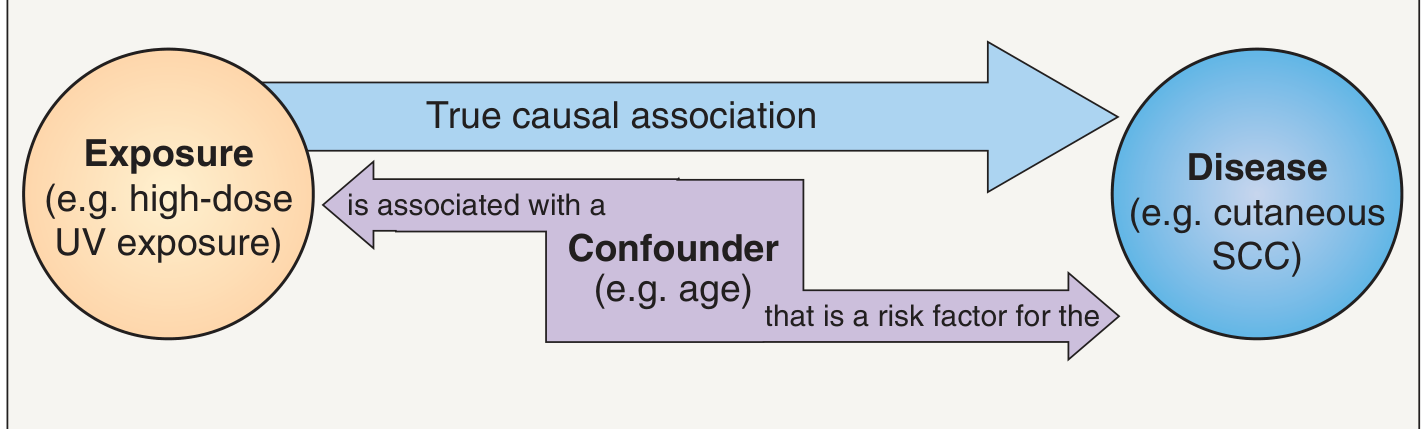
Fig: Confounding - the blue arrow = true causal association; the purple path = spurious apparent association due to the confounder.
The Three Mandatory Criteria for a Confounder
A variable must satisfy ALL THREE criteria simultaneously:
| Criterion | Explanation |
|---|---|
| 1. Associated with the exposure | It is related to the exposure (risk factor) being studied |
| 2. Associated with the outcome | It is an independent risk factor for the disease/outcome |
| 3. NOT on the causal pathway | It is not an intermediate step between exposure and outcome (i.e., not a mediator) |
"A confounder is a factor that is (1) associated with the exposure, (2) associated with the outcome independent of exposure, and (3) not on the pathway between exposure and outcome." -- Firestein & Kelley's Textbook of Rheumatology
Classic Example
- Study question: Does high-dose UV exposure cause cutaneous squamous cell carcinoma (SCC)?
- Confounder: Age - older people spend more time outdoors (associated with UV exposure) AND are at higher risk of SCC (independent risk factor), but age is not in the causal pathway between UV and SCC.
- Result: A crude (unadjusted) association may overestimate or underestimate the true UV-SCC relationship because of this age confounding.
PSM Classic Example (Park's Textbook)
In a study of alcohol and lung cancer: smoking is a classic confounder because:
- Smokers tend to drink more (associated with exposure = alcohol)
- Smoking causes lung cancer (independent risk factor for outcome)
- Smoking is not on the causal pathway between alcohol and lung cancer
So apparent alcohol-lung cancer association may partly or fully reflect confounding by smoking.
Types of Confounding
| Type | Description |
|---|---|
| Measured confounding | The confounder is identified and measured - can be adjusted for |
| Residual confounding | Confounder is imperfectly measured; adjustment is incomplete |
| Unmeasured confounding | Confounder not measured at all ("known unknown" or "unknown unknown") |
| Confounding by indication | The indication for a treatment is itself a risk factor for the outcome (channeling bias) - common in drug studies |
How to Detect Confounding
Rule of thumb (Change-in-Estimate method):
$$\text{Magnitude of confounding} = \frac{|\text{RR}{crude} - \text{RR}{adjusted}|}{\text{RR}_{crude}} \times 100$$
- If this value is ≥ 10%, confounding is likely present
- Example: Crude RR = 1.05, Adjusted RR = 2.01 → magnitude = ~91% → strong confounding present
Note: There is no statistical test for confounding - it is assessed by the change-in-estimate approach.
Methods to Control Confounding
At the Design Stage:
| Method | How it works |
|---|---|
| Randomization | Randomly allocates participants to groups, theoretically balancing both measured and unmeasured confounders - the gold standard |
| Restriction / Specification | Limit the study to only one level of the confounder (e.g., only women, only non-smokers). Reduces sample size. |
| Matching | Match cases to controls (or exposed to unexposed) on potential confounders (e.g., age-matched, sex-matched). Often used in case-control studies. Frequency matching (multiple controls per case) preserves power. |
Park's PSM Note: "Bias due to confounding can be removed by matching in case-control studies."
At the Analysis Stage:
| Method | How it works |
|---|---|
| Stratification | Analyze the exposure-outcome association separately in each stratum of the confounder; then pool using Mantel-Haenszel method |
| Multivariable regression | Include confounder(s) as covariates in regression model |
| Propensity score methods | Use logistic regression to estimate probability of exposure given baseline characteristics; can be used for matching, stratification, or weighting (IPTW) |
| Marginal structural models | Handle time-varying confounders in longitudinal data |
| Instrumental variables | Use a variable associated with exposure but not directly with outcome to estimate causal effect |
EFFECT MODIFICATION (Effect Modifier)
Definition
An effect modifier (also called moderator or interaction variable) is a variable that changes the magnitude or direction of the association between the exposure and the outcome across its different levels (strata).
- Unlike confounding, effect modification is a real biological phenomenon - it is NOT a bias
- It is not something to be removed - it should be reported by stratification
- It can be statistically measured (unlike confounding, which cannot be directly tested)
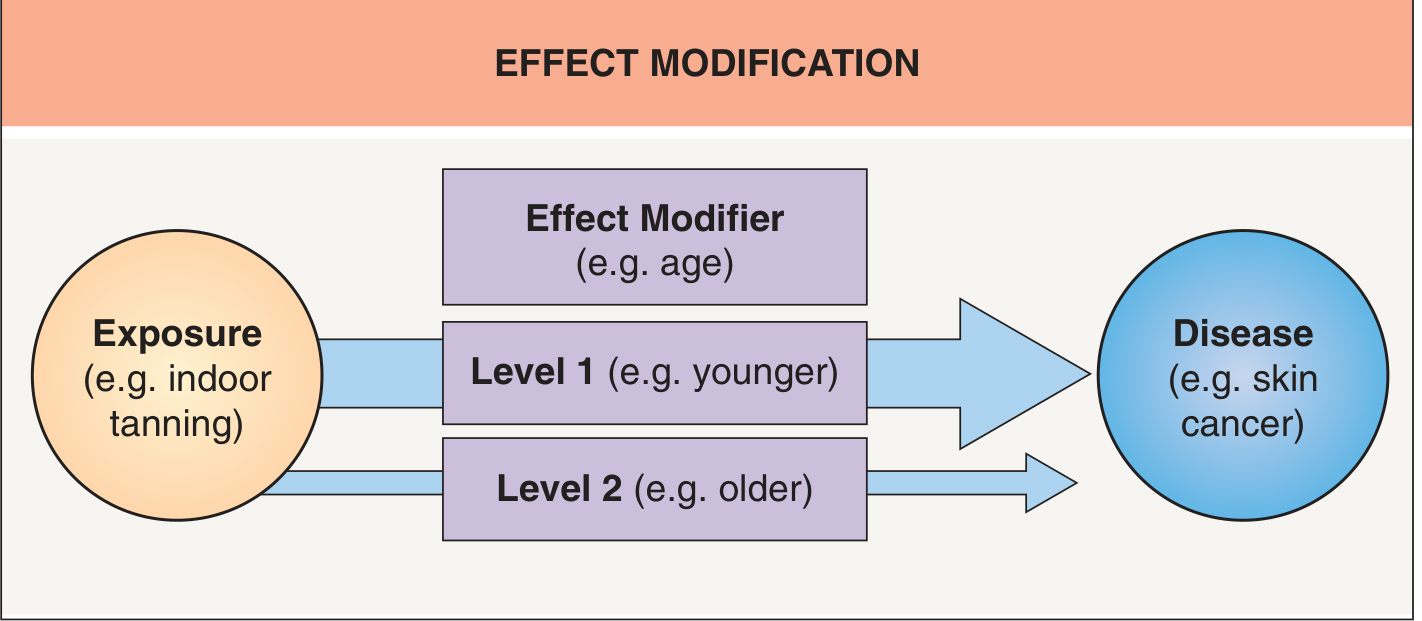
Fig: Effect modification - the thickness of the arrow varies at different levels of the effect modifier (e.g., age), reflecting a stronger association in younger vs. older persons.
How Effect Modification Manifests
Effect modification can be:
- Quantitative - associations in the same direction but different strength (e.g., RR = 3.0 in females vs. RR = 1.2 in males)
- Qualitative - associations in opposite directions across strata (e.g., protective in one group, harmful in another)
- Presence/absence - association present in one stratum, absent in another
Classic Example (from Dermatology textbook)
- Exposure: Indoor tanning
- Disease: Skin cancer
- Effect modifier: Age
- Finding: Women exposed to tanning beds in teenage/college years had HIGHER risk of BCC than those exposed later in life. Age modifies the exposure-disease relationship.
Another Clinical Example
- Studying TNFi (TNF inhibitor) use and risk of infections:
- RR in females = 3.0
- RR in males = 1.2
- Conclusion: Sex is an effect modifier for this exposure-outcome association
Effect Modification vs. Interaction - Distinction
| Feature | Effect Modification | Interaction |
|---|---|---|
| Symmetry | Asymmetric - the third variable modifies the effect of the exposure | Symmetric - two exposures jointly affect the outcome |
| Nature | One variable modifies the effect of another | Two variables have a joint effect beyond their individual effects |
| Example | Sex modifies the effect of a drug | Smoking interacts with anti-TNF therapy (smokers respond poorly - biological interaction) |
| Both | Can be assessed on multiplicative scale (RR, OR, HR) and additive scale (risk difference) |
KEY COMPARISON: Confounding vs. Effect Modification
| Feature | Confounding | Effect Modification |
|---|---|---|
| Nature | A bias / nuisance | A real biological phenomenon |
| Goal | To be controlled / eliminated | To be identified and reported |
| What to do? | Adjust for it (restrict, match, stratify, regression) | Stratify and report separately for each level |
| Statistical test? | No - assessed by change-in-estimate (≥10%) | Yes - Breslow-Day test for homogeneity |
| Effect on estimates | Makes crude estimate differ from adjusted estimate | Makes stratum-specific estimates differ from each other |
| Relationship with exposure | Associated with exposure AND outcome, NOT on causal pathway | Modulates the strength/direction of exposure-outcome association |
| On causal pathway? | Must NOT be | Irrelevant |
| Pooling strata? | After adjustment, pool to get summary estimate | Do NOT pool - report each stratum separately |
STRATIFICATION - The Common Approach for Both
When you stratify data by a third variable Z:
- If stratum-specific estimates ≈ each other AND differ from crude estimate → Confounding (Z is a confounder; pool the adjusted estimate)
- If stratum-specific estimates differ significantly from each other → Effect modification (Z is an effect modifier; present stratum-specific results)
- If stratum-specific estimates ≈ each other AND ≈ crude estimate → Neither (Z is neither)
MANTEL-HAENSZEL METHOD
Used in stratified analysis to:
- Calculate stratum-specific RR or OR
- Test for homogeneity across strata (Breslow-Day test)
- If homogeneous (no effect modification): calculate pooled Mantel-Haenszel summary estimate (removes confounding)
Memory Aid
Confounder = Complicates the picture - Control itEffect Modifier = Enhances understanding - Explain it (report it)
Sources:
- Firestein & Kelley's Textbook of Rheumatology (confounding definition, types, control methods, effect modification, Breslow-Day test)
- Dermatology 2-Volume Set 5e (effect modifier diagram, tanning bed example)
- Park's Textbook of Preventive and Social Medicine (confounding as bias in case-control studies, matching as control)
- Berek & Novak's Gynecology (confounder definition)
This is a shared conversation. Sign in to Orris to start your own chat.