
Code blue video presentation
Reading File
Searching for comprehensive Code Blue information to support a video presentation.
search_medical_text
Code Blue hospital cardiac arrest emergency response protocol
Recognizing and Responding to Clinical Deterioration Outside the ICU
Page 12
search_medical_text
CPR ACLS advanced cardiac life support resuscitation algorithm
Use of Advanced Airways, Vasopressors, and Extracorporeal Cardiopulmonary Resuscitation During Cardiac Arrest
Page 2
search_medical_image
Code Blue CPR cardiac arrest resuscitation algorithm

Hugging Face pmc clinical VQA raw
Page 0
GradeResponse
GradeResponse
GradeResponse
Here is a comprehensive outline and content for a Code Blue Video Presentation:
🔵 Code Blue: Hospital Cardiac Arrest Response
1. What Is a Code Blue?
A Code Blue is a hospital emergency code that signals a patient is in cardiopulmonary arrest — the heart and/or breathing has stopped — requiring immediate resuscitation by a trained team.
| Term | Meaning |
|---|---|
| Code Blue | Cardiac/respiratory arrest |
| Calling a Code | Activating the emergency response system overhead or via phone |
| Code Team | Physician, nurses, respiratory therapy, pharmacist, charge nurse |
2. Recognizing a Code Blue
Trigger criteria — call a Code Blue if the patient is:
- Unresponsive (no response to voice or sternal rub)
- Pulseless (no carotid pulse after 10 seconds)
- Apneic (not breathing or only gasping)
Golden rule: If in doubt, call it out. Early activation saves lives.
3. Initial Response: The First 2 Minutes
Any bedside responder should immediately:
- Call for help — activate Code Blue overhead (dial the emergency number)
- Start CPR — begin high-quality chest compressions without delay
- Get the crash cart — defibrillator/AED, medications, airway equipment
- Apply monitor/defibrillator pads as soon as available
4. BLS/CPR Training Steps
The following images illustrate the sequential BLS algorithm:
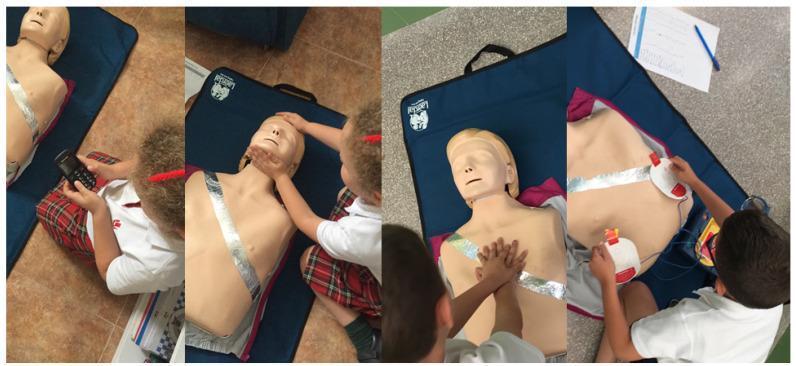
High-Quality CPR Components (AHA 2019 ACLS Guidelines):
| Parameter | Standard |
|---|---|
| Compression rate | 100–120 /min |
| Compression depth | ≥2 inches (5 cm) in adults |
| Chest recoil | Full recoil between compressions |
| Interruptions | Minimize — pause <10 seconds |
| Compression fraction | ≥60% of resuscitation time |
| Ventilation (with advanced airway) | 1 breath every 6 seconds (10/min) |
5. ACLS Algorithm Overview
Based on the AHA 2019 ACLS Guidelines (Use of Advanced Airways, Vasopressors, and Extracorporeal CPR During Cardiac Arrest, p. 2):
Shockable Rhythms (VF/pVT)
- CPR → Analyze rhythm → Shock (biphasic 200J)
- Resume CPR 2 min → Epinephrine 1 mg IV/IO every 3–5 min
- After 2nd shock → Amiodarone 300 mg IV (or Lidocaine 1–1.5 mg/kg)
- Treat reversible causes (H's and T's)
Non-Shockable Rhythms (PEA/Asystole)
- CPR → Epinephrine 1 mg IV/IO as soon as possible
- Resume CPR 2 min → Analyze → Repeat
- Treat reversible causes
6. The H's and T's — Reversible Causes
| H's | T's |
|---|---|
| Hypovolemia | Tension pneumothorax |
| Hypoxia | Tamponade (cardiac) |
| Hydrogen ion (acidosis) | Toxins/overdose |
| Hypo/Hyperkalemia | Thrombosis (pulmonary — PE) |
| Hypothermia | Thrombosis (coronary — MI) |
7. Team Roles During a Code Blue
| Role | Responsibility |
|---|---|
| Team Leader | Directs resuscitation, closed-loop communication |
| Compressor | Delivers chest compressions (rotate every 2 min) |
| Airway Manager | BVM ventilation → advanced airway (ETT/LMA) |
| IV/IO Access | Establishes access, draws labs |
| Pharmacist/Nurse | Prepares and administers medications |
| Recorder | Documents timeline, medications, interventions |
| Family Liaison | Communicates with family outside the room |
8. Post-Resuscitation Care (ROSC)
After Return of Spontaneous Circulation (ROSC):
- Targeted Temperature Management (TTM): 32–36°C for 24 hours in comatose patients
- 12-lead ECG: Rule out STEMI — activate cath lab if indicated
- Head CT: If neurological status unclear
- Hemodynamic support: Maintain MAP ≥65 mmHg
- Avoid hyperoxia/hypoxia: Target SpO₂ 94–98%
- Avoid hypercapnia/hypocapnia: Target PaCO₂ 35–45 mmHg
- Neurological prognostication: Begin at 72 hours post-arrest
9. Rapid Response Teams (RRT) — Preventing Code Blues
Research shows that Medical Emergency Teams (METs)/Rapid Response Systems significantly reduce the incidence of unexpected cardiac arrests and in-hospital mortality (Recognizing and Responding to Clinical Deterioration Outside the ICU, p. 12; Buist et al., BMJ 2002).
Early warning signs to trigger an RRT call (MEWS):
- Acute change in mental status
- RR <8 or >25/min
- SpO₂ <90% despite O₂
- SBP <90 mmHg
- HR <40 or >130/min
10. Key Takeaways for the Presentation
- Early recognition and immediate activation are the most critical steps
- High-quality, uninterrupted CPR is the backbone of survival
- Defibrillation within 3–5 minutes for shockable rhythms dramatically improves outcomes
- Clear team roles and closed-loop communication prevent errors
- Post-ROSC care is as important as the arrest management itself
Suggested Video Structure (10–15 min)
| Segment | Duration |
|---|---|
| Introduction: What is Code Blue? | 1–2 min |
| Recognition & Activation | 1–2 min |
| BLS/CPR demonstration | 2–3 min |
| ACLS algorithm walkthrough | 3–4 min |
| Team roles simulation | 2–3 min |
| Post-ROSC care | 1–2 min |
| Summary & Q&A | 1 min |
This outline covers the full spectrum from recognition to post-resuscitation care, aligned with AHA 2019 ACLS guidelines. Let me know if you need speaker notes, slides content, a specific section expanded, or a visual poster/diagram generated.
This is a shared conversation. Sign in to Orris to start your own chat.