
Toric contact lense Pg ophthalmology short question Standard book
Reading File
Finding Sources
Finding Sources
Finding Sources
Finding Sources
Finding Sources
Finding Sources
Toric Contact Lens
Definition:
A toric contact lens is a contact lens (soft or rigid) that has two different powers/curvatures in two perpendicular meridians, used to correct astigmatism in addition to the spherical refractive error (myopia/hypermetropia). Unlike a spherical lens (single power in all meridians), a toric lens has a spherocylindrical optical design.
Indication:
- Correction of astigmatism (regular, corneal or lenticular) where spectacle correction is not desired/feasible, or in cases of irregular astigmatism, anisometropia, keratoconus (early), or for cosmetic/occupational reasons.
Types:
- Rigid (hard) toric contact lenses - toric on the back surface (for high corneal astigmatism), front surface, or bitoric (both surfaces toric).
- Soft toric contact lenses - most commonly used; made of hydrogel/silicone hydrogel material with a cylindrical correction incorporated.
Problem unique to toric lenses - Stabilization/Rotation:
Because the lens has a specific cylinder axis that must align with the astigmatic axis of the eye, the lens must be prevented from rotating on the eye. This is achieved by special stabilization designs:
- Prism ballast - the lens is made thicker inferiorly (like a prism) so gravity and the lower lid keep the thick edge down, maintaining orientation.
- Truncation - the bottom edge of the lens is cut flat (truncated), which combined with lid pressure prevents rotation.
- Double slab-off (thin zone) design - thinner zones above and below the horizontal meridian, allowing the lids to hold the lens in position during blink.
- Peri-ballast designs.
Fitting consideration:
- Correct axis alignment is essential; the lens carries axis markings (usually at 6 o'clock or 3 and 9 o'clock) to allow the practitioner to judge on-eye rotation and adjust the prescribed cylinder axis (using the "LARS" rule - Left Add, Right Subtract - if the lens rotates, e.g., if it rotates 10 degrees to the patient's left/nasal side on right eye, add 10 to the axis ordered, and vice versa for rotation to the right).
Advantage over spectacle correction of astigmatism:
- Better/more natural retinal image size and reduced meridional magnification compared to a spectacle cylindrical lens, and wider field of view.
Disadvantage:
- More expensive, technically more difficult to fit, and any residual rotation causes blurred/distorted vision because the cylinder axis is off from the astigmatic axis.
This corresponds to the standard description found in ophthalmology texts (e.g., under "Contact Lenses" in AK Khurana's Comprehensive Ophthalmology), which is the typical "standard book" reference for PG exam short questions on this topic. Note: the in-house textbook library used here (Kanski's, Wills Eye Manual) covers toric intraocular lenses in detail for astigmatism correction during cataract/refractive surgery, but does not carry a dedicated contact-lens-optics chapter - the above answer reflects the standard optics/clinical teaching typically tested in PG ophthalmology exams.
If you want, I can also give you the toric IOL equivalent (used in cataract surgery) for comparison, since that is a closely related PG favorite topic.
With diagram
Searching Images
toric contact lens prism ballast design diagram astigmatism correction
Searching Images
toric intraocular lens axis markings diagram
query_images_db
Generating Image
A labeled medical diagram of a soft toric contact lens for astigmatism correction, showing prism ballast design (thicker inferior edge), truncated bottom edge, thin zones above and below, axis alignment markings at 6 o'clock, and a cross-section comparing a spherical lens versus a toric lens with two different curvatures in perpendicular meridians
Toric Contact Lens (with Diagram)
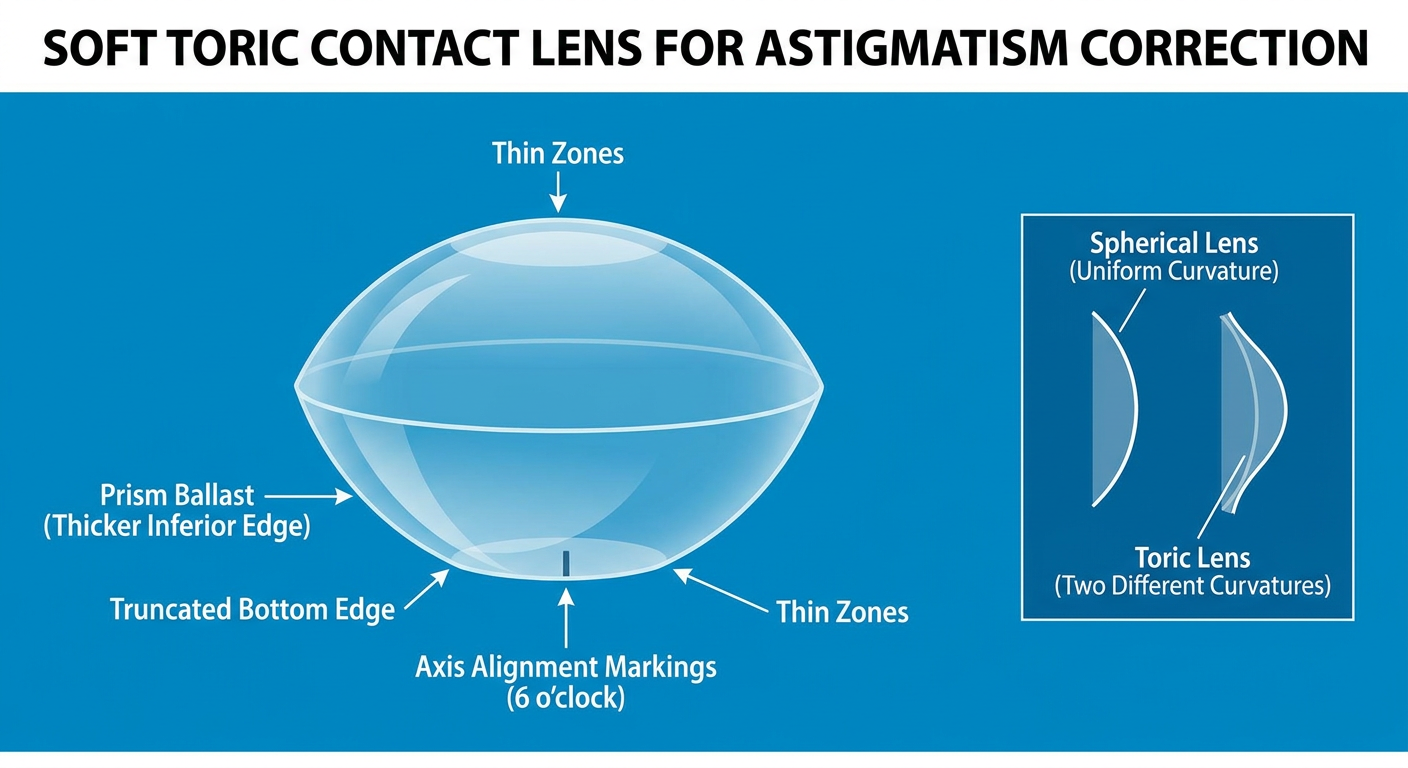
Definition:
A toric contact lens is a contact lens (soft or rigid) with two different powers/curvatures in two perpendicular meridians (spherocylindrical optics), used to correct astigmatism along with the underlying spherical error (myopia/hypermetropia).
Why a special design is needed:
An ordinary spherical lens has the same power in every meridian, so it can rotate freely on the eye without affecting vision. A toric lens, however, has a specific cylinder axis that must stay aligned with the eye's astigmatic axis - so the lens must be prevented from rotating.
Stabilization/design methods (shown in diagram):
- Prism ballast - the lens is molded thicker at the bottom edge (like a prism), so gravity plus lower lid pressure keeps the thick edge down and the lens rotationally stable.
- Truncation - the inferior edge of the lens is cut flat; combined with lid action this resists rotation.
- Double slab-off / thin-zone design - thin zones above and below the horizontal meridian let the upper and lower lids "grip" the lens during blink, locking orientation.
- Peri-ballast design - a variant combining ballast with peripheral thinning.
Axis markings:
Lenses carry reference marks (commonly at the 6 o'clock position, sometimes 3 and 9 o'clock) so the fitter can judge on-eye rotation.
Fitting rule for residual rotation - "LARS" rule:
- Left rotation -> Add the degrees of rotation to the ordered axis
- Right rotation -> Subtract the degrees of rotation from the ordered axis
Types:
- Soft toric contact lens (most common, hydrogel/silicone hydrogel)
- Rigid (hard) toric lens - back surface toric, front surface toric, or bitoric (both surfaces)
Advantages over spectacle cylindrical correction: more natural retinal image size, less meridional distortion, wider field of view.
Disadvantages: costlier, technically harder to fit, and any rotation on the eye causes blurred/distorted vision since the cylinder axis shifts away from the astigmatic axis.
Note: the medical-library textbooks available to me (Kanski's, Wills Eye Manual) go into good detail on toric intraocular lenses used in cataract/refractive surgery but do not carry a dedicated contact-lens-optics chapter with an illustration. The diagram above was generated to depict the standard prism-ballast/truncation design typically taught in PG ophthalmology texts (e.g., AK Khurana's Comprehensive Ophthalmology) for this exact short-question topic.
This is a shared conversation. Sign in to Orris to start your own chat.