
Explain myasthenia gravis
I'll start with a quick overview from memory, then pull from the medical library for a thorough, textbook-grounded answer.
Myasthenia gravis (MG) is an autoimmune neuromuscular junction disorder where antibodies (most commonly against acetylcholine receptors) block neuromuscular transmission, causing fatigable muscle weakness. It classically affects ocular, bulbar, and limb muscles, and is treated with acetylcholinesterase inhibitors and immunosuppression.
Searching sources...
Reading File
Now I'll search the library database and PubMed in parallel for comprehensive coverage.
Finding Sources
Searching PubMed
"myasthenia gravis"[MeSH Terms] AND treatment
The neurology textbook (Bradley and Daroff) has the most dedicated sections. I'll read the primary MG chapter alongside searching for pathophysiology details in parallel.
Reading File
Reading File
Finding Sources
Excellent. Now I'll read the comprehensive MG chapter from Bradley and Daroff block 29 (the main NMJ chapter) and the Goldman-Cecil and Harrison's sections for management/pathophysiology in parallel.
Reading File
Reading File
Reading File
I now have rich content from three authoritative sources. Let me read the diagnostics and crisis management sections from Bradley & Daroff, and also pull the pathophysiology image.
Reading File
Reading File
I have comprehensive material from the main MG chapter in Bradley & Daroff and Goldman-Cecil. I also have Harrison's on treatment. Let me fetch the key MG clinical image and also read the treatment/crisis section from Bradley & Daroff.
Loading Image
Reading File
I now have all the major sections I need. I also spotted that the truncated read includes critical crisis/thymectomy/novel biologic content. Let me do one final read to capture myasthenic crisis and emerging therapies.
Reading File
I have thorough coverage across all major domains. I can now compile the full, well-cited answer.
Myasthenia Gravis - A Comprehensive Overview
Definition
Myasthenia gravis (MG) is the most common primary disorder of neuromuscular transmission (NMT). Autoantibodies bind to proteins at the postsynaptic neuromuscular junction (NMJ) - most commonly the nicotinic acetylcholine receptor (AChR) - disrupting the conversion of nerve impulses into muscle fiber action potentials. The result is fatigable muscle weakness that worsens with activity and improves with rest.
- Bradley and Daroff's Neurology in Clinical Practice, p. 2770
Epidemiology
-
US prevalence: ~20/100,000 (approx. 60,000 patients)
-
Prevalence has increased over the past 50 years (better ascertainment, reduced mortality, aging population)
-
Sex and age pattern: Women are affected ~3x more often than men before age 40; incidence is higher in males after age 50; roughly equal during puberty
-
Today, the majority of US MG patients are over age 50 and more men are now affected than women overall
-
Bradley and Daroff's Neurology in Clinical Practice, p. 2770
Pathophysiology
The NMJ has no blood-nerve barrier, making it uniquely vulnerable to circulating immune factors. Three antibody mechanisms have been described:
| Antibody Target | Mechanism | Prevalence |
|---|---|---|
| AChR (alpha-1 subunit) | Complement activation destroying the postjunctional membrane; antigenic modulation (cross-linking + receptor internalization); direct functional blockade | ~85% of generalized MG |
| MuSK (muscle-specific kinase) | IgG4 antibodies inhibit clustering of AChRs on the postsynaptic surface | Up to 50% of AChR-negative generalized MG |
| LRP4 (lipoprotein receptor-related protein 4) | Interferes with signals maintaining NMJ integrity | Minority; less well understood |
| Seronegative | No detectable antibodies by standard testing | ~10% |
The net result is a reduced density of functional AChRs at the motor endplate. With repeated nerve stimulation, the normal presynaptic quantal release of ACh decrements against a shrinking pool of available receptors, producing the characteristic fatigable weakness.
The thymus is central to pathogenesis:
-
Early-onset MG (mostly women): thymic hyperplasia with active germinal centers suggests a thymus-initiated breakdown in immune tolerance
-
Thymoma-associated MG (~10-15% of patients): deficiency of the autoimmune regulatory protein AIRE leads to reduced regulatory T cells and increased autoreactivity
-
There is also a genetic component - ~5% of patients have an affected family member, with a heritability index of 0.65
-
Goldman-Cecil Medicine, p. 4111; Bradley and Daroff's Neurology in Clinical Practice
Clinical Presentation
Cardinal Features
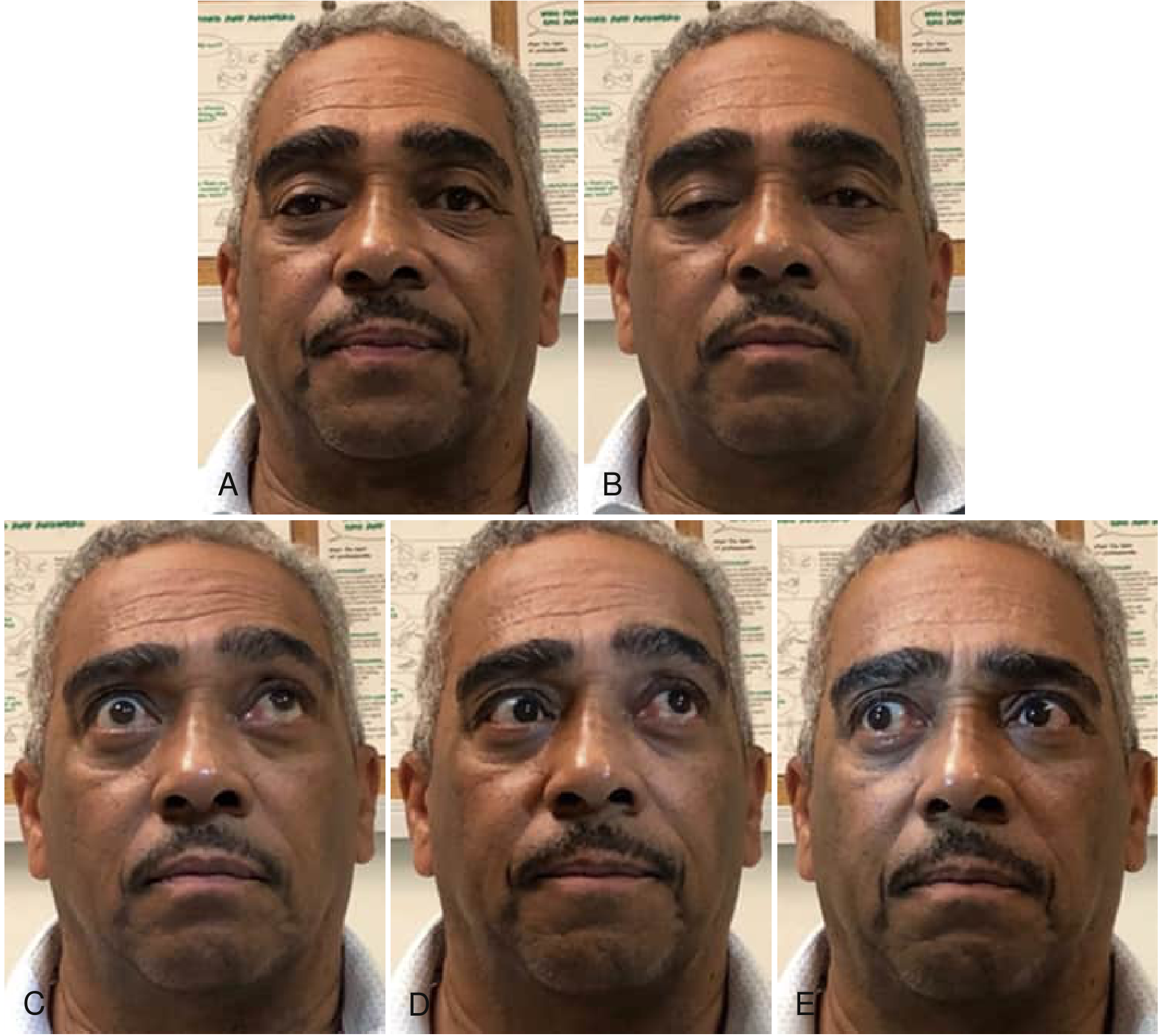
Fig: Ocular motility abnormalities in MG. A-B: Progressive right lid ptosis on sustained forward gaze. C: Incomplete superior movement on attempted upward gaze. D-E: Skew deviation and incomplete lateral gaze from multiple periocular muscle weakness. (Bradley and Daroff's Neurology in Clinical Practice)
- Ptosis and/or diplopia are the initial symptoms in up to 85% of patients; nearly all develop both within 2 years
- Weakness worsens with activity and improves with rest; typically least severe in the morning
- Bulbar symptoms (dysphagia, dysarthria, jaw fatigue) affect up to 30% at onset
- Limb weakness (proximal > distal) occurs in ~10% at onset
- Respiratory muscles can be involved - leading to myasthenic crisis
Distribution Patterns by Subtype
| Subtype | Key Features |
|---|---|
| Ocular MG (OMG) | Confined to ocular muscles; 10-15% in Caucasians, up to 58% in Asian populations; if ocular only after 2 years, 90% chance it won't generalize |
| Early-onset generalized (EOMG) | Women, <50 y, AChR-Ab+, thymic hyperplasia |
| Late-onset generalized (LOMG) | Men, >50 y, AChR-Ab+, normal/atrophic thymus; anti-titin and anti-ryanodine receptor Abs common; more crises |
| MuSK-MG | Predominantly female; prominent bulbar/facial/neck/respiratory weakness; often muscle atrophy; may worsen with pyridostigmine |
| Thymoma-associated | Equal sex; peak onset ~50 y; striated muscle Abs common |
- Bradley and Daroff's Neurology in Clinical Practice, p. 2771-2774
Diagnosis
1. Clinical recognition: Fatigable weakness in a characteristic distribution - ptosis worsening on sustained upgaze, fatigable proximal limb weakness, bulbar findings.
2. Serological testing:
- AChR antibodies (binding, blocking, modulating) - positive in ~85% of generalized MG, ~50% of ocular MG
- MuSK antibodies - checked when AChR-Ab negative
- LRP4 antibodies - emerging test
3. Edrophonium (Tensilon) test: IV injection of this short-acting acetylcholinesterase inhibitor produces transient improvement in ocular or bulbar weakness; now less used due to cardiac risks.
4. Electrodiagnostic studies:
- Repetitive nerve stimulation (RNS): Decremental response (>10% decrement) at 3 Hz is characteristic
- Single-fiber EMG (SFEMG): Most sensitive test; increased "jitter" reflects variable NMJ transmission; required when RNS and antibodies are negative (especially in OMG)
5. Imaging:
-
CT or MRI of chest to detect thymoma or thymic hyperplasia - required in all newly diagnosed MG patients
-
Wills Eye Manual; Bradley and Daroff's Neurology in Clinical Practice; Goldman-Cecil Medicine
Myasthenic Crisis
A myasthenic crisis is respiratory failure from respiratory or oropharyngeal muscle weakness requiring ventilatory support. It is a medical emergency. Common triggers include:
- Infection (especially respiratory)
- Aspiration/dysphagia (precipitant in 56% of crises in one study)
- Medication errors or non-compliance
- Aminoglycosides, fluoroquinolones, beta-blockers, magnesium, neuromuscular blocking agents (all can worsen MG)
- Surgery, pregnancy, stress
Management requires ICU admission, ventilatory support, plasmapheresis or IVIg (begin before high-dose steroids to prevent early steroid-associated worsening), and treatment of the underlying trigger.
Treatment
Treatment is individualized by extent (ocular vs. generalized) and severity. The goal defined by the MG Foundation of America Task Force: "no symptoms or functional limitations from MG, with no more than mild side effects requiring no intervention."
1. Symptomatic: Cholinesterase Inhibitors (ChEIs)
- Pyridostigmine (Mestinon): 30-60 mg orally every 4-8 hours; first-line symptomatic therapy for most patients
- Inhibits acetylcholinesterase, increasing ACh availability at the NMJ
- Muscarinic side effects: nausea, diarrhea, cramps, increased secretions - can be managed with glycopyrrolate
- Caution: MuSK-MG patients may worsen with ChEIs
2. Short-term Immunotherapy (rapid but transient benefit)
- Plasma exchange (plasmapheresis): Removes circulating antibodies; response within days; used pre-operatively, pre-thymectomy, and in crisis
- IVIg: Comparable efficacy to plasma exchange; mechanism includes Fc receptor saturation and immune modulation; given as 2 g/kg over 2-5 days
3. Long-term Immunosuppression
| Agent | Mechanism | Notes |
|---|---|---|
| Prednisone | Broad immunosuppression | First-line; start low (15-25 mg/d) and increase to 50-60 mg/d; taper slowly once controlled; watch for early worsening |
| Azathioprine | Purine synthesis inhibition | RCT evidence; steroid-sparing; onset 12+ months; check TPMT enzyme; avoid with allopurinol |
| Mycophenolate mofetil (MMF) | Selective lymphocyte purine synthesis inhibition | 1000-1500 mg twice daily; widely used; teratogenic - stop 4 months before pregnancy |
| Cyclosporine | Calcineurin inhibitor (inhibits IL-2) | RCT evidence; limited by nephrotoxicity and drug interactions |
| Tacrolimus | Calcineurin inhibitor | Approved for MG in Japan; useful in refractory cases; less nephrotoxic than cyclosporine |
| Rituximab | Anti-CD20 B-cell depletion | Particularly effective in MuSK-MG; a 2025 Cochrane review (PMID: 40607605) assessed its evidence base |
| Cyclophosphamide | Alkylating cytotoxic agent | Reserved for refractory cases; RCT evidence for pulse IV dosing |
4. Thymectomy
- Recommended for all patients with thymoma
- Also recommended for AChR-Ab+ generalized MG patients aged 18-65, even without thymoma (MGTX trial evidence)
- Effect is gradual - maximal benefit may not appear for years
5. Novel Biologics (emerging/approved)
Recent network meta-analyses (PMID: 40346603, PMID: 39470879) have evaluated newer agents:
- Eculizumab (complement C5 inhibitor): FDA-approved for refractory generalized AChR-Ab+ MG
- Efgartigimod (FcRn antagonist): Reduces IgG antibody levels by blocking neonatal Fc receptor recycling; FDA-approved
- Rozanolixizumab, nipocalimab: Also FcRn antagonists under study
- Zilucoplan: Subcutaneous complement C5 inhibitor; FDA-approved 2023
These agents represent a mechanistic shift from broad immunosuppression to targeted pathway blockade.
- Bradley and Daroff's Neurology in Clinical Practice, pp. 2775-2790; Harrison's Principles of Internal Medicine 22E, p. 3674
Prognosis
The prognosis has dramatically improved in the past 50 years due to advances in ICU care and immunotherapy. With modern treatment:
- The majority of patients achieve minimal manifestation status or complete stable remission
- Mortality from MG itself is now rare in specialized centers
- Spontaneous remission occurs in a subset, more common in early-onset ocular MG
- Patients with thymoma have a more guarded prognosis related to the underlying neoplasm
Summary Table: MG vs. Lambert-Eaton (key differential)
| Feature | Myasthenia Gravis | Lambert-Eaton Myasthenic Syndrome |
|---|---|---|
| Antibody target | AChR / MuSK / LRP4 | VGCC (voltage-gated calcium channel) |
| Weakness pattern | Ocular, bulbar, proximal limb | Proximal limb (legs >> arms); spares ocular |
| Fatigability | Worsens with use | Improves transiently with brief exercise |
| Reflexes | Normal | Reduced, may augment after exercise |
| RNS | Decremental at low frequency (3Hz) | Incremental at high frequency (>10Hz) |
| Autonomic features | Absent | Common (dry mouth, constipation) |
| Association | Thymic disease | Small cell lung cancer (60%) |
Recent evidence note: A 2025 Cochrane systematic review (PMID: 40607605) examined rituximab specifically in MG, and a 2025 network meta-analysis (PMID: 40346603) compared novel biologics (complement inhibitors, FcRn antagonists) - both informing the rapidly evolving treatment landscape for generalized MG.
This is a shared conversation. Sign in to Orris to start your own chat.