
Hanging FM
Reading File
Searching for information on hanging fracture-dislocation mechanics and related injuries.
search_medical_text
hangman fracture C2 traumatic spondylolisthesis mechanism diagnosis management
Bailey and Love's Short Practice of Surgery 28th Edition
Page 418
search_medical_image
hangman fracture C2 bilateral pedicle fracture imaging
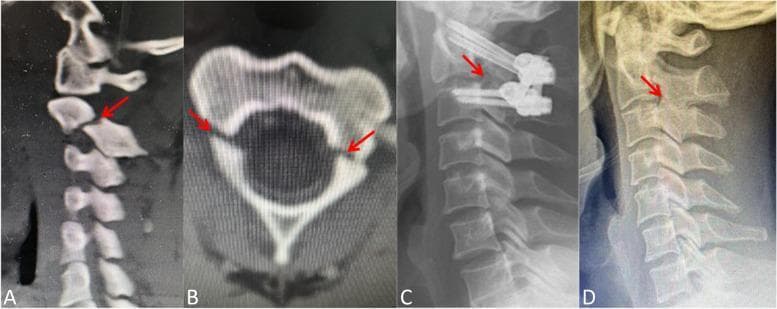
Hugging Face pmc clinical VQA raw
Page 0
GradeResponse
GradeResponse
Hangman's Fracture (Traumatic Spondylolisthesis of the Axis)
Definition & Mechanism
A Hangman's fracture is a bilateral fracture through the pars interarticularis (neural arch/pedicles) of C2, resulting in traumatic spondylolisthesis of C2 on C3. Despite its name — derived from judicial hanging, where the knot causes hyperextension and distraction — most modern cases result from:
- High-energy hyperextension + axial loading (e.g., motor vehicle collisions, diving accidents)
- The forces fracture both C2 pedicles, and the anterior body of C2 displaces anteriorly relative to C3
Classification: Levine-Edwards System
| Type | Description | Stability |
|---|---|---|
| I | Bilateral pedicle fractures, <3 mm displacement, no angulation | Stable |
| II | >3 mm displacement and/or >11° angulation at C2-C3 disc | Unstable |
| IIA | Minimal displacement but severe angulation (flexion-distraction mechanism) | Unstable |
| III | Displacement + unilateral or bilateral facet dislocation | Highly unstable |
Imaging
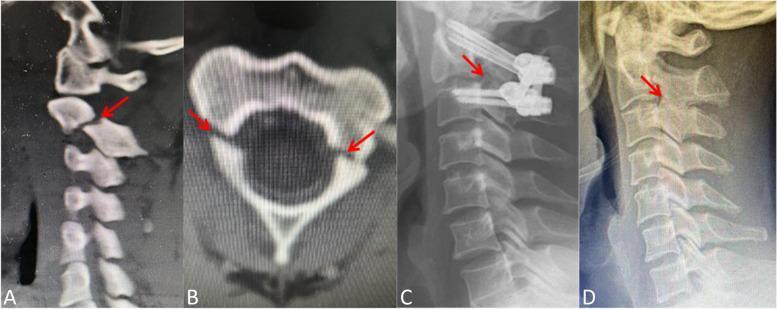
CT is the gold standard and typically shows:
- Bilateral fracture lines through the C2 pedicles/pars interarticularis
- Anterior displacement of the C2 body
- Disc space widening at C2-C3 in higher grades
The image below illustrates CT findings and postoperative outcomes:
Clinical Presentation
- Neck pain ± tenderness at C2 level
- Neurological deficits are paradoxically uncommon — the bilateral pedicle fractures actually decompress the spinal canal by expanding it
- Severe cases (Type III with facet dislocation) may present with myelopathy or radiculopathy
Management
(Bailey & Love's Short Practice of Surgery, 28th Ed., p. 418)
| Type | Treatment |
|---|---|
| Type I | Hard cervical collar (rigid immobilization) for 6–12 weeks |
| Type II | Halo-vest orthosis; operative if reduction fails |
| Type IIA | Traction contraindicated (worsens distraction); halo-vest or surgery |
| Type III | Operative — typically posterior C2-C3 stabilization with pedicle screws ± anterior fusion |
Surgical approaches include:
- Posterior C2-C3 fixation (pedicle screws + rods) — most common
- Anterior C2-C3 discectomy + fusion — for disc disruption
- Direct osteosynthesis of the C2 pedicles (screw fixation) — motion-preserving option for Type II
Prognosis
- Type I: Excellent — high union rates with conservative management
- Type II/IIA: Good with appropriate immobilization or fixation
- Type III: Variable; depends on degree of neurological compromise at presentation
- Spontaneous bony fusion at C2-C3 facet joints has been documented even after hardware removal (as shown in the imaging above)
Explain Hanging in forensic medicine
search_medical_text
hanging forensic medicine types mechanisms death findings
search_medical_text
hanging postmortem findings autopsy ligature mark signs asphyxia
Clinical Management of Non-Fatal Strangulation in Acute and Emergency Care Services
Page 2
GradeResponse
GradeResponse
The retrieval is limited here, so I'll provide a comprehensive answer from forensic medicine knowledge, supplemented by the retrieved source.
Hanging in Forensic Medicine
Hanging is defined as asphyxia caused by suspension of the body by a ligature around the neck, where the constricting force is the weight of the body itself (partial or complete). It is one of the three forms of strangulation — the others being ligature strangulation and manual strangulation (Clinical Management of Non-Fatal Strangulation, p. 2).
Classification
1. By Suspension
| Type | Definition |
|---|---|
| Complete hanging | Entire body weight suspended; feet off the ground |
| Incomplete (partial) hanging | Part of body weight acts; feet/knees touch the ground — most common in suicides |
Even as little as 2–4 kg of force is sufficient to compress the neck vessels, so complete suspension is not required for death.
2. By Intent
| Type | Features |
|---|---|
| Suicidal | Most common; typically incomplete suspension |
| Accidental | Children, autoerotic asphyxiation |
| Homicidal | Rare; victim usually incapacitated first |
| Judicial | Standardized drop method; causes fracture-dislocation of C2 (Hangman's fracture) |
Mechanism of Death
Death in hanging occurs through one or more of the following mechanisms:
- Asphyxia — compression of the trachea (requires ~15 kg) obstructs airflow
- Venous obstruction — jugular vein compression (~2 kg) impedes cerebral venous drainage → cerebral congestion and hypoxia
- Arterial obstruction — carotid artery compression (~5 kg) reduces cerebral blood supply
- Vagal inhibition (reflex cardiac arrest) — pressure on the carotid sinus/vagus nerve triggers bradycardia and cardiac arrest
- Spinal cord injury — in judicial/long-drop hanging; fracture-dislocation at C1-C2 or C2-C3 severs the cord
In judicial hanging (long-drop method), death is rapid due to cord transection. In suicidal/accidental hanging (short-drop), asphyxia and venous congestion predominate and death is slower.
Postmortem (Autopsy) Findings
External Findings
| Finding | Description |
|---|---|
| Ligature mark | Oblique, upward-directed, non-continuous furrow on the neck (does not encircle completely at the level of the knot); pale/brown parchment-like; situated above the thyroid cartilage |
| Groove characteristics | Width reflects ligature width; depth deeper at the sides, absent at the knot |
| Pallor of face | In complete hanging (arterial compression); face pale |
| Congestion of face | In incomplete hanging; face cyanosed, petechiae present |
| Petechiae | Pinpoint hemorrhages in conjunctivae, sclerae, skin — due to venous obstruction |
| Tongue | Protruded, cyanosed, dry; tip may protrude between teeth |
| Drooling of saliva | Dried trickle from angle of mouth |
| Post-mortem lividity | In lower limbs and forearms (glove-and-stocking pattern) if body suspended for prolonged period |
| Priapism / seminal discharge | Occasionally in males |
Internal Findings
| Structure | Finding |
|---|---|
| Skin beneath ligature | Ecchymosis, soft tissue hemorrhage in deeper layers |
| Neck muscles | Hemorrhage into strap muscles |
| Carotid arteries | Intimal tears (crescent-shaped transverse tears), particularly at bifurcation |
| Hyoid bone | Fracture — particularly in older individuals (ossified); greater cornu most commonly |
| Thyroid cartilage | Fracture of superior cornua (in adults) |
| Cervical vertebrae | Fracture-dislocation in judicial hanging (classically C2) |
| Brain | Congestion, petechial hemorrhages (Tardieu spots) |
| Lungs | Congested, edematous; subpleural petechiae |
Ligature Mark: Hanging vs. Ligature Strangulation
| Feature | Hanging | Ligature Strangulation |
|---|---|---|
| Direction | Oblique, upward toward knot | Horizontal (transverse) |
| Continuity | Incomplete (absent at knot site) | Complete around neck |
| Position | Above thyroid cartilage | At or below thyroid cartilage |
| Depth | Deeper at sides, shallow at knot | Uniform depth |
| Nature | Dry, parchment-like | May show more bruising |
| Cause | Usually suicide/accidental | Usually homicide |
Manner of Death Determination
To determine whether a hanging is suicidal, accidental, or homicidal, forensic evaluation considers:
- Scene investigation: ligature material, knot type, height of suspension point, footstool/chair present
- Distribution and character of ligature mark
- Presence of defense injuries (suggests homicide)
- Toxicology: drugs/alcohol (incapacitation before hanging — raises suspicion of homicide)
- Injuries inconsistent with hanging (blunt trauma, restraint marks)
- History and psychological background
Special Scenarios
- Autoerotic asphyxiation: Accidental hanging during solo sexual activity; typically male, partial suspension, elaborate restraint systems, pornographic material at scene
- Postural asphyxia: Body position (e.g., head lower than body) causes fatal asphyxia even without a ligature — can mimic hanging
- Decomposed bodies: Ligature mark may be the only finding; DNA from ligature is critical
Time Since Death in Hanging
- Suspension of the body influences postmortem lividity pattern (lividity in distal extremities)
- Duration of suspension before discovery affects extent of congestion, putrefaction pattern, and arthropod activity (forensic entomology)
This is a shared conversation. Sign in to Orris to start your own chat.