
Palatogram
Reading File
Searching for information on palatogram now.
search_medical_text
palatogram definition technique speech articulation
Bailey and Love's Short Practice of Surgery 28th Edition
Page 767
search_medical_image
palatogram palate contact pattern articulation
Hugging Face pmc clinical VQA raw
Page 0
GradeResponse
GradeResponse
Palatogram
A palatogram is a diagnostic technique used to record and visualize the contact patterns between the tongue and the palate during speech production or swallowing. It provides a two-dimensional map of where — and how much — the tongue touches the palatal surface.
Types
| Type | Description |
|---|---|
| Static palatogram | Records tongue-palate contact for a single, held consonant or sound |
| Dynamic / Electropalatogram (EPG) | Uses a custom pseudo-palate embedded with electrodes to record contact patterns in real-time during connected speech |
Technique
Direct (static) method:
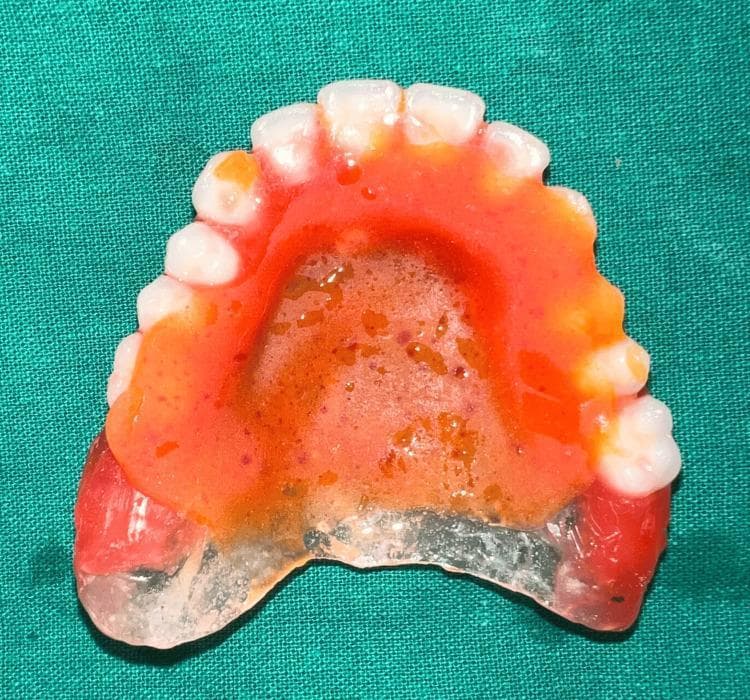
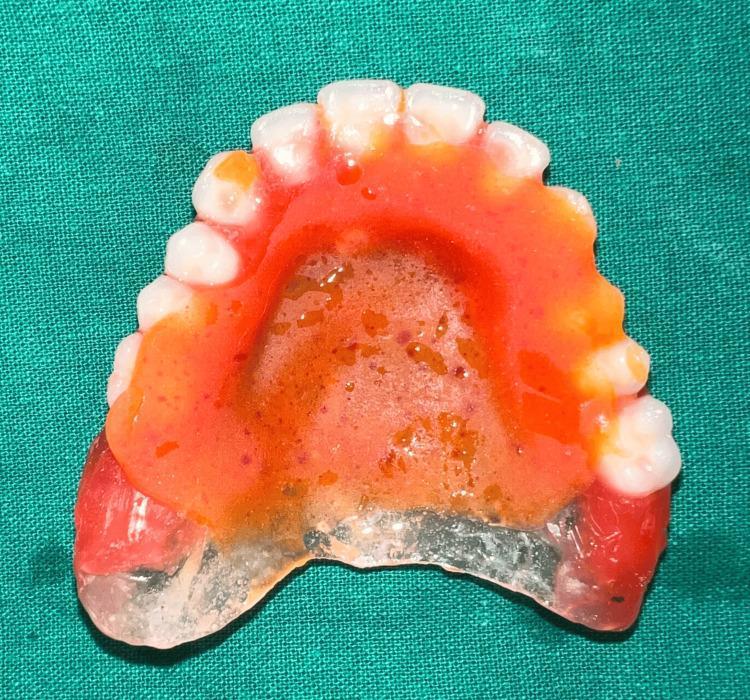
- The palate (or a prosthetic palate/denture) is coated with a contrasting substance — classically dark powder (cocoa, charcoal) or, in prosthodontics, a tissue conditioner mixed with food coloring (as seen in the image below).
- The subject produces the target sound or phoneme.
- The residual contact pattern on the palate is photographed or traced.
- A complementary linguogram may be made by photographing the corresponding contact marks on the tongue.
Electropalatography (EPG):
- A thin acrylic pseudo-palate custom-fitted to the patient carries up to ~96 electrodes.
- Contact is sampled at ~100 Hz, producing frame-by-frame digital maps of tongue-palate contact throughout an utterance.
Clinical Applications
- Speech pathology: Identifying place-of-articulation errors (e.g., retracted /s/ in cleft palate speech, lateral /s/, backing of alveolar consonants)
- Velopharyngeal incompetence (VPI): Documenting compensatory articulation errors that arise when a child adapts to inadequate velopharyngeal closure
- Cleft palate/craniofacial surgery: Pre- and post-operative assessment of articulation
- Prosthodontics: Evaluating tongue-palate contact in patients with maxillary dentures or obturators to optimize palatal contours for speech intelligibility
- Phonetics research: Documenting cross-linguistic variation in tongue placement
Palatogram in Prosthodontics
In removable prosthetics, palatograms help clinicians assess whether the palatal contour of a denture or obturator promotes or hinders normal tongue movement. The palatal surface is coated with a colored tissue conditioner; after the patient phonates, displaced areas reveal functional contact zones, guiding selective relief or contouring of the prosthesis.
Interpretation
- Anterior contact: Normal for alveolar and dental consonants (/t/, /d/, /n/, /s/, /z/)
- Posterior or lateral spreading: May indicate compensatory articulation or structural anomaly
- Asymmetric patterns: May reflect unilateral structural defects or neuromuscular asymmetry
- Incomplete anterior contact for alveolars: Suggests backing or pharyngeal articulation
Palatography remains a gold-standard tool in both clinical phonetics and speech-language pathology for objective, visual documentation of articulation.
This is a shared conversation. Sign in to Orris to start your own chat.