

bcdfe54c-154c-4c1d-84c9-2f250257d380.jpeg
explain explain
The image shows two classic pharmacology dose-response curve diagrams (Figs. 1.11 and 1.12 from Goodman & Gilman) comparing competitive and noncompetitive antagonism.
Searching sources...
Reading File
analyse_media
Finding Sources
Finding Sources
Reading File
Reading File
Loading Image
Here is a full explanation of the two figures from your textbook (Goodman & Gilman's The Pharmacological Basis of Therapeutics):
Fig. 1.11 - Competitive Antagonism
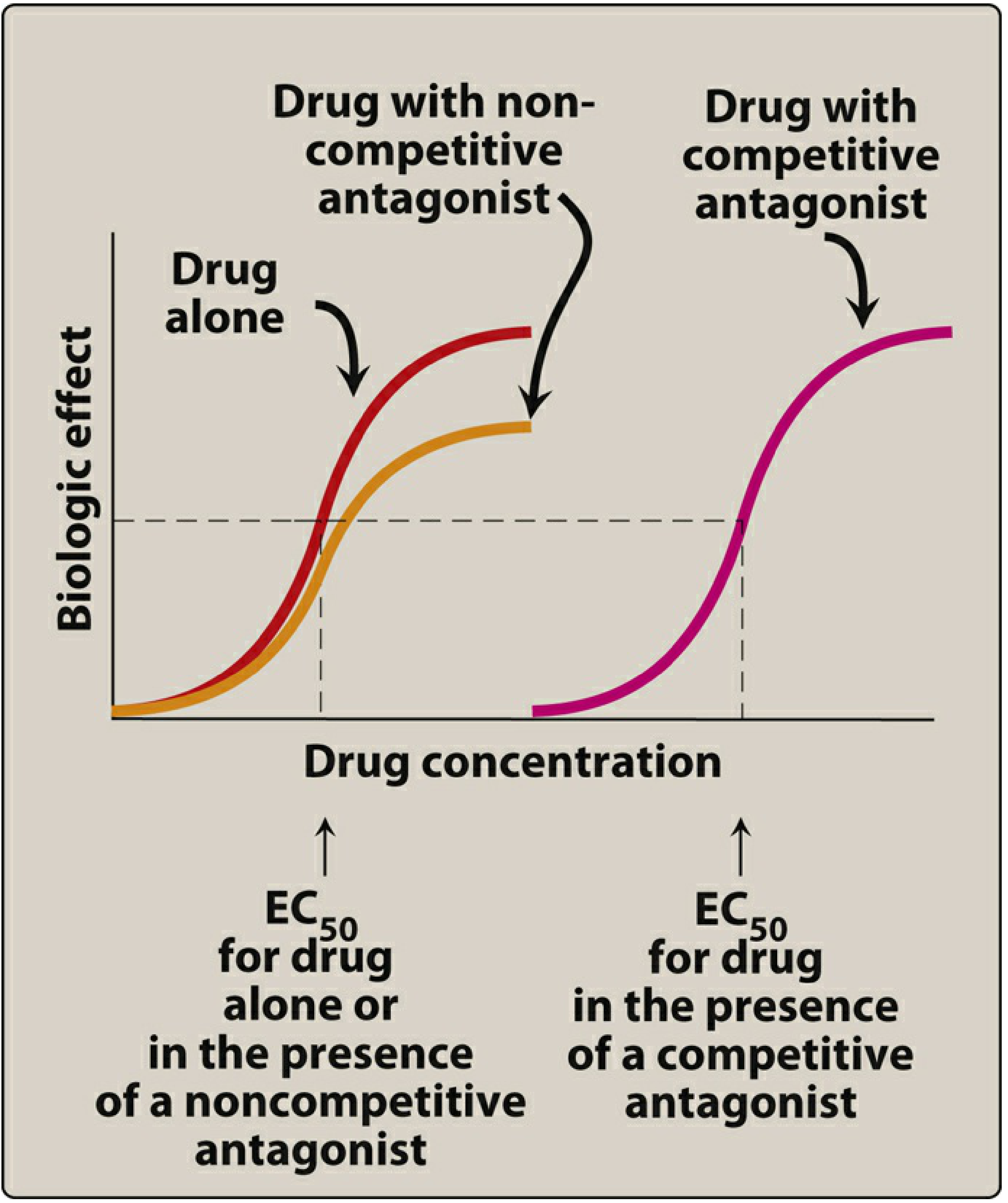
What is competitive antagonism?
A competitive antagonist binds reversibly to the same active (orthosteric) site as the agonist. Both molecules compete for the same binding pocket on the receptor.
What happens on the graph?
| Feature | Agonist alone | Agonist + Competitive antagonist |
|---|---|---|
| Shape of curve | Normal sigmoid (S-shape) | Same sigmoid shape |
| EC50 (potency) | Lower (leftward position) | Higher - curve shifts RIGHT |
| Emax (maximal effect) | 100% | Unchanged - still 100% |
Why does this happen?
- The antagonist blocks some receptors, so you need more agonist to get the same effect - hence the rightward shift.
- But if you keep adding agonist, you can outcompete the antagonist and still reach 100% maximal response. This is called surmountable antagonism.
- EC50 increases (potency decreases), but Emax is preserved.
Clinical example: Terazosin (alpha-blocker) competes with norepinephrine at alpha-1 receptors. Naloxone competes with opioids at mu receptors.
Fig. 1.12 - Noncompetitive Antagonism
What is noncompetitive antagonism?
A noncompetitive antagonist binds irreversibly to the active site, OR binds to an allosteric site (a different site, not the agonist-binding pocket). In either case, the agonist cannot produce a full response regardless of its concentration.
What happens on the graph?
| Feature | Agonist alone | Agonist + Low NC antagonist | Agonist + High NC antagonist |
|---|---|---|---|
| EC50 (potency) | Normal | Unchanged | Unchanged |
| Emax (efficacy) | 100% | Reduced | Further reduced |
| Curve shape | Normal | Flatter plateau | Even flatter |
Why does this happen?
- The antagonist permanently blocks or inactivates a portion of receptors.
- No matter how much agonist you add, those blocked receptors cannot be activated.
- The result is a downward shift of the Emax (the ceiling of the response is lowered).
- This is insurmountable antagonism - adding more agonist does NOT help.
Clinical example: Phenoxybenzamine (irreversible alpha-blocker used in pheochromocytoma). Picrotoxin (allosteric block of GABA-A chloride channel).
Key Comparison: Competitive vs Noncompetitive
| Parameter | Competitive | Noncompetitive |
|---|---|---|
| Binding site | Same as agonist (orthosteric) | Different site (allosteric) OR irreversible same site |
| Binding type | Reversible | Irreversible / allosteric |
| Effect on EC50 | Increased (rightward shift) | No change |
| Effect on Emax | No change | Decreased (downward shift) |
| Surmountable? | Yes - more agonist overcomes it | No - insurmountable |
| Curve shift | Parallel rightward shift | Downward shift (flattening) |
The single most important rule to memorize:
- Competitive antagonist = shifts curve RIGHT (potency down, efficacy same)
- Noncompetitive antagonist = shifts curve DOWN (efficacy down, potency same)
Sources: Lippincott Illustrated Reviews Pharmacology, p.106-107; Goodman & Gilman's The Pharmacological Basis of Therapeutics, Quantifying Antagonism section
This is a shared conversation. Sign in to Orris to start your own chat.