
Treatment of respiratory opd cases with clinical features and inveetigations and treatment with dosage and brand name
Reading File
Now let me search the medical library for respiratory OPD conditions in parallel.
Finding Sources
Finding Sources
Finding Sources
Finding Sources
Searching the Web
respiratory OPD common cases clinical features investigations treatment dosage 2024
Finding Sources
Finding Sources
Finding Sources
Excellent - I found Murray & Nadel's Textbook of Respiratory Medicine and Family Medicine. Let me read the key sections now.
Reading File
Reading File
Reading File
Finding Sources
Reading File
Finding Sources
Reading File
Reading File
I now have excellent material from Katzung's Pharmacology and Family Medicine textbooks. Let me now read the key asthma treatment section from Family Medicine and fetch the asthma classification image.
Reading File
I now have comprehensive information from authoritative textbooks. Let me compile a thorough, clinically practical answer covering the major respiratory OPD conditions.
Loading Image
I now have all the content needed for a comprehensive, clinically structured answer. Let me compile it.
Respiratory OPD Cases: Clinical Features, Investigations & Treatment
Below are the most common respiratory conditions seen in outpatient practice, presented in a practical clinical format.
1. BRONCHIAL ASTHMA
Clinical Features
- Symptoms: Recurrent episodes of wheezing, breathlessness, chest tightness, cough (especially nocturnal)
- Triggers: Allergens (dust, pollen, animal dander), cold air, exercise, viral URTIs, NSAIDs, stress, smoke
- Signs: Bilateral expiratory wheeze, prolonged expiration, use of accessory muscles in severe attacks
- Note: "Not all wheezing is asthma, and not all asthma has wheezing" - Textbook of Family Medicine 9e
Investigations
| Test | Finding in Asthma |
|---|---|
| Spirometry (gold standard) | FEV1/FVC <70%, reversibility >12% (>200 mL) after bronchodilator |
| Peak Expiratory Flow Rate (PEFR) | Reduced; diurnal variation >20% |
| Chest X-ray | Hyperinflation in severe/chronic cases; usually normal |
| CBC | Eosinophilia (especially in allergic asthma) |
| Serum IgE | Elevated in atopic asthma |
| Skin prick test / RAST | Identify allergens |
| ABG (severe attacks) | Hypoxia; initially hypocapnia, late hypercapnia = danger sign |
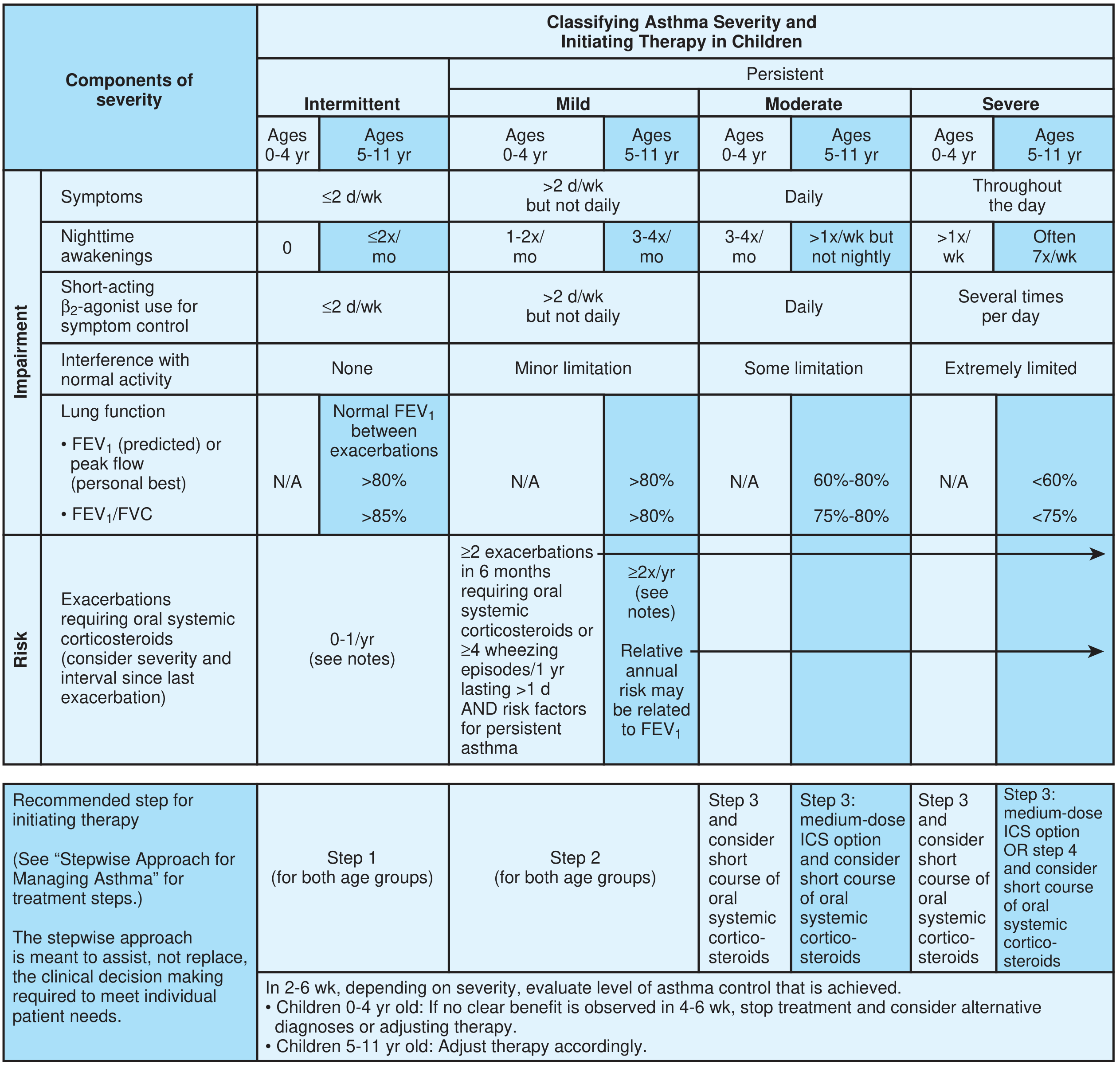
Asthma Severity Classification (for initiating therapy):
Treatment (Stepwise Approach - Adults)
Step 1 - Intermittent Asthma (symptoms ≤2 days/week):
| Drug | Dose | Brand Name (India) |
|---|---|---|
| Salbutamol (Albuterol) inhaler (SABA - reliever) | 100-200 mcg (1-2 puffs) PRN | Asthalin, Ventorlin |
| Levosalbutamol inhaler | 50-100 mcg PRN | Levolin |
Step 2 - Mild Persistent (symptoms >2 days/week but not daily):
| Drug | Dose | Brand Name |
|---|---|---|
| Budesonide inhaler (ICS) | 200-400 mcg/day | Budecort, Pulmicort |
| Beclomethasone dipropionate (ICS) | 200-400 mcg/day | Beclate, Becotide |
| Montelukast (LTRA - alternative) | 10 mg OD at night (adults); 5 mg OD (child 6-14 yr) | Montair, Montek |
| + SABA as needed | As above | Asthalin |
Step 3 - Moderate Persistent (daily symptoms):
| Drug | Dose | Brand Name |
|---|---|---|
| Budesonide + Formoterol (ICS+LABA combo) | 200/6 mcg, 1-2 puffs BD | Symbicort, Foracort |
| Fluticasone + Salmeterol | 250/25 mcg, 1 puff BD | Seretide, Foxair, Combitide |
| Montelukast (add-on) | 10 mg OD | Montair |
Step 4 - Severe Persistent (continual symptoms throughout day):
| Drug | Dose | Brand Name |
|---|---|---|
| High-dose ICS+LABA | Budesonide/Formoterol 400/12 mcg, 2 puffs BD | Foracort 400, Symbicort |
| Theophylline SR (add-on) | 200-400 mg BD | Deriphyllin, Theo-Asthalin |
| Prednisolone (oral, for exacerbations) | 40-60 mg/day x 5-7 days | Omnacortil, Wysolone |
| Ipratropium bromide (anticholinergic, add-on) | 20-40 mcg (2-4 puffs) 3-4x/day | Ipravent, Atrovent |
2. CHRONIC OBSTRUCTIVE PULMONARY DISEASE (COPD)
Clinical Features
- Symptoms: Chronic progressive dyspnea, chronic productive cough, sputum (especially morning), decreased exercise tolerance
- History: Long-term smoker (>10 pack-years), biomass fuel exposure
- Signs: Barrel chest, hyperresonant percussion, reduced breath sounds, expiratory wheeze, prolonged expiration, "pink puffer" (emphysema) or "blue bloater" (chronic bronchitis)
- Comorbidities: Cardiovascular disease, depression, anxiety, muscle wasting, anemia
Investigations
| Test | Finding |
|---|---|
| Spirometry (post-bronchodilator) | FEV1/FVC <0.70 (fixed obstruction, not fully reversible) |
| FEV1 % predicted | Grades severity: Mild >80%, Moderate 50-79%, Severe 30-49%, Very severe <30% |
| Chest X-ray | Hyperinflation, flattened diaphragm, increased AP diameter, bullae |
| HRCT chest | Emphysematous changes, air trapping |
| CBC | Polycythemia (secondary), eosinophils guide ICS use |
| ABG | Hypoxemia, hypercapnia in advanced disease |
| ECG | Cor pulmonale (P pulmonale, right axis deviation) |
| 6-Minute Walk Test | Functional capacity assessment |
Treatment (GOLD 2024 Guidelines)
Bronchodilators - First line:
| Drug | Dose | Brand Name |
|---|---|---|
| Salbutamol (SABA) | 100-200 mcg, 2-4x/day | Asthalin, Ventolin |
| Ipratropium bromide (SAMA) | 20-40 mcg (2-4 puffs) 3-4x/day | Ipravent, Atrovent |
| Tiotropium (LAMA - once daily) | 18 mcg (1 capsule) OD via Handihaler | Tiova, Spiriva |
| Indacaterol (LABA - once daily) | 150-300 mcg OD | Onbrez |
| Glycopyrronium (LAMA) | 50 mcg OD | Seebri |
Combination bronchodilators (LABA+LAMA):
| Drug | Dose | Brand Name |
|---|---|---|
| Indacaterol+Glycopyrronium | 110/50 mcg OD | Ultibro |
| Tiotropium+Olodaterol | 2.5/2.5 mcg, 2 puffs OD | Stiolto |
| Formoterol+Ipratropium | 12/200 mcg BD | Duolin |
Add ICS only if: Blood eosinophils ≥300 cells/mcL, or history of frequent exacerbations, or concurrent asthma:
| Drug | Dose | Brand Name |
|---|---|---|
| Budesonide+Formoterol | 320/9 mcg BD | Foracort 400 |
| Fluticasone+Salmeterol | 500/50 mcg BD | Seretide 500 |
COPD Exacerbation management:
| Drug | Dose | Brand Name |
|---|---|---|
| Prednisolone | 40 mg/day x 5 days | Omnacortil |
| Antibiotics (if purulent sputum): Amoxicillin-Clavulanate | 625 mg TDS x 5-7 days | Augmentin, Moxclav |
| OR Azithromycin | 500 mg OD x 3-5 days | Zithromax, Azithral |
| OR Levofloxacin (severe) | 750 mg OD x 5-7 days | Levoday, Tavanic |
| Roflumilast (PDE4 inhibitor, severe COPD with chronic bronchitis) | 500 mcg OD | Daxas |
3. UPPER RESPIRATORY TRACT INFECTION (URTI)
Clinical Features
- Rhinorrhea, nasal congestion, sneezing, mild sore throat, low-grade fever
- Mild cough, malaise; usually self-limiting in 7-10 days
- Mostly viral (rhinovirus, coronavirus, influenza)
Investigations
- Usually clinical diagnosis; no investigations needed for mild URTI
- Throat swab culture (if streptococcal pharyngitis suspected)
- Rapid Strep test (RADT)
- CBC (to differentiate viral vs bacterial)
Treatment
| Drug | Dose | Brand Name |
|---|---|---|
| Paracetamol (fever/pain) | 500-1000 mg TDS | Calpol, Crocin, Dolo |
| Cetirizine (antihistamine for rhinorrhea) | 10 mg OD at night | Cetcip, Zyrtec |
| Loratadine | 10 mg OD | Lorfast, Clarityn |
| Oxymetazoline nasal spray (decongestant, max 5 days) | 1-2 sprays/nostril BD | Otrivin, Nasivion |
| Dextromethorphan (for dry cough) | 15-30 mg TDS | Cofsils DM, Alex |
| Ambroxol (mucolytic, if thick secretions) | 30 mg TDS | Mucolite, Ambrodil |
| Antibiotics only if: Secondary bacterial infection (purulent sputum, high fever, tonsillar exudate for >72 hrs) | ||
| Amoxicillin (strep pharyngitis) | 500 mg TDS x 7-10 days | Mox, Amoxil |
| Azithromycin (penicillin allergy) | 500 mg OD x 3 days | Azithral |
4. COMMUNITY-ACQUIRED PNEUMONIA (CAP)
Clinical Features
- Fever (>38°C), chills, productive cough (rusty/purulent sputum), pleuritic chest pain
- Dyspnea, tachypnea (>20 breaths/min), tachycardia
- Signs: Dullness on percussion, bronchial breath sounds, increased vocal resonance, crackles
Investigations
| Test | Finding |
|---|---|
| Chest X-ray | Lobar/segmental consolidation, air bronchograms |
| CBC | Leukocytosis (WBC >11,000), left shift |
| CRP / ESR | Elevated |
| Sputum Gram stain + Culture & Sensitivity | Identify pathogen |
| Blood culture x2 | Positive in bacteremic pneumonia |
| Procalcitonin | Elevated in bacterial pneumonia |
| Pulse oximetry / ABG | SpO2 assessment |
| Urine Legionella antigen | If Legionella suspected |
| CURB-65 score | Assess severity, guide admission |
CURB-65 Severity Score
- C = Confusion, U = Urea >7 mmol/L, R = RR ≥30/min, B = BP <90/60, Age ≥65
- Score 0-1: Treat as outpatient; Score 2: Consider hospitalization; Score ≥3: Severe - hospitalize/ICU
Treatment
Outpatient (mild CAP, CURB-65 0-1):
| Drug | Dose | Brand Name |
|---|---|---|
| Amoxicillin | 500-1000 mg TDS x 5-7 days | Mox, Cipmox |
| OR Amoxicillin-Clavulanate | 625 mg TDS x 5-7 days | Augmentin |
| + Azithromycin (for atypicals) | 500 mg OD x 5 days | Azithral, Zithromax |
| Levofloxacin (monotherapy option) | 750 mg OD x 5 days | Levoday, Tavanic |
| Moxifloxacin (respiratory fluoroquinolone) | 400 mg OD x 5 days | Moxiflox, Avelox |
Adjuncts:
| Drug | Dose | Brand Name |
|---|---|---|
| Paracetamol (fever) | 1000 mg TDS | Crocin, Dolo 650 |
| Ambroxol (mucolytic) | 75 mg SR OD or 30 mg TDS | Ambrodil SR, Mucolite |
| Vitamin C + Zinc (supportive) | OTC doses | Limcee, Zincovit |
5. ALLERGIC RHINITIS (Major driver of respiratory OPD)
Clinical Features
- Paroxysmal sneezing, profuse watery rhinorrhea, nasal congestion, nasal/palatal/eye itching
- "Allergic salute", bluish-grey turbinates on examination, post-nasal drip causing chronic cough
- Seasonal (pollens) or perennial (dust mites, pet dander)
- Often co-exists with asthma - "one airway, one disease"
Investigations
- Clinical diagnosis
- Skin prick test / Specific IgE (RAST) - identify allergen
- Nasal cytology - eosinophilia
- Nasal endoscopy if indicated
Treatment
| Drug | Dose | Brand Name |
|---|---|---|
| Intranasal Fluticasone (first-line) | 2 sprays/nostril OD | Flonase, Flixonase, Nasoflo |
| Intranasal Mometasone | 2 sprays/nostril OD | Nasonex, Momesone |
| Intranasal Budesonide | 2 sprays/nostril BD | Rhinocort |
| Cetirizine (2nd gen antihistamine) | 10 mg OD | Cetcip, Zyrtec |
| Fexofenadine | 120-180 mg OD | Allegra, Fexova |
| Loratadine | 10 mg OD | Lorfast, Clarityn |
| Montelukast (LTRA, add-on) | 10 mg OD night | Montair, Montek |
| Montelukast + Levocetirizine (combo) | 1 tab OD at night | Montair-LC, Montek-LC |
| Ipratropium nasal spray (for watery rhinorrhea) | 2 sprays/nostril BD-TDS | Ipravent nasal |
6. ACUTE BRONCHITIS
Clinical Features
- Productive cough (white/yellow sputum), low-grade fever, malaise
- Chest discomfort, mild wheeze possible
- Usually follows URTI; mostly viral
- Resolves in 2-3 weeks
Investigations
- Mostly clinical; chest X-ray to exclude pneumonia
- CBC: may show mild leukocytosis
Treatment (mostly symptomatic)
| Drug | Dose | Brand Name |
|---|---|---|
| Ambroxol (mucolytic) | 30 mg TDS or 75 mg SR OD | Ambrodil, Mucolite |
| Salbutamol inhaler (if wheeze) | 100-200 mcg PRN | Asthalin |
| Dextromethorphan (for dry irritating cough) | 15-30 mg TDS | Alex DX, Cofsils DM |
| Paracetamol (fever/malaise) | 500-1000 mg TDS | Crocin, Dolo |
| Antibiotics (only if secondary bacterial infection): Amoxicillin-Clavulanate | 625 mg TDS x 5 days | Augmentin |
7. PULMONARY TUBERCULOSIS (TB) - Important in South Asia
Clinical Features
- Chronic cough >2 weeks, hemoptysis, evening fever, drenching night sweats
- Weight loss, anorexia, fatigue
- Signs: Reduced breath sounds, crackles in upper lobes
Investigations
| Test | Finding |
|---|---|
| Sputum AFB smear x 2 | Acid-fast bacilli |
| Sputum CBNAAT/GeneXpert | Confirms MTB + rifampicin resistance in 2 hrs |
| Chest X-ray | Upper lobe infiltrates, cavitation, fibrosis, hilar lymphadenopathy |
| Mantoux test (TST) | Induration ≥10 mm (positive in non-immunocompromised) |
| IGRA (QuantiFERON) | Latent TB diagnosis |
| CBC, LFT, RFT, Blood sugar | Before starting ATT (baseline) |
Treatment (RNTCP/NTEP - India, DOTS regimen)
Intensive Phase (2 months):
| Drug | Daily Dose (by weight) | Brand Name |
|---|---|---|
| Isoniazid (H) | 5 mg/kg (max 300 mg) | Isonex, Stanozide |
| Rifampicin (R) | 10 mg/kg (max 600 mg) | Rifocin, Rimactane |
| Pyrazinamide (Z) | 25 mg/kg (max 2 g) | Pyrafat |
| Ethambutol (E) | 15 mg/kg | Combutol |
| Fixed-dose combination (FDC) used in NTEP | Weight-based FDC | Forox (H+R+Z+E) |
Continuation Phase (4 months):
| Drug | Dose | Brand Name |
|---|---|---|
| Isoniazid + Rifampicin | As above | Rifinah, Macox |
| Pyridoxine (B6 - prevents INH neuropathy) | 10-25 mg OD | Benadon |
Key Prescribing Principles for Respiratory OPD
- Inhaler technique must always be demonstrated; a good drug with poor technique = poor outcome
- Spirometry before and after bronchodilator is the standard for asthma and COPD diagnosis
- Do not over-prescribe antibiotics for viral URTIs and acute bronchitis - most resolve without them
- Allergy control + trigger avoidance are as important as medications in asthma and allergic rhinitis
- COPD is irreversible but treatable - smoking cessation remains the single most effective intervention
- CURB-65 guides pneumonia severity and treatment setting decision
- Monitor for side effects: ICS - oral candidiasis (rinse mouth after); fluoroquinolones - tendinopathy, QT prolongation; theophylline - narrow therapeutic index, check levels
Sources: Katzung's Basic and Clinical Pharmacology 16e, Textbook of Family Medicine 9e, Murray & Nadel's Textbook of Respiratory Medicine, Fishman's Pulmonary Diseases and Disorders, GOLD 2024 COPD Guidelines
This is a shared conversation. Sign in to Orris to start your own chat.