I now have everything needed - the full PPT content plus rich textbook material with diagrams. Let me compile the complete, exam-ready answer.
THE LIMBIC SYSTEM - Complete Guide for 20-Mark Answer
INTRODUCTION
The word "limbic" comes from the Latin limbus, meaning "border" - because these structures form a curved rim or border at the junction of the diencephalon and the cerebral hemispheres.
Historical milestones:
- Paul Broca coined the term "Limbic Lobe" - described the cingulate and parahippocampal gyri on the medial surface as a border around the brainstem
- James Papez (1937) - proposed the Papez Circuit as the neural basis for emotion, linking hippocampus, mammillary bodies, anterior thalamus, and cingulate gyrus
- Heinrich Klüver and Paul Bucy (1939) - removed temporal lobes in monkeys and found roles of amygdala in fear, aggression, feeding, and sex (Klüver-Bucy Syndrome)
- Paul MacLean (1952) - coined the term "Limbic System" to include Broca's limbic lobe + related subcortical nuclei as the neural substrate for emotion
Definition: The limbic system is the entire neuronal circuitry that controls emotional behavior, motivational drives, memory, olfaction, and homeostatic functions.
Memory aid: HOME
H - Homeostasis | O - Olfaction | M - Memory | E - Emotion
ANATOMY / MAJOR STRUCTURES
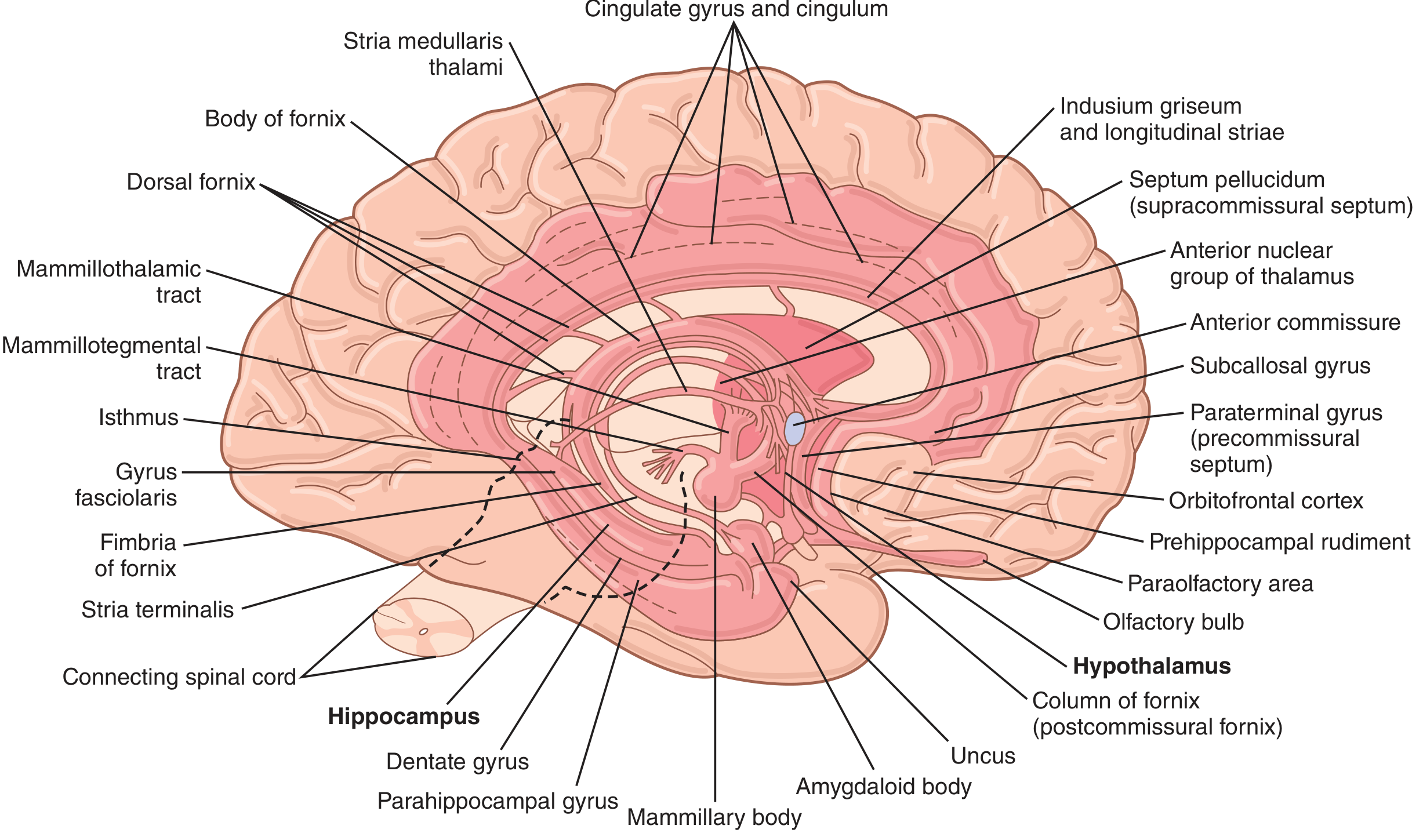
Anatomy of the limbic system (Guyton & Hall). The ring of limbic cortex on the medial hemisphere surrounds subcortical structures, with the hypothalamus at the center.
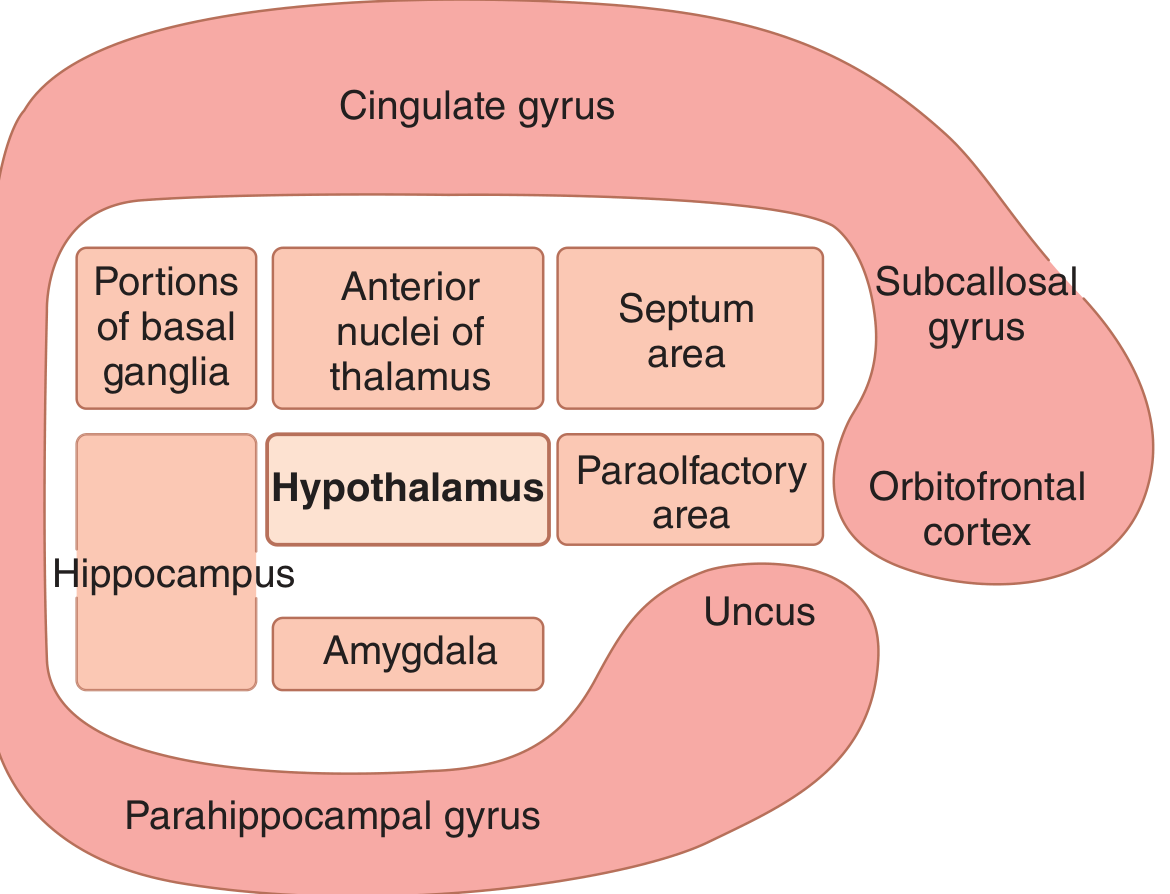
Schematic showing the key central position of the hypothalamus within the limbic system.
The limbic system comprises:
- Limbic Cortex (Cingulate gyrus + Parahippocampal gyrus)
- Hippocampal Formation (Dentate gyrus + Hippocampus + Subicular complex)
- Amygdala
- Septal Area
- Hypothalamus
- Related thalamic areas (Anterior nucleus of thalamus)
- Habenula (epithalamus, functionally connected)
PARTS AND THEIR FUNCTIONS
1. LIMBIC CORTEX
A) Cingulate Gyrus
A C-shaped strip of cortex lying dorsal to and following the corpus callosum. Divided into 4 parts:
| Subdivision | Key Functions |
|---|
| Anterior Cingulate Cortex (ACC) | Emotional response, storage of emotional memory, shifting attention, working memory (short + long term), conflict control; connected with basal ganglia and orbitofrontal cortex |
| Middle Cingulate Cortex | Conflict monitoring, planning motor response to emotional sensations; major component of the medial pain system |
| Posterior Cingulate Cortex | Autobiographical memory; part of default mode network |
| Rostrosplenium Cortex | Part of default mode network |
Subgenual Anterior Cingulate (Brodmann area 25):
- Connected to amygdala and hypothalamus
- Overactive in depression - antidepressants, ECT, rTMS all reduce activity here
- Target for Deep Brain Stimulation (DBS) in treatment-resistant depression
B) Parahippocampal Gyrus
Located in the medial temporal lobe. Contains the Entorhinal Cortex (ERC) - the main gateway into and out of the hippocampus.
- Rostral part - pyriform lobe - receives primary olfactory information
- Caudal part - entorhinal cortex - receives input from multimodal association areas, sends output to hippocampal formation
2. HIPPOCAMPAL FORMATION
Located in the floor of the temporal horn of the lateral ventricle. C-shaped structure. Has 3 zones:
A) Dentate Gyrus
Three layers:
- Outer molecular layer (acellular, faces hippocampal fissure)
- Middle layer of granule cells - send axons as mossy fiber projection to hippocampus
- Inner polymorphic layer
B) Hippocampus
Also trilaminate. Middle layer contains pyramidal neurons.
Divided into fields: CA3 → CA2 → CA1 (CA = Cornu Ammonis, after Egyptian deity Ammon with ram horns)
White matter adjacent to polymorphic layer = alveus → contributes to fimbria → becomes crus of fornix → bilateral crura converge to form body of fornix → travels anteriorly → turns inferiorly as columns of fornix → passes through hypothalamus → ends at mammillary bodies
Function: Critical for long-term declarative (explicit) memory storage. Also involved in acquisition, extinction, and recovery of contextual fear.
C) Subicular Complex
Three components - presubiculum, parasubiculum, subiculum. Transition zone between hippocampus and parahippocampal gyrus.
3. AMYGDALA
Located in the medial temporal lobe (MTL), just anterior to the hippocampal formation. Three main nuclear groups:
| Group | Notes |
|---|
| Basolateral Complex (largest) | CB1 receptor immunoreactive; functions like a multimodal cortical region |
| Centromedial Group | CB1 receptor negative; part of the extended amygdala (continuous with bed nucleus of stria terminalis - BNST) |
| Olfactory Group | Cortical amygdaloid nuclei |
Extended Amygdala: Consists of central amygdaloid nucleus + lateral BNST (reciprocally connected with brainstem visceral regions and lateral hypothalamus) and medial amygdaloid nucleus + medial BNST (connected with endocrine hypothalamus).
Functions of the Amygdala:
- Gateway integrating internal drives (hunger, thirst) with external sensory stimuli to assign emotional significance
- Mediates learned fear responses (anxiety, panic) via connections with medial geniculate nucleus and basolateral complex
- Conditioned fear: neutral stimulus (e.g., a tone) repeatedly paired with an aversive stimulus → fear response; medial geniculate → basolateral amygdala pathway is essential
- Exerts more powerful influence on the cortex than cortex exerts on the amygdala
- Aggression - stimulation produces rage; without amygdala, animals cannot interpret threatening visual stimuli
- Emotional memory - consolidation and retrieval together with prefrontal cortex and medial temporal lobe
- Olfaction - emotional response to smell
- Addiction - amygdala (especially basolateral) and nucleus accumbens form the reward circuitry; amygdala plays key role in cue-induced relapse
- Food intake - modulates emotional aspects of appetite
- Damage: loss of ability to detect fear and anger in others' facial expressions/voices; preserved recognition of happiness, sadness, disgust
4. SEPTAL AREA
- Gray matter structure immediately above the anterior commissure
- Reciprocally connected with hippocampus, amygdala, and hypothalamus
- Projects to numerous brainstem structures
- Septohippocampal pathway - neurobiologic circuit for regulation of anxiety
5. HYPOTHALAMUS
Small diencephalic structure at the center of the limbic system. Boundaries on inferior surface: optic chiasm (rostral) to posterior edge of mammillary bodies (caudal). The area between = tuber cinereum → median eminence → infundibular stalk → posterior pituitary.
Divided into:
- Anterior-posterior: Supraoptic → Infundibular → Mammillary regions (+ preoptic area anteriorly)
- Medial-lateral: Divided by the fornix
Key nuclei and functions:
| Nucleus | Function |
|---|
| Suprachiasmatic | Receives retinal projections; regulates circadian/diurnal rhythms |
| Supraoptic + Paraventricular | Magnocellular neurons; produce oxytocin and vasopressin (ADH) |
| Lateral nucleus | Feeding center (stimulation → hunger) |
| Ventromedial nucleus | Satiety center (stimulation → stop eating) |
| Posterior hypothalamus | Part of mammillary bodies → Papez circuit |
Overall: Regulates emotions, autonomic functions, endocrine functions, body temperature, osmolality, drives to eat and drink, energy balance, and body weight ("vegetative functions").
6. HABENULA
- Part of epithalamus but functionally linked to limbic system
- Divided into medial and lateral
- Lateral habenula - hub connecting limbic, basal ganglia, and brainstem circuits
- Projects to: serotonergic raphe nuclei and dopaminergic VTA (ventral tegmental area)
- Role in mood regulation - involved in depression
- DBS of lateral habenula - successful for treatment-resistant depression
THE PAPEZ CIRCUIT
Proposed by James Papez (1937) as the neural mechanism for emotion:
Hippocampus
    ↓ (via fornix)
Mammillary bodies
    ↓ (via mammillothalamic tract)
Anterior nucleus of thalamus
    ↓
Cingulate gyrus
    ↓
Hippocampus (completes the loop)
Key point: The cortex controls emotional expression through this circuit. The cingulate gyrus provides subjective emotional experience ("feeling"), while the hypothalamus provides the autonomic/visceral expression ("expression").
FUNCTIONS OF THE LIMBIC SYSTEM (Summary)
| Function | Key Structure(s) |
|---|
| Emotion | Amygdala, cingulate gyrus |
| Memory (declarative) | Hippocampus |
| Emotional memory | Amygdala + hippocampus + prefrontal cortex |
| Fear and conditioned fear | Amygdala (basolateral complex) |
| Aggression | Amygdala, hypothalamus |
| Olfaction | Entorhinal cortex, amygdala |
| Homeostasis / Autonomic control | Hypothalamus |
| Neuroendocrine control | Hypothalamus → pituitary |
| Reward and addiction | Amygdala, nucleus accumbens, VTA |
| Anxiety regulation | Septohippocampal pathway, anterior cingulate |
| Circadian rhythm | Suprachiasmatic nucleus |
LESIONS AND DISEASES
1. KLÜVER-BUCY SYNDROME
Cause: Bilateral destruction of temporal lobes - especially amygdala and hippocampus (first described by Klüver and Bucy in 1939 in monkeys)
Clinical features (5 hallmarks):
- Visual agnosia - cannot recognize objects by sight
- Placidity - no fear, no anger, tame behavior
- Hypermetamorphosis - compulsion to touch/examine every object in the environment
- Hyperorality - putting everything in the mouth
- Hypersexuality - inappropriate sexual behavior
Causes in humans:
- Cerebral trauma
- Infections (Herpes encephalitis, other encephalitides)
- Alzheimer's disease and other dementias
- Niemann-Pick disease
- Cerebrovascular disease
2. KORSAKOFF'S PSYCHOSIS / AMNESIC SYNDROME
Structures damaged: Mammillary bodies, dorsomedial nucleus of thalamus, hypothalamus (due to thiamine deficiency in chronic alcoholism)
Features:
- Chronic prominent impairment of recent AND remote memory (recent > remote)
- Immediate recall is preserved
- Confabulation (making up answers to fill memory gaps) - not invariably present
3. ALZHEIMER'S DISEASE
- Degenerative changes in the limbic system
- Marked atrophy of dentate gyrus and hippocampus
- Senile plaques and neurofibrillary tangles throughout cerebral cortex and basal ganglia - but hippocampus and amygdala are severely involved
- Leads to progressive memory loss and eventually dementia
4. TEMPORAL LOBE EPILEPSY (TLE)
- Most common epilepsy in adults
- Most often caused by hippocampal sclerosis
- Involves hippocampus, amygdala, and parahippocampal gyrus
- Mesial temporal sclerosis (MTS) is not limited to medial temporal lobe - it is a limbic system disorder
- Classic aura: unpleasant smell (uncinate fits), déjà vu, fear, rising epigastric sensation
5. LIMBIC ENCEPHALITIS
- Paraneoplastic syndrome - onconeuronal antibodies against limbic structures
- Inflammation of: cingulate cortex, amygdala, orbitofrontal cortex, hippocampus, medial temporal lobe
- Specific manifestations by structure:
- Hypothalamus lesion → elevated or suppressed appetite/libido
- Amygdala damage → heightened aggression and abnormal emotion
- Hippocampus destruction → memory and concentration deficits
6. ANXIETY DISORDERS
- Failure of anterior cingulate and hippocampus to modulate amygdala activity
- Individuals have heightened activity in limbic system areas
7. AFFECTIVE DISORDERS (Depression / Bipolar)
- Reduced volumes of frontal lobes, basal ganglia, amygdala, and hippocampus
- Decreased prefrontal and anterior cingulate activity
- Subgenual ACC (area 25) is overactive in depression
- Dysfunction of anterior limbic network (prefrontal + thalamus + striatum + amygdala) is implicated in bipolar disorder
8. SCHIZOPHRENIA
- Reduced gray matter weight of the brain
- MRI: reduced volumes of hippocampus, amygdala, and parahippocampal gyrus
- Increased activation of temporal lobe during willed actions
- Decreased neuropil density - thought to relate to excessive adolescent synaptic pruning causing too little frontolimbic activity
- Hypometabolism of prefrontal cortex → working memory impairment, loosening of associations
- Bleuler's 4 A's (affect, associations, ambivalence, autism) - all involve limbic structures
9. AUTISM SPECTRUM DISORDER (ASD)
- Disproportionate impairment in social cognition
- Structures involved: cingulate gyrus and amygdala (mediating cognitive and affective processing)
- Disruption of the basolateral circuit integral for social cognition
10. ADHD
- Enlarged hippocampus seen - may represent a compensatory response to disturbances in temporal processing and stimulus-seeking
- Disrupted amygdala-orbitofrontal cortex connections → behavioral disinhibition
11. PICK'S DISEASE (Frontotemporal Dementia)
- Degenerative changes prominently in the limbic system, particularly dentate gyrus and hippocampus
OTHER IMPORTANT ASPECTS
Motivation and Addiction
The reward circuitry includes:
- Prefrontal cortex → VTA → amygdala (basolateral) → nucleus accumbens core → ventral pallidum
- This pathway mediates drug-seeking behavior and compulsive drug-taking
- All major drugs of abuse (heroin, cocaine, alcohol, opiates, marijuana, nicotine, amphetamines) act on elements of limbic circuitry
- Drugs of abuse serve as biological rewards by activating the reinforcement system
- Cue-induced relapse involves hippocampus and amygdala activation
Olfaction and the Limbic System
- The limbic system is closely related to the olfactory cortex
- Amygdala - emotional response to smell
- Entorhinal cortex - olfactory memories
- This explains why certain smells trigger strong emotional memories (e.g., smell of hospital triggering anxiety)
Default Mode Network (DMN)
- Posterior cingulate cortex and rostrosplenium are part of the DMN
- Active during self-referential thought, mind-wandering, autobiographical memory
QUICK REVISION TABLE - STRUCTURE → LESION → DISEASE
| Structure | Lesion/Disease | Manifestation |
|---|
| Hippocampus | Alzheimer's, TLE, hippocampal sclerosis | Anterograde amnesia, seizures |
| Amygdala | Klüver-Bucy, limbic encephalitis | Placidity, hypersexuality, hyperorality, fearlessness |
| Mammillary bodies | Korsakoff's (thiamine deficiency) | Recent memory loss, confabulation |
| Subgenual ACC (area 25) | Depression | Overactivity → treated with DBS, ECT, rTMS |
| Lateral habenula | Depression | Target for DBS |
| Septal area | Septohippocampal disruption | Anxiety dysregulation |
| Hypothalamus | Limbic encephalitis | Appetite/libido changes |
| Temporal lobe (bilateral) | Klüver-Bucy syndrome | All 5 features |
EXAM TIP - HOW TO WRITE A 20-MARK ANSWER
Structure your answer like this:
- Introduction (2 marks) - Etymology, definition, historical contributions (Broca, Papez, Klüver-Bucy, MacLean), mnemonic HOME
- Parts and Anatomy (4 marks) - List all 6-7 components with brief anatomy of each; draw the anatomy diagram if possible
- Functions of each part (5 marks) - Tabular format works well; mention amygdala functions in detail (fear, aggression, addiction, emotional memory)
- Papez Circuit (2 marks) - Draw the circuit: Hippocampus → Mammillary bodies → Anterior thalamus → Cingulate → Hippocampus
- Lesions and Clinical Syndromes (5 marks) - Klüver-Bucy (most important), Korsakoff's, TLE, Limbic encephalitis, Alzheimer's
- Associated psychiatric disorders (2 marks) - Schizophrenia, depression, anxiety, ASD, ADHD
Key examiner favorites: Klüver-Bucy Syndrome (features + causes), Korsakoff's (structures + memory pattern), Papez Circuit (draw it), and the role of amygdala in fear/aggression.
Sources: Kaplan & Sadock's Comprehensive Textbook of Psychiatry; Guyton and Hall Textbook of Medical Physiology; Neuroanatomy through Clinical Cases 3rd Edition; PPT - "Limbic System" by Dr. Dhatri Sarvaiya, Psychiatry Department