
Herbal drug used for anti-inflammatory properties.
herbal plants anti-inflammatory mechanisms
herbal drugs anti-inflammatory pharmacology mechanisms clinical uses 2024
herbal plants anti-inflammatory turmeric ginger boswellia
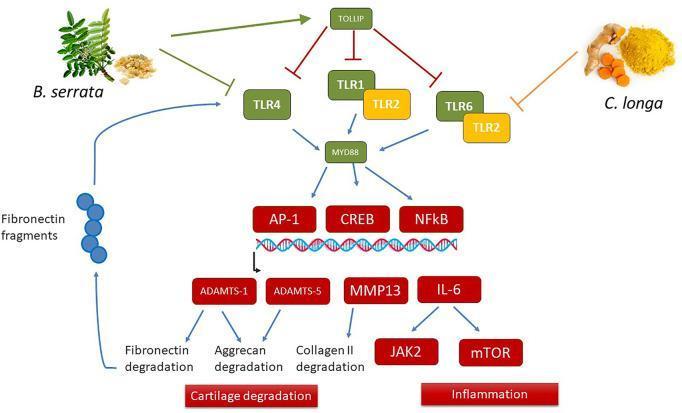
This pathophysiology diagram illustrates the anti-inflammatory and anti-catabolic signaling pathways of Boswellia serrata and Curcuma longa in the context of osteoarthritis and cartilage degradation. The flowchart depicts B. serrata inhibiting TLR4 and upregulating TOLLIP (Toll-interacting protein), which further inhibits TLR1, TLR4, and TLR6. C. longa is shown specifically inhibiting TLR2. These Toll-like receptors converge on the adaptor protein MYD88, which activates downstream transcription factors AP-1, CREB, and NFkB. This activation triggers the expression of catabolic enzymes and pro-inflammatory mediators, including ADAMTS-1, ADAMTS-5, MMP13, and IL-6. The diagram identifies the resulting outcomes: ADAMTS-1 and -5 lead to fibronectin and aggrecan degradation; MMP13 causes Collagen II degradation; and IL-6 activates JAK2 and mTOR signaling. A positive feedback loop is shown where fibronectin fragments further activate TLR4. The visual organizes these final effects into two primary clinical categories: Cartilage degradation and Inflammation.
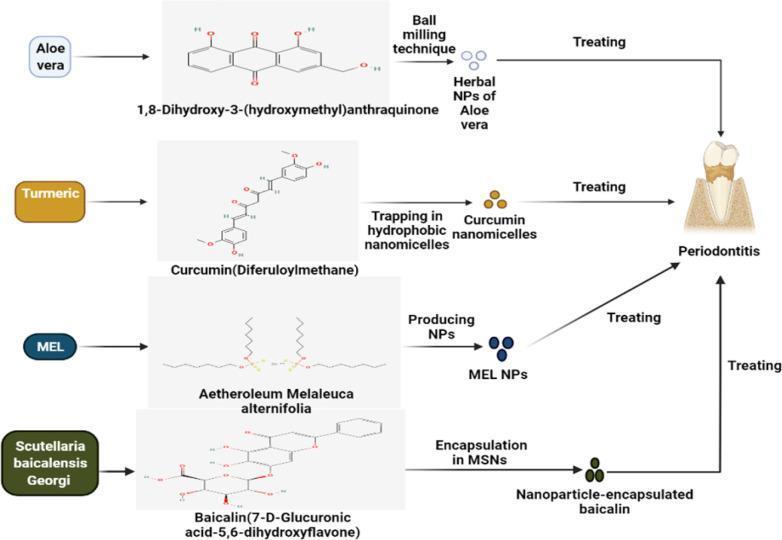
This medical flowchart illustrates various preparation methods for nano-based herbal formulations derived from medicinal plants to treat periodontitis. The diagram follows four parallel pathways: 1) Aloe vera (extracting 1,8-Dihydroxy-3-(hydroxymethyl)anthraquinone) undergoes a ball milling technique to create herbal nanoparticles (NPs). 2) Turmeric (extracting Curcumin/Diferuloylmethane) is processed via trapping in hydrophobic nanomicelles. 3) Melaleuca alternifolia (MEL/Aetheroleum Melaleuca alternifolia) is used for producing NPs. 4) Scutellaria baicalensis Georgi (extracting Baicalin/7-D-Glucuronic acid-5,6-dihydroxyflavone) is encapsulated in mesoporous silica nanoparticles (MSNs). Each pathway shows the chemical structure of the active compound, the specific nanotechnology-based manufacturing technique, and the resulting nanoparticle morphology (represented by color-coded spheres). All four paths converge on a clinical illustration of periodontitis—showing a tooth with bone loss and inflamed gingival tissue—indicating their application as targeted therapeutic interventions. This diagram is designed for dentistry and pharmacology education to highlight drug delivery systems that overcome the poor solubility and bioavailability of natural phytochemicals in treating inflammatory oral diseases.
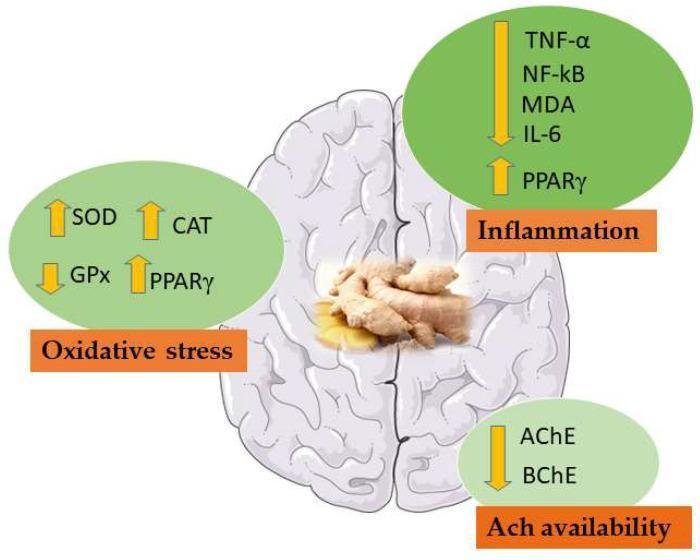
This pathophysiology diagram illustrates the neuroprotective effects of ginger on the brain, specifically in the context of vascular dementia (VD). The central feature is a superior view of a stylized human brain with ginger rhizomes overlaid at the center. Three callout boxes categorize the biological impacts: 1. Oxidative Stress: Ginger increases antioxidant enzymes SOD (Superoxide dismutase) and CAT (Catalase), along with PPARγ (peroxisome proliferator-activated receptor gamma), while decreasing GPx (glutathione peroxidase). 2. Inflammation: The diagram shows a downregulation of pro-inflammatory markers TNF-̑ (Tumor Necrosis Factor-̑), NF-̑B (Nuclear Factor kappa-B), MDA (Malondialdehyde), and IL-6 (Interleukin 6), alongside an upregulation of anti-inflammatory PPAȒ. 3. ACh Availability: The visual indicates the inhibition of AChE (Acetylcholinesterase) and BChE (Butyrylcholinesterase), suggesting enhanced cholinergic transmission. This educational infographic summarizes how ginger compounds modulate biochemical pathways related to neuroinflammation, oxidative damage, and neurotransmitter preservation in neurodegenerative conditions.
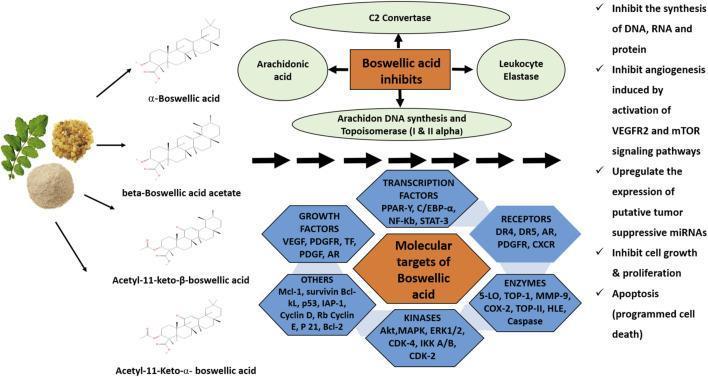
This medical schematic details the pharmacological mechanisms and molecular targets of boswellic acids derived from Boswellia serrata, emphasizing their role in oncology. The diagram is organized into four sections: chemical structures, direct inhibition targets, downstream molecular signaling, and cellular outcomes. On the left, it shows the plant origin and chemical structures of alpha-boswellic acid, beta-boswellic acid acetate, and acetyl-11-keto derivatives. The top center illustrates direct inhibitory action on C2 convertase, arachidonic acid, leukocyte elastase, and DNA synthesis/topoisomerases (I & II alpha). Below this, a central hub categorizes downstream molecular targets into six groups: transcription factors (NF-kB, STAT-3, PPAR-γ), growth factors (VEGF, PDGF), kinases (Akt, MAPK, CDK-2/4), receptors (DR4/5, CXCR), enzymes (5-LO, COX-2, MMP-9), and other apoptotic regulators (p53, Bcl-2, survivin). The right side summarizes the clinical significance: inhibition of DNA/RNA synthesis, suppression of angiogenesis via VEGFR2/mTOR pathways, upregulation of tumor-suppressive miRNAs, and induction of apoptosis. This visual serves as a comprehensive map for understanding the anti-cancer and anti-inflammatory properties of boswellic acid in human cellular pathways.
Herbal Drugs with Anti-Inflammatory Properties
1. Turmeric (Curcuma longa) - Curcumin
- Inhibits NF-kB (Nuclear Factor kappa-B) signaling - a master regulator of inflammation
- Inhibits COX-2 (cyclooxygenase-2) and LOX (lipoxygenase) enzymes
- Reduces pro-inflammatory cytokines: TNF-alpha, IL-1beta, IL-6
- Strong antioxidant activity - scavenges reactive oxygen species (ROS)
- Inhibits TLR2 (Toll-like receptor 2), blocking downstream inflammatory cascades
2. Boswellia (Boswellia serrata) - Boswellic Acids
- Inhibits 5-lipoxygenase (5-LO) - prevents leukotriene synthesis
- Inhibits COX-2 and MMP-9 (matrix metalloproteinase)
- Inhibits TLR4 and upregulates TOLLIP (Toll-interacting protein), suppressing TLR1/4/6 signaling
- Suppresses NF-kB and STAT-3 transcription factors
- Prevents cartilage degradation by inhibiting ADAMTS and MMP13 in osteoarthritis
3. Ginger (Zingiber officinale) - Gingerols & Shogaols
- Downregulates NF-kB, TNF-alpha, and IL-6
- Inhibits COX-1 and COX-2 (similar to NSAIDs, but weaker)
- Increases antioxidant enzymes SOD and catalase
- Upregulates PPARgamma (anti-inflammatory nuclear receptor)
- Inhibits acetylcholinesterase (neuroprotective bonus effect)
4. Willow Bark (Salix alba) - Salicin
5. Devil's Claw (Harpagophytum procumbens)
6. Green Tea (Camellia sinensis) - EGCG
7. Cannabidiol (CBD) from Cannabis sativa
8. Quercetin, Resveratrol, and Other Flavonoids
| Compound | Plant Source | Key Mechanism |
|---|---|---|
| Quercetin | Onions, apples, berries | Inhibits NF-kB, COX-2, LOX |
| Resveratrol | Grapes, red wine | Activates Sirt-1, inhibits NF-kB |
| Apigenin | Parsley, chamomile | Inhibits AGEs/RAGE/NF-kB pathway |
| Baicalein | Scutellaria baicalensis | Inhibits JNK and NF-kB activation |
Key Inflammatory Pathways Targeted by Herbal Drugs
Stimulus → TLR4/NF-kB → COX-2 / 5-LOX → Prostaglandins / Leukotrienes → Inflammation

Herbal drugs act at multiple points:
- TLR inhibition:      Boswellia (TLR4), Curcumin (TLR2)
- NF-kB inhibition:    Curcumin, Boswellia, Ginger, Resveratrol
- COX-2 inhibition:    Curcumin, Ginger, Willow bark, Devil's Claw
- 5-LOX inhibition:    Boswellia (most potent herbal 5-LOX inhibitor)
- Cytokine reduction:  Ginger, Devil's Claw (TNF-alpha, IL-1, IL-6)
Important Drug Interactions to Note
- St. John's Wort: Induces CYP450 enzymes - interacts with warfarin, cyclosporine, oral contraceptives, antiretrovirals, and SSRIs (Goldman-Cecil Medicine)
- Ginseng, Goldenseal: Significant potential for drug-drug interactions
- Turmeric: May enhance anticoagulant effects of warfarin at high doses