I now have excellent textbook content and clinical images. Here is the comprehensive answer:
Navigation in Orthopaedic Surgery
Definition
Surgical navigation — also called Computer-Assisted Surgery (CAS) or Image-Guided Surgery (IGS) — is a real-time intraoperative system that tracks the position of surgical instruments and implants in three dimensions relative to the patient's anatomy, displayed on a monitor much like a GPS system.
Core Components of a Navigation System
| Component | Function |
|---|
| Imaging source | Provides anatomical map (preoperative CT/MRI, intraoperative fluoroscopy, or 3D O-arm CT) |
| Localiser / camera unit | Optical infrared or electromagnetic detector that tracks tracker positions in space |
| Reference trackers | Rigid arrays with reflective spheres fixed to patient bones and instruments |
| Navigation workstation | Software that registers patient anatomy and displays real-time instrument position |
| Navigated instruments | Probes, drills, reamers, saws fitted with tracking arrays |
How It Works: The Workflow
1. Image Acquisition
- Preoperative CT/MRI → imported into workstation; virtual 3D model constructed
- Intraoperative fluoroscopy (most common) → C-arm images taken after patient positioning, automatically calibrated
- Intraoperative 3D CT (O-arm, Vario 3D) → highest accuracy; spin CT acquired on table, registered automatically
According to Rockwood & Green's Fractures in Adults (10th Ed., p. 232): "Computer-assisted surgical navigation utilizing fluoroscopy is an emerging technology applied to percutaneous pelvic and acetabular screw placement. Fluoroscopy is commonly used for surgical navigation because of its flexibility, convenience, lower radiation exposure, and lower cost."
2. Registration
- The process of matching the virtual image model to the actual patient anatomy in real space
- Methods:
- Point-to-point registration: surgeon touches anatomical landmarks with a tracked probe
- Surface matching: probe swept over bone surface; software matches contour to CT model
- Image-based (automatic): O-arm/C-arm auto-registers after intraoperative scan — no manual step required
3. Tracking
- A reference frame (star-shaped array with retroreflective spheres) is rigidly fixed to the patient's bone (e.g., spinous process pin, iliac crest pin, or tibial pin)
- Instruments fitted with tracking arrays
- The camera continuously tracks both patient and instrument positions
- Real-time position displayed on workstation in 2D/3D reconstructions
4. Guided Surgery
- Surgeon views instrument trajectory on screen relative to anatomy in axial, sagittal, coronal, and 3D views
- Allows precise planning and execution of cuts, screw trajectories, implant placement
Navigation Technologies: Types
| Technology | Image Source | Accuracy | Use Case |
|---|
| Fluoroscopy-based navigation | Intraoperative C-arm | ±2–3 mm | Fracture fixation, pelvic screws |
| CT-based navigation | Preoperative CT | ±1–2 mm | Spine (pedicle screws), pelvis |
| Intraoperative 3D CT (O-arm) | Intraop CT spin | <1 mm | Spine, complex deformity |
| Imageless navigation | Kinematic data (no imaging) | ±2–3 mm | TKA alignment, THA |
| Robotic-assisted navigation | CT + robotic arm | <1 mm | TKA, THA, spine screws |
| Electromagnetic navigation | EM field tracking | ±2–3 mm | Minimally invasive, no line-of-sight |
Clinical Applications
1. Total Knee Arthroplasty (TKA)
The most widely studied application.
Purpose: Achieve neutral mechanical axis alignment (target: 0° ± 3° of the mechanical axis)
Methods:
- Imageless CAS: sensors capture knee kinematics (range of motion, femoral/tibial axes) without imaging; software guides cutting blocks
- CT-based / robotic: preoperative plan mapped onto patient in theatre
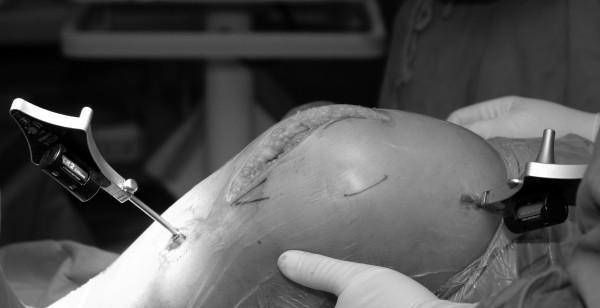
Intraoperative CAS-TKA showing navigation trackers rigidly fixed to femur and tibia via bicortical pins (Stryker-Leibinger system)
Evidence:
Schwartz's Principles of Surgery (11th Ed., p. 1937): "Computer navigation in total joint arthroplasty has been shown to minimize outliers in alignment, but there has been no proven benefit in survival or function secondary to computer-navigated or robotic-assisted joint replacement."
Miller's Review of Orthopaedics (9th Ed.): "Evidence supports not using intraoperative navigation because there is no difference in outcomes or complications" (conventional TKA instrumentation).
Interpretation: Navigation reduces malalignment outliers (components placed outside ±3° of neutral) but has not yet demonstrated superior long-term clinical outcomes over conventional instrumentation.
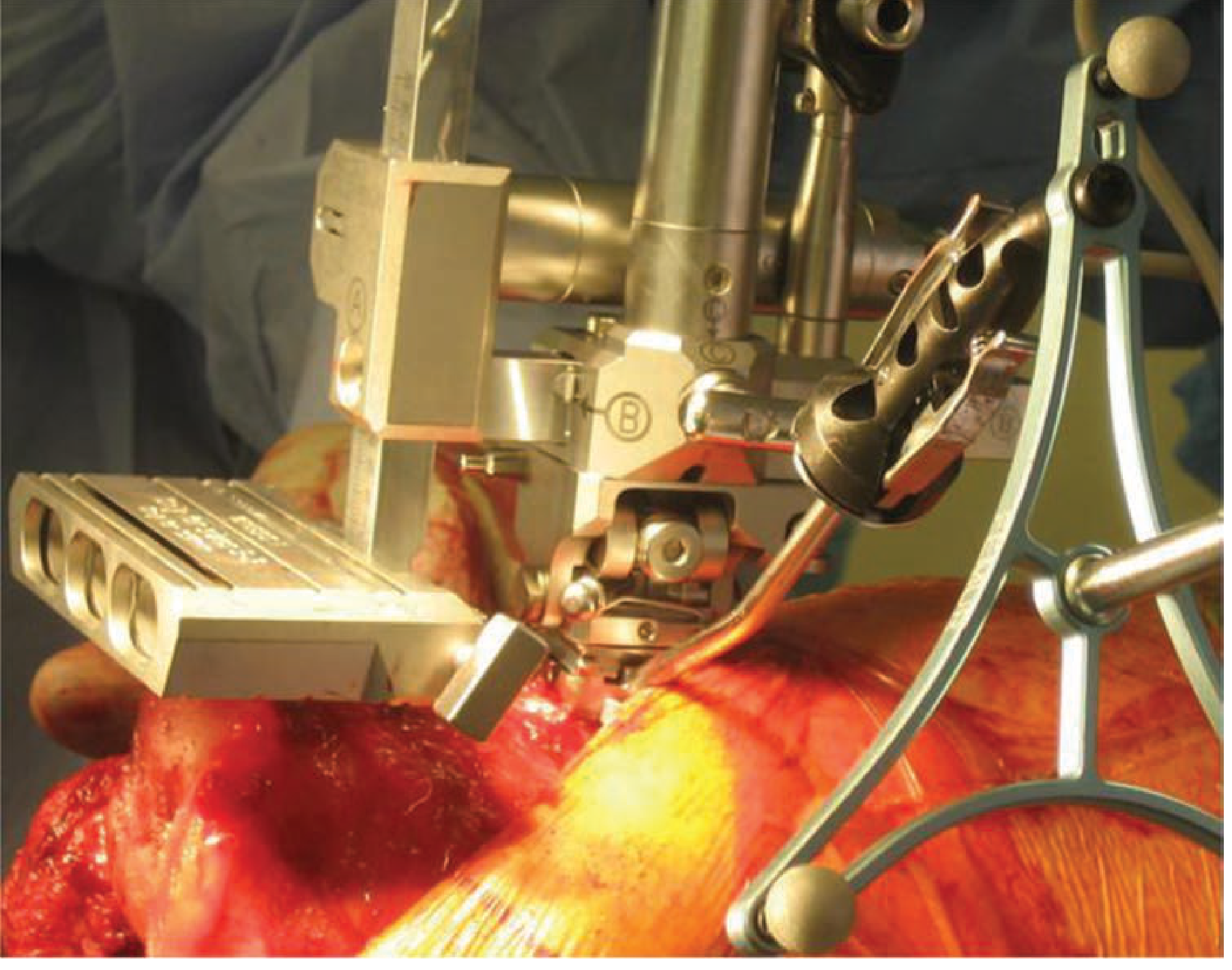
Robotic targeting arm for computer-assisted total knee replacement — Schwartz's Principles of Surgery, 11th Ed.
2. Total Hip Arthroplasty (THA)
Purpose: Accurate cup orientation (target: 40° inclination, 15° anteversion — the "safe zone")
- Cup malposition is the leading cause of dislocation and impingement
- Imageless CAS or robot-assisted (e.g., MAKO, Stryker) guides acetabular reaming and cup insertion
- Leg length and offset can be measured intraoperatively with navigation
3. Pedicle Screw Placement (Spine)
The most impactful application in terms of safety.
Purpose: Accurate screw placement within the pedicle, avoiding breach into the canal, foramen, or vascular structures
Without navigation: fluoroscopy-based freehand — breach rate 15–40% (literature range)
With CT navigation: breach rate drops to <5%
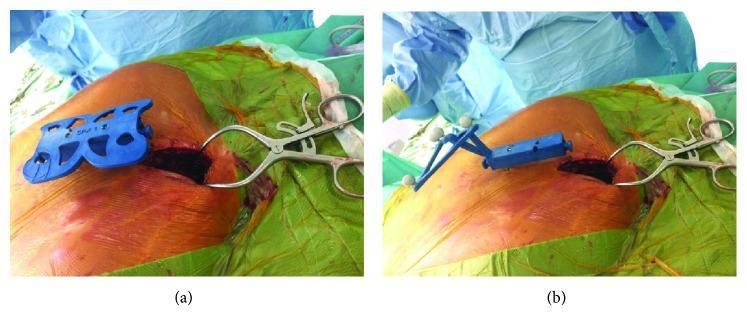
Posterior cervicothoracic navigation setup: imaging reference frame fixed to spinous processes, replaced by optical tracker frame for real-time screw guidance (Surgivisio® system)
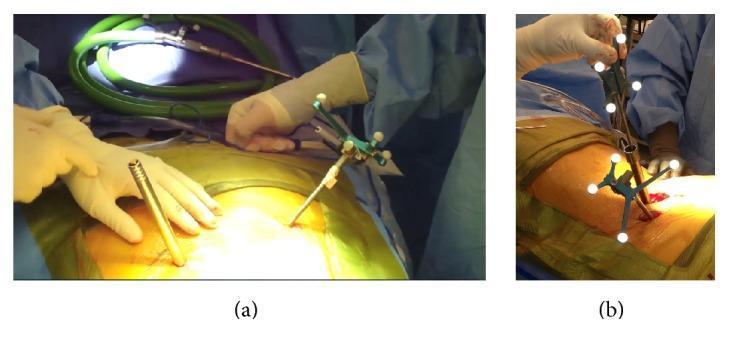
Navigated dilator and Jamshidi needle for percutaneous pedicle screw placement in MIS spine surgery — reflective tracking spheres visible on instrument arrays
Rockwood & Green's (10th Ed., p. 895): "Intraoperative CT systems such as the O-arm (Medtronic), Vario 3D by Ziehm, or Surgivisio (eCential) can be coupled with navigation systems and may improve reduction and fixation in trauma surgery. Intraoperative CT coupled to robotics is currently used in spine and arthroplasty surgery."
Systems used: Medtronic StealthStation, Brainlab Spine, Surgivisio, ROSA Spine (Zimmer Biomet)
4. Fracture Fixation & Trauma Surgery
Applications:
- Percutaneous pelvic and acetabular screw placement (iliosacral, supra-acetabular, column screws)
- Femoral nail antegrade/retrograde — guidewire placement
- Tibial plateau and pilon fractures
- Distal radius fixation
Advantage: Reduces radiation exposure to surgeon by allowing navigation-guided drilling without continuous fluoroscopy
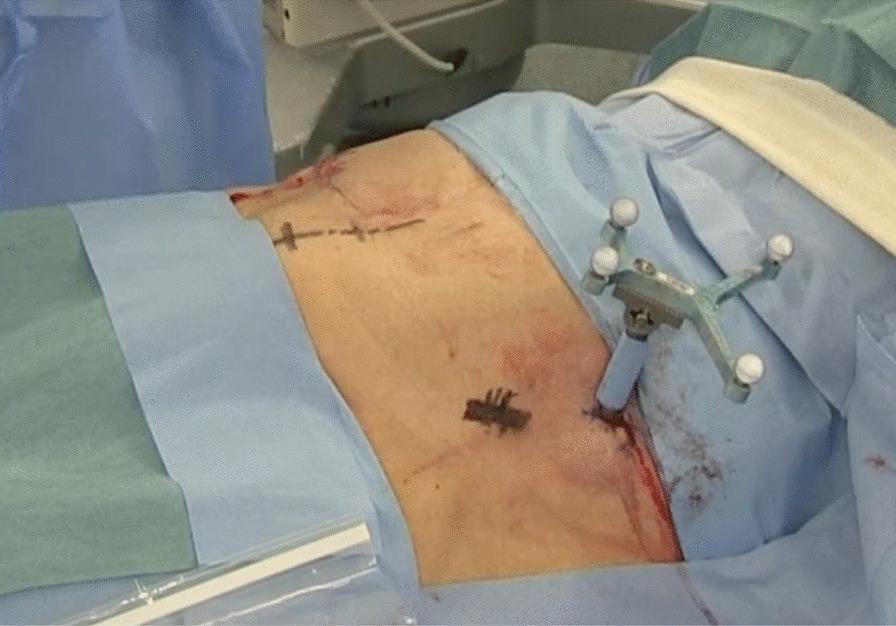
Medtronic StealthStation reference frame fixed to iliac crest via pin — used for navigated pelvic ring fracture fixation
Rockwood & Green's (10th Ed.): Computer-assisted fluoroscopy navigation has "been applied to percutaneous pelvic and acetabular screw placement with expected continued progress."
5. Complex Spinal Deformity
- Navigated osteotomies (e.g., posterior vertebral column resection) guided in real time
- Multiplanar CT reconstructions allow precise bone removal and implant trajectory planning
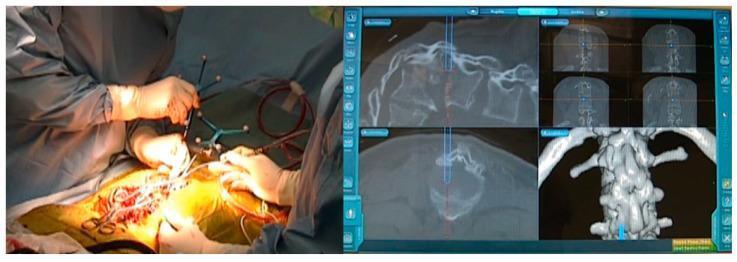
Navigation during posterior vertebral column resection (p-VCR) for severe kyphosis in achondroplasia — multiplanar CT views with real-time instrument tracking displayed on navigation monitor
Robotic-Assisted Navigation
Robotics adds a physical constraint or active assistance on top of navigation:
| System | Type | Application |
|---|
| MAKO (Stryker) | Semi-active (haptic boundary) | TKA, UKA, THA |
| ROSA Knee (Zimmer Biomet) | Semi-active | TKA |
| Mazor X (Medtronic) | Active arm guidance | Pedicle screws |
| ROSA Spine | Active arm guidance | Spine screws |
| Navio (Smith & Nephew) | Imageless robotic | UKA, TKA |
Robotic types:
- Passive: navigation display only, surgeon controls instrument freely
- Semi-active (haptic): robotic arm creates a virtual boundary; surgeon cannot cut outside planned zone
- Active: robot moves autonomously to planned position, surgeon supervises
Miller's Anesthesia (10th Ed.): "Many robotic spine surgery platforms have been introduced, but their acceptance has [been variable] — robots provide intraoperative image-guided navigation combined with robotic assistance for 3D reconstruction for screw placement."
Advantages of Navigation
| Advantage | Detail |
|---|
| Improved accuracy | Reduces outliers in implant positioning and screw placement |
| Reduced radiation | Less fluoroscopy needed intraoperatively |
| Minimally invasive compatibility | Enables MIS approaches without direct visualisation |
| Real-time feedback | Surgeon sees instrument position before committing |
| Documentation | Digital record of intraoperative alignment and implant position |
| Revision planning | Intraoperative data guides revision decisions |
Limitations and Disadvantages
| Limitation | Detail |
|---|
| Increased setup time | Registration and tracker fixation adds 15–30 minutes |
| Cost | Navigation systems expensive; disposables costly per case |
| Learning curve | Requires training; accuracy depends on correct registration |
| Registration error | Poorly performed registration renders the whole system inaccurate |
| Line-of-sight issues | Optical systems require clear view between camera and trackers |
| Reference frame movement | If tracker shifts after registration, all subsequent data is invalid |
| No proven outcome benefit (TKA) | Alignment improved but clinical scores and survival unchanged in RCTs |
| Soft tissue kinematics | Navigation does not assess ligament balance in real time (though kinematic sensors now address this) |
Patient-Specific Instrumentation (PSI) — A Related Concept
PSI uses preoperative CT/MRI to manufacture custom cutting jigs that fit uniquely to the patient's bone surfaces, pre-planned in a virtual environment. It shares navigation's goal of accuracy without an intraoperative system.
Miller's Review of Orthopaedics: "Evidence supports not using patient-specific instrumentation compared to conventional instrumentation for TKA because there is no difference in pain or functional outcomes."
Summary Table: Navigation by Application
| Procedure | Navigation Type | Key Benefit | Evidence Strength |
|---|
| TKA | Imageless / robotic (MAKO) | Reduces malalignment outliers | Strong (no outcome benefit proven) |
| THA | Imageless / robotic | Cup orientation accuracy | Moderate |
| Pedicle screw | CT-based / O-arm robotic | Reduces breach rate | Strong |
| Pelvic screws | Fluoroscopy-based | Corridor accuracy, less radiation | Moderate |
| Spinal deformity | CT navigation | Complex osteotomy precision | Moderate |
| Fracture fixation | Fluoroscopy navigation | MIS guidance, radiation reduction | Emerging |
Navigation represents a significant advance in precision orthopaedic surgery. Its greatest proven benefit is in spinal pedicle screw placement, while in joint replacement its role continues to evolve alongside robotic platforms.
— Schwartz's Principles of Surgery 11th Ed., p. 1937; Rockwood & Green's Fractures in Adults 10th Ed., pp. 232, 895; Miller's Review of Orthopaedics 9th Ed.