

Give details abut this slide and also give images and short video clips link that I can show in my seminar
surgical knot tying types square reef granny surgeon's knot technique video
surgical knot tying YouTube video half hitch reef square granny surgeon knot seminar teaching
surgical knot tying images diagrams half hitch reef square granny surgeon's knot anatomy illustration
Slide 49 - Knot Tying (Surgical Techniques)
What the Slide Covers
The 6 Types of Surgical Knots Illustrated
1. Half-Hitch
- The simplest single throw - one strand crosses over the other and passes through the loop once.
- Crossings are in the same direction (black over pink in the diagram).
- By itself it slips easily and is never used alone as a final knot. It is the building block of all other knots.
- From the textbook: "If too much tension is applied to one strand, that strand will straighten and a half hitch in the other strand will result... half hitches will slip on the straightened member." - Pfenninger & Fowler's Procedures for Primary Care
2. Crossed Half-Hitch
- Similar to a half-hitch but the crossings are opposite (black over pink, then pink over black).
- This configuration is what distinguishes a square knot from a granny knot - the direction of the second throw relative to the first determines which you get.
3. Reef (Square) Knot - THE GOLD STANDARD
- Formed by two throws in opposite helical directions - first throw one way, second throw the other.
- Flat, symmetric, secure, and does not slip.
- The textbook states: "The square knot is the prototype suture knot because it is easy to tie, is strong, and does not loosen easily." - Pfenninger & Fowler's
- Textbook rule: 3 throws minimum; in practice with monofilament (e.g., Prolene) surgeons often add 6-7 throws because of suture memory.
4. Granny Knot - AVOID THIS
- Formed when both throws go in the same helical direction.
- Looks like a square knot but slips much more easily.
- The slide specifically warns: "Avoid the granny - it slips."
- From the textbook: "Granny knots slip much more easily than square knots and therefore should be avoided when tying sutures." - Pfenninger & Fowler's
5. Extra Half-Hitch on Square Knot
- A square knot with an additional single half-hitch added on top for extra security.
- Used when extra security is needed, especially in monofilament sutures with high memory.
6. Surgeon's Knot - TENSION SITUATIONS
- A modified square knot where the first throw has two helical twists (double throw) instead of one.
- The extra twist increases friction and holds the first throw in place while the second throw is applied - critical when tissue edges are under tension and the first throw might loosen.
- From the textbook: "The surgeon's knot is an adaptation of the square knot with two helical twists in the first throw. This additional twist increases the friction within the first throw and helps to hold it tight while the second throw is made." - Pfenninger & Fowler's
Key Bullet Points from the Slide (Explained)
| Point | What It Means |
|---|---|
| Square (reef) = surgeon's (double first throw) | These are the two go-to knots in surgery. Surgeon's knot = square knot but with a doubled first throw |
| Avoid the granny - it slips | Both throws in the same direction = knot failure, wound dehiscence risk |
| Instrument tie vs hand tie | Instrument tie uses needle driver/forceps; hand tie uses fingers. Each has pros and cons depending on depth and access |
Reality Check Box (Explained)
"Textbook says 'square knot, 3 throws.' Monofilament memory means under-throwing unties in vivo - surgeons add throws by feel (Prolene often 6-7)."
Images for Your Seminar
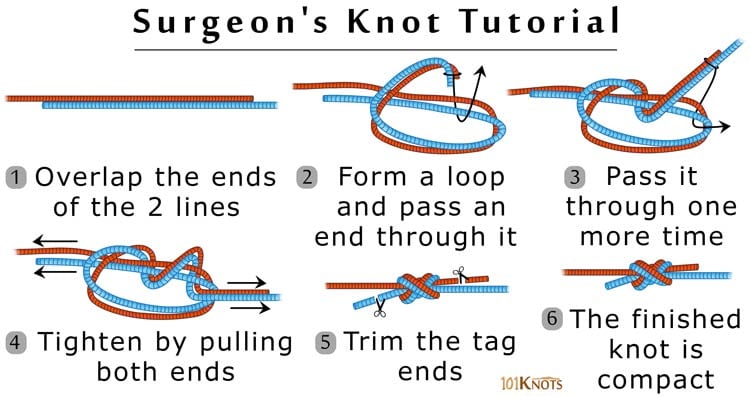
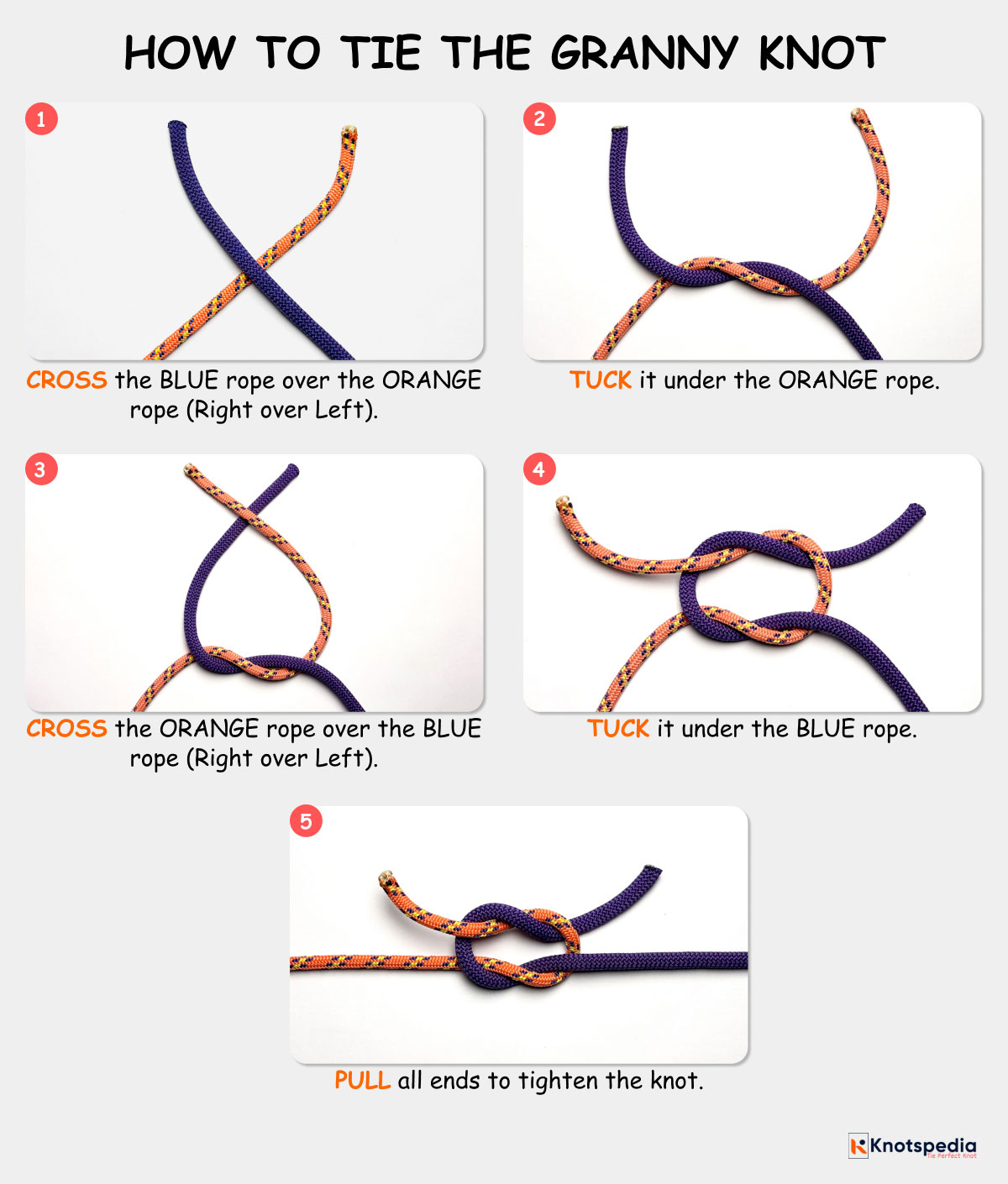
Video Clips for Your Seminar
| Topic | Link | Why Use It |
|---|---|---|
| All surgical knots overview | Learn All Surgical Knots (YouTube) | Covers every knot type in one video - great as a seminar opener |
| Surgeon's knot technique | Master the Surgeon's Knot (YouTube) | Dedicated to the double-first-throw surgeon's knot with clear hand movements |
| Square knot + granny knot | Simutomy: Reef, Granny, Square Knot (YouTube) | Perfect for showing the difference between square (correct) and granny (wrong) |
| Avoiding granny knots | Surgical Knot Tying - Avoiding Granny Knots (Vimeo) | Short and focused - great for the "avoid the granny" bullet point |
| Two-hand square knot | Two-Hand Square Knot (Vimeo) | Clean demonstration of instrument vs hand tie technique |
| Full knot tying module | Surgical Knot Tying Full Video (YouTube) | 15-min comprehensive video including karate chop, figure-4, and square knot techniques |
Bonus: Downloadable PDF Reference
Make poster indicating 6 knots in detailed
A detailed medical educational poster titled "Types of Surgical Knots" for a surgery seminar. The poster has a clean white background with a dark navy blue header bar. It shows 6 surgical knots arranged in a 2x3 grid, each in its own bordered panel with a colored header. Each panel contains a large clear diagram of the knot structure drawn with colored suture lines (pink and black/dark), the knot name as a bold title, a step-by-step formation description, key clinical notes, and a warning or tip box. Panel 1 - HALF-HITCH (blue header): Diagram showing a single throw where one strand loops over the other. Text: "Single throw in one direction. Crossings same direction (black over pink). Building block of all knots. WARNING: Slips alone - never use as final knot." Panel 2 - CROSSED HALF-HITCH (purple header): Diagram showing opposite direction crossings. Text: "Single throw with opposite crossing direction. Black over pink, then pink over black. Transitional throw used in square knot construction." Panel 3 - REEF / SQUARE KNOT (green header): Diagram showing two throws in opposite helical directions forming a flat symmetric knot. Text: "GOLD STANDARD. Two throws in OPPOSITE directions. Flat, symmetric, secure. Minimum 3 throws (monofilament: 6-7 throws). Does not slip easily." Panel 4 - GRANNY KNOT (red header with warning): Diagram showing two throws in the SAME direction forming an asymmetric knot. Text: "DANGER - AVOID. Both throws in SAME direction. Looks like square knot but SLIPS. Risk of wound dehiscence. Common mistake - identify and avoid." Panel 5 - EXTRA HALF-HITCH ON SQUARE KNOT (orange header): Diagram showing a square knot with an additional half-hitch on top. Text: "Square knot + extra half-hitch security layer. Used for high-tension or slippery monofilament sutures. Adds additional friction and holding power." Panel 6 - SURGEON'S KNOT (teal header): Diagram showing first throw with double twist (two loops) followed by single second throw. Text: "DOUBLE FIRST THROW. First throw = 2 helical twists. Second throw = 1 twist (opposite direction). Holds under tissue tension. Use when edges under stress." At the bottom: a coral/salmon colored "CLINICAL PEARL" box stating: "Textbook = 3 throws. In vivo with Prolene (monofilament): add throws by feel - often 6 to 7. Monofilament memory causes untying. Braided sutures need fewer throws." Footer shows "Surgical Techniques - Knot Tying Reference Poster"
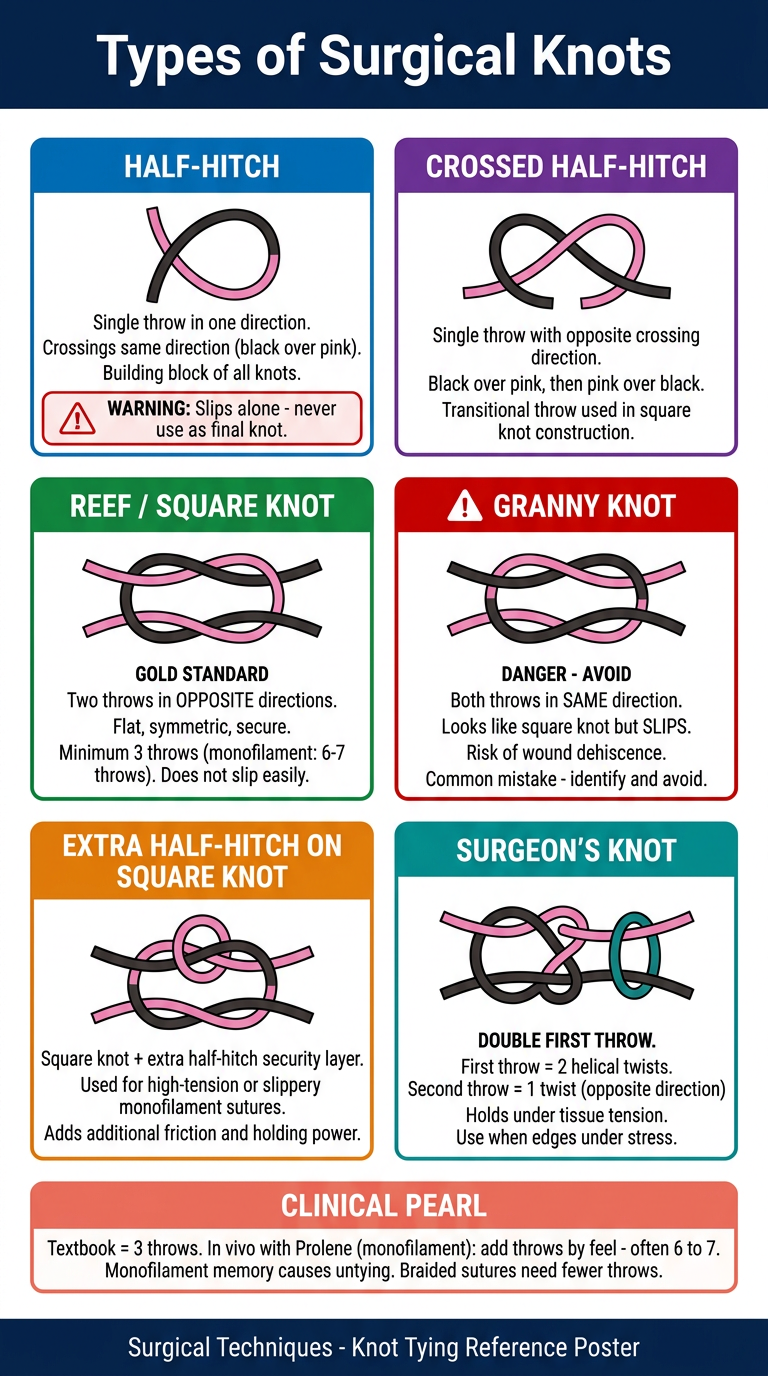
| # | Knot | Key Teaching Point |
|---|---|---|
| 1 | Half-Hitch | Single throw, same direction - building block, slips alone |
| 2 | Crossed Half-Hitch | Opposite direction crossing - transitional throw |
| 3 | Reef/Square Knot | Two opposite throws - gold standard, 3-7 throws |
| 4 | Granny Knot | Both throws same direction - DANGEROUS, avoid |
| 5 | Extra Half-Hitch on Square | Added security layer for monofilament/tension cases |
| 6 | Surgeon's Knot | Double first throw - use when tissue is under tension |
Use above screen shot image for reference
A detailed medical seminar poster that closely replicates the visual style of a surgical techniques slide. White background. Top-left has a small teal/cyan uppercase label "TECHNIQUES" followed by large bold title "Knot tying" in dark serif font. On the RIGHT side, a teal-colored heading "Types of Surgical Knots" sits above a 3-row by 2-column grid of knot diagrams. Each diagram uses EXACTLY the same style as the reference: thick pink suture lines with black/dark crossing lines drawn on a flat tissue surface (beige/skin-toned horizontal band at the bottom of each knot image). Each diagram is clean, minimal, medical illustration style with a label below it: Row 1: - Left: "Half-hitch" - a simple single loop, crossings are same (black over pink), label underneath reads "crossings are same (black over pink)" - Right: "Crossed half-hitch" - single loop with opposite crossings, label reads "crossings are opposite (black/pink)" Row 2: - Left: "Reef or square knot" - flat symmetric two-throw knot with pink and black suture forming a proper square knot on a tissue base, dotted circle highlighting the knot center - Right: "Granny knot" - similar to square but asymmetric loops, dotted circle highlighting the difference, slightly looser look Row 3: - Left: "Extra half-hitch on square knot" - three loops, more complex stacking of throws in pink and black - Right: "Surgeon's knot" - double first throw visible, two loops on first throw, one on second, pink and black suture On the LEFT side below the title, three bullet points in dark text: • Square (reef) · surgeon's (double first throw) • Avoid the granny — it slips • Instrument tie vs hand tie At the BOTTOM, a wide terracotta/burnt orange rectangle box with a small white pill-shaped label "REALITY CHECK" in the top-left corner of the box, and inside the box white text: Textbook says "square knot, 3 throws." Monofilament memory means under-throwing unties in vivo — surgeons add throws by feel (Prolene often 6–7). Overall aesthetic: clean medical textbook slide expanded into a large A3 portrait poster, high resolution, professional surgical education design.
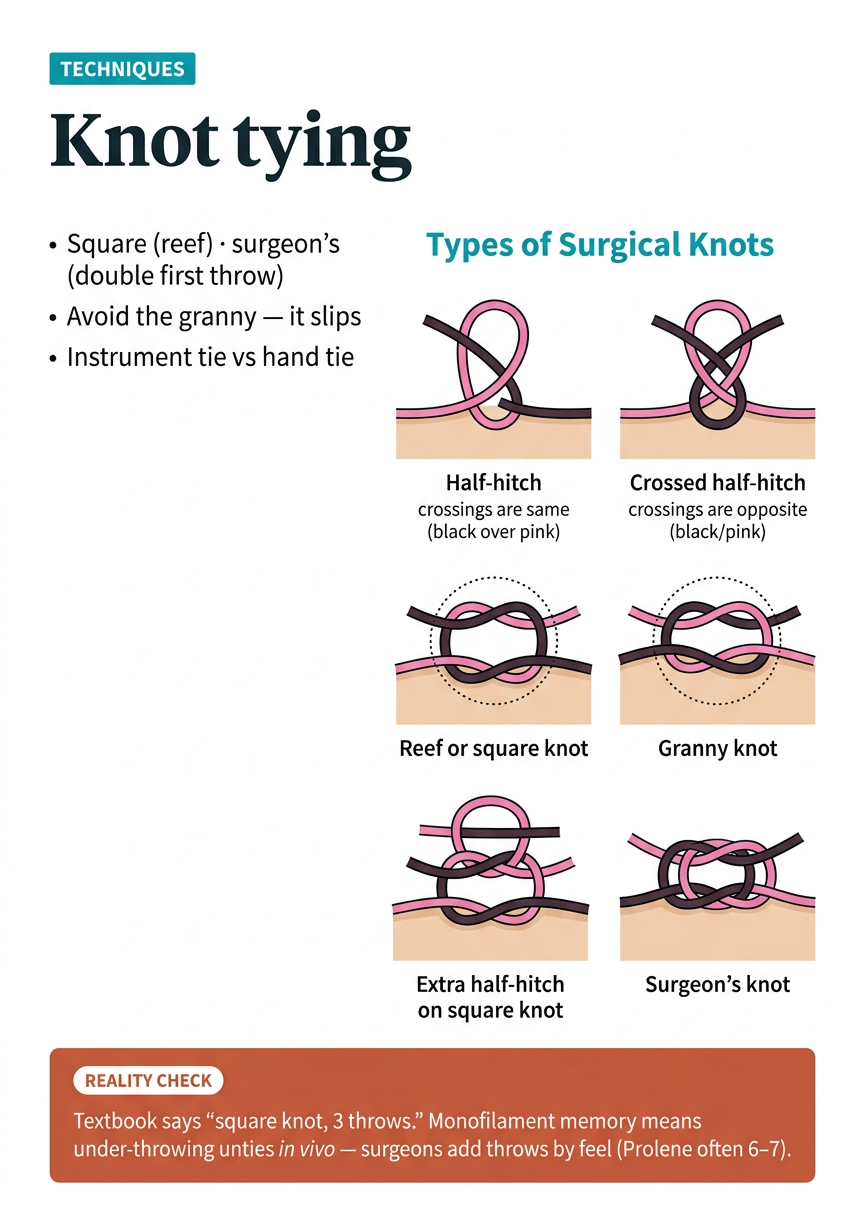
- Same layout - "TECHNIQUES" teal label + "Knot tying" title on the left, knot diagrams on the right
- Same color scheme - pink and black suture lines on a skin-toned tissue base
- Same 3x2 grid - all 6 knots in the same order as your slide (Half-hitch, Crossed half-hitch, Reef/Square, Granny, Extra half-hitch, Surgeon's knot)
- Same bullet points - Square/Reef, Avoid Granny, Instrument vs Hand tie
- Same terracotta "REALITY CHECK" box at the bottom with the Prolene 6-7 throws pearl
Generate correct image of granny And reef knot
A precise medical illustration showing two surgical knots side by side on a white background, labeled clearly. LEFT PANEL - "Reef Knot (Square Knot)" with a green checkmark: Draw the knot using two colored ropes - one PINK and one BLACK. The reef/square knot is formed by two half-hitches in OPPOSITE directions. Step-by-step construction shown above the final knot: Step 1: Pink over black (right over left) Step 2: Black over pink (left over right - OPPOSITE direction) The final knot is FLAT, SYMMETRIC, and SQUARE-shaped. The two loops interlock neatly. The ends exit in opposite directions on the same side. The knot lies flat and does not twist. Both strands exit parallel to the tissue. Label: "OPPOSITE throws = SECURE" in green text. A small note: "crossings are opposite (pink/black)" RIGHT PANEL - "Granny Knot" with a red X warning: Draw using same PINK and BLACK ropes. The granny knot is formed by two half-hitches in the SAME direction. Step-by-step: Step 1: Pink over black (right over left) Step 2: Pink over black AGAIN (same direction - WRONG) The final knot is ASYMMETRIC, TWISTED, and LOPSIDED. One loop sits on top of the other at an angle, the knot looks like it wants to slide. The ends exit at an angle rather than flat. Label: "SAME throws = SLIPS!" in red text. A small note: "crossings are same direction (black over pink both times)" Between the two panels, a clear comparison table: Reef Knot | Granny Knot Opposite throws | Same direction throws Flat and square | Twisted/asymmetric Secure, does not slip | SLIPS - dangerous Gold standard | AVOID in surgery Background is clean white. Illustration style is detailed anatomical/medical textbook quality. Both knots drawn in high detail showing the weave of the suture threads clearly.
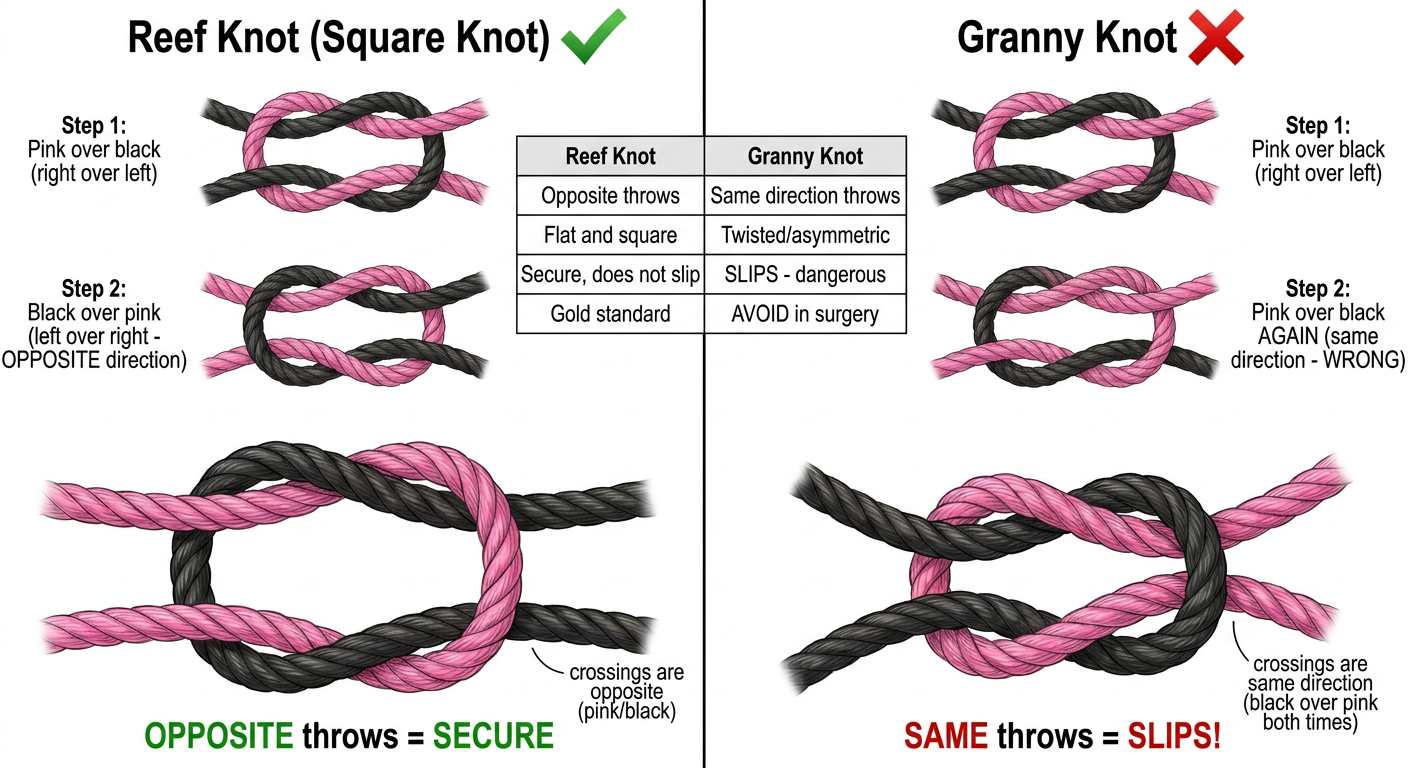
| Feature | Reef / Square Knot | Granny Knot |
|---|---|---|
| Throws | Opposite directions | Same direction both times |
| Shape | Flat, symmetric, square | Twisted, asymmetric, lopsided |
| Security | Locks on itself - secure | Slides along the suture - slips |
| Use in surgery | Gold standard | Never use - risk of wound dehiscence |