
Explain about oncogene and conversion of proto oncogenes to oncogenes in biochemistry
Reading File
Now let me search the medical library for oncogenes and proto-oncogene conversion topics in parallel.
Finding Sources
Finding Sources
Excellent! Found the key biochemistry source. Let me now read the relevant sections in parallel.
Reading File
Finding Sources
The biochemistry textbook has detailed content. Let me read the core oncogene sections.
Reading File
Reading File
I now have rich content. Let me read the specific section on gain-of-function mutations in proto-oncogenes and the oncogene classes.
Reading File
Reading File
I now have excellent content. Let me also fetch the key diagram showing transforming mutations in proto-oncogenes.
Loading Image
Reading File
I now have comprehensive content to write a detailed, well-organized answer. Let me compile everything.
Oncogenes and Conversion of Proto-Oncogenes to Oncogenes
(Source: Basic Medical Biochemistry - A Clinical Approach, 6e)
1. What is a Proto-Oncogene?
Proto-oncogenes are normal cellular genes that regulate cellular proliferation and differentiation. They encode proteins involved in:
- Growth factor signaling
- Signal transduction
- Transcription factor activity
- Cell cycle regulation
When a proto-oncogene undergoes a gain-of-function mutation, it becomes an oncogene - a mutated, overactive version that drives uncontrolled cell growth. The term "oncogene" comes from the Greek onkos, meaning "bulk" or "tumor."
"The genes that regulate cellular growth are called proto-oncogenes, and their mutated forms are called oncogenes."
- Basic Medical Biochemistry, p. 594
2. What is an Oncogene?
An oncogene is a mutated proto-oncogene that produces either:
- A more active protein (hyperactive/constitutively active), or
- An increased amount of the normal protein
Either way, the result is that growth-promoting signals are continuously "on," pushing the cell toward uncontrolled proliferation even in the absence of normal activating signals.
The first proof that oncogenes were mutant proto-oncogenes came from studies of human bladder carcinoma, where the ras oncogene sequence differed from the normal c-ras by just a single point mutation - yet this was enough to transform normal cells.
3. Mechanisms of Conversion: Proto-Oncogene → Oncogene
There are four major mechanisms:
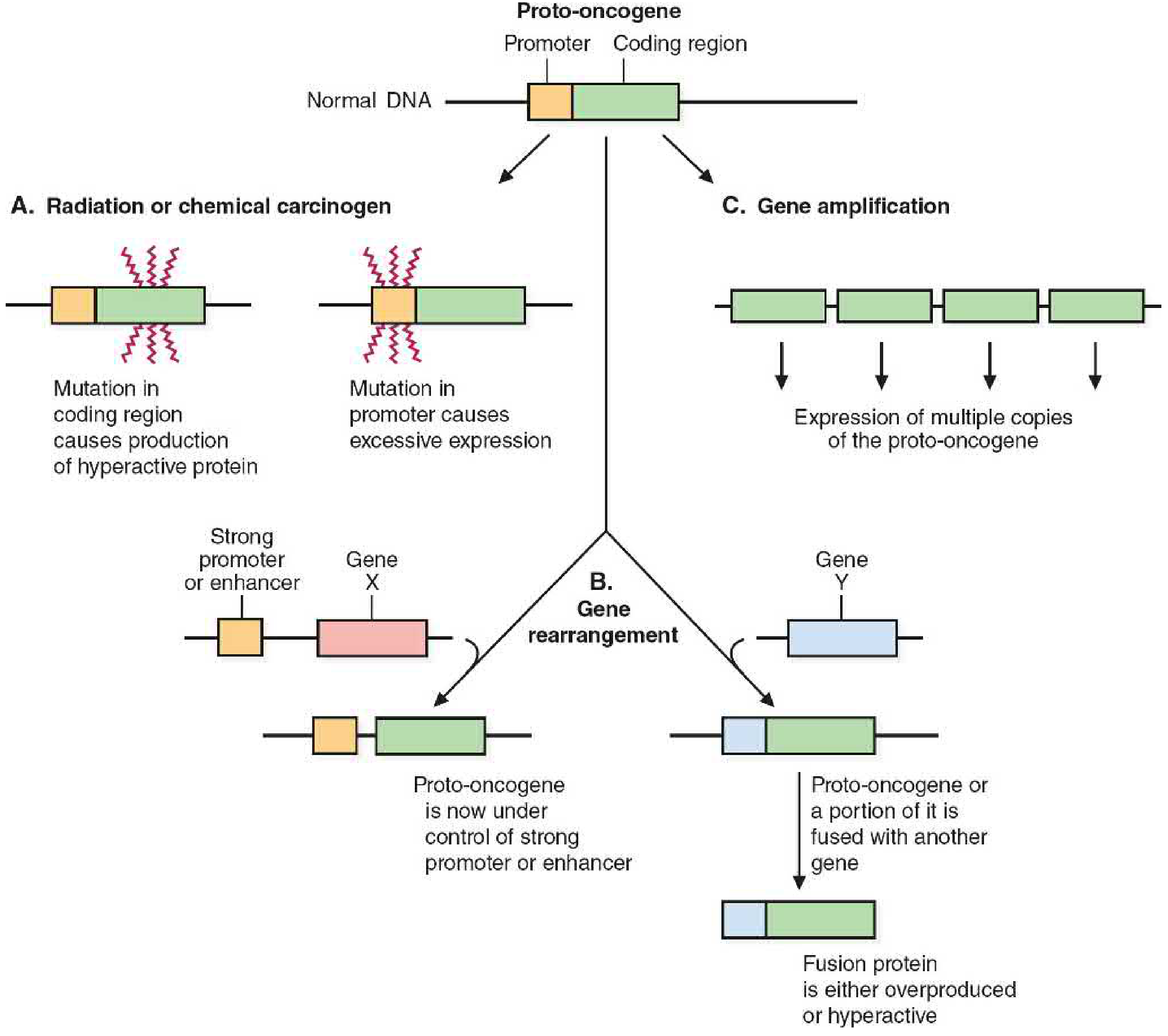
A. Point Mutations / Chemical & Radiation Carcinogens
Radiation, UV light, and chemical carcinogens (e.g., nitrosamines) cause mutations in DNA in two ways:
- Mutation in the coding region - produces a protein with altered amino acid composition that is constitutively active (hyperactive), even without its normal activating signal
- Mutation in the promoter/regulatory region - increases the rate of transcription, resulting in overproduction of the normal proto-oncogene protein
Classic example: A single point mutation at codon 12 of ras (glycine → valine) locks the Ras G-protein in its active GTP-bound state permanently, continuously stimulating cell proliferation. This mutation is found in lung, colon, thyroid, pancreatic cancers, and many leukemias.
B. Gene Rearrangement (Translocation or Transposition)
The proto-oncogene (or a portion of it) is moved from its normal chromosomal location to a new position. This can cause:
- Strong promoter takeover - the relocated gene comes under control of a stronger, more active promoter, leading to overexpression in inappropriate tissues or at abnormally high levels
- Fusion protein formation - a portion of the proto-oncogene fuses with another gene, producing a chimeric protein that is hyperactive or loses its regulatory region
Classic examples:
-
Burkitt lymphoma: The proto-oncogene c-myc (chromosome 8) translocates to chromosome 14, placing it under the control of the immunoglobulin heavy-chain promoter - a very active promoter in B cells. This causes massive overexpression of Myc transcription factor → uncontrolled B-cell proliferation.
-
Chronic Myelogenous Leukemia (CML) - Philadelphia Chromosome: A reciprocal translocation between chromosomes 9 and 22 fuses the Bcr gene (chr 22) with the Abl proto-oncogene (chr 9). The resulting Bcr-Abl fusion protein has lost its regulatory region and is constitutively active as a tyrosine kinase, continuously activating the Ras pathway and driving leukemic cell proliferation. This is the molecular target of the drug imatinib (Gleevec).
C. Gene Amplification
Multiple copies of the proto-oncogene are produced in a single cell. More gene copies = more mRNA = more protein = accelerated cell growth.
Examples:
- N-myc amplification in some neuroblastomas (associated with poor prognosis)
- erb-B2 (HER2/neu) amplification in breast, ovarian, lung, and stomach cancers - this is the target of trastuzumab (Herceptin)
D. Viral Insertion
- Direct oncogene insertion: An oncogenic virus integrates its viral oncogene (v-onc) into the host cell genome
- Insertional mutagenesis: A virus inserts a strong viral promoter adjacent to a normal cellular proto-oncogene, driving its overexpression (e.g., retroviruses in animal models)
4. Classes of Oncogenes and Associated Tumors
Oncogenes can be classified by the normal function of their protein products:
| Class | Proto-oncogene | Activation Mechanism | Location | Associated Tumor |
|---|---|---|---|---|
| Growth factors | sis (PDGF-β) | Overexpression | Secreted | Glioma |
| int-2 (FGF) | Amplification | Secreted | Fibrosarcoma, Breast cancer, Melanoma | |
| Growth factor receptors | erb-B1 (EGFR) | Overexpression | Cell membrane | Squamous cell carcinoma (lung) |
| erb-B2 (HER2) | Amplification | Cell membrane | Breast, ovarian, lung, stomach cancers | |
| PDGFR | Translocation | Cell membrane | Chronic myelomonocytic leukemia | |
| SMO (Hedgehog) | Point mutation | Cell membrane | Basal cell carcinoma | |
| Signal transduction (G-protein) | ras | Point mutation | Cytoplasm | Lung, colon, thyroid, pancreas, leukemias |
| Tyrosine kinases | abl | Translocation | Cytoplasm | Chronic myeloid leukemia (Philadelphia chr) |
| src | Overexpression | Cytoplasm | Acute lymphoblastic leukemia, Colon carcinoma | |
| raf | Overexpression | Cytoplasm | Myeloid leukemia | |
| Serine-threonine kinase | akt2 | Amplification | Cytoplasm | Ovarian carcinoma |
| Hormone receptors | RARα (retinoid) | Translocation | Nucleus | Acute promyelocytic leukemia |
| Transcription factors | Myc | Translocation | Nucleus | Burkitt lymphoma |
5. The Multistep Nature of Carcinogenesis
A single mutation in a proto-oncogene is not sufficient to cause cancer. Full transformation requires the accumulation of 4 to 7 mutations in genes controlling:
- Cell proliferation/differentiation (proto-oncogenes)
- Growth suppression (tumor-suppressor genes like Rb, p53)
- DNA repair (BRCA1, BRCA2, mismatch repair genes)
- Apoptosis regulation
The process follows a pattern of clonal expansion: one cell acquires a mutation, proliferates to form a large population, then one cell in that population acquires a second mutation, and so on. Each expansion step increases the probability of acquiring the next transforming mutation.
Key Summary
| Feature | Proto-oncogene | Oncogene |
|---|---|---|
| Normal function | Promotes regulated growth | Drives uncontrolled growth |
| Mutation type | None | Gain-of-function |
| Activity | Active only when signaled | Constitutively active |
| Copies | Normal (2 alleles) | Amplified or overexpressed |
| Dominance | - | Dominant (one mutant allele suffices) |
The dominant nature of oncogenes means that even a single mutated allele can override the normal allele and drive transformation - unlike tumor-suppressor gene mutations, which require loss of both alleles (Knudson's "two-hit" hypothesis).
- Basic Medical Biochemistry - A Clinical Approach, 6e, pp. 594-597
This is a shared conversation. Sign in to Orris to start your own chat.