
What would you like me to do with these 6 papers?
What aspect should the synthesis focus on?
Extract and summarize the clinical content from three PDF papers. Use Python/pypdf or pdfplumber to extract text from each PDF. Focus especially on: study design, patient population, key findings, and most importantly clinical implications & recommendations. PDF 1: /home/daytona/workspace/attachments/1330cdbb-d555-477b-b190-9cb511f0f5d7/crt-2025-1161.pdf PDF 2: /home/daytona/workspace/attachments/1330cdbb-d555-477b-b190-9cb511f0f5d7/theoncologist_1646.pdf PDF 3: /home/daytona/workspace/attachments/1330cdbb-d555-477b-b190-9cb511f0f5d7/nihms-1647173.pdf For each paper, return: - Full title and authors - Journal and year - Study type (RCT, retrospective, review, etc.) - Cancer type(s) and patient population - Key findings (2-4 bullet points) - Clinical implications and recommendations (this is the most important section - be thorough) - Any biomarkers or predictive markers discussed Use pdfplumber to extract text. Read the first ~50-80% of each PDF to capture abstract, introduction, results, discussion, and conclusion. Return structured summaries for all 3 papers.
Extract and summarize the clinical content from three PDF papers. Use Python/pypdf or pdfplumber to extract text from each PDF. Focus especially on: study design, patient population, key findings, and most importantly clinical implications & recommendations. PDF 1: /home/daytona/workspace/attachments/1330cdbb-d555-477b-b190-9cb511f0f5d7/po-7-e2200179.pdf PDF 2: "/home/daytona/workspace/attachments/1330cdbb-d555-477b-b190-9cb511f0f5d7/Manuscript Lancet Accepted Version (1).pdf" PDF 3: "/home/daytona/workspace/attachments/1330cdbb-d555-477b-b190-9cb511f0f5d7/The Oncologist - 2016 - Lee - Mismatch Repair Deficiency and Response to Immune Checkpoint Blockade.pdf" For each paper, return: - Full title and authors - Journal and year - Study type (RCT, retrospective, review, etc.) - Cancer type(s) and patient population - Key findings (2-4 bullet points) - Clinical implications and recommendations (this is the most important section - be thorough) - Any biomarkers or predictive markers discussed Use pdfplumber to extract text. Read the first ~50-80% of each PDF to capture abstract, introduction, results, discussion, and conclusion. Return structured summaries for all 3 papers.
python3 << 'EOF' import pdfplumber import os pdfs = { "pdf1": "/home/daytona/workspace/attachments/1330cdbb-d555-477b-b190-9cb511f0f5d7/po-7-e2200179.pdf", "pdf2": "/home/daytona/workspace/attachments/1330cdbb-d555-477b-b190-9cb511f0f5d7/Manuscript Lancet Accepted Version (1).pdf", "pdf3": "/home/daytona/workspace/attachments/1330cdbb-d555-477b-b190-9cb511f0f5d7/The Oncologist - 2016 - Lee - Mismatch Repair Deficiency and Response to Immune Checkpoint Blockade.pdf" } for key, path in pdfs.items(): print(f"\n{'='*80}") print(f"PDF: {key} => {os.path.basename(path)}") print(f"{'='*80}") try: with pdfplumber.open(path) as pdf: total_pages = len(pdf.pages) pages_to_read = max(1, int(total_pages * 0.80)) print(f"Total pages: {total_pages}, Reading first {pages_to_read} pages") for i, page in enumerate(pdf.pages[:pages_to_read]): text = page.extract_text() if text: print(f"\n--- Page {i+1} ---") print(text) except Exception as e: print(f"ERROR: {e}") EOF
python3 << 'EOF' import pdfplumber pdf_path = "/home/daytona/workspace/attachments/1330cdbb-d555-477b-b190-9cb511f0f5d7/crt-2025-1161.pdf" with pdfplumber.open(pdf_path) as pdf: total_pages = len(pdf.pages) print(f"Total pages: {total_pages}") # Extract first ~75% of pages pages_to_read = max(1, int(total_pages * 0.80)) print(f"Reading {pages_to_read} pages") text = "" for i in range(pages_to_read): page_text = pdf.pages[i].extract_text() if page_text: text += f"\n--- PAGE {i+1} ---\n{page_text}" print(text[:25000]) EOF
python3 << 'EOF' import pdfplumber pdf_path = "/home/daytona/workspace/attachments/1330cdbb-d555-477b-b190-9cb511f0f5d7/crt-2025-1161.pdf" with pdfplumber.open(pdf_path) as pdf: total_pages = len(pdf.pages) pages_to_read = max(1, int(total_pages * 0.80)) text = "" for i in range(pages_to_read): page_text = pdf.pages[i].extract_text() if page_text: text += f"\n--- PAGE {i+1} ---\n{page_text}" # Print pages 7-11 print(text[25000:]) EOF
python3 << 'EOF' import pdfplumber pdf_path = "/home/daytona/workspace/attachments/1330cdbb-d555-477b-b190-9cb511f0f5d7/theoncologist_1646.pdf" with pdfplumber.open(pdf_path) as pdf: total_pages = len(pdf.pages) print(f"Total pages: {total_pages}") pages_to_read = max(1, int(total_pages * 0.80)) print(f"Reading {pages_to_read} pages") text = "" for i in range(pages_to_read): page_text = pdf.pages[i].extract_text() if page_text: text += f"\n--- PAGE {i+1} ---\n{page_text}" print(text[:30000]) EOF
python3 << 'EOF' import pdfplumber pdf_path = "/home/daytona/workspace/attachments/1330cdbb-d555-477b-b190-9cb511f0f5d7/theoncologist_1646.pdf" with pdfplumber.open(pdf_path) as pdf: total_pages = len(pdf.pages) pages_to_read = max(1, int(total_pages * 0.80)) text = "" for i in range(pages_to_read): page_text = pdf.pages[i].extract_text() if page_text: text += f"\n--- PAGE {i+1} ---\n{page_text}" print(text[30000:]) EOF
python3 << 'EOF' import pdfplumber pdf_path = "/home/daytona/workspace/attachments/1330cdbb-d555-477b-b190-9cb511f0f5d7/nihms-1647173.pdf" with pdfplumber.open(pdf_path) as pdf: total_pages = len(pdf.pages) print(f"Total pages: {total_pages}") pages_to_read = max(1, int(total_pages * 0.80)) print(f"Reading {pages_to_read} pages") text = "" for i in range(pages_to_read): page_text = pdf.pages[i].extract_text() if page_text: text += f"\n--- PAGE {i+1} ---\n{page_text}" print(text[:30000]) EOF
python3 << 'EOF' import pdfplumber pdf_path = "/home/daytona/workspace/attachments/1330cdbb-d555-477b-b190-9cb511f0f5d7/nihms-1647173.pdf" with pdfplumber.open(pdf_path) as pdf: total_pages = len(pdf.pages) pages_to_read = max(1, int(total_pages * 0.80)) text = "" for i in range(pages_to_read): page_text = pdf.pages[i].extract_text() if page_text: text += f"\n--- PAGE {i+1} ---\n{page_text}" # Print pages 9 onwards print(text[30000:]) EOF
Clinical Synthesis: dMMR/MSI-H Across Six Papers
The Six Papers at a Glance
| # | Paper | Journal / Year | Study Type | Primary Scope |
|---|---|---|---|---|
| 1 | Kwak et al. | Cancer Res Treat, 2026 | Comprehensive expert review | Pan-tumor dMMR diagnostics & treatment |
| 2 | Lee, Murphy, Le, Diaz | The Oncologist, 2016 | Review + Phase 2 trial (Le NEJM 2015) | Foundational ICI evidence in dMMR |
| 3 | Latham et al. | Clin Cancer Res, 2021 | Retrospective cohort (n=100) | dMMR small bowel adenocarcinoma |
| 4 | Gutierrez et al. | JCO Precis Oncol, 2023 | Retrospective NCDB (n=101,259) | MSI-H prevalence & prognosis in US CRC |
| 5 | Ercan, Tabori et al. | The Lancet, 2022-23 | Prospective int'l registry (n=201) | Constitutional MMR deficiency (CMMRD) |
| 6 | Lee / Diaz | The Oncologist, 2016 | Review + Phase 2 trial data | Same as Paper 2 (appears to be the same publication) |
I. Universal Testing: The Most Consistent Cross-Paper Recommendation
- Kwak 2026: Test all solid tumors; IHC is the first-line method when tissue is limited (needs only 4 slides); ctDNA-based MSI is research-only and not yet a clinical-grade diagnostic.
- Lee/Diaz 2016: Predicted (correctly) that MSI testing would become a pan-cancer biomarker; argued it should expand beyond CRC and endometrial cancer to all tumor types with documented dMMR rates.
- Latham 2021 (SBA): Demonstrated that SBA has a 26% dMMR rate - higher than CRC - and that 50% of Lynch syndrome cases in this series would have gone undetected without MMR testing of the SBA. Mandates universal testing for all small bowel adenocarcinomas.
- Gutierrez 2023 (NCDB): Shows that 14.2% of all US CRC is MSI-H, with specific populations at higher risk (elderly patients: ~20% MSI-H; medullary histology: 41%; mucinous: 24.6%). Testing cannot be selectively skipped in elderly patients or on the basis of histological assumption.
- Ercan/Tabori 2022 (CMMRD): Demonstrates the catastrophic consequences of missed testing - patients with Constitutional MMR Deficiency develop cancers starting in infancy; 90% cumulative cancer incidence by age 18.
II. Immunotherapy Selection: Who Benefits and How Much
| Population | ICI Agent | Response Rate | Source |
|---|---|---|---|
| dMMR CRC (3rd-line+) | Pembrolizumab | 40% irORR | Lee/Diaz 2016 |
| pMMR CRC (3rd-line+) | Pembrolizumab | 0% irORR | Lee/Diaz 2016 |
| dMMR non-CRC (ampullary, cholangiocarcinoma, endometrial, SBA, gastric) | Pembrolizumab | 71% irORR | Lee/Diaz 2016 |
| Advanced dMMR SBA | Various ICI | 60% (3/5) | Latham 2021 |
| CMMRD (pediatric/young adult) | Various ICI | Improved 5-yr OS: 56% vs. 28% | Ercan/Tabori 2022 |
- First-line metastatic MSI-H/dMMR CRC: Pembrolizumab is FDA-approved (KEYNOTE-177); nivolumab ± ipilimumab received CRC approval in April 2025 (Kwak 2026). Offer ICI first-line without delay.
- All advanced solid tumors with confirmed dMMR: The FDA's 2017 tumor-agnostic pembrolizumab approval applies. Tumor histology should not determine ICI eligibility - biomarker status alone should.
- CMMRD patients with advanced cancers: ICI should be introduced early and universally, given that every CMMRD tumor is ultra-hypermutated regardless of histology.
- Gene-specific benefit in CMMRD (Ercan/Tabori): ICI benefit was most pronounced in PMS2/MSH6 patients (5-yr OS 58% vs. 33% without ICI). MLH1/MSH2 CMMRD patients benefit more from surveillance than from ICI alone, likely because CNS tumors in this group have distinct dynamics.
III. Chemotherapy Avoidance: Consensus Across All Applicable Papers
- Stage II CRC (Lee/Diaz 2016; Kwak 2026; Gutierrez 2023): Multiple prospective trials and meta-analyses confirm 5-FU monotherapy does not benefit MSI-H stage II colon cancer. NCCN guidelines advise against adjuvant 5-FU monotherapy. The mechanism is clear: an intact MMR system is required to recognize 5-FU-induced DNA damage; dMMR cells cannot register this damage to trigger cell death.
- Stage III CRC (Kwak 2026): FOLFOX/CAPOX (oxaliplatin-containing regimens) retains benefit in MSI-H stage III disease; the detrimental effect of 5-FU monotherapy appears to be overcome by adding oxaliplatin.
- Gastric cancer (Kwak 2026; Lee/Diaz 2016): MSI-H gastric cancer appears not to benefit from standard capecitabine+oxaliplatin adjuvant regimens post-D2 resection. Retrospective Korean data showed that adding adjuvant chemotherapy in MSI-H gastric cancer actually flipped a survival advantage (HR 0.49 favoring MSI-H) into a disadvantage (HR 1.16). ESMO recommends careful consideration before using adjuvant chemo in this subset.
- Endometrial cancer (Kwak 2026): dMMR EC should NOT receive chemoradiation purely on the basis of high histologic grade. ESGO/ESTRO/ESP guidelines mandate molecular classification first - it is the p53-mutant (POLE-wt) subgroup, not dMMR, that gains from chemoradiation.
- Small bowel adenocarcinoma Stage II (Latham 2021): MMR-D stage II SBA had a recurrence rate of 18.2% vs. 88.2% in MMR-P patients - an 8-fold difference. By analogy with dMMR CRC, consideration should be given to withholding adjuvant chemotherapy in MMR-D stage II SBA.
IV. Lynch Syndrome Detection: A Shared Obligation
- Latham 2021 (SBA): 38.5% of dMMR SBAs harbor Lynch syndrome - twice the LS rate seen in dMMR CRC (19%). Critically, 50% of these LS patients had SBA as their very first cancer, and 80% had no family history of SBA. Without MMR testing, Lynch syndrome would be entirely missed in these patients and their families.
- Gutierrez 2023 (NCDB CRC): Bimodal age distribution of MSI-H (peaks in patients <30 and ≥80) reflects the dual LS (early-onset, germline) and sporadic (late-onset, CIMP-driven) etiologies, underscoring the need for different downstream workups at different ages.
- Kwak 2026: Complete algorithm for distinguishing sporadic dMMR from Lynch: MLH1 promoter methylation testing + BRAF V600E. If MLH1 is lost on IHC and methylation is absent and BRAF is wild-type, Lynch syndrome should be presumed until ruled out by germline testing.
V. Diagnostic Pitfalls: Where Testing Goes Wrong
- Missense MMR mutations producing immunoreactive but non-functional proteins: In one Latham 2021 case, a patient with germline MLH1 c.55A>T missense variant had MSI-H SBA confirmed by MSIsensor (score 25.06) but showed intact MLH1 staining on IHC - because the mutant protein was present but non-functional. She had a prior dMMR endometrial cancer that was also IHC-negative. This patient's Lynch syndrome would have been missed by IHC alone.
- Atypical punctate nucleolar MLH1 staining (Kwak 2026): A pattern that can be misread as retained expression (false negative) by inexperienced pathologists.
- Subclonal MMR loss: Heterogeneous staining where some tumor cells retain expression.
- Spatial/temporal heterogeneity (Kwak 2026): ~12% of metastatic CRC patients have MMR-discordant primary vs. metastasis. Testing the primary alone is insufficient in metastatic disease; rebiopsy and retesting of a metastatic site should be considered.
VI. Population-Specific and Equity Considerations
- Non-Hispanic White: 16.9% MSI-H
- Hispanic: 15.1%
- Asian/Pacific Islander: 12.4%
- Non-Hispanic Black: 11.3%
VII. Emerging and Neoadjuvant Frontiers
- Neoadjuvant ICI for locally advanced dMMR CRC: Phase II trials show substantial pathological responses; non-operative ("watch and wait") organ-preservation strategies are being investigated. This is not yet standard of care but represents an active and rapidly evolving area.
- ctDNA-based MSI testing: Sensitivity as low as 6% at tumor fractions below 1%. No FDA CDx approval as of 2025; ESMO recommends only when tissue is unavailable. Not reliable enough for routine clinical decision-making.
Master Summary: Seven Actionable Clinical Recommendations
| Priority | Recommendation | Evidence Source(s) |
|---|---|---|
| 1 | Test all solid tumors for MMR/MSI reflexively; do not restrict to CRC/endometrial | All 6 papers |
| 2 | Offer PD-1 checkpoint inhibitors to ALL advanced dMMR/MSI-H solid tumors regardless of histology | Lee/Diaz 2016; Kwak 2026; Latham 2021; Ercan/Tabori 2022 |
| 3 | Withhold adjuvant 5-FU monotherapy in dMMR/MSI-H stage II CRC; use FOLFOX for stage III | Lee/Diaz 2016; Kwak 2026; Gutierrez 2023 |
| 4 | Reflexively pursue Lynch syndrome workup (methylation + BRAF + germline) for every dMMR case | Kwak 2026; Latham 2021; Gutierrez 2023 |
| 5 | Supplement IHC with PCR/NGS MSI testing in high-suspicion Lynch syndrome cases with "retained" IHC | Kwak 2026; Latham 2021 |
| 6 | Apply gene-specific and variant-specific management in CMMRD: surveillance for MLH1/MSH2; ICI priority for PMS2/MSH6 with advanced cancer | Ercan/Tabori 2022 |
| 7 | Account for racial/ethnic and community-specific factors in MSI-H screening programs and CMMRD risk assessment | Gutierrez 2023; Ercan/Tabori 2022 |
I didn't understand
What part would you like me to clarify or simplify?
What These 6 Papers Are All About - Simply Explained
The Big Idea
- dMMR = deficient Mismatch Repair (the repair system is broken)
- MSI-H = Microsatellite Instability-High (a lab test result that means the same thing)
Why Does a Broken Spell-Checker Matter?
What the 6 Papers Found - In Simple Terms
Papers 1 & 6 - The 2016 Review (Lee, Diaz)
"We proved that patients with broken spell-checkers respond dramatically to immunotherapy - regardless of which organ the cancer is in."
- Patients with the broken spell-checker had a 40-71% response rate to the drug pembrolizumab
- Patients with a normal spell-checker had a 0% response rate to the same drug
- This was the study that led to the first-ever cancer drug approved for any tumor type based purely on a DNA test, not the organ of origin
Paper 2 - The 2026 Expert Review (Kwak)
"Here is everything doctors need to know about how to test for the broken spell-checker and what to do with the results."
- Explains which lab tests to use and when
- Warns about common mistakes in testing (some tests can give false results)
- Notes that immunotherapy is now approved for many tumor types
- Advises against certain chemotherapy regimens in these patients
Paper 3 - Small Bowel Cancer Study (Latham, 2021)
"In small bowel cancer, the broken spell-checker is even more common than we thought, and finding it is critical for two reasons."
- 26% of small bowel cancers have the broken spell-checker
- These patients have a much lower chance of cancer coming back after surgery (18% vs. 88%)
- Importantly: 38% of these patients turned out to have an inherited condition called Lynch syndrome - which means their entire family may also be at risk
Paper 4 - US Population Study (Gutierrez, 2023)
"In the US, about 1 in 7 colon cancer patients has the broken spell-checker - but rates differ significantly by race and ethnicity."
- 14.2% of all US colon cancer patients have the broken spell-checker
- It is more common in older patients, women, and certain tumor types
- Black and Asian patients have lower rates (~11-12%) than White patients (~17%) - and screening programs need to account for this
- These patients live longer when treated appropriately
Paper 5 - Inherited Form in Children (Ercan, Tabori, 2022)
"In rare cases, children are born with the broken spell-checker in every cell of their body - and they develop cancers starting in early childhood."
- This rare inherited syndrome is called CMMRD (Constitutional MMR Deficiency)
- By age 18, 90% of these children have developed at least one cancer
- The specific gene that is broken determines how aggressive the disease is
- Regular surveillance (screening) and immunotherapy dramatically improve survival
- Doctors often misdiagnose these children as having a different condition (NF1), which delays treatment
The Practical Takeaways for Doctors - Very Simply
| Question | Answer |
|---|---|
| Should every cancer patient be tested? | Yes - all solid tumors should be tested for the broken spell-checker |
| What if the test is positive (broken spell-checker)? | Prioritize immunotherapy; it works dramatically better than in other patients |
| What chemo should be avoided? | 5-FU-based chemotherapy alone in stage II colon/gastric/endometrial cancer |
| What else should be done? | Check if the patient has an inherited Lynch syndrome - which would put their family at risk too |
| What if testing gives unclear results? | Don't rely on just one type of test; use both blood/tissue molecular tests and protein staining together |
| What about children? | If a child develops multiple cancers, consider the inherited form (CMMRD) - especially in communities where family members have children together |
Create a one-page clinical decision flowchart for MMR testing and treatment
A clean, professional one-page clinical decision flowchart for MMR (Mismatch Repair) testing and treatment in oncology. The flowchart should flow top to bottom with clear decision boxes and arrows. Include these steps in order: START: "Newly Diagnosed Solid Tumor" (green header box) Step 1 decision diamond: "Perform MMR/MSI Testing" with sub-note "IHC (MLH1, MSH2, MSH6, PMS2) + PCR/NGS-based MSI" Two branches: LEFT branch (red/orange): "pMMR / MSS" → "Standard treatment per tumor type and stage" → END RIGHT branch (green): "dMMR / MSI-H" → continues down Step 2 (right branch): Decision diamond "Stage / Setting?" - Branch A: "Stage II Colon Cancer" → box "Avoid 5-FU monotherapy adjuvant. Consider surgery alone or FOLFOX if high-risk features." - Branch B: "Stage III Colon / Gastric / Endometrial" → box "FOLFOX acceptable for CRC. Caution with adjuvant chemo in gastric/endometrial - molecular subtype first." - Branch C: "Metastatic / Advanced Disease" → box "Offer PD-1 inhibitor (pembrolizumab/nivolumab) FIRST LINE. FDA tumor-agnostic approval." Step 3: All dMMR branches converge to: "Lynch Syndrome Workup" box (yellow) → "Test MLH1 methylation + BRAF V600E" Two sub-branches: - "Methylated MLH1 / BRAF mutant → Sporadic. No germline referral needed." - "Unmethylated / BRAF wild-type → Refer for germline testing. Cascade family screening." Step 4 warning box (orange): "⚠ Testing Pitfalls: If strong Lynch suspicion but IHC intact → Add PCR/NGS MSI (missense mutations can give false-negative IHC). Retest metastatic site if primary was tested." Step 5 special note box (purple): "CMMRD (Pediatric): Multiple cancers in child / consanguinity → Biallelic MMR germline testing. Gene-specific surveillance + early ICI." Footer: "Sources: KEYNOTE-158/177 | NCDB 2023 | Lancet IRRDC 2022 | NCCN Guidelines" Use a white background, clear sans-serif font, color-coded boxes (green=positive/actionable, red=negative branch, yellow=genetic workup, orange=warnings, purple=special populations), professional medical style suitable for a hospital wall poster or clinical guideline document.
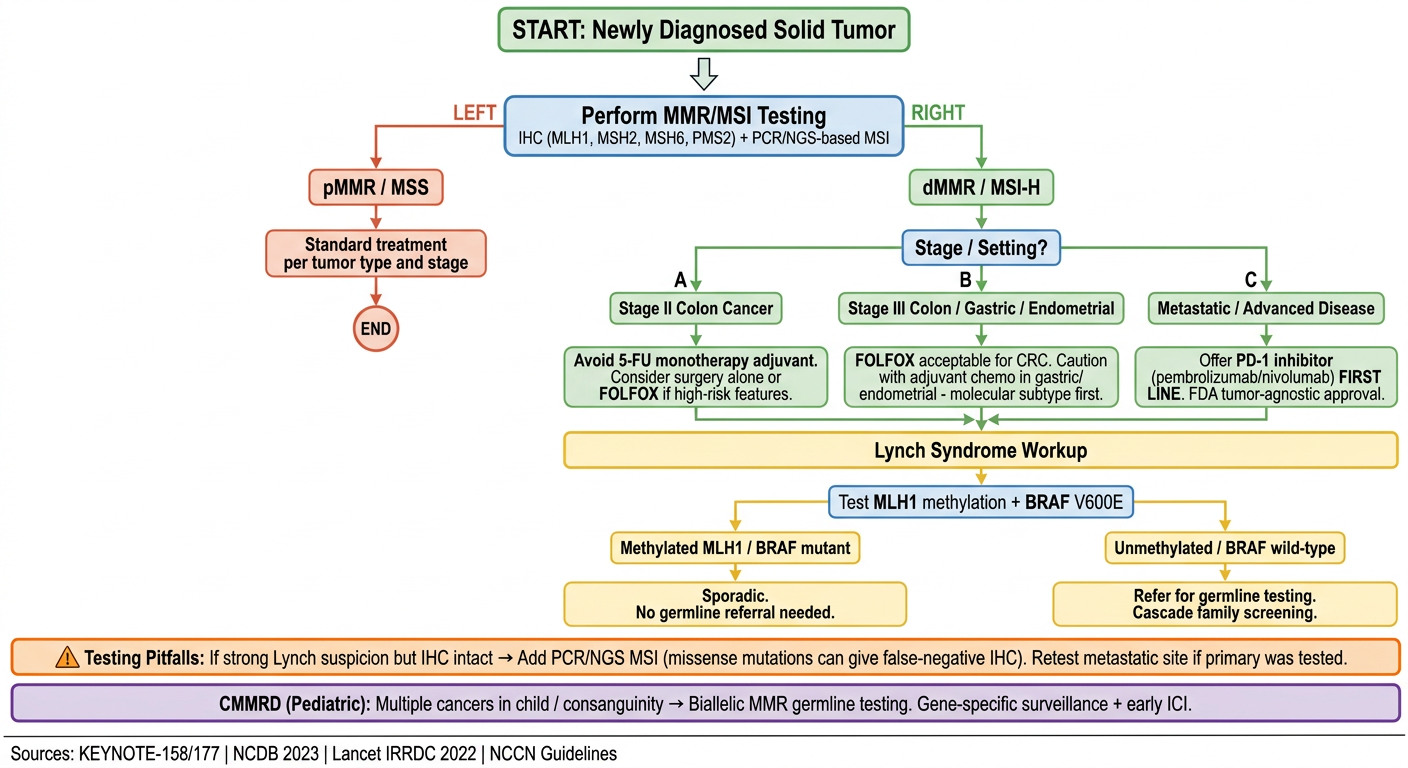
- Entry point - any newly diagnosed solid tumor triggers MMR/MSI testing (IHC + PCR/NGS)
- Two branches - pMMR/MSS goes to standard care; dMMR/MSI-H triggers the full decision tree
- Stage-based treatment guidance - stage II colon (avoid 5-FU), stage III (FOLFOX acceptable for CRC, caution in gastric/endometrial), metastatic (PD-1 inhibitor first-line)
- Lynch syndrome workup - MLH1 methylation + BRAF V600E to distinguish sporadic from hereditary; germline referral for Lynch-suspicious cases
- Pitfall warning - false-negative IHC risk in missense mutations; retest metastatic sites
- Pediatric/CMMRD flag - for children with multiple cancers or consanguinity background