
Balanced deit in community medicine
A balanced diet is a core topic in community medicine/public health nutrition. Here's a quick overview:
A balanced diet provides all essential nutrients (carbohydrates, proteins, fats, vitamins, minerals, and water) in the right proportions to meet the body's needs for growth, maintenance, and disease prevention. It follows reference dietary allowances set by national bodies (in India, the ICMR-NIN recommendations).
Searching sources...
Reading File
Searching the Web
balanced diet community medicine ICMR NIN recommended dietary allowances
Finding Sources
Finding Sources
The primary source is Park's Textbook of Preventive and Social Medicine - the gold standard for community medicine. Let me read that section.
Reading File
Finding Sources
Reading File
Reading File
Now I have all the content I need. Let me also fetch the food pyramid image that was referenced.
Loading Image
I now have comprehensive content from Park's Textbook of Preventive and Social Medicine. Here is the full, detailed answer:
Balanced Diet in Community Medicine
Source: Park's Textbook of Preventive and Social Medicine
Definition
A diet is defined as the kinds of food on which a person or group lives.
A balanced diet is defined as one which contains a variety of foods in such quantities and proportions that the need for energy, amino acids, vitamins, minerals, fats, carbohydrates, and other nutrients is adequately met for:
- Maintaining health, vitality, and general well-being
- Making a small provision for extra nutrients to withstand short duration of leanness
A balanced diet has become an accepted means to safeguard a population from nutritional deficiencies.
Principles of Constructing a Balanced Diet
When constructing a balanced diet, the following principles should be kept in mind:
| Priority | Nutrient | Recommended Proportion |
|---|---|---|
| 1st | Protein | 10-15% of daily energy intake |
| 2nd | Fat | 15-30% of daily energy intake |
| 3rd | Carbohydrates (rich in natural fibre) | Remaining food energy |
Additional guidelines:
- (a) Protein requirement must be met first - 10-15% of daily energy intake
- (b) Fat requirement limited to 15-30% of daily energy intake
- (c) Carbohydrates rich in natural fibre should constitute the remaining food energy
- (d) Sources rich in energy such as fats and alcohol should be restricted
- (e) Salt intake should be reduced to not more than 5 g/day (in India it averages 15 g/day)
- (f) Protein should account for approximately 10-15% of daily intake
- (g) Junk foods such as colas, ketchups and other foods supplying empty calories should be reduced
Note: Diet should be adapted to special needs of growth, pregnancy, lactation, physical activity, and medical disorders (e.g., diabetes).
The Food Guide Pyramid
The food guide pyramid visually represents the relative proportions of different food groups in a balanced diet:
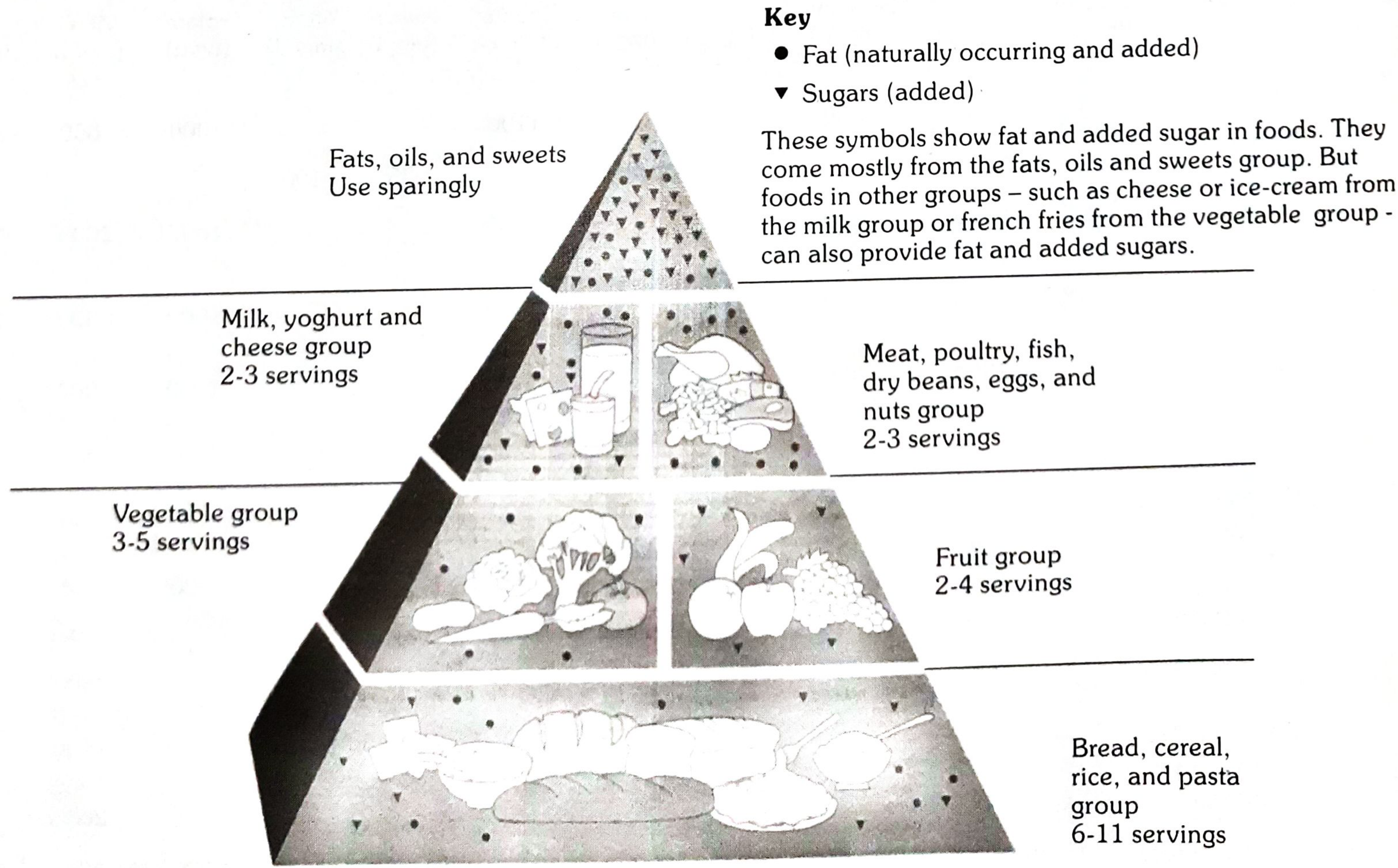
| Food Group | Recommended Servings/Day |
|---|---|
| Bread, cereal, rice, and pasta | 6-11 servings (base - largest) |
| Vegetables | 3-5 servings |
| Fruits | 2-4 servings |
| Milk, yogurt, and cheese | 2-3 servings |
| Meat, poultry, fish, dry beans, eggs, nuts | 2-3 servings |
| Fats, oils, and sweets | Use sparingly (apex - smallest) |
RDA for Indians (ICMR-NIN 2020) - Summary Table
Key values for adults (moderate work):
| Nutrient | Men (65 kg) | Women (55 kg) |
|---|---|---|
| Protein | 54 g/d | 46 g/d |
| Dietary Fibre | 41 g/d | 32 g/d |
| Calcium | 1000 mg/d | 1000 mg/d |
| Iron | 19 mg/d | 29 mg/d |
| Zinc | 17 mg/d | 13 mg/d |
| Iodine | 150 μg/d | 150 μg/d |
| Vitamin C | 80 mg/d | 65 mg/d |
| Vitamin A | 1000 μg/d | 840 μg/d |
| Vitamin D | 600 IU/d | 600 IU/d |
| Folate | 300 μg/d | 220 μg/d |
| Vitamin B12 | 2.2 μg/d | 2.2 μg/d |
Special requirements increase for: Pregnancy (+9.5 g protein in 2nd trimester, +22 g in 3rd trimester), lactation, and heavy work.
Food Groups (Classification for Balanced Diet Planning)
Nutritionists classify foods into groups to simplify balanced diet planning for the community:
Group I - Energy Foods:
- Cereals, roots and tubers, fats and oils, sugars
Group II - Body-Building Foods:
- Pulses, nuts, oilseeds
- Milk and milk products
- Meat, fish, poultry, eggs
Group III - Protective Foods:
- Green leafy vegetables (rich in iron, calcium, beta-carotene, folate)
- Other vegetables and fruits (rich in vitamins and minerals)
Importance in Community Medicine / Public Health
- Prevention of Nutritional Deficiency Diseases - PEM, anaemia, Vitamin A deficiency, iodine deficiency disorders, rickets
- Prevention of Chronic Diseases - Obesity, diabetes, cardiovascular disease, hypertension
- Maternal and Child Health - Prevents low birth weight (LBW < 2500 g), stunting, wasting
- Nutrition Education Programs - ICDS, Mid-Day Meal Scheme, POSHAN Abhiyaan rely on principles of balanced diet
- Assessment Tool - 24-hour dietary recall and food frequency questionnaire assess adequacy against balanced diet standards at community level
Dietary Guidelines for Indians (NIN 2024 - Key Guidelines)
Based on the NIN Dietary Guidelines for Indians 2024:
- Eat a variety of foods to ensure a balanced diet
- Eat plenty of vegetables and legumes
- Use oils/fats in moderation; choose a variety of oilseeds, nuts, nutricereals
- Obtain good quality proteins through appropriate combination of foods
- Adopt healthy lifestyle to prevent obesity
- Restrict salt intake
- Consume safe and clean foods
- Be physically active and exercise regularly
- Drink adequate quantity of water
- Minimize consumption of high fat, sugar, salt (HFSS) and ultra-processed foods (UPFs)
Reference: Park's Textbook of Preventive and Social Medicine, Chapter on Nutrition and Health (pp. 733-735 of the relevant edition), ICMR-NIN RDA 2020.
This is a shared conversation. Sign in to Orris to start your own chat.