
3D printing in orthopaedics
3D printing additive manufacturing orthopaedics implants surgical planning
Bailey and Love's Short Practice of Surgery 28th Edition
Page 576
3D printed bone scaffolds bioprinting fracture reconstruction
Monitoring and Antagonism of Neuromuscular Blockade
Page 14
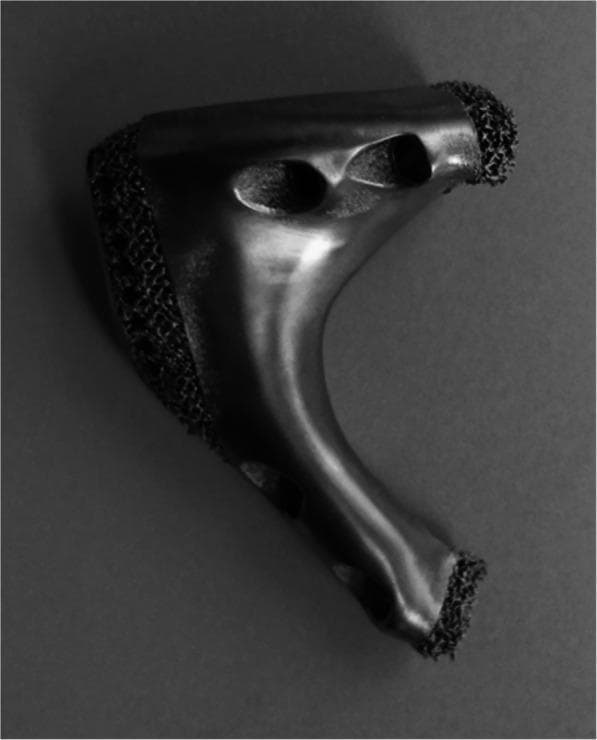
3D printed orthopaedic implant custom prosthesis
Hugging Face pmc clinical VQA raw
Page 0
3D Printing in Orthopaedics
What Is Additive Manufacturing?
Key Applications
1. Preoperative Planning & Surgical Models
- Visualize complex deformities before operating
- Practice osteotomies or implant placement on an exact replica
- Improve team communication and patient consent
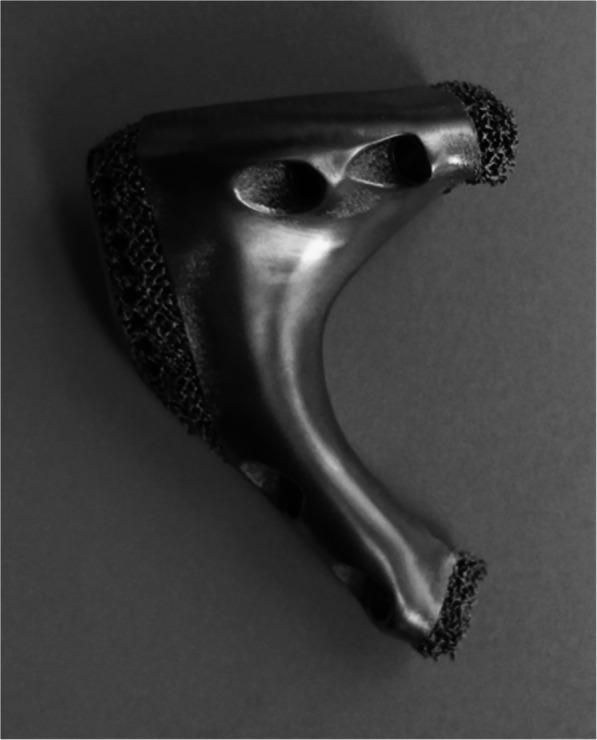
2. Patient-Specific Implants (PSI)
| Domain | Example |
|---|---|
| Oncology | Pelvic/limb-salvage prostheses after tumour resection |
| Trauma | Craniofacial and complex acetabular reconstruction |
| Revision arthroplasty | Filling large bone defects after failed hip/knee replacements |
| Spine | Custom cages, vertebral body replacements |
| Paediatrics | Growth-sparing implants for sarcoma |
3. Manufacturing Technologies Used
| Technology | Material | Use Case |
|---|---|---|
| Selective Laser Sintering (SLS) | Titanium, CoCr | Structural implants |
| Electron Beam Melting (EBM) | Titanium (Ti-6Al-4V) | Porous-surfaced orthopaedic implants |
| Fused Deposition Modelling (FDM) | PLA, PEEK | Surgical models, guides |
| Stereolithography (SLA) | Photopolymers | Anatomical planning models |
| Bioprinting | Hydrogels + cells | Experimental scaffold tissue engineering |
4. Cutting Guides & Surgical Jigs
- Total knee arthroplasty (TKA) alignment
- Corrective osteotomies
- Spinal pedicle screw placement
5. Bone Scaffolds & Bioprinting (Experimental)
Osseointegration: Why Porosity Matters
- Mimic cancellous bone architecture
- Allow vascular and bony ingrowth
- Improve long-term biological fixation, reducing aseptic loosening
Regulatory & Sterilization Considerations
- Sterilization validation is complex — gas plasma may fail to penetrate hollow structures; steam autoclaving can deform thermoplastic models
- Residual manufacturing materials (support material, solvents) must be reduced to safe levels
- Experimental devices require IRB approval and Institutional Policy Committee oversight unless they present a "non-significant risk"
- FDA (and equivalent bodies) regulate implantable 3D-printed devices as Class II/III medical devices
Advantages vs. Limitations
| Advantages | Limitations |
|---|---|
| Patient-specific fit | Higher cost vs. off-the-shelf implants |
| Complex geometry possible | Longer lead time (days–weeks) |
| Porous surfaces for osseointegration | Regulatory and sterilization challenges |
| Reduced surgical time (with cutting guides) | Fatigue properties of printed metals vary |
| Improved outcomes in complex cases | Limited long-term clinical outcome data |
Clinical Impact Summary
- Pre-surgical planning models — now routine in complex trauma and tumour surgery
- Custom oncology implants — replacing large bone segments after sarcoma resection
- Revision arthroplasty — managing cavitary and segmental bone defects
- Spinal surgery — custom cages and interbody devices
3D printing in orthopaedics
3D printing additive manufacturing orthopaedics implants surgical planning
Bailey and Love's Short Practice of Surgery 28th Edition
Page 576
3D printed bone scaffolds patient specific implants fracture reconstruction
Monitoring and Antagonism of Neuromuscular Blockade
Page 14
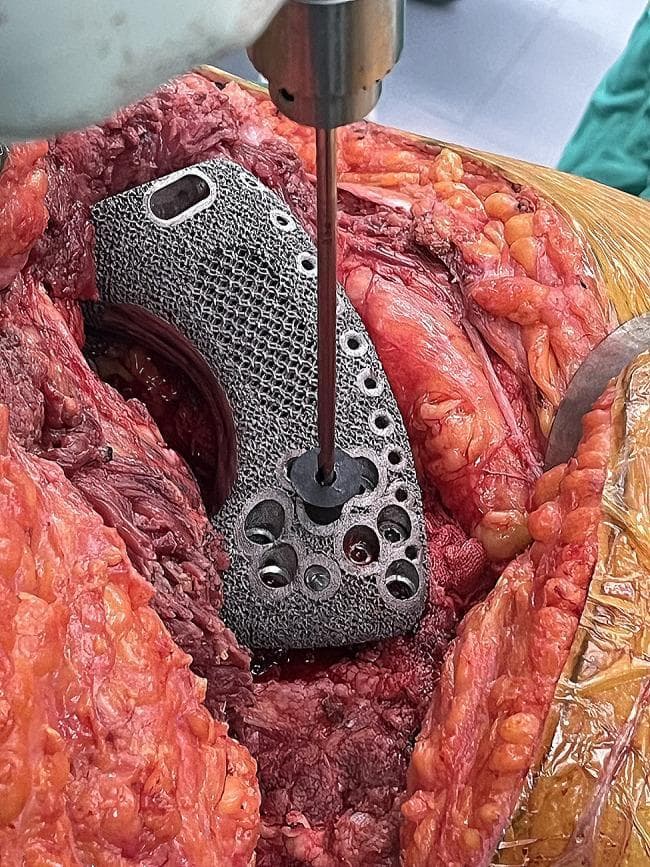
3D printed orthopaedic implant custom prosthesis surgical guide
Hugging Face pmc clinical VQA raw
Page 0
3D Printing in Orthopaedics
Overview
1. Preoperative Planning & Anatomical Models
- Visualise complex deformities, fracture patterns, and tumour involvement before entering the operating theatre
- Rehearse osteotomies, reduction manoeuvres, or implant seating on an exact anatomical replica
- Improve multidisciplinary team communication and patient-informed consent
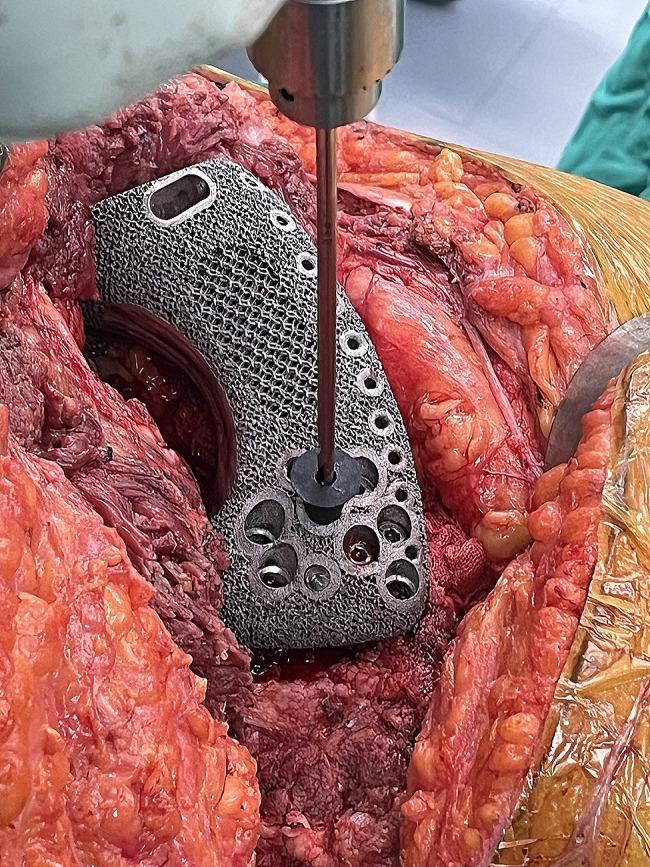
2. Patient-Specific Implants (PSI)
Clinical Domains for PSI
| Domain | Application |
|---|---|
| Orthopaedic oncology | Pelvic, femoral, humeral reconstruction after sarcoma resection |
| Revision arthroplasty | Filling large cavitary/segmental defects after failed hip or knee replacements |
| Trauma | Comminuted periarticular fractures, acetabular defects |
| Spine | Custom vertebral body cages, interbody devices |
| Paediatrics | Growth-sparing implants in skeletally immature patients |
3. Patient-Specific Cutting Guides & Jigs
- Total knee arthroplasty (TKA) — femoral and tibial resections
- Corrective osteotomies (tibial, femoral, forearm)
- Pedicle screw placement in spinal deformity surgery
4. Printing Technologies & Materials
| Technology | Material | Primary Use |
|---|---|---|
| Electron Beam Melting (EBM) | Ti-6Al-4V | Porous structural implants |
| Selective Laser Sintering/Melting (SLS/SLM) | Titanium, CoCr | Load-bearing implants |
| Fused Deposition Modelling (FDM) | PLA, PEEK | Surgical models, guides, orthoses |
| Stereolithography (SLA) | Photopolymers | High-resolution planning models |
| Bioprinting | Hydrogels + cells | Experimental scaffold/tissue engineering |
5. Why Porosity Matters: Osseointegration
- Porosity: 60–80%
- Pore size: 300–900 µm
- Architecture: Interconnected lattices (dodecahedron, gyroid, etc.)
6. Bone Scaffolds & Bioprinting (Experimental)
7. Regulatory & Sterilization Considerations
- Gas plasma sterilization fails to penetrate hollow internal geometries
- Steam autoclaving can deform thermoplastic models
- Residual manufacturing materials (support structures, solvents) must be reduced to safe levels
- IRB and Institutional Policy Committee oversight is required for experimental onsite-printed devices
- Implantable devices are regulated as Class II/III medical devices by the FDA (and equivalent bodies globally)
8. Advantages vs. Limitations
| Advantages | Limitations |
|---|---|
| Anatomically precise fit | Higher unit cost than off-the-shelf implants |
| Complex porous geometry achievable | Longer lead time (days to weeks) |
| Improved osseointegration | Sterilization validation complexity |
| Reduced operative time (with cutting guides) | Variable fatigue/mechanical properties |
| Enables limb salvage in oncology | Limited long-term RCT outcome data |
| Improved surgical training models | Regulatory pathway can be lengthy |
Summary: Where 3D Printing Is Established vs. Emerging
| Status | Application |
|---|---|
| Established | Surgical planning models, oncology PSI, revision arthroplasty augments, cutting guides |
| Growing | Spinal cages, trauma reconstruction, orthotic/prosthetic devices |
| Experimental | Bioprinted cartilage, drug-eluting scaffolds, smart implants with sensors |