
A 75 year old man have hypochromic normosszzZ,,z,,,,zzz,,cytic anemia with slight low level of zzZzzazzz,e than its normal level with serumm.9, creatinine 1.75
Reading File
The query has some garbled text (likely typed while drowsy - "zzz" etc.), but I can interpret the clinical scenario:
- 75-year-old man
- Hypochromic microcytic (or normocytic?) anemia
- "Slight low level... than its normal level" - likely referring to serum erythropoietin (EPO) being slightly below normal
- Serum creatinine 1.75 mg/dL (mildly elevated - stage 2-3 CKD)
This points toward anemia of chronic kidney disease (CKD) with relative EPO deficiency. Let me search the medical library now.
Finding Sources
Finding Sources
Good leads. Let me now read the key textbook sections for detailed content on CKD anemia and EPO deficiency.
Reading File
Reading File
Excellent - I have very rich content. Let me also fetch the diagnostic flowchart image which was referenced.
Loading Image
I now have everything needed for a complete, well-sourced answer. Here is the full clinical analysis:
Clinical Analysis: 75-Year-Old Man with Hypochromic/Normochromic Normocytic Anemia, Low-Normal EPO, Creatinine 1.75 mg/dL
Interpreting the Garbled Query
The most likely intended clinical data (reconstructing from the partly garbled text):
- Hypochromic normocytic anemia (pale red cells with normal MCV)
- Serum erythropoietin (EPO) slightly below normal (relative EPO deficiency)
- Serum creatinine 1.75 mg/dL - this corresponds to mild-to-moderate CKD (estimated GFR likely 30-45 mL/min in a 75-year-old male - Stage 3 CKD)
Most Likely Diagnosis: Anemia of Chronic Kidney Disease (CKD)
This presentation is classic for anemia of CKD. Here is why:
Pathophysiology:
- The kidneys are the primary site of EPO production. As renal function declines, EPO output falls.
- A creatinine of 1.75 in a 75-year-old man (low muscle mass) likely corresponds to an eGFR of ~35-42 mL/min/1.73 m² - right at the threshold where anemia begins.
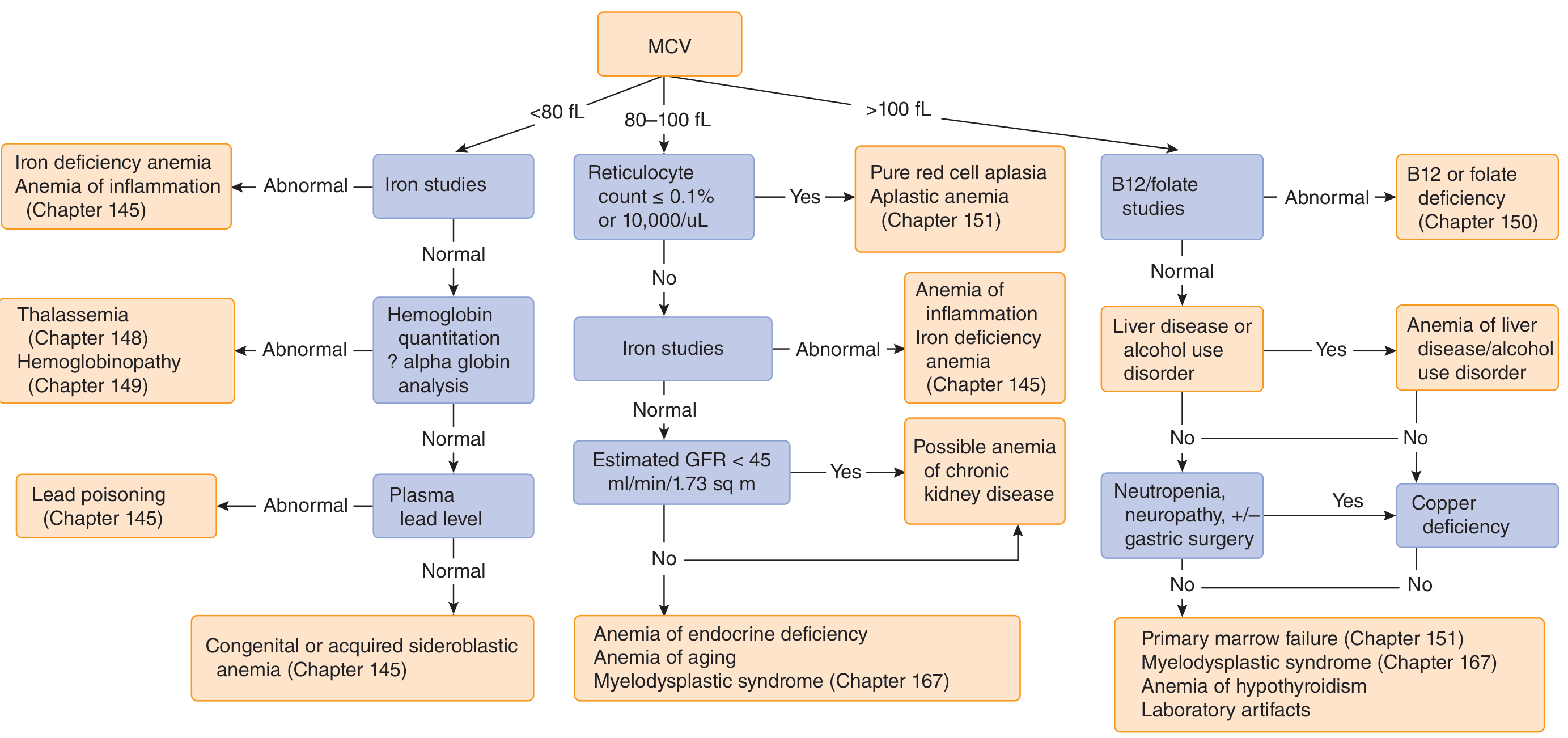
- Goldman-Cecil Medicine states: "Anemia is almost invariable in significant renal insufficiency, beginning when the estimated glomerular filtration rate (eGFR) falls below 45 mL/min/1.73 m²" - this patient likely sits just at or below this threshold.
- The major pathogenetic factor is EPO deficiency - the kidneys simply cannot produce enough EPO to stimulate the bone marrow adequately.
Why EPO appears only "slightly low" rather than dramatically low:
- Goldman-Cecil notes: "Erythropoietin concentrations are generally not helpful in making a diagnosis because the usual feedback relationship between hemoglobin concentration/hematocrit and erythropoietin secretion is lost."
- In normal physiology, anemia should cause a large compensatory rise in EPO. In CKD, the EPO response is inappropriately blunted - so the EPO level may appear near-normal or only slightly low, but it is far lower than what the degree of anemia demands. This is called relative EPO deficiency.
Red cell morphology:
- Classically normocytic and normochromic (or mildly hypochromic if iron stores are also depleted)
- Echinocytes ("burr cells") may be seen
- Reticulocyte count is low relative to the degree of anemia (hypoproliferative pattern)
Diagnostic Flowchart
The algorithm below (from Goldman-Cecil Medicine) shows the workup approach - with MCV in the normal range (80-100 fL) and an eGFR < 45 mL/min, the pathway points directly to "Possible anemia of chronic kidney disease":
Differential Diagnoses to Consider
Even with a likely CKD cause, at age 75 other contributors should be excluded:
| Condition | Distinguishing Feature |
|---|---|
| Iron deficiency anemia | Low serum ferritin, low transferrin saturation, MCV often low (microcytic) |
| Anemia of inflammation | Elevated ferritin, low serum iron, normal/high ferritin - often co-exists with CKD |
| Myelodysplastic syndrome (MDS) | Common in elderly; dysplastic cells on smear; bone marrow biopsy needed |
| Hypothyroidism | TSH elevated; normocytic anemia + systemic symptoms |
| Anemia of aging | Diagnosis of exclusion; no single cause found |
In practice, CKD anemia and anemia of inflammation frequently coexist, both contributing to hypoproliferative, normochromic normocytic anemia.
Workup Recommended
- CBC with reticulocyte count - expect low reticulocyte index
- Iron studies (serum iron, TIBC, ferritin, transferrin saturation) - rule out concurrent iron deficiency
- eGFR calculation (CKD-EPI using creatinine + age + sex)
- Peripheral blood smear - look for echinocytes, dysplastic cells
- TSH - rule out hypothyroidism
- B12/folate - rule out concurrent deficiency
- Serum EPO level - may be "inappropriately normal" for degree of anemia
- Urinalysis + urine protein/creatinine ratio - characterize CKD further
Management of CKD Anemia
Per Goldman-Cecil Medicine:
- Erythropoiesis-stimulating agents (ESAs): recombinant EPO (epoetin alfa) or darbepoetin alfa. Target Hb of 9-11 g/dL - NOT full correction to normal (Hb > 13 g/dL is associated with increased risk of stroke, MI, and thrombosis).
- Treatment threshold: Start ESA when Hb < 9 g/dL; suspend when Hb reaches 9-11 g/dL.
- Iron supplementation: Essential - check if transferrin saturation < 30% or ferritin < 500 ng/mL. IV iron is preferred over oral because hepcidin (elevated in CKD) impairs oral iron absorption.
- Daprodustat: Oral HIF prolyl hydroxylase inhibitor, FDA-approved for dialysis patients - stimulates endogenous EPO production and regulates iron metabolism.
- Resistance to ESA most often indicates iron deficiency or concurrent inflammation.
Key Teaching Points
- In CKD, EPO levels are "inappropriately normal" - not dramatically low - because the normal EPO-to-anemia feedback is broken. A slightly low or even normal EPO in the context of significant anemia IS the pathology.
- Creatinine 1.75 in a 75-year-old man underestimates the degree of renal impairment because muscle mass (the source of creatinine) declines with age. The true eGFR is likely lower than you'd calculate in a younger person with the same creatinine.
- Anemia of CKD is normocytic and normochromic classically - but hypochromia can appear if iron deficiency coexists (very common, especially in elderly patients with poor nutrition or chronic blood loss).
Sources: Goldman-Cecil Medicine International Edition (p. 1675); Frameworks for Internal Medicine (p. 333)
This is a shared conversation. Sign in to Orris to start your own chat.