
What is the difference between planning and programming I was studying health planning chapter steps of planning
Planning focuses on setting goals, identifying needs, allocating resources, and deciding what to do - it's the broader decision-making process. Programming is a step within planning that involves translating those plans into specific, scheduled activities, tasks, and timetables. In short: planning is the "what and why," programming is the "how and when."
Searching sources...
Reading File
Finding Sources
Searching the Web
difference between planning and programming health planning steps
Finding Sources
Reading Web Page
https://www.open.edu/openlearncreate/mod/oucontent/view.php?…
Finding Sources
Finding Sources
Park's Textbook is the right source. Let me read the planning and programming sections directly.
Finding Sources
Excellent! Found the key sections. Let me read them all at once.
Reading File
Reading File
Reading File
Reading File
Reading File
Now let me also read the planning cycle steps (the key section) more carefully:
Reading File
I now have all the information needed. Let me also fetch the planning cycle image for a visual aid.
Loading Image
Here is a thorough answer based directly on Park's Textbook of Preventive and Social Medicine (the standard reference for community medicine / health planning topics):
Planning vs. Programming in Health Planning
These two terms are closely related but refer to different levels of the same process. Programming is actually Step 6 within the broader planning cycle - it cannot exist without planning, but planning is incomplete without programming.
Planning - The Big Picture
Health Planning is defined as:
"The orderly process of defining community health problems, identifying unmet needs and surveying the resources to meet them, establishing priority goals that are realistic and feasible, and projecting administrative action to accomplish the purpose of the proposed programme."
More broadly, planning is:
"A process of analysing a system, defining a problem, assessing the extent to which the problem exists as a need, formulating goals and objectives, examining and choosing from among alternative intervention strategies, initiating the necessary action for its implementation, and evaluating the results of intervention in the light of stated objectives."
Planning answers: What needs to be done? Why? For whom? With what resources?
The Steps of the Planning Cycle (as per Park's)
Here is the full planning cycle, which shows exactly where programming fits in:
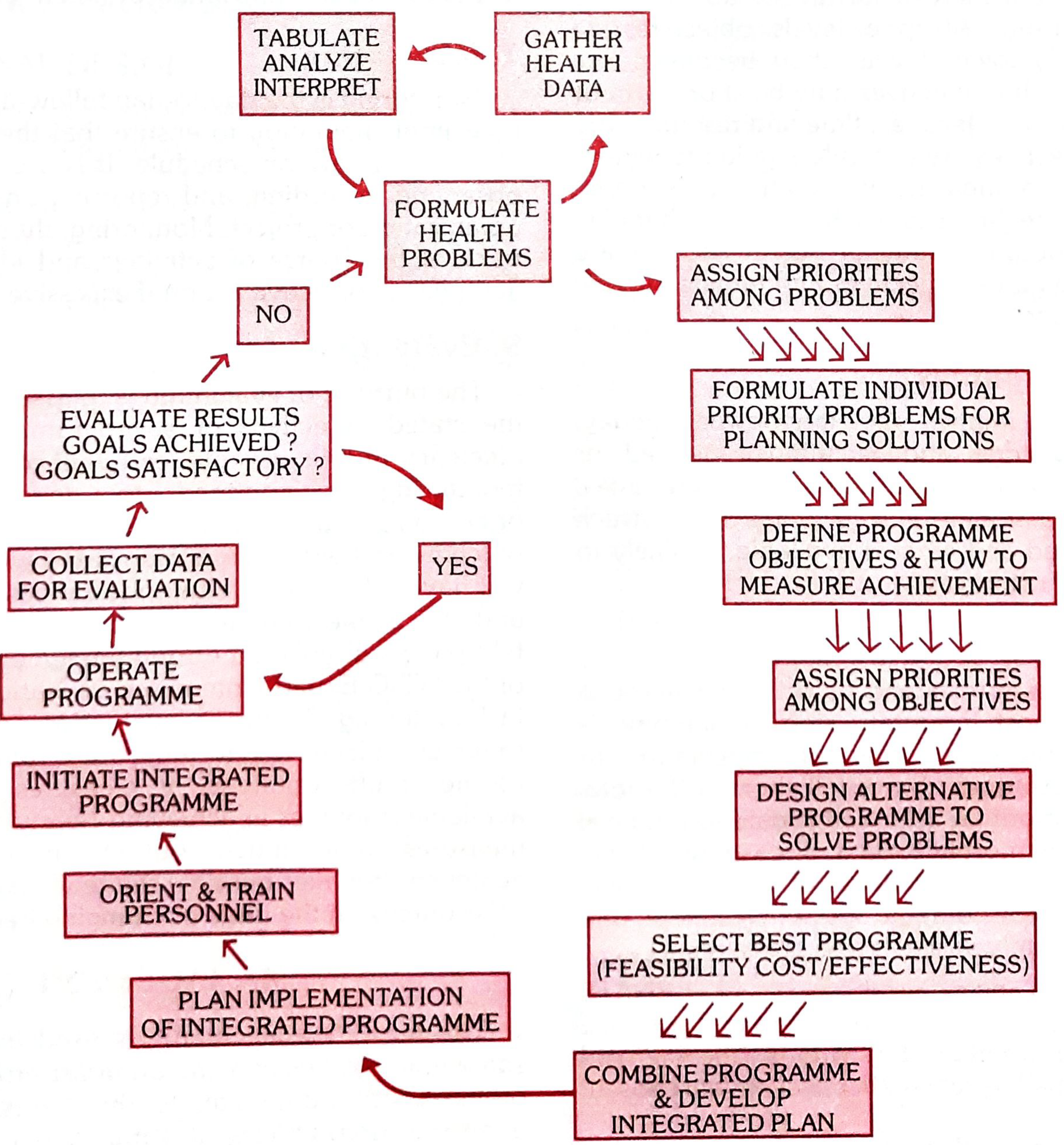
| Step | Name | What happens |
|---|---|---|
| 1 | Analysis of the health situation | Collect data on morbidity, mortality, resources, attitudes |
| 2 | Establishment of objectives and goals | Set measurable targets to guide action |
| 3 | Assessment of resources | Inventory manpower, money, materials available |
| 4 | Fixing priorities | Rank problems by importance and feasibility |
| 5 | Write-up of the formulated plan | Prepare a detailed, costed blueprint for action |
| 6 | Programming and implementation | Translate the plan into concrete activities and execute them |
| 7 | Monitoring | Track progress against objectives |
| 8 | Evaluation | Assess results; feed back into a new planning cycle |
Programming - The Operational Step
"Once the health plan has been selected and approved by the policy making authorities, programming and implementation are begun."
Programming is the step where the approved plan is broken down into:
- Defined roles and tasks - who does what
- Selection, training, motivation and supervision of the manpower involved
- Organization and communication systems set up
- Efficiency measures at each institution (hospital, health centre, etc.)
A "programme" itself is defined as:
"A sequence of activities designed to implement policies and accomplish objectives. A programme gives a step-by-step approach to guide the action necessary to reach a predetermined goal."
A "schedule" (part of programming) is:
"A time sequence for the work to be done."
Programming answers: How exactly will it be done? When? By whom specifically? In what sequence?
Key Differences: Side-by-Side
| Feature | Planning | Programming |
|---|---|---|
| Nature | Conceptual / analytical | Operational / action-oriented |
| Focus | What to do and why | How, when, and by whom |
| Outcome | A written Plan (blueprint) | A set of scheduled activities and tasks |
| Involves | Data analysis, priority setting, goal formulation | Role definition, timetables, staff training, task sequencing |
| Stage | Steps 1-5 of the planning cycle | Step 6 of the planning cycle |
| Scope | Broad and strategic | Specific and tactical |
| Example | "We will reduce malaria incidence by 30% in 5 years by deploying insecticide-treated nets" | "District X will distribute 5,000 nets to PHCs by March; health workers trained in week 1..." |
The PPBS (Planning-Programming-Budgeting System)
Park's also mentions a formal system that links all three:
"The Planning-Programming-Budgeting System (PPBS) is primarily a system to help decision makers allocate resources so that the available resources of an organization are used in the most effective way in achieving its objectives. It calls for grouping of activities into programmes related to each objective."
This confirms that planning, programming, and budgeting are three distinct but sequential phases - planning sets the goals, programming designs the activities to reach those goals, and budgeting finances them.
In summary: Planning is the entire strategic decision-making process (Steps 1-5), while programming is the specific step (Step 6) that converts the approved plan into concrete, scheduled, assigned activities ready for implementation. You cannot have effective programming without prior planning, and a plan that is never programmed into action remains just a document.
- Park's Textbook of Preventive and Social Medicine, Chapter 22 (Planning and Management)
Goal vs objective vs target explain with a practical scenario
A goal is the broad, ultimate desired state (e.g., "eliminate malaria"). An objective is a specific, measurable endpoint you either achieve or don't (e.g., "reduce malaria deaths by 50% in 5 years"). A target refers to a discrete, countable activity (e.g., "distribute 10,000 bed nets this quarter"). Goals are visionary, objectives are precise endpoints, and targets are operational counts that track progress toward objectives.
Searching sources...
Finding Sources
Reading File
Got the exact textbook definitions. Here is the full breakdown:
Goal vs. Objective vs. Target
These three terms are all used to describe end-results of planning. Park's Textbook gives clear, distinct definitions for each:
The Definitions (from Park's)
| Term | Park's Definition | Key Character |
|---|---|---|
| Goal | "The ultimate desired state towards which objectives and resources are directed" | Broad, not constrained by time or resources, not necessarily attainable |
| Objective | A precise planned end-point - "it is either achieved or not achieved" | Binary - you either hit it or you don't |
| Target | Refers to a discrete, countable activity - "permits the concept of degree of achievement" | Quantitative - you can be 60%, 80%, or 100% there |
A crucial distinction from the textbook:
"Targets are concerned with the factors involved in a problem, whereas objectives are concerned directly with the problem itself."
Practical Scenario: A District Tuberculosis Control Programme
Let's apply all three to one real health scenario.
The Problem: A district has a high burden of tuberculosis (TB). The District Health Officer sits down to plan.
GOAL
"To eliminate tuberculosis as a public health problem in the district."
- This is the ultimate desired state - the big vision
- It is not time-bound ("when?" is not specified)
- It is not constrained by available resources - even if the budget is limited, the goal remains the same
- It may not even be fully attainable in the near term, but it gives direction to all work
- It answers: What are we ultimately working toward?
OBJECTIVE
"To reduce TB mortality in the district by 50% within the next 5 years (by 2030)."
- This is precise - a specific number (50%), a specific outcome (mortality), a specific deadline (5 years)
- It is binary - at the end of 5 years, either you achieved 50% reduction or you did not. There is no "halfway objective"
- It is directly concerned with the problem itself (mortality from TB)
- It answers: Exactly what measurable result are we aiming to achieve and by when?
TARGET
"Sputum smear examination of 500 suspected TB cases per month." "Put 200 newly diagnosed patients on DOTS treatment by December."
- These are discrete, countable activities - the number of blood films collected, patients treated, health workers trained
- They allow partial achievement - if 300 patients were put on DOTS instead of 200, you achieved 150% of target; if only 100, you achieved 50%
- They are concerned with factors involved in the problem (diagnosis rate, treatment coverage), not the problem directly (TB deaths)
- They answer: How many specific activities need to be completed to drive us toward the objective?
How They Relate - The Hierarchy
GOAL  (Vision - ultimate desired state)
  |
  └──► OBJECTIVE  (Precise end-point - achieved or not)
            |
            └──► TARGET  (Discrete activity count - degree of achievement possible)
Think of it like this:
- Goal = "Win the war against TB"
- Objective = "Capture this specific hill by Sunday"
- Target = "Fire 500 rounds and advance 2 km today"
The military origin of these words (as Park's notes) makes this analogy very apt.
Another Quick Scenario: Immunization Programme
| Level | Statement |
|---|---|
| Goal | Protect every child in India from vaccine-preventable diseases |
| Objective | Achieve 90% full immunization coverage in the district by 2026 |
| Target | Vaccinate 1,200 children under 1 year in each PHC per quarter |
Notice how targets (PHC-level counts) roll up into the objective (district-level coverage), and the objective drives toward the goal (national protection).
Summary Table
| Feature | Goal | Objective | Target |
|---|---|---|---|
| Breadth | Broadest | Specific | Most specific |
| Time-bound? | No | Yes | Yes |
| Resource-constrained? | No | Yes | Yes |
| Achievement | Not necessarily attainable | Binary (yes/no) | Degree (%) |
| Concerned with | Ultimate desired state | The problem directly | Factors/activities involved |
| Example | Eliminate malaria | Reduce malaria deaths by 50% in 5 years | Distribute 10,000 bed nets this quarter |
- Park's Textbook of Preventive and Social Medicine, Chapter 22 - "Objectives, targets and goals" (p. 973)
This is a shared conversation. Sign in to Orris to start your own chat.