
hernia ( elaborate)
Reading File
Now let me search for comprehensive hernia content in parallel across headings and paragraphs, plus images.
Finding Sources
Searching PubMed
"hernia"[MeSH Terms] AND "surgical repair"[MeSH Terms]
Searching Images
hernia types anatomy inguinal femoral umbilical
Now let me read the main hernia sections from Bailey & Love (surgery bible) and the GI textbook in parallel.
Reading File
Reading File
Reading File
Now let me read the Bailey & Love main hernia chapter and more of the emergency procedures text for comprehensive coverage.
Finding Sources
Reading File
Reading File
Let me now read the main hernia section from Bailey & Love surgery textbook and the Mulholland surgical textbook for comprehensive surgical management details.
Finding Sources
Reading File
Now let me get more surgical management details from Bailey & Love and Mulholland surgery.
Reading File
Reading File
I now have comprehensive information. Let me also fetch the main hernia anatomy image and one clinical image.
Loading Image
Loading Image
I now have comprehensive information from multiple authoritative textbooks. Here is a thorough, well-structured answer on hernias.
Hernia — Comprehensive Overview
Definition
A hernia is the protrusion of any viscus (or part of a viscus) from its normal cavity through an abnormal or congenitally weak opening. In the abdomen, this most commonly means intra-abdominal contents (bowel, omentum, or fat) passing through a defect in the abdominal wall musculature or peritoneum.
— Roberts and Hedges' Clinical Procedures in Emergency Medicine
Epidemiology
- Hernias develop in approximately 5% of men and 2% of women
- 75% of all hernias occur in the groin (inguinal/femoral)
- In children and young adults, the majority are indirect inguinal hernias of congenital origin
- Direct hernias are acquired and become more prevalent with aging
- Incisional hernias complicate up to 20% of abdominal surgeries
Anatomy of Hernia Types
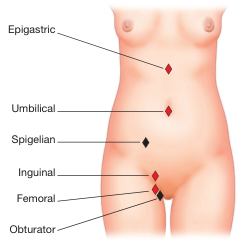
1. Inguinal Hernia (most common — ~75% of all hernias)
Located within the inguinal triangle (bounded by: inguinal ligament inferiorly, inferior epigastric artery superolaterally, lateral edge of rectus abdominis medially).
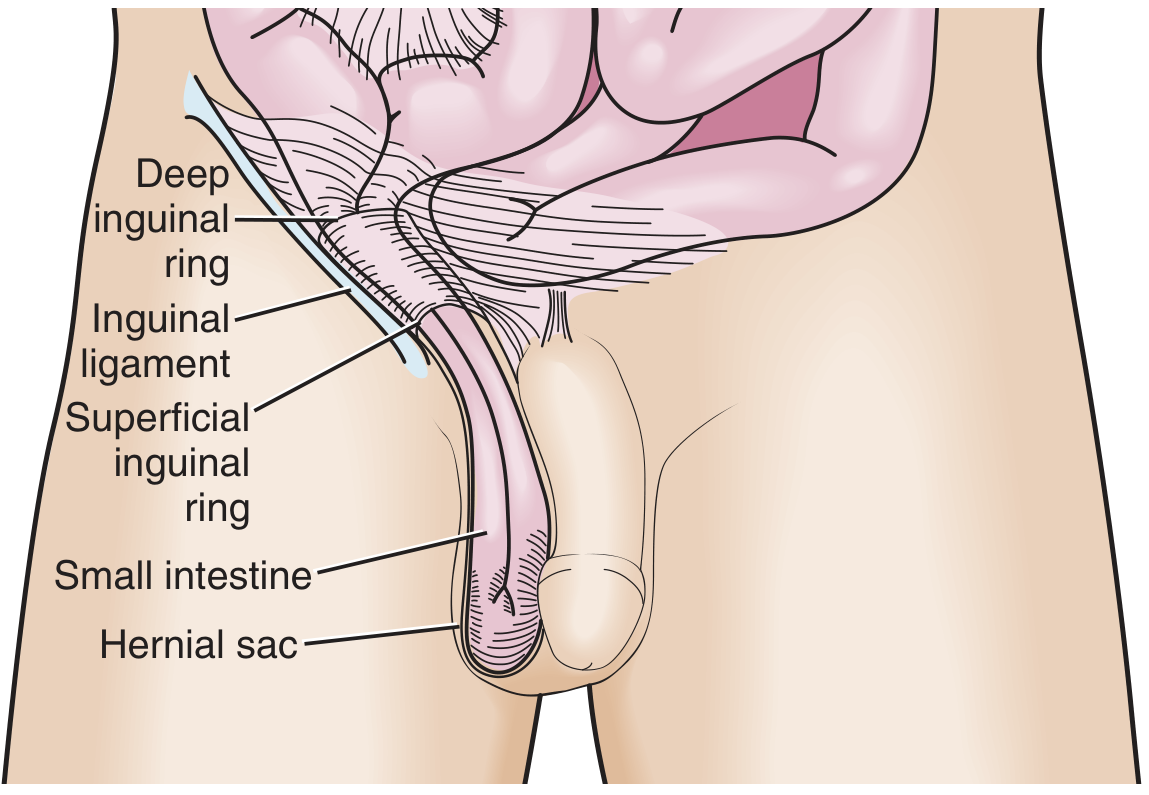
a) Indirect Inguinal Hernia
- Passes through the internal (deep) inguinal ring → travels down the inguinal canal → exits the external (superficial) ring → may enter the scrotum
- Runs lateral to the inferior epigastric artery
- Usually congenital: due to a patent processus vaginalis that fails to close
- Most common in children and young men; can occur at any age
- Physical exam: hernia contents strike the tip of the examining finger when palpating the canal
b) Direct Inguinal Hernia
- Protrudes directly through the posterior wall of the inguinal canal (Hesselbach's triangle), medial to the inferior epigastric artery
- Acquired — caused by weakness of the transversalis fascia from aging, heavy lifting, or increased intra-abdominal pressure
- More common in older men
- Exam: hernia contents push against the volar pad of the finger; pressure over the internal ring after reduction does NOT prevent recurrence on Valsalva (unlike indirect)
c) Pantaloon Hernia
- A combination of both direct and indirect hernias straddling the inferior epigastric artery — difficult to diagnose clinically, often found at surgery.
2. Femoral Hernia
- Protrudes inferior to the inguinal ligament through a defect in the transversalis fascia
- Contents enter the femoral canal — the space medial to the femoral vein and lateral to the lacunar ligament
- Presents as a medial thigh mass below where inguinal hernias are seen
- More common in women
- Has a narrow neck → high risk of incarceration: up to 45% are strangulated at presentation — the most dangerous groin hernia
3. Umbilical Hernia
- Traverses the fibrous umbilical ring
- In adults: acquired; associated with obesity, ascites, multiparity, and raised intra-abdominal pressure
- In neonates: usually closes spontaneously within 1–2 years
- Accounts for ~15% of emergency hernia surgery; up to 60% show strangulation at operation
4. Epigastric Hernia
- Through the linea alba above the umbilicus
- Usually contains pre-peritoneal fat; may be multiple
- Commonly tender and small
5. Incisional / Ventral Hernia
- Occurs at or near a previous surgical scar
- Complicates up to 20% of laparotomies; risk increased by wound infection, obesity, malnutrition, steroid use
- Recurrence rate after repair: 20–50%
- Larger defects paradoxically have lower incarceration risk (wide neck)
6. Spigelian Hernia
- Occurs along the lateral border of the rectus abdominis, just below the arcuate line
- Often occult — contents pass between muscle layers and may not be visible on surface exam
- CT is frequently required for diagnosis
7. Hiatal Hernia
- Herniation of the stomach (or other abdominal contents) through the esophageal hiatus of the diaphragm
- Type I (Sliding): The gastroesophageal junction slides into the chest — most common; strongly associated with GERD
- Type II (Rolling/Paraesophageal): The gastric fundus herniates alongside the esophagus; GEJ remains in place — risk of gastric volvulus
- Types III & IV: Mixed or large, containing multiple organs
- Mechanisms promoting GERD: reduced LES pressure, loss of intra-abdominal LES segment, enlarged "acid pocket" above the diaphragm, increased transient LES relaxations
8. Internal Hernias
- Congenital: Paraduodenal (most common congenital type), foramen of Winslow, transmesenteric
- Acquired/Iatrogenic: After Roux-en-Y gastric bypass, colectomy, Whipple procedure — bowel herniates through mesenteric defects
- Often only diagnosed at laparotomy
9. Other Rare Hernias
| Type | Location | Notes |
|---|---|---|
| Richter hernia | Any location | Only part of the bowel wall is trapped — can strangulate without complete obstruction |
| Obturator hernia | Obturator canal | Elderly women; Howship-Romberg sign (medial thigh pain) |
| Lumbar hernia | Petit/Grynfeltt triangles | Posterior abdominal wall |
| Paraduodenal hernia | Left > right | Congenital; most common internal hernia |
| Parastomal hernia | Around a stoma | Complicates up to 50% of stomas |
Classification by Reducibility
| State | Definition | Management |
|---|---|---|
| Reducible | Contents return to cavity spontaneously or manually | Elective outpatient repair |
| Incarcerated | Contents irreducible without surgery; blood supply intact | Urgent (not always emergency) surgical repair |
| Strangulated | Incarcerated + compromised blood supply → ischemia/necrosis | Surgical emergency |
Key principle: smaller neck = greater risk of strangulation. Femoral and umbilical hernias have the highest strangulation rates; large incisional hernias have the lowest.
Etiology and Risk Factors
Congenital factors:
- Patent processus vaginalis → indirect inguinal hernia
- Developmental defects in abdominal wall musculature
Acquired factors:
- Aging and loss of tissue elasticity
- Raised intra-abdominal pressure: chronic cough (COPD), constipation, straining (BPH), obesity, pregnancy, ascites, heavy lifting
- Failure of wound healing: infection, malnutrition, steroids, diabetes
- Collagen disorders (Marfan, Ehlers-Danlos)
Clinical Features
Symptoms
- Reducible hernia: intermittent bulge that appears on straining/standing, disappears on lying down; often painless
- Incarcerated hernia: non-reducible lump; constant dull ache; signs of bowel obstruction (nausea, vomiting, distension, obstipation)
- Strangulated hernia: severe local pain, tender, erythematous skin overlying; systemic sepsis (fever, tachycardia); peritonitis
Physical Examination (Groin Hernia)
- Examine in both standing and supine positions
- In males: invaginate scrotal skin and palpate inguinal canal; ask patient to cough or Valsalva
- Indirect vs. direct distinction:
- Indirect: starts lateral to inferior epigastric vessels; tip of finger impulse; occlusion of internal ring prevents recurrence
- Direct: medial to epigastric vessels; pad of finger impulse; internal ring occlusion doesn't prevent bulge
- A hernia descending into the scrotum is almost always indirect
Investigations
- Diagnosis is clinical in most cases
- Ultrasound: useful for groin hernias, especially in obese patients or equivocal examination; sensitivity ~86%
- CT scan: investigation of choice for suspected internal hernias, occult hernias (e.g., Spigelian), assessing complications (strangulation — bowel wall thickening, fat stranding, fluid within sac), and preoperative planning for large incisional hernias
- MRI: occasionally used for athletic pubalgia / groin pain differentiation
- Plain X-ray: may show dilated bowel loops in obstruction
Complications
- Incarceration — irreducibility; may lead to obstruction
- Strangulation — ischemia → gangrene; up to 75% of hernias causing SBO have intestinal ischemia; >25% have intestinal necrosis at surgery
- Bowel obstruction — hernias are second only to adhesions as causes of small bowel obstruction in Western countries
- Recurrence — after primary repair (tissue repairs: higher rate; mesh repairs: lower rate)
- Haematoma / seroma
- Wound infection — especially with mesh
- Chronic groin pain — ilioinguinal/iliohypogastric/genitofemoral nerve injury
Emergency Management (ED)
Assessment Priorities
- Is the mass truly a hernia?
- Is it reducible, incarcerated, or strangulated?
- Is there bowel obstruction?
Manual Reduction (Taxis)
- Appropriate for incarcerated but non-strangulated hernias
- Position patient supine with hips slightly flexed (Trendelenburg)
- Apply gentle, sustained pressure directed toward the defect — do NOT use excessive force
- More reliable for groin and umbilical hernias than large incisional defects
- Contraindications: fever, skin erythema, severe tenderness, systemic signs of strangulation — these require urgent surgical referral, not reduction attempts
Strangulated Hernia (Surgical Emergency)
- IV access, fluid resuscitation, NBM
- IV antibiotics (cover gram-negative and anaerobes)
- Urgent surgical consultation → laparotomy or laparoscopy; bowel resection if necrotic; hernia repair
Surgical Management
Principles
- Elective repair is preferred (lower morbidity, better outcomes than emergency repair)
- Emergency repair carries significantly higher rates of short-term complications and recurrence
Techniques
Open Tissue Repair (Non-mesh)
- Shouldice repair: multi-layer imbrication of the posterior inguinal wall; recurrence ~1–2% in expert hands
- Bassini repair: classical; less used now
- Preferred in contaminated fields (strangulation, bowel resection) where mesh infection risk is high
Open Mesh Repair
- Lichtenstein tension-free repair: mesh sutured to inguinal ligament and conjoint tendon; standard for elective inguinal hernia
- Plug-and-patch and other variants exist
- Mesh significantly reduces recurrence rates compared to tissue repairs
Laparoscopic Repair
- TAPP (Trans-Abdominal Pre-Peritoneal): mesh placed in pre-peritoneal space via intra-abdominal approach; excellent visualization of triangle of doom (external iliac vessels) and triangle of pain (femoral/lateral cutaneous nerve)
- TEP (Totally Extra-Peritoneal): pre-peritoneal dissection without entering peritoneal cavity; avoids intra-abdominal complications
- Benefits: less post-operative pain, faster return to activity, lower chronic pain rates, better for bilateral or recurrent hernias
Mesh Use in Emergency
- In emergency hernia repair with contamination or bowel resection, tissue repair is preferred (mesh infection risk); mesh deferred to later stage if recurrence occurs
- Without contamination, mesh can be used with acceptable outcomes
Special Considerations
- Hiatal hernia: managed with proton pump inhibitors (medical); surgery (Nissen fundoplication ± mesh hiatal cruroplasty) for symptomatic paraesophageal or failed medical therapy
- Incisional hernia: component separation techniques for large defects; biologic meshes in contaminated fields
- Parastomal hernia: difficult to manage; mesh repair via laparoscopic Sugarbaker technique or open repair
Summary Table
| Hernia | Location | Sex preference | Key feature | Strangulation risk |
|---|---|---|---|---|
| Indirect inguinal | Above inguinal lig., through deep ring | M >> F | Congenital; enters scrotum | Moderate |
| Direct inguinal | Above inguinal lig., Hesselbach's triangle | M >> F | Acquired; older men | Low |
| Femoral | Below inguinal lig., femoral canal | F > M | Narrow neck; medial thigh mass | Very high (45%) |
| Umbilical | At umbilicus | F > M (adults) | Self-resolves in neonates | High (60% at operation) |
| Incisional | At surgical scar | Equal | Post-surgical; 20% of laparotomies | Lower with large defect |
| Spigelian | Lateral rectus border | Equal | Often occult; needs CT | Moderate |
| Epigastric | Linea alba, above umbilicus | M > F | Small, fat-containing | Low |
| Hiatal | Esophageal hiatus | F > M (older) | Associated with GERD | Low (volvulus risk) |
| Richter | Any narrow orifice | Variable | Partial wall entrapment; no full obstruction | High |
Sources:
- Roberts and Hedges' Clinical Procedures in Emergency Medicine, Chapter 44
- Sleisenger and Fordtran's Gastrointestinal and Liver Disease, Chapters 46 & 123
- Mulholland and Greenfield's Surgery: Scientific Principles and Practice, 7e, Chapter 49
- Bailey and Love's Short Practice of Surgery, 28th Edition
This is a shared conversation. Sign in to Orris to start your own chat.