
Management of IBS
I'll start by reading the medical library skill, then search for IBS management content in parallel.
Reading File
Now let me search the library and PubMed in parallel.
Finding Sources
Searching PubMed
"irritable bowel syndrome"[MeSH Terms] AND "management"[Title/Abstract]
Let me search with broader terms in the library and do a paragraph search simultaneously.
Finding Sources
Finding Sources
Excellent sources found. Let me read the most comprehensive ones in parallel - Sleisenger & Fordtran's GI (the gold standard GI textbook), Goldman-Cecil Medicine, and Lippincott Pharmacology.
Reading File
Reading File
Reading File
Now let me read the full management section from Goldman-Cecil and the Sleisenger chapter on IBS.
Reading File
Reading File
I have the Goldman-Cecil treatment section. Let me read more of it and also fetch the Lippincott drug summary image.
Reading File
Loading Image
I now have the management section. Let me read the full treatment content from Goldman-Cecil.
Reading File
I have very rich content. I now have everything needed to write a comprehensive answer. Let me also fetch the diagnostic algorithm image to include it.
Management of Irritable Bowel Syndrome (IBS)
IBS is a functional bowel disorder characterized by chronic or recurrent abdominal pain associated with alterations in stool form and/or frequency. It is diagnosed using the Rome IV criteria and managed in a stepwise, subtype-guided fashion. Below is a structured overview.
1. Diagnosis First: Rome IV Criteria
Before treatment, confirm the diagnosis positively - IBS should not be a diagnosis of exclusion in straightforward cases.
Rome IV criteria (symptoms for at least 6 months, active for last 3 months):
- Recurrent abdominal pain at least 1 day/week, associated with 2 or more of:
- Related to defecation
- Change in stool frequency
- Change in stool form/appearance
Alarm features requiring investigation:
- New onset at age ≥50 years
- Unintentional weight loss
- Rectal bleeding (hematochezia/melena not from hemorrhoids)
- Nocturnal diarrhea
- Anemia
- Palpable abdominal mass or lymphadenopathy
- Family history of colorectal cancer, IBD, or celiac disease
Recommended tests (limited):
| Test | Population |
|---|---|
| Celiac serologies (IgA anti-TTG) | IBS-D |
| Fecal calprotectin/lactoferrin | IBS-D |
| CRP | IBS-D |
| Bile acid diarrhea testing | IBS-D if suspected |
| Giardia stool antigen | IBS-D in endemic areas |
| Colonoscopy with random biopsies | Age >45-50 or alarm features |
Not routinely recommended: routine colonoscopy in patients <45 without alarm features, food allergy testing, lactulose/glucose breath tests.
2. IBS Subtypes
| Subtype | Abbreviation | Frequency |
|---|---|---|
| Predominant diarrhea | IBS-D | 35-40% |
| Mixed bowel habits | IBS-M | 35-40% |
| Predominant constipation | IBS-C | ~25% |
| Unclassified | IBS-U | <5% |
3. Overall Management Approach (Severity-Tiered)
Mild symptoms (little impact on quality of life): positive diagnosis, patient education, reassurance, dietary advice, OTC medications.
Moderate symptoms (affect daily activities): above + pharmacotherapy targeted to the dominant symptom.
Severe symptoms (major quality-of-life impact, psychological comorbidity, treatment-refractory): integrated pharmacologic + behavioral/psychological treatment.
4. Non-Pharmacological Treatments (All Subtypes)
Diet - Low-FODMAP
The low-FODMAP diet (reducing Fermentable Oligosaccharides, Disaccharides, Monosaccharides, And Polyols) is a proven first-line intervention. It reduces global IBS symptoms, particularly bloating, abdominal pain, and abnormal bowel habits, especially in IBS-D. This diet should be supervised by a trained dietitian who guides re-introduction of foods. A 1-2 week food and symptom diary helps identify individual triggers.
A recent 2025 network meta-analysis (Lancet Gastroenterol Hepatol, PMID 40258374) confirms dietary interventions - particularly low-FODMAP - have the strongest evidence among dietary approaches.
Gluten-free diet: less clear benefit; may be tried in patients whose symptoms consistently worsen with gluten-containing foods.
Soluble Fiber
- Psyllium (soluble fiber): 25-35 g/day; most beneficial in IBS-C; also helpful in other subtypes.
- Start at low doses and increase gradually to avoid gas and discomfort.
- Insoluble fiber (bran) is NOT recommended - can worsen symptoms.
Exercise
Regular physical activity improves overall IBS symptoms and is recommended as part of lifestyle management.
Stress Reduction
Psychological stress is a major trigger. Identifying and reducing stressors is part of first-line care.
5. Psychological / Brain-Gut Behavioral Therapies
These are the most evidence-based treatments for severe or refractory IBS. A 2025 network meta-analysis in Lancet Gastroenterol Hepatol (PMID 41077057) confirms their efficacy.
| Therapy | Notes |
|---|---|
| Cognitive Behavioral Therapy (CBT) | Strongest evidence; first-line for severe/refractory IBS |
| Gut-directed hypnotherapy | High efficacy, especially for global symptoms |
| Mindfulness-based stress reduction | Beneficial for abdominal pain |
| Psychodynamic therapy | Evidence for global symptoms |
| Relaxation training | Adjunctive benefit |
A 2024 network meta-analysis (Gastroenterology, PMID 38777133) specifically shows brain-gut behavioral treatments are superior to control for abdominal pain in IBS.
6. Pharmacological Treatment
IBS-C (Constipation-Predominant) Agents
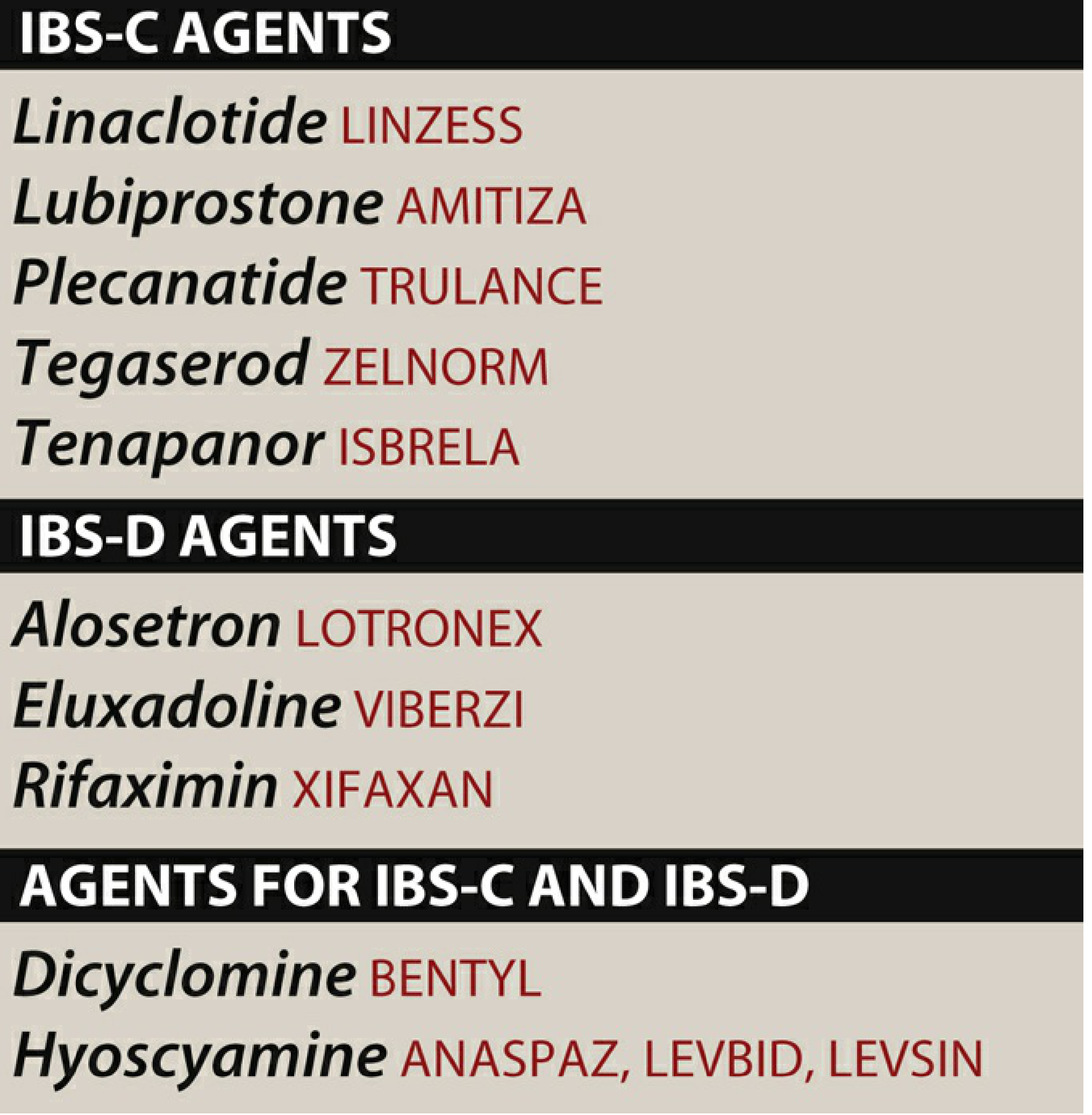
| Drug | Mechanism | Key Notes |
|---|---|---|
| Linaclotide (Linzess) | Guanylate cyclase-C agonist | IBS-C; also used in chronic idiopathic constipation; main SE: diarrhea |
| Plecanatide (Trulance) | Guanylate cyclase-C agonist | IBS-C; similar to linaclotide; SE: diarrhea |
| Lubiprostone (Amitiza) | Chloride channel (ClC-2) activator | Women with IBS-C; increases intestinal fluid secretion; SE: nausea, diarrhea |
| Tegaserod (Zelnorm) | 5-HT4 partial agonist | Women with IBS-C and <65 years old; contraindicated in history of MI, stroke, or angina |
| Tenapanor (Isbrela) | NHE3 (sodium/hydrogen exchanger 3) inhibitor | IBS-C; reduces sodium absorption, increases water in stool; SE: diarrhea |
| Osmotic laxatives (PEG/macrogol) | Osmotic effect | Can improve stool consistency but not validated to reduce abdominal pain in IBS-C specifically |
IBS-D (Diarrhea-Predominant) Agents
| Drug | Mechanism | Key Notes |
|---|---|---|
| Rifaximin (Xifaxan) | Non-absorbable antibiotic (structural analog of rifampin) | Short-term use; reduces bacterial load; may be repeated; SE: nausea, fatigue, headache, rare C. difficile |
| Alosetron (Lotronex) | 5-HT3 antagonist | Women with severe IBS-D only (restricted prescribing program); SE: constipation, ischemic colitis (rare) |
| Eluxadoline (Viberzi) | Mixed mu/kappa-opioid agonist + delta-opioid antagonist | IBS-D; reduces diarrhea and pain; contraindicated in pancreatitis, biliary duct obstruction, alcoholism; SE: constipation, abdominal pain, rare pancreatitis |
| Loperamide | Opioid receptor agonist (peripheral) | OTC; slows motility; reduces diarrhea but NOT validated for abdominal pain in IBS |
| Cholestyramine | Bile acid sequestrant | Useful in bile acid malabsorption-related IBS-D |
Antispasmodics (IBS-C and IBS-D)
| Drug | Mechanism | Notes |
|---|---|---|
| Dicyclomine (Bentyl) | Antimuscarinic | Reduces GI spasms and motility; SE: anticholinergic effects (dry mouth, drowsiness) |
| Hyoscyamine (Levsin) | Antimuscarinic | Same class; overdose can cause hallucinations, arrhythmias |
| Peppermint oil | Smooth muscle calcium channel relaxation | Natural antispasmodic; evidence for abdominal pain reduction |
Antidepressants
Used for pain modulation via central and peripheral mechanisms, independent of their antidepressant effect:
| Drug | Use |
|---|---|
| Tricyclic antidepressants (TCAs) - e.g., amitriptyline, nortriptyline | IBS-D (anticholinergic effects slow GI transit); also reduce visceral hypersensitivity |
| SSRIs/SNRIs | IBS-C (can accelerate transit); also helpful for psychological comorbidities |
| Low-dose antidepressants | Used even in absence of depression for visceral pain modulation |
7. Treatment by Subtype - Summary Algorithm
ALL IBS:
  → Education + reassurance
  → Dietary modification (low-FODMAP, trigger avoidance)
  → Soluble fiber (psyllium)
  → Regular exercise + stress management
  → Antispasmodics (for pain/cramps)

IBS-C (add):
  → Osmotic laxatives (PEG)
  → Linaclotide / Plecanatide
  → Lubiprostone (women)
  → Tenapanor
  → Tegaserod (women <65, no CVD)
  → TCAs (SSRIs if constipation dominant)

IBS-D (add):
  → Loperamide (acute diarrhea control)
  → Rifaximin (short course, repeatable)
  → Eluxadoline (avoid in pancreatitis/alcoholism)
  → Alosetron (severe IBS-D in women only, restricted program)
  → Bile acid sequestrants if bile acid malabsorption suspected
  → TCAs (low dose)

Refractory/Severe (any subtype, add):
  → CBT
  → Gut-directed hypnotherapy
  → Psychodynamic therapy / mindfulness
  → Specialist referral
8. Special Populations
- Pregnancy: Most pharmacological agents above are avoided; dietary and behavioral approaches are first-line.
- Post-infectious IBS: Consider rifaximin; address gut dysbiosis. Small intestinal bacterial overgrowth (SIBO) can co-occur - treat if present.
- IBS with bloating/distention: Low-FODMAP diet most effective; rifaximin may help; neuromodulators can reduce visceral sensitivity.
Key Points to Remember
- IBS is a positive diagnosis using Rome IV criteria, not a diagnosis of exclusion.
- Low-FODMAP diet is the most evidence-based dietary intervention - always involve a dietitian.
- Soluble fiber yes, insoluble fiber no.
- Psychological therapies (especially CBT and gut-directed hypnotherapy) have strong evidence for refractory or severe IBS.
- Drug choice is subtype-dependent - IBS-C agents can precipitate severe diarrhea in IBS-D and vice versa.
- Alosetron (IBS-D) and tegaserod (IBS-C) have restricted use due to safety concerns (ischemic colitis and cardiovascular risk, respectively).
- Antidepressants work for visceral pain modulation even without comorbid depression.
- Treatment is rarely a single intervention - most patients benefit from a combination approach.
Sources: Goldman-Cecil Medicine (International Edition) - Ch. 123; Lippincott Illustrated Reviews: Pharmacology - Ch. 42; Sleisenger & Fordtran's Gastrointestinal and Liver Disease - Ch. 122. Recent evidence: PMID 40258374 (dietary interventions, Lancet GH 2025), PMID 41077057 (behavioral therapies, Lancet GH 2025), PMID 38777133 (brain-gut treatments, Gastroenterology 2024).
This is a shared conversation. Sign in to Orris to start your own chat.