
1. Functional Histology of the Cortex: What are the six structural layers of the neocortex and the primary cell types (Pyramidal, Stellate) and the significance of Betz cells? 2. Lobes and Functional Areas: How is the cortex divided into Frontal, Parietal, Temporal, and Occipital lobes, and what are their primary Brodmann areas? 3. Frontal Lobe Physiology: What are the roles of the Primary Motor Area, Broca's area, and the Prefrontal cortex in movement and personality? 4. Sensory and Association Areas: How do the Parietal, Temporal, and Occipital lobes process somatosensory, auditory, and visual information? 5. Cerebral Dominance and Speech: What is the concept of categorical vs. representational hemispheres, and how do Wernicke's and Broca's are coordinate speech?
neocortex six layers cortical histology pyramidal stellate cells Betz cells
cerebral cortex lobes Brodmann areas frontal parietal temporal occipital primary motor sensory auditory visual areas Broca Wernicke cerebral dominance
Harrison's Principles of Internal Medicine, Twenty First Edition
Page 857
neocortex six layers cortical cytoarchitecture pyramidal cells diagram

Hugging Face pmc clinical VQA raw
Page 0
Brodmann areas cerebral cortex lateral medial view lobes functional areas map

Hugging Face pmc clinical VQA raw
Page 0
Functional Histology and Physiology of the Cerebral Cortex
1. Functional Histology of the Neocortex
The Six Layers (Roman Numerals I–VI)
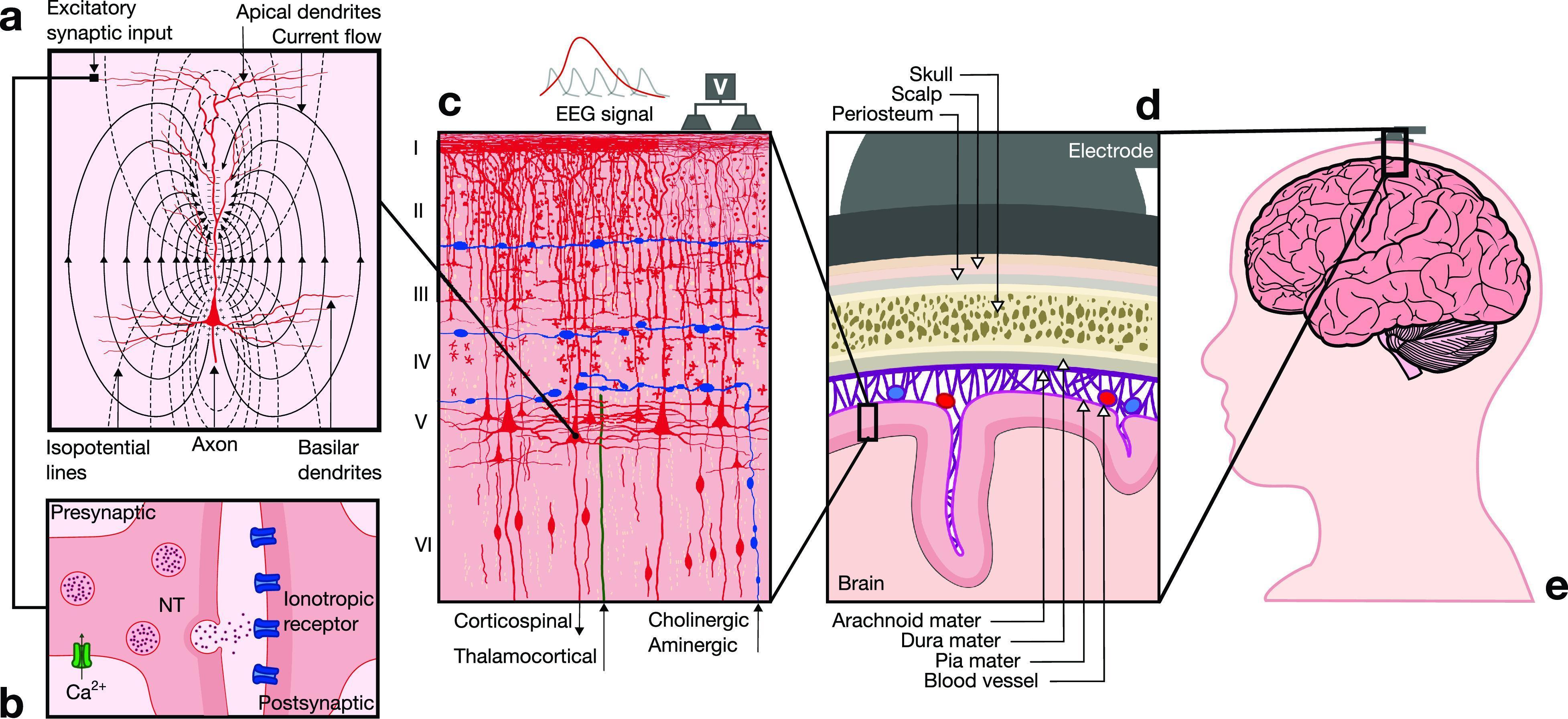
| Layer | Name | Composition | Key Connections |
|---|---|---|---|
| I | Molecular (Plexiform) | Sparse neurons; mainly axons & dendrites | Receives inputs from thalamus (diffuse), apical dendrites of deep pyramidal cells |
| II | External Granular | Small pyramidal + stellate cells | Cortico-cortical connections (association/commissural) |
| III | External Pyramidal | Medium-to-large pyramidal cells | Primary output to other cortical areas (ipsilateral and contralateral via corpus callosum) |
| IV | Internal Granular | Densely packed stellate (granule) cells | Primary thalamic input layer — most developed in sensory cortex |
| V | Internal Pyramidal (Ganglionic) | Large pyramidal cells | Primary output to subcortical targets (brainstem, spinal cord, basal ganglia) |
| VI | Multiform (Fusiform) | Spindle-shaped & polymorphic neurons | Reciprocal feedback to thalamus |
Key principle: Sensory cortex (e.g., primary somatosensory, visual) has a thick Layer IV — so prominent it is called granular cortex (koniocortex). Motor cortex has a thin/absent Layer IV and a thick Layer V — called agranular cortex.
Primary Cell Types
Pyramidal Cells
- The principal excitatory projection neurons of the cortex.
- Characteristic triangular soma with a single apical dendrite ascending toward Layer I (receiving input from corticothalamic afferents) and multiple basal dendrites.
- Axons project out of the cortex (corticospinal, corticobulbar, callosal, corticostriatal, corticothalamic tracts).
- Use glutamate as neurotransmitter.
- Found predominantly in Layers III, V, and VI.
Stellate (Granule) Cells
- Small, multipolar neurons with short local axons — they are the primary interneurons of the cortex.
- Spiny stellate cells in Layer IV are the main recipients of thalamocortical input and relay it to pyramidal cells.
- Smooth (aspiny) stellate cells are largely GABAergic inhibitory interneurons (e.g., basket cells, chandelier cells) that modulate local circuit excitability.
- Most concentrated in Layer IV.
Betz Cells — Clinical & Physiological Significance
| Feature | Detail |
|---|---|
| Location | Layer V, primary motor cortex (Brodmann Area 4), precentral gyrus |
| Axons | Give rise to the fastest-conducting fibers of the corticospinal (pyramidal) tract (~70 m/s) |
| Number | Only ~30,000 per hemisphere — a tiny fraction of all corticospinal neurons |
| Function | Direct control of fine, skilled voluntary movement, especially distal limb and hand muscles |
| Clinical relevance | Selectively lost in Amyotrophic Lateral Sclerosis (ALS), primary lateral sclerosis, and other UMN disorders. Their loss produces the upper motor neuron syndrome: spasticity, hyperreflexia, Babinski sign, loss of fine motor dexterity |
Betz cells account for only ~3% of corticospinal tract fibers, yet their large diameter gives them disproportionate physiological influence by ensuring rapid, precise motor commands.
2. Lobes and Functional (Brodmann) Areas
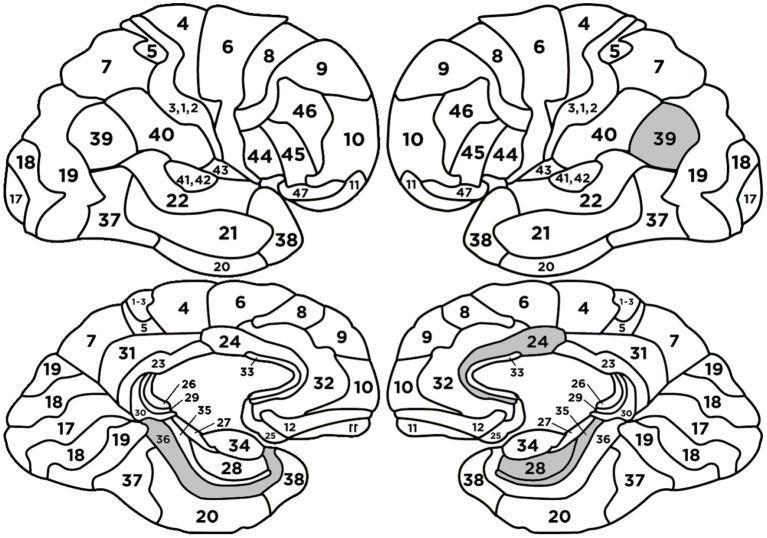
Lobe-by-Lobe Brodmann Reference
| Lobe | Boundaries | Key Brodmann Areas | Primary Function |
|---|---|---|---|
| Frontal | Anterior to central sulcus, above lateral fissure | 4, 6, 8, 9–12, 44, 45, 46, 47 | Motor control, executive function, speech production, personality |
| Parietal | Between central sulcus & parieto-occipital sulcus | 1, 2, 3, 5, 7, 39, 40 | Somatosensory processing, spatial awareness, language integration |
| Temporal | Below lateral fissure | 22, 41, 42, 37, 20, 21, 38 | Auditory processing, language comprehension, memory, face recognition |
| Occipital | Posterior to parieto-occipital sulcus | 17, 18, 19 | Visual processing (primary + association) |
3. Frontal Lobe Physiology
A. Primary Motor Area (Brodmann Area 4)
- Located on the precentral gyrus, immediately anterior to the central sulcus.
- Contains Betz cells (see above) and gives rise to the majority of corticospinal and corticobulbar fibers.
- Organized as a somatotopic map (motor homunculus):
- Medial surface: lower extremity
- Dorsolateral surface: trunk, upper extremity
- Lateral surface: face, larynx, tongue
- Hands and face have disproportionately large representations (high dexterity demands).
- Stimulation produces contralateral movements; ablation produces contralateral flaccid paralysis acutely, then UMN syndrome.
B. Premotor and Supplementary Motor Areas (Brodmann Area 6)
- Lateral premotor cortex: programs visually guided movements; coordinates with basal ganglia.
- Supplementary Motor Area (SMA) — medial BA 6: involved in motor planning, bimanual coordination, and internally generated (self-initiated) movements.
- Lesion → alien hand syndrome, difficulty with bimanual tasks.
C. Broca's Area (Brodmann Areas 44 & 45)
- Located in the inferior frontal gyrus (pars opercularis = BA 44; pars triangularis = BA 45) of the dominant hemisphere (left in ~96% of right-handers).
- Responsible for motor programming of speech — the articulation and grammatical construction of language output (expressive/production aspect).
- Broca's aphasia (expressive aphasia): non-fluent, effortful, telegraphic speech; comprehension relatively preserved; repetition impaired; patient is typically aware of their deficit (frustrated).
| Feature | Broca's Aphasia |
|---|---|
| Fluency | Non-fluent, halting |
| Comprehension | Relatively intact |
| Repetition | Impaired |
| Naming | Impaired |
| Lesion | Left BA 44/45, inferior frontal gyrus |
D. Prefrontal Cortex (Brodmann Areas 9, 10, 11, 12, 46, 47)
| Subdivision | Brodmann Areas | Functions |
|---|---|---|
| Dorsolateral PFC (DLPFC) | 9, 46 | Working memory, cognitive flexibility, planning, abstract reasoning, attention |
| Orbitofrontal Cortex (OFC) | 11, 12, 47 | Emotional regulation, reward processing, impulse control, social behavior |
| Ventromedial PFC | 10, 11 | Decision-making integrating emotion and logic (Damasio's somatic marker hypothesis) |
| Anterior Cingulate Cortex | 24, 32 | Error detection, conflict monitoring, motivation |
- DLPFC lesion: impaired working memory, poor planning, perseveration (Wisconsin Card Sorting), dysexecutive syndrome.
- OFC/ventromedial lesion: disinhibition, impulsivity, poor judgment, inappropriate social behavior, personality change — classically illustrated by Phineas Gage (1848), whose personality transformed after an iron rod destroyed his OFC/ventromedial PFC.
4. Sensory and Association Areas
A. Parietal Lobe — Somatosensory Processing
Primary Somatosensory Cortex (SI) — Brodmann Areas 3, 1, 2
- Located on the postcentral gyrus, immediately posterior to the central sulcus.
- Receives thalamocortical input from VPL (body) and VPM (face) nuclei of the thalamus.
- Organized as a somatosensory homunculus (Penfield) — hands, lips, and tongue have large representations.
- BA 3a: proprioception (muscle spindle afferents)
- BA 3b: cutaneous touch (most primary input)
- BA 1: texture discrimination
- BA 2: size and shape (stereognosis)
Secondary Somatosensory Cortex (SII)
- Located in the parietal operculum (upper bank of lateral fissure).
- Bilateral representation; involved in tactile learning and memory.
Posterior Parietal Association Cortex — Brodmann Areas 5 & 7
- BA 5: Somatosensory association — integrates tactile + proprioceptive signals; cross-modal body awareness.
- BA 7: Visuospatial integration — links visual and somatosensory data for spatial tasks (reaching, grasping).
Inferior Parietal Lobule — Brodmann Areas 39 & 40
- Supramarginal Gyrus (BA 40): phonological processing, tactile naming, apraxia circuits.
- Angular Gyrus (BA 39): reading, writing, arithmetic, cross-modal association (visual-to-language linkage); part of Wernicke's area network.
- Left hemisphere lesion → Gerstmann's syndrome (agraphia, acalculia, finger agnosia, left-right confusion).
- Right hemisphere lesion → Hemispatial neglect (contralateral spatial inattention, often left side).
B. Temporal Lobe — Auditory and Language Comprehension
Primary Auditory Cortex — Brodmann Areas 41 & 42
- Located on Heschl's gyri (transverse temporal gyri), buried within the lateral fissure on the superior temporal plane.
- Receives tonotopic (frequency-organized) input from the medial geniculate nucleus of the thalamus.
- BA 41: primary reception of auditory signals.
- BA 42: secondary/refinement of auditory processing; tonotopic organization maintained.
Wernicke's Area — Brodmann Area 22 (posterior)
- Located in the posterior superior temporal gyrus of the dominant hemisphere.
- Critical for auditory language comprehension — decodes phonological sequences into meaningful language.
- Wernicke's aphasia: fluent but paraphasic speech (neologisms, jargon), severely impaired comprehension, impaired repetition; patient unaware of errors (anosognosia for language errors).
| Feature | Wernicke's Aphasia |
|---|---|
| Fluency | Fluent (normal rate/rhythm, abnormal content) |
| Comprehension | Severely impaired |
| Repetition | Impaired |
| Content | Paraphasias, neologisms, "word salad" |
| Lesion | Left posterior BA 22 |
Other Temporal Areas
- BA 37 (Fusiform gyrus): face recognition (fusiform face area); word-form recognition ("visual word form area").
- BA 20, 21 (Inferior/Middle temporal gyrus): object recognition, semantic memory.
- BA 38 (Temporal pole): social-emotional meaning of stimuli, autobiographical memory.
- Medial temporal lobe (parahippocampal gyrus, entorhinal cortex, hippocampus): declarative memory consolidation (not strictly neocortex, but functionally integral).
C. Occipital Lobe — Visual Processing
Primary Visual Cortex (V1) — Brodmann Area 17
- Located on the calcarine sulcus (medial occipital lobe).
- Receives retinotopic input from the lateral geniculate nucleus (LGN) of the thalamus via the optic radiations.
- Contains a thick Layer IV (koniocortex, particularly Layer IVc), receives M (magnocellular) and P (parvocellular) stream inputs.
- Organized retinotopically: fovea is represented posteriorly (large area = high acuity); peripheral vision anteriorly.
Visual Association Cortex — Areas 18 & 19
- BA 18 (V2, V3): Early integration of orientation, spatial frequency, color.
- BA 19 (V4, V5/MT): Higher visual processing.
The Two Visual Streams (Beyond V1)
| Stream | Pathway | Function |
|---|---|---|
| Ventral ("What") stream | V1 → V2 → V4 → Inferotemporal cortex (BA 37, 20) | Object recognition, color, face identification |
| Dorsal ("Where/How") stream | V1 → V2 → V5/MT → Posterior parietal cortex (BA 7) | Spatial localization, motion detection, visually guided action |
- Ventral lesion → visual agnosia, prosopagnosia, achromatopsia.
- Dorsal lesion → optic ataxia, neglect, Bálint's syndrome.
5. Cerebral Dominance and Speech
Categorical vs. Representational Hemispheres
| Feature | Left (Categorical) Hemisphere | Right (Representational) Hemisphere |
|---|---|---|
| Primary domain | Language, speech, sequential analysis | Visuospatial processing, music, holistic pattern recognition |
| Cognitive style | Analytic, linear, detail-oriented | Synthetic, global, gestalt-oriented |
| Praxis | Dominant for skilled learned movements (apraxia on damage) | Non-dominant |
| Emotion | Processing of positive emotions (some evidence) | Prosody, emotional tone of speech, face emotion recognition |
| Spatial | Local features | Global/spatial relationships, mental rotation |
| Dominance prevalence | Left dominant in ~96% of right-handers; ~70% of left-handers | Right dominant: ~4% right-handers, ~30% left-handers |
The terms "categorical" and "representational" were championed by Geschwind and Galaburda. The left hemisphere "categorizes" language and logical operations symbolically; the right "represents" information in a more holistic, spatial, and imagery-based manner.
The Language Network: Broca's and Wernicke's Areas
HEARD SPEECH:
Primary Auditory Cortex (BA 41/42)
        ↓
Wernicke's Area (BA 22, posterior STG) ← COMPREHENSION
        ↓
Arcuate Fasciculus (white matter tract)
        ↓
Broca's Area (BA 44/45, inferior frontal gyrus) ← SPEECH PRODUCTION
        ↓
Primary Motor Cortex (BA 4) → articulation muscles
- Visual input → Primary Visual Cortex (BA 17) → Angular Gyrus (BA 39) → Wernicke's → Arcuate Fasciculus → Broca's → Motor Cortex
The Arcuate Fasciculus
- Lesion → Conduction aphasia: fluent speech, intact comprehension, but severely impaired repetition (the "signature" deficit). Patient hears, understands, and wants to speak normally but cannot faithfully repeat.
Aphasia Summary Table
| Aphasia Type | Fluency | Comprehension | Repetition | Lesion Site |
|---|---|---|---|---|
| Broca's | Non-fluent | Intact | Impaired | BA 44/45 (L inferior frontal) |
| Wernicke's | Fluent | Impaired | Impaired | BA 22 (L posterior STG) |
| Conduction | Fluent | Intact | Severely impaired | Arcuate fasciculus |
| Global | Non-fluent | Impaired | Impaired | Large left MCA territory |
| Transcortical Motor | Non-fluent | Intact | Intact | Anterior/superior to Broca's |
| Transcortical Sensory | Fluent | Impaired | Intact | Posterior to Wernicke's |
| Anomic | Fluent | Intact | Intact | Variable (angular gyrus common) |
Key Integrating Principle: The Lateralized Brain
- Dominant (left) hemisphere is specialized for the sequential, phonological, syntactic, and semantic aspects of language.
- Non-dominant (right) hemisphere handles prosody (melody, emotional tone of speech), pragmatics, and metaphor — damage here produces aprosodia (flat, emotionally unmodulated speech).
- Handedness and dominance are linked but not identical — ~70% of left-handers still have left-hemisphere language dominance.
- Split-brain studies (Sperry & Gazzaniga) — after corpus callosotomy — definitively demonstrated the independent capabilities of each hemisphere, confirming that the right hemisphere has sophisticated nonverbal cognition despite being "mute" for speech output.
Summary: Cortical Functional Architecture at a Glance
| Domain | Key Area | Brodmann # | Critical Cell/Circuit |
|---|---|---|---|
| Motor execution | Primary Motor Cortex | 4 | Betz cells → corticospinal tract |
| Motor planning | SMA, Premotor | 6 | UMN output, basal ganglia loop |
| Speech production | Broca's | 44, 45 | L inferior frontal, arcuate fasciculus |
| Executive function | Prefrontal | 9, 10, 46 | DLPFC working memory circuits |
| Somatosensory | Primary SS cortex | 3, 1, 2 | VPL → Layer IV granule cells |
| Spatial integration | Posterior parietal | 5, 7, 40 | Dorsal visual stream |
| Auditory | Primary Auditory | 41, 42 | MGN → Heschl's gyri |
| Language comprehension | Wernicke's | 22 | L posterior STG |
| Vision (primary) | Striate cortex | 17 | M/P streams, Layer IVc |
| Visual association | Prestriate | 18, 19 | Ventral & dorsal streams |