
60 yr old female has pruritus in upper half of body since 1 month
Reading File
Now let me search the medical library for relevant content on pruritus - particularly upper body pruritus, systemic causes, and the clinical approach in an elderly female.
Finding Sources
Finding Sources
Searching PubMed
pruritus upper body systemic causes elderly
The first result is very promising - Cholinergic urticaria with pruritus in the upper half of the body. Let me also search for systemic causes of pruritus more broadly and read the dedicated pruritus sections in Fitzpatrick's.
Reading File
Reading File
Finding Sources
Searching PubMed
chronic pruritus systemic causes
Excellent. Now let me read the dedicated "Internal Causes of Pruritus" section from Andrews' and the IFSI classification from Fitzpatrick's, as these are the most directly relevant:
Reading File
Reading File
Let me read more of the "Internal Causes" section in Andrews' and look for upper body distribution and PV-related pruritus:
Reading File
Finding Sources
Now let me read the Polycythemia vera and Aquagenic Pruritus sections - these are very relevant to a 60-year-old with upper body pruritus:
Reading File
Reading File
Now I have a solid foundation. Let me also look for cholestatic pruritus and the IFSI classification image, and check the Polycythemia vera section for upper body pruritus specifically:
Reading File
Finding Sources
I now have comprehensive information. Let me also fetch the IFSI classification figure to include in my answer:
Loading Image
I now have everything needed to give a thorough, well-organized answer. Let me compile the comprehensive clinical response.
Pruritus in Upper Half of Body - 60-year-old Female, 1 Month Duration
This is a clinically significant presentation. The combination of age (60 years), female sex, upper body predominance, and 1-month duration narrows the differential considerably. Duration >6 weeks defines chronic pruritus; at 1 month this is subacute, but still warrants a systematic workup.
IFSI Classification Framework
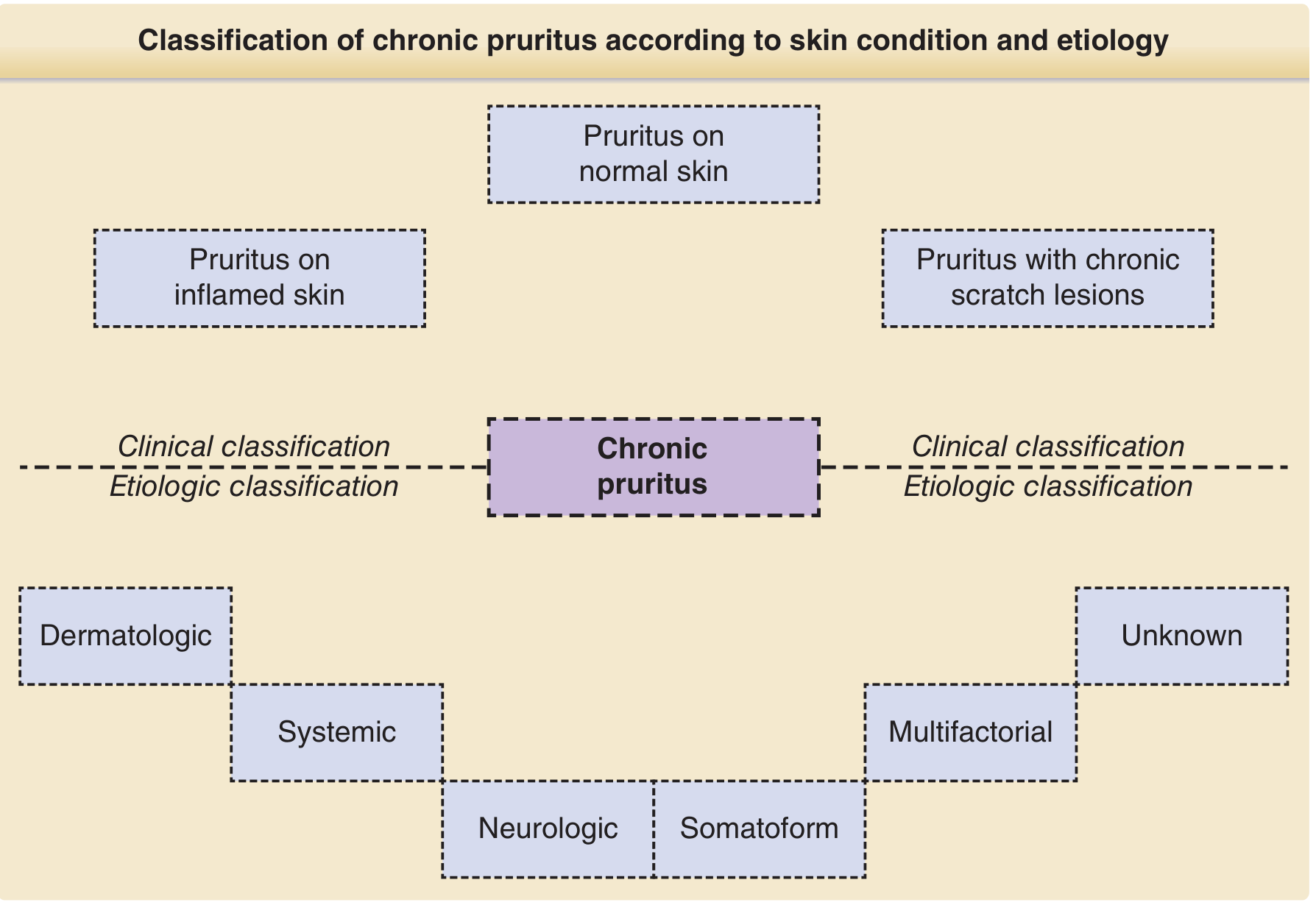
IFSI classification of chronic pruritus - Fitzpatrick's Dermatology
The International Forum for the Study of Itch (IFSI) classifies chronic pruritus into three clinical groups based on skin findings:
- Group I - pruritus on inflamed skin (dermatologic causes)
- Group II - pruritus on normal-appearing skin (systemic, neurologic, or psychiatric)
- Group III - pruritus with chronic scratch lesions (secondary changes)
Etiologic categories: Dermatologic | Systemic | Neurologic | Somatoform | Multifactorial | Unknown
Key Differential Diagnoses - Upper Body Pruritus in a 60-year-old Female
1. Cholinergic Urticaria / Cholinergic Pruritus (TOP consideration for upper body distribution)
The hallmark: pruritus is most prominent on the upper half of the body, symmetrically distributed, following sweat-inducing stimuli (exercise, hot baths, emotional stress, spicy food, alcohol). Small 2-3 mm wheals with flare appear within 15 minutes of the trigger. Angioedema, faintness, palpitations, and wheezing may accompany. Though more common in young atopic adults, it can occur at any age.
- Dermatology 2-Volume Set 5e, Cholinergic urticaria section
2. Aquagenic Pruritus
Prickling/burning/stinging within 30 minutes of water contact at any temperature, no visible skin lesions. Classically affects lower extremities first then generalizes, sparing head, but variants exist. In a 60-year-old woman, two key subcategories to distinguish:
- Polycythemia vera (PV)-associated: aquagenic pruritus precedes PV by years, eventually affects 30-50% of PV patients. Must rule out in older patients. Associated with JAK2 V617F mutation, ruddy complexion, elevated Hb/Hct.
- Aquagenic pruritus of the elderly: associated with xerosis.
- Dermatology 2-Volume Set 5e, Aquagenic Pruritus
3. Cholestatic / Hepatobiliary Disease
Primary Biliary Cholangitis (PBC) is particularly important here - it classically affects middle-aged to older women, causes severe pruritus (up to 70% of PBC patients), and is the most common chronic cholestatic liver disease in adults. Other causes: primary sclerosing cholangitis, obstructive choledocholithiasis, hepatitis C. Cholestatic pruritus is typically worse on the palms and soles first, but can be generalized or upper-body predominant.
- Dermatology 2-Volume Set 5e, Cholestatic Pruritus; Yamada's Gastroenterology
4. Hematologic Malignancy
- Hodgkin Lymphoma: pruritus in 10-30% of cases, may be the first symptom in 7%. Typically continuous, severe, may be burning in character. Upper body lymphadenopathy may be present.
- Cutaneous T-cell lymphoma (Mycosis fungoides): chronic pruritus with or without skin patches.
- Polycythemia vera: as above.
- Andrews' Diseases of the Skin
5. Thyroid Disease
Both hypothyroidism and hyperthyroidism can cause generalized pruritus. Hypothyroidism leads to xerosis-mediated itch; hyperthyroidism causes warm, moist skin with itch. Very relevant in a 60-year-old woman.
6. Chronic Kidney Disease (CKD-aP)
The most common systemic cause of pruritus overall (20-80% of CRF patients). Usually generalized or worse on the back, but can be localized. Associated with xerosis, dialysis.
- Andrews' Diseases of the Skin, CKD section
7. Senile/Xerotic Pruritus (Pruritus of Aging)
Dry skin (xerosis) is universal in elderly females; the trunk and limbs are most affected. Upper body itch from xerosis in post-menopausal women is extremely common, worsened by:
- Reduced sebum production
- Decreased skin hydration
- Air conditioning / cold weather
- Hot showers
8. Neuropathic Pruritus
Dermatomal or segmental distribution suggests a nerve compression etiology. Upper body pruritus may point to cervical or thoracic nerve root compression (C3-T4 dermatomes). Brachioradial pruritus (posterior forearms, upper arms, shoulders, neck) is a distinct neuropathic entity linked to cervical spine pathology.
9. Drug-Induced Pruritus
Common culprits in a 60-year-old woman:
- Opioids
- ACE inhibitors (causes bradykinin-mediated itch)
- Diuretics, statins
- Calcium channel blockers
- Antimalarials, chloroquine
10. Other Systemic Causes
- Diabetes mellitus (generalized itch, especially vulval/perianal in women)
- Iron deficiency anemia (without dermatitis)
- Carcinoid syndrome (flushing + pruritus)
- HIV / parasites (if risk factors present)
- Connective tissue disease / dermatomyositis
- Somatoform / psychiatric (rule-out diagnosis)
Diagnostic Workup
Based on Andrews', a suggested systematic workup for chronic/subacute generalized pruritus includes:
| Investigation | Purpose |
|---|---|
| CBC with differential | Polycythemia vera, lymphoma, leukemia, iron deficiency |
| Peripheral smear | Myeloproliferative disease |
| LFTs + GGT | Cholestatic liver disease (PBC: raised ALP, GGT) |
| Renal function tests | CKD |
| TFTs (TSH, T3, T4) | Thyroid disease |
| Fasting blood glucose / HbA1c | Diabetes |
| Hepatitis C serology | Common cause |
| Anti-mitochondrial antibody (AMA) | PBC |
| JAK2 V617F mutation | Polycythemia vera |
| Serum protein electrophoresis | Myeloma |
| HIV antibody (if risk factors) | |
| Urinalysis | Renal |
| Stool for occult blood | GI malignancy |
| Chest X-ray / CT chest/abdomen | Lymphoma, mediastinal disease |
| Skin biopsy (if lesions present) | Dermatitis herpetiformis, pemphigoid |
| Aquagenic challenge test | If water-provoked |
History must ask:
- Provoked by water/sweating/heat? (cholinergic, aquagenic)
- Time of day pattern? (systemic causes often worse at night)
- Any medications recently started?
- Jaundice, pale stools, dark urine? (cholestasis)
- Weight loss, night sweats, fevers? (B-symptoms of lymphoma)
- Symptoms of thyroid disease?
Why the Upper Body Distribution Matters
The upper body predominance is a useful localizing clue:
| Pattern | Suggests |
|---|---|
| Upper body, triggered by sweat/heat | Cholinergic urticaria |
| Water-triggered, upper/lower | Aquagenic pruritus (PV) |
| Upper body + palms/soles | Cholestatic pruritus |
| Dermatomal upper back/arms | Brachioradial pruritus, neuropathic |
| Generalized but worse upper body | Hodgkin lymphoma |
| Upper chest + skin thickening | Mycosis fungoides |
Management Approach (While Workup Pending)
Per Fitzpatrick's step-by-step approach:
- Emollients - applied twice daily regardless of cause; treat xerosis
- Topical antipruritics - menthol 1%, polidocanol, urea
- Antihistamines - non-sedating (cetirizine, fexofenadine) by day; sedating (hydroxyzine, chlorphenamine) at night for sleep
- Avoid triggers - hot showers, synthetic fabrics, harsh soaps
- Treat the underlying cause once identified
If neuropathic component suspected: gabapentin or pregabalin (onset 8-12 weeks).
If cholestatic: cholestyramine, rifampicin, naltrexone.
If PV: ruxolitinib (JAK1/2 inhibitor), aspirin, SSRIs.
Most Likely Diagnosis in This Patient
Given the clinical profile (60F, upper body, 1 month, no specific skin lesion mentioned), the top 3 working diagnoses to investigate are:
- Hepatobiliary disease (PBC) - classic demographic (middle-aged/older woman), pruritus is often the first symptom, upper body distribution
- Polycythemia vera - aquagenic pruritus, JAK2 mutation, elevated CBC
- Thyroid disease / xerosis of aging - very prevalent in this age-sex group, frequently overlooked
Sources: Fitzpatrick's Dermatology Vol 1-2 (IFSI Classification, Chronic Pruritus); Dermatology 2-Volume Set 5e (Cholinergic Urticaria, Aquagenic Pruritus, Cholestatic Pruritus, PV); Andrews' Diseases of the Skin (Internal Causes of Pruritus, CKD-aP)
Recent literature: A 2024 JAMA review on chronic pruritus (PMID 38809527) and the European S2k Guideline on Chronic Pruritus 2025 (PMID 40843597) both emphasize the importance of systematic evaluation with a focus on systemic causes in older patients.
With normal skin
This is a critical narrowing clue. Pruritus on normal-appearing skin in a 60-year-old female places her firmly in IFSI Group II, which shifts the diagnostic focus almost entirely toward systemic, neurologic, and somatoform causes - dermatologic conditions are largely excluded.
Searching sources...
Finding Sources
Finding Sources
Finding Sources
Reading File
Finding Sources
Finding Sources
Reading File
Reading File
Reading File
Loading Image
This is the perfect algorithm for this patient. Now I have everything needed.
Pruritus on Normal Skin - 60F, Upper Body, 1 Month
The normal skin finding is the single most important clinical discriminator. It eliminates primary dermatologic diseases and places this patient squarely in the "generalized unexplained pruritus on normal skin" pathway.
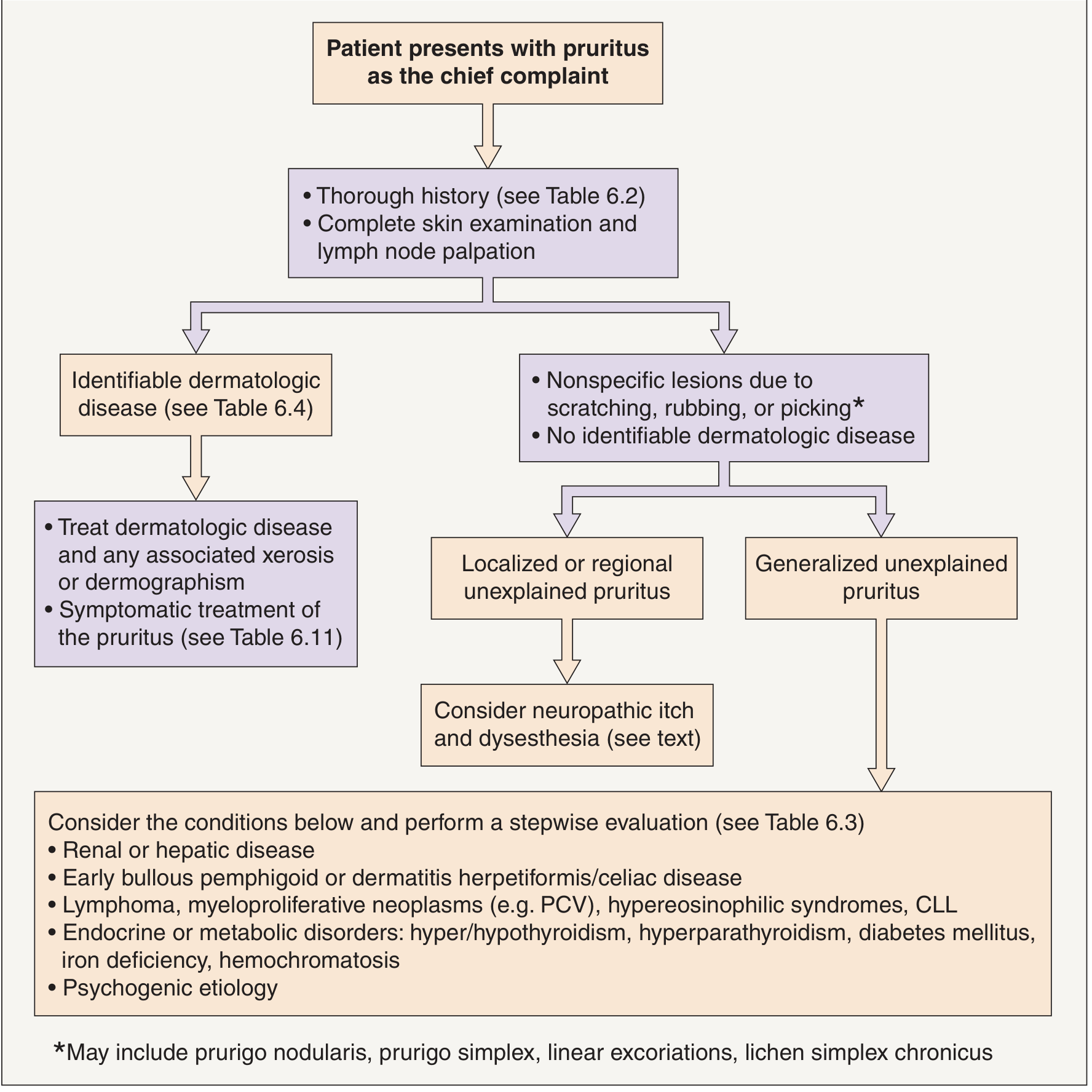
Structured diagnostic approach for pruritus without identifiable skin disease - Dermatology 2-Volume Set 5e
Why "Normal Skin" Changes Everything
Per the IFSI framework and Dermatology 5e:
"Patients with no identifiable primary skin disease require further investigation to determine the etiology of their pruritus... laboratory workups to investigate possible systemic or neurologic conditions gain relevance in patients with pruritus on normal skin."
The diagnostic focus now shifts to the lower box in the algorithm:
- Renal or hepatic disease
- Early bullous pemphigoid or dermatitis herpetiformis/celiac disease (may precede skin lesions by months)
- Lymphoma, myeloproliferative neoplasms (PV, CLL), hypereosinophilic syndromes
- Endocrine/metabolic: hyper/hypothyroidism, hyperparathyroidism, diabetes mellitus, iron deficiency, hemochromatosis
- Psychogenic etiology
- Neuropathic itch (upper body, localized - suggests this strongly)
Prevalence of Pruritus in Key Conditions (Table 6.1, Dermatology 5e)
| Condition | Prevalence of Pruritus |
|---|---|
| Primary biliary cholangitis | 80% - often the presenting symptom |
| End-stage kidney disease on HD | 25-30% |
| Cutaneous T-cell lymphoma | 60-80%; >90% in Sézary |
| Polycythemia vera | 30-50% |
| Hodgkin lymphoma | ≤30% |
| Non-Hodgkin lymphoma | ≤10% |
| Herpes zoster / postherpetic neuralgia | ≤60% / ≤30% |
Differential Focused on This Patient (60F, Normal Skin, Upper Body)
PRIORITY 1: Hepatobiliary Disease
Primary Biliary Cholangitis (PBC) is the #1 consideration in a 60-year-old woman with pruritus on normal skin.
- Affects women 9x more than men, peak age 40-60 years
- 80% have pruritus - often the first/only symptom, sometimes years before jaundice develops
- Skin is normal in early disease
- Pattern: worse on palms, soles, and areas constricted by clothing; nocturnal worsening; migratory
- Key tests: ALP elevated (cholestatic pattern), GGT, Anti-Mitochondrial Antibody (AMA) - positive in >90% of PBC
- Not relieved by scratching
Dermatology 2-Volume Set 5e, Cholestatic Pruritus
PRIORITY 2: Neuropathic Pruritus - Upper Body Distribution
The upper body predominance with normal skin is a strong pointer to neuropathic/neurogenic itch. In a 60-year-old woman, consider:
- Brachioradial pruritus: affects upper arms, forearms, shoulders, back of neck - linked to cervical spondylosis / C5-C8 nerve root compression. No skin lesions; diagnosed by exclusion and cervical MRI/X-ray. Hallmark: "ice pack sign" - relief with ice.
- Notalgia paresthetica: localized burning/itching on mid-upper back (subscapular region), associated with T2-T6 thoracic nerve compression. Often unilateral.
- Both are extremely common in older women and are frequently missed.
Per the algorithm: "Localized or regional unexplained pruritus → consider neuropathic itch and dysesthesia."
PRIORITY 3: Polycythemia Vera (PV)
- Aquagenic pruritus (triggered by water/heat) affects 30-50% of PV patients; no visible skin lesions at the time of itch
- Can precede PV diagnosis by years
- Age 60 is the typical peak for PV
- Check: CBC (elevated Hb, Hct, WBC, platelets), JAK2 V617F mutation
- Ruddy complexion, splenomegaly may be present
Dermatology 2-Volume Set 5e, Polycythemia vera
PRIORITY 4: Hematologic Malignancy
- Hodgkin lymphoma: pruritus can antedate diagnosis by months to years, generalized/severe, continuous. Often burning in character. May involve upper body preferentially due to mediastinal/cervical nodal involvement. Look for lymphadenopathy, constitutional B-symptoms (fever, night sweats, weight loss).
- Iron deficiency (without anemia): can cause pruritus before Hb falls; check serum ferritin.
Goldman-Cecil Medicine; Andrews' Diseases of the Skin
PRIORITY 5: Thyroid Disease
- Both hypo- and hyperthyroidism cause pruritus on normal-appearing skin
- Hypothyroid pruritus = dry skin-mediated, usually mild
- Hyperthyroid pruritus = warm skin, weight loss, palpitations, anxiety
- TSH is the single best screen
PRIORITY 6: Chronic Kidney Disease
- 25-30% of patients on HD have pruritus; can be localized to upper back/arms
- Check creatinine, eGFR, urea
PRIORITY 7: Early Bullous Pemphigoid (BP)
- BP can present with months of intense generalized pruritus on normal skin, before any blisters appear (pre-bullous phase)
- Common in elderly women
- Diagnosis: skin biopsy (perilesional), direct immunofluorescence (IgG + C3 at BMZ), serum anti-BP180 and anti-BP230 antibodies
- This diagnosis is frequently delayed - keep a low threshold to test
PRIORITY 8: Diabetes Mellitus / Metabolic
- Check HbA1c; diabetic neuropathy can cause regional itch
- Hyperparathyroidism (often asymptomatic in elderly women post-menopause) - check serum Ca, PTH
Recommended Investigations - Stepwise
Tier 1 (All patients - order together):
| Test | Rationale |
|---|---|
| CBC + differential + peripheral smear | PV, lymphoma, iron deficiency, eosinophilia |
| LFTs: AST, ALT, ALP, GGT, bilirubin | PBC, cholestasis |
| Anti-Mitochondrial Antibody (AMA) | PBC (>90% sensitivity) |
| Renal function: creatinine, eGFR, urea | CKD |
| TSH | Thyroid disease |
| Fasting glucose / HbA1c | Diabetes |
| Serum ferritin + iron studies | Iron deficiency |
| Hepatitis C serology | Common cause |
| Serum calcium, PTH | Hyperparathyroidism |
| Urinalysis | Renal |
| Chest X-ray | Lymphoma, mediastinal mass |
Tier 2 (If Tier 1 inconclusive):
| Test | Rationale |
|---|---|
| JAK2 V617F mutation | Polycythemia vera |
| Serum protein electrophoresis + immunofixation | Myeloma, paraprotein |
| Anti-BP180 / Anti-BP230 antibodies | Pre-bullous pemphigoid |
| Anti-tissue transglutaminase IgA | Dermatitis herpetiformis / celiac |
| CT chest/abdomen/pelvis | Occult lymphoma, solid malignancy |
| Cervical spine X-ray or MRI | Neuropathic (brachioradial) pruritus |
| Skin biopsy (normal-appearing skin) + DIF | BP, DH |
| HIV antibody (if risk factors) | |
| Stool for occult blood + parasites | GI malignancy, helminths |
Clinical Clues to Help Narrow Further
| Clue on history | Think |
|---|---|
| Worse on palms/soles, nocturnal | Cholestatic (PBC) |
| Triggered by water or warm bath | Polycythemia vera |
| Burning + no itch relief + continuous | Hodgkin lymphoma |
| Upper arm/neck/shoulder, ice relieves | Brachioradial pruritus |
| Mid-upper back, unilateral | Notalgia paresthetica |
| Preceding blistering or new skin fragility | Early bullous pemphigoid |
| Night sweats, weight loss, lymph nodes | Lymphoma |
| Palpitations, weight loss, heat intolerance | Hyperthyroidism |
| Post-menopausal, fatigue, jaundice-free | PBC early |
Most Likely Diagnosis in This Patient
Given 60-year-old female + upper body + normal skin + 1 month:
- Primary Biliary Cholangitis - most likely single systemic diagnosis; classic demographic, pruritus is the sentinel symptom, skin is initially normal
- Neuropathic pruritus (brachioradial pruritus / notalgia paresthetica) - localized upper body distribution on normal skin is characteristic; very common and under-diagnosed at this age
- Pre-bullous pemphigoid - insidious onset, elderly female, normal skin phase can last months
These three should be the first confirmed or excluded, alongside the standard blood panel.
Sources: Dermatology 2-Volume Set 5e (Evaluation of pruritus, Cholestatic pruritus, Hematologic pruritus, PV, Iron deficiency); Andrews' Diseases of the Skin (Internal causes, Hodgkin disease); Fitzpatrick's Dermatology (IFSI classification); Goldman-Cecil Medicine (Hodgkin lymphoma); Yamada's Gastroenterology (PBC)
This is a shared conversation. Sign in to Orris to start your own chat.