
Apocrine, eccrine,paracrine, holocrine
Reading File
Searching for information on types of secretion mechanisms.
search_medical_text
apocrine eccrine paracrine holocrine secretion mechanisms types
Harrison's Principles of Internal Medicine, Twenty First Edition
Page 10537
search_medical_image
apocrine eccrine holocrine paracrine secretion diagram
Hugging Face pmc clinical VQA raw
Page 0
GradeResponse
GradeResponse
Here is a comprehensive comparison of the four secretion types:
Types of Secretion / Signaling Mechanisms
1. Eccrine Secretion
- Mechanism: The secretory cell remains intact. Products are released by exocytosis (vesicle fusion with the cell membrane) without any loss of cytoplasm.
- Cell fate: Cell survives and continues to function.
- Classic example: Eccrine sweat glands — the most numerous sweat glands in humans, distributed all over the body surface. They secrete a watery, hypotonic sweat primarily for thermoregulation.
- Other examples: Salivary glands, pancreatic acini, goblet cells (mucus).
- Also called: Merocrine secretion.
2. Apocrine Secretion
- Mechanism: The secretory product accumulates at the apical portion of the cell, which then pinches off and is released, taking a portion of the cytoplasm and cell membrane with it.
- Cell fate: Cell loses part of its cytoplasm but survives and regenerates.
- Classic examples:
- Apocrine sweat glands (axilla, groin, areola) — produce a thicker, odorless secretion that becomes pungent when metabolized by skin bacteria.
- Mammary glands (lipid component of milk).
- Key distinction from eccrine: Partial sacrifice of the cell apex.
3. Holocrine Secretion
- Mechanism: The entire cell disintegrates and becomes the secretion. Cells accumulate their product, die, and are released in full.
- Cell fate: Cell dies and is shed as the secretion.
- Classic example: Sebaceous glands — produce sebum (an oily mixture) that lubricates and waterproofs hair and skin. The entire sebocyte ruptures to release sebum.
- Key distinction: Most "destructive" mode — the product IS the dead cell.
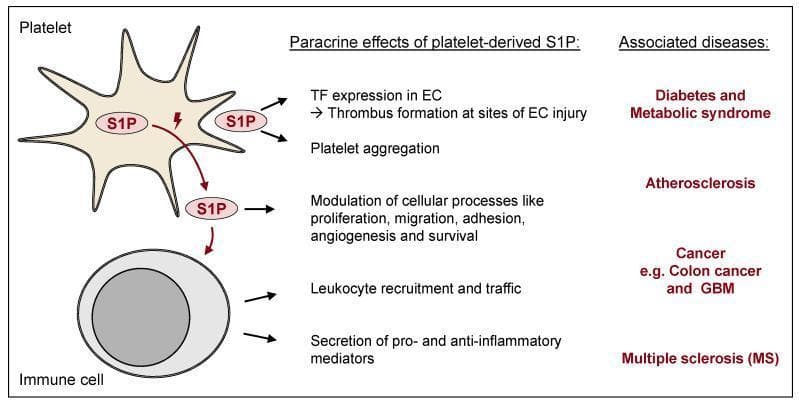
4. Paracrine Secretion (Signaling)
- Mechanism: A cell releases signaling molecules that act locally on adjacent or nearby cells in the same tissue. The signal diffuses through the interstitium over short distances (does NOT enter systemic circulation).
- Cell fate: Cell survives.
- Classic examples:
- Pancreatic δ cells release somatostatin, which inhibits nearby β cells (suppressing insulin) and α cells (suppressing glucagon).
- Histamine release from mast cells acting on adjacent blood vessels.
- Growth factors (EGF, FGF, PDGF) in tissue repair.
- Distinction from endocrine: Endocrine hormones travel through the bloodstream to distant targets; paracrine signals act locally.
Harrison's Principles of Internal Medicine, 21st Ed., p. 10537: "Paracrine regulation refers to factors released by one cell that act on an adjacent cell in the same tissue."
Summary Comparison Table
| Feature | Eccrine (Merocrine) | Apocrine | Holocrine | Paracrine |
|---|---|---|---|---|
| Cell fate | Intact (survives) | Partially lost (survives) | Completely destroyed | Intact (survives) |
| Mechanism | Exocytosis | Apical budding | Cell lysis/death | Local diffusion of signaling molecules |
| Product | Vesicle contents | Cytoplasm + membrane fragment | Entire cell | Soluble mediators/growth factors |
| Example gland/cell | Eccrine sweat glands | Apocrine sweat glands, mammary gland | Sebaceous glands | Pancreatic islet δ cells |
| Category | Glandular secretion | Glandular secretion | Glandular secretion | Cell signaling |
Quick Memory Tip
- Holocrine = whole cell dies
- Apocrine = apex of cell is lost
- Eccrine (merocrine) = exocytosis, cell intact
- Paracrine = acts on parallel/adjacent cells (local signaling)
This is a shared conversation. Sign in to Orris to start your own chat.