
Umbilical hernia pediatrics
Reading File
Searching for comprehensive information on pediatric umbilical hernias across clinical presentation, management, and imaging.
search_medical_text
umbilical hernia pediatrics etiology diagnosis management
Bailey and Love's Short Practice of Surgery 28th Edition
Page 1093
search_medical_text
umbilical hernia children surgical repair indications complications
Bailey and Love's Short Practice of Surgery 28th Edition
Page 1094
search_medical_image
umbilical hernia pediatric clinical image

Hugging Face pmc clinical VQA raw
Page 0
GradeResponse
GradeResponse
GradeResponse
Here is a comprehensive overview of umbilical hernia in pediatrics:
Umbilical Hernia in Pediatrics
Definition & Pathophysiology
An umbilical hernia results from a failure of the umbilical ring to close after birth. Normally, the umbilical ring closes as the cord stump heals within the first week of life. When this closure is delayed or incomplete, abdominal contents (typically omentum or bowel) can herniate through the defect, forming a soft, reducible bulge at the umbilicus.
Epidemiology & Risk Factors
| Factor | Detail |
|---|---|
| Incidence | Very common; occurs in ~10–30% of newborns |
| Prematurity | Significantly higher incidence in preterm infants |
| Low birth weight | Strong association |
| Ethnicity | Up to 3–9x more common in Black infants |
| Associated conditions | Down syndrome, Beckwith-Wiedemann, hypothyroidism, mucopolysaccharidoses |
| Sex | Equal incidence in males and females |
Clinical Presentation
- Soft, reducible swelling at the umbilicus, often more prominent with crying, straining, or standing
- Usually asymptomatic — incidental finding in infants
- Hernia reduces spontaneously when the child is relaxed or supine
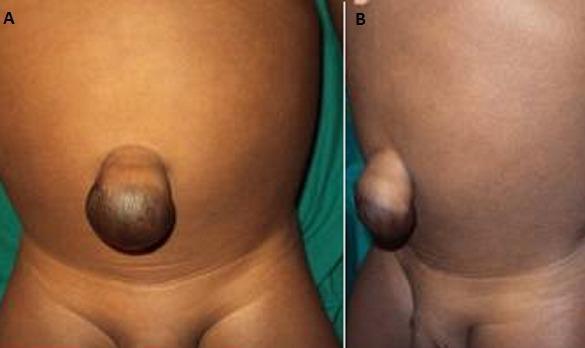
- The proboscoid variant features redundant overlying skin with significant outward projection (see image below)
Natural History
The majority of pediatric umbilical hernias close spontaneously without intervention:
| Defect Size | Expected Closure |
|---|---|
| < 1 cm | High likelihood of spontaneous closure by age 3–4 years |
| 1–2 cm | May close by age 5, but less reliable |
| > 2 cm | Unlikely to close spontaneously |
- Most hernias that will close do so by age 3–5 years
- Strangulation/incarceration is rare in children (< 1%), making expectant management safe in most cases
Indications for Surgical Repair
Surgery is generally deferred until age 3–5 years unless specific indications exist:
| Indication | Detail |
|---|---|
| Defect > 1.5–2 cm at age 2–3 years | Unlikely to close spontaneously |
| Persistent hernia beyond age 5 | Standard threshold for elective repair |
| Incarceration or strangulation | Emergency surgery |
| Rapid enlargement | Expedited repair |
| Symptomatic (pain, skin breakdown) | Elective repair |
| Trunk of skin excess (proboscoid type) | Umbilicoplasty for functional/cosmetic correction |
Taping/coin binding has no proven benefit and is not recommended.
Surgical Management
(Bailey & Love's 28th Ed., p. 1094)
Open Umbilical Hernia Repair:
- < 1 cm defect: Simple suture repair, provided fascia is tension-free. A darn suture (non-absorbable monofilament criss-crossed across the defect) is an alternative.
- Up to 2 cm: Transverse incision → hernia sac dissected, opened, contents reduced → peritoneum closed → fascial edges closed in overlapping "waistcoat over trousers" (Mayo repair) with non-absorbable sutures.
- > 2 cm: Mesh repair strongly recommended due to high recurrence risk with primary closure alone.
- Redundant skin may be excised for better cosmetic outcome.
Umbilicoplasty: Used in proboscoid variants to reconstruct a natural-appearing umbilicus while repairing the fascial defect.
Complications
| Complication | Notes |
|---|---|
| Incarceration | Rare in children; more common in adults |
| Strangulation | Surgical emergency; rare in pediatrics |
| Recurrence | Higher with primary repair for defects > 2 cm; mesh reduces risk |
| Wound infection | Uncommon with standard technique |
| Cosmetic dissatisfaction | Addressed by umbilicoplasty techniques |
Key Differentials
- Paraumbilical hernia (adjacent to umbilicus, through linea alba — more common in adults)
- Omphalocele / gastroschisis (present at birth with bowel outside abdomen — neonatal emergency)
- Umbilical granuloma (small, moist, pink tissue at base of cord — no hernial defect)
- Urachal cyst/sinus (midline infraumbilical mass)
Summary Algorithm
Neonate/infant with umbilical bulge
        ↓
Confirm reducibility → if irreducible → URGENT surgical review
        ↓
Defect ≤ 1–1.5 cm? → Watchful waiting until age 3–5 yrs
        ↓
Persists at age 5 OR defect > 1.5–2 cm at age 3 → Elective surgical repair
        ↓
Defect < 1 cm → Simple suture
Defect 1–2 cm → Mayo repair (waistcoat-over-trousers)
Defect > 2 cm → Mesh repair ± umbilicoplasty
Bottom line: Pediatric umbilical hernias are common, usually self-limiting, and rarely complicated. Watchful waiting is the standard of care for most cases, with elective surgical repair reserved for persistent or large defects after age 3–5 years.
This is a shared conversation. Sign in to Orris to start your own chat.