
Macular dystrophy on fundus examination
Reading File
Searching for macular dystrophy fundus findings, classification, and relevant imaging simultaneously.
search_medical_text
macular dystrophy fundus examination findings classification
Age-Related Macular Degeneration
Page 32

GradeResponse
GradeResponse
Macular Dystrophy on Fundus Examination
Macular dystrophies are a group of inherited retinal diseases characterized by progressive degeneration of the macular retinal pigment epithelium (RPE), photoreceptors, and Bruch's membrane. Below is a structured overview of their fundus findings and key differentiating features.
Fundus Examination Approach
A comprehensive evaluation includes:
- Stereoscopic biomicroscopic (slit-lamp) fundus examination — essential to detect subtle macular signs
- Amsler grid — assesses central scotoma and metamorphopsia
- Multimodal imaging: Fundus autofluorescence (FAF), SD-OCT, fluorescein angiography (FA)
Key Macular Dystrophies and Their Fundus Findings
1. Stargardt Disease (Fundus Flavimaculatus)
The most common inherited macular dystrophy (ABCA4 mutation).
| Feature | Finding |
|---|---|
| Central lesion | "Beaten bronze" or "bull's eye" macular atrophy |
| Flecks | Yellow-white pisciform (fish-shaped) flecks at the level of the RPE, scattered around the macula and posterior pole |
| Choroidal silence | Classic FA finding — dark choroid due to lipofuscin accumulation blocking choroidal fluorescence |
| Late stage | Geographic RPE atrophy |
2. Best Disease (Vitelliform Macular Dystrophy)
Caused by BEST1 (bestrophin-1) gene mutation. Staged progression:
| Stage | Fundus Appearance |
|---|---|
| Pre-vitelliform | Normal fundus; abnormal EOG |
| Vitelliform | Classic "egg-yolk" bright yellow subretinal lesion, ~0.5–2 DD |
| Pseudohypopyon | Layering of yellow material inferiorly |
| Vitelliruptive ("scrambled egg") | Fragmentation of the yolk lesion |
| Atrophic | Central RPE atrophy, chorioretinal scar |
Key test: Electrooculogram (EOG) — markedly reduced Arden ratio (<1.5)
3. Pattern Dystrophies (PRPH2/RDS mutations)
| Subtype | Fundus Pattern |
|---|---|
| Butterfly dystrophy | Triradiate pigment deposition at fovea resembling butterfly wings |
| Macroreticular/Spider dystrophy | Pigment arranged in a web-like network |
| Adult-onset foveomacular vitelliform dystrophy | Small central yellowish subretinal deposit, ~1/3 DD |
4. North Carolina Macular Dystrophy (MCDR1)
- Autosomal dominant, non-progressive after childhood
- Grade I: Yellow-white drusen-like deposits confined to macula
- Grade II: Confluent drusen; geographic atrophy
- Grade III: Large coloboma-like excavation of the macula; may involve optic nerve
5. Sorsby Fundus Dystrophy (TIMP3 mutation)
- Early choroidal neovascularization (CNV) resembling wet AMD
- Drusen-like deposits at the posterior pole
- Progressive central and peripheral visual loss
6. Central Areolar Choroidal Dystrophy
- Early: subtle RPE mottling and pigment clumping at fovea
- Late: well-demarcated geographic atrophy of RPE and choriocapillaris at the macula, with visible large choroidal vessels beneath
Multimodal Imaging Correlation
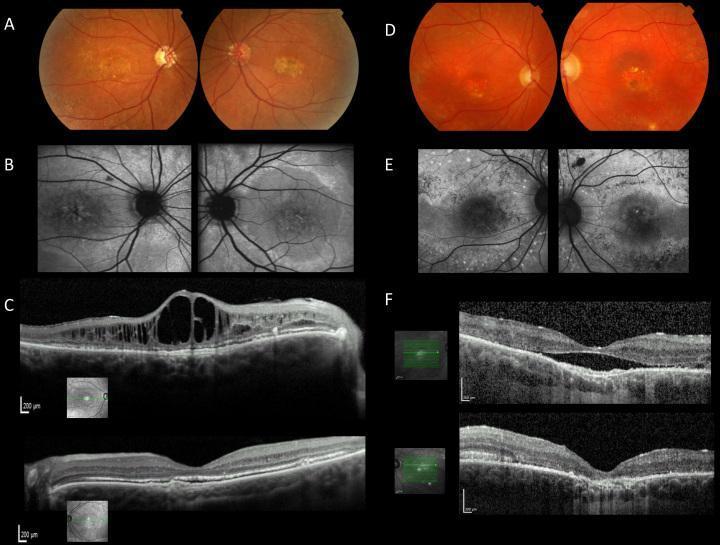
Color fundus (RPE alterations + yellowish subretinal deposits), FAF (areas of hyper/hypo-autofluorescence indicating RPE stress/atrophy), and SD-OCT (cystoid macular edema, subretinal fluid, retinal thinning) in two patients with macular dystrophy.
| Modality | Key Finding |
|---|---|
| Color fundus | RPE alterations, flecks, atrophy, pigment clumping |
| FAF | Hyper-AF (lipofuscin accumulation) → Hypo-AF (RPE atrophy/loss) |
| SD-OCT | Intraretinal/subretinal fluid, ellipsoid zone disruption, retinal thinning, cystic cavities |
| FA | Dark choroid (Stargardt), staining, window defects, late leakage (if CNV) |
| ERG / EOG | ERG reduced in advanced cases; EOG pathognomonic in Best disease |
Common Fundus Signs Across Dystrophies
- Bull's eye maculopathy — Stargardt, cone dystrophy, chloroquine toxicity
- Geographic atrophy — advanced stage of most dystrophies
- Drusen-like deposits — North Carolina MD, Sorsby, pattern dystrophies
- Subretinal yellow material — Best disease, adult foveomacular vitelliform dystrophy
- Pigment clumping/migration — late-stage degeneration
Differential Diagnosis
| Condition | Key Distinguishing Feature |
|---|---|
| AMD | Age >50, drusen, no family history pattern |
| Chloroquine/HCQ toxicity | Drug history; bull's eye; 10-2 VF defect |
| Cone dystrophy | Photophobia, color vision loss early; ERG cone-predominant loss |
| Solar retinopathy | History of sun gazing; foveal lesion |
Genetic testing (next-generation sequencing panels for inherited retinal dystrophies) is the gold standard for definitive diagnosis and confirms the specific gene mutation, which has implications for prognosis and eligibility for gene therapy trials.
This is a shared conversation. Sign in to Orris to start your own chat.