
Datura poisoning signs and symptoms, treatment and medicolegal importance. For 10 marks long essay question .source must be from standard forensic medicine textbook
I'll start by reading the medical library skill, then search for Datura poisoning in forensic medicine textbooks simultaneously.
Reading File
Now let me search the forensic medicine textbooks for Datura poisoning content in parallel:
Finding Sources
Finding Sources
Finding Sources
Excellent! I found the key sources. Now let me read all three forensic medicine textbook sections on Datura in parallel:
Reading File
Finding Sources
Finding Sources
I have the Dikshit content. Now let me read more of it (treatment, medicolegal) and also read the Essentials of Forensic Medicine and Parikh's sections:
Reading File
Finding Sources
Finding Sources
I have the bulk of the Dikshit content. Now let me read the medicolegal aspects section and the Essentials of Forensic Medicine section on Datura, plus Parikh's content:
Reading File
Finding Sources
Now let me read the Essentials of Forensic Medicine (2026 edition) content on Datura and the Parikh's Datura table:
Finding Sources
Reading File
Now let me read the Essentials of Forensic Medicine 2026 edition section on Datura (the 10 D's section):
Reading File
I now need the Essentials section from slightly earlier (the signs/symptoms and the Datura fastuosa description):
Reading File
Reading File
I now have comprehensive material from both standard forensic medicine textbooks. Let me also fetch the Datura plant image to include in the answer:
Loading Image
Loading Image
I now have all the content needed for a comprehensive 10-mark long essay answer. Let me compose it:
DATURA POISONING
Signs & Symptoms, Treatment, and Medicolegal Importance
Sources: P.C. Dikshit Textbook of Forensic Medicine and Toxicology; The Essentials of Forensic Medicine and Toxicology, 36th Edition (2026); Parikh's Textbook of Medical Jurisprudence, Forensic Medicine and Toxicology
I. INTRODUCTION
Datura (Dhatura) is a deliriant poison belonging to the family Solanaceae. It is classified under Cerebral poisons - Deliriants, alongside Cannabis indica and Belladonna. It is one of the most medically and forensically significant plant poisons in India due to its wide availability and criminal use.
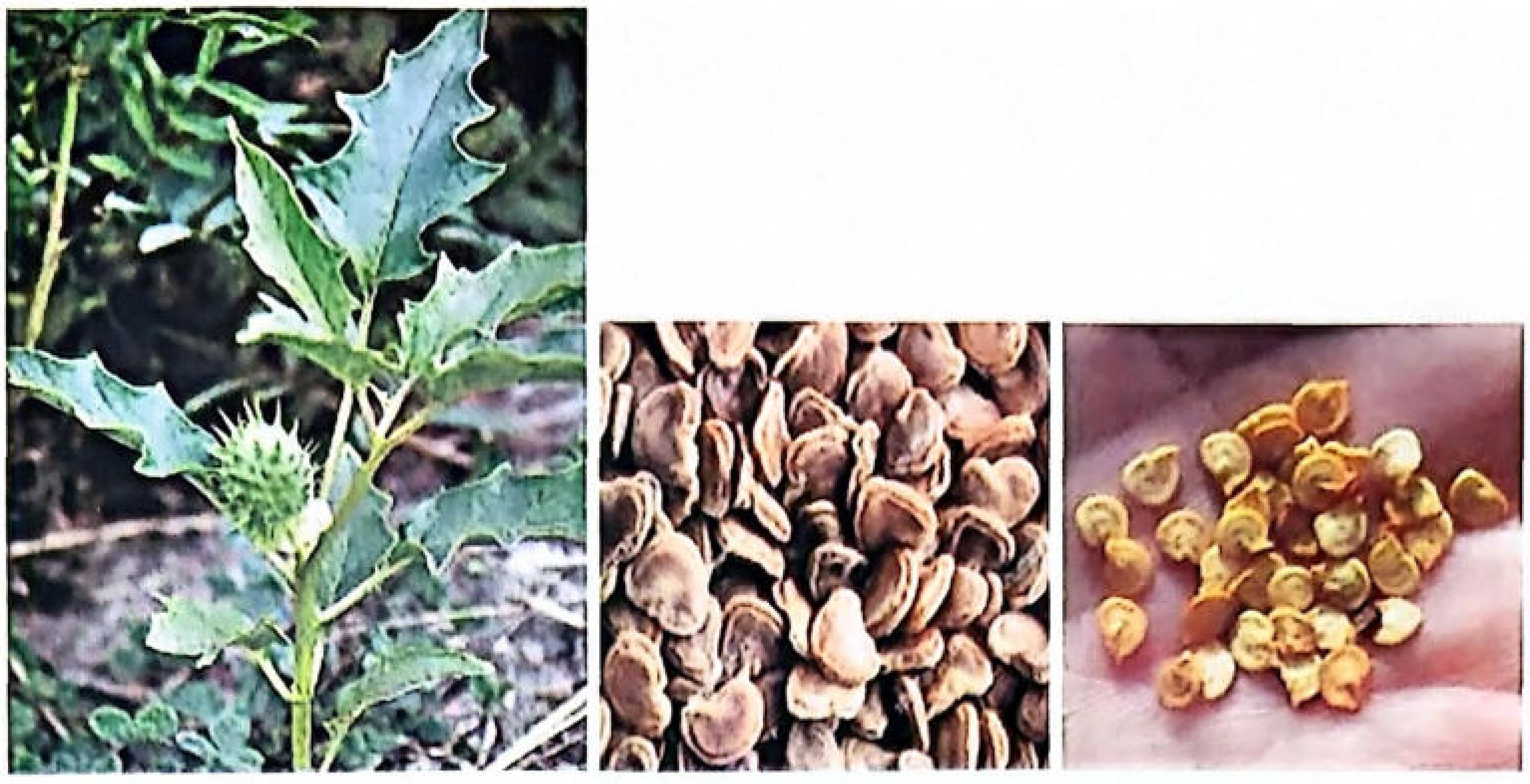
II. BOTANICAL DESCRIPTION AND VARIETIES
| Feature | Details |
|---|---|
| Botanical name | Datura fastuosa (commonest in India), D. stramonium (Himalayas), D. alba (white flowers - Safed Dhatura), D. niger (black/purple flowers - Kala Dhatura), D. atrox, D. metal |
| Common names | Thorn Apple, Jimson Weed, Angel's Trumpet, Shivashekhar |
| Habitat | Waste places and barren roadsides all over India; D. stramonium grows at high altitudes in the Himalayas |
| Most poisonous part | Fruits and seeds (all parts poisonous) |
| Fruit appearance | Spherical with sharp spines ("Thorn Apple"), containing yellowish-brown seeds |
III. ACTIVE PRINCIPLES (MECHANISM OF TOXICITY)
The seeds contain three principal alkaloids - all producing anticholinergic effects:
- Hyoscine (scopolamine) - the most important
- Hyoscyamine - most abundant by weight
- Traces of Atropine (believed to be the racemic form of hyoscyamine formed during extraction)
These alkaloids competitively block muscarinic acetylcholine receptors both centrally and peripherally, producing the classic anticholinergic toxidrome.
IV. SIGNS AND SYMPTOMS
Symptoms appear within 30 minutes of ingestion of seeds. Contact with leaves and flowers causes dermatitis in sensitive individuals.
A. Classic Mnemonic - "5 Phrases"
(The Essentials of Forensic Medicine and Toxicology, 36th Ed.)
| Phrase | Meaning |
|---|---|
| Hot as a hare | Hyperthermia (fever up to 107-108°F) |
| Blind as a bat | Mydriasis, disturbed/blurred vision, photophobia |
| Dry as a bone | Intense thirst, dry mouth, dry skin |
| Mad as a hen | Delirium, hallucinations, delusions, restlessness |
| Red as a beet | Flushing of the face |
B. The "10 D's" of Datura Poisoning
(P.C. Dikshit; The Essentials of Forensic Medicine and Toxicology)
- Dysphagia - difficulty in swallowing and talking
- Delusions - false beliefs
- Dermatitis - skin rash on contact; at times scarlatiniform rashes or exfoliation of skin over the body
- Delirium - altered state of consciousness, failure to identify oneself
- Drowsiness - progressing to coma
- Dry skin and mucous membranes - intense thirst, bitter taste, dryness of mouth and throat
- Dilated pupils (Mydriasis) - with photophobia; loss of accommodation for near vision; red and injected conjunctiva
- Dreadful hallucinations - of sight and hearing
- Dysuria - inability to pass urine (urinary retention)
- Dysarthria - difficulty in speaking
C. Detailed Systemic Features
(P.C. Dikshit Textbook of Forensic Medicine and Toxicology, p. 509)
Gastrointestinal:
- Bitter taste and burning pain in stomach
- Vomiting may occur immediately after ingestion (gastric irritation)
- Dysphagia
Cardiovascular:
- Pulse is initially full and bounding
- Later becomes weak, irregular and intermittent
Respiratory:
- Respiration is increased initially
- Death from respiratory paralysis in severe cases
Neurological:
- Headache followed by giddiness
- Staggering gait and incoordination of muscles
- Muscle tone and deep reflexes are increased
- Muscular spasms may be present
- Pin-rolling movements of fingers
- Dreadful hallucinations of sight and hearing
- Delusions; patient may become dangerous - can climb objects, break things, run out of bed, try to pick up non-existent objects
Skin:
- Dry and hot skin with hyperthermia (107-108°F)
- Flushing of face
- Scarlatiniform rashes may appear
Ophthalmological:
- Dilated pupils (mydriasis)
- Photophobia
- Loss of accommodation for near vision
- Red and injected conjunctiva
D. Course of Illness
- Excitement phase lasts 1-2 hours
- Then passes into deep coma or sleep which may end in death from respiratory paralysis
- Illness may last 2-3 days with definite improvement at 24 hours
- Recovering patients develop secondary delirium as stupor passes
- Amnesia - patient remembers nothing about the illness and is surprised to find themselves in hospital
V. FATAL DOSE AND FATAL PERIOD
| Parameter | P.C. Dikshit | Essentials of FM & Tox (2026) |
|---|---|---|
| Fatal Dose | 4 fruits; 100 seeds or 0.5-1 gm | 50-100 crushed seeds |
| Fatal Period | 24 hours | 1-2 days if untreated |
VI. TREATMENT
(P.C. Dikshit; The Essentials of Forensic Medicine and Toxicology, 36th Ed.)
A. Gastrointestinal Decontamination
- Emetics - can be given
- Stomach wash - using 5% tannic acid or weak potassium permanganate solution. Due to decreased gut motility caused by the poison, stomach wash is useful even several hours after ingestion
- Enema - using sodium sulphate as purgative
B. Antidotes
- Physostigmine 0.5-1 mg IV or IM, 1-2 hourly - physiological antidote of choice
- Crosses the blood-brain barrier
- Relieves both cerebral and peripheral manifestations
- 1-2 mg IV slowly, every 5 minutes until poison signs disappear
- Prostigmine (Neostigmine) 0.5-1 mg subcutaneously as single dose - more effective and less toxic (does NOT cross blood-brain barrier)
- Pilocarpine nitrate 5 mg subcutaneously as single dose, repeated after 2 hours - has no central action
C. Symptomatic Management
- Maintain airway and respiration - artificial respiration and oxygen inhalation
- Short-acting barbiturates - for convulsions
- Sponging - to relieve hyperthermia
- Nursing care - to prevent falls, jumping from bed, or running away
- Sedation is usually not indicated
- Morphine - contraindicated (though physiological antidote, it is too toxic)
VII. AUTOPSY / POSTMORTEM FINDINGS
(P.C. Dikshit; The Essentials of Forensic Medicine and Toxicology, 36th Ed.)
- Postmortem findings are not characteristic
- Signs of asphyxia are present
- Seeds or their fragments may be found in the stomach or intestine
- Stomach shows slight inflammation
- Lungs are congested and oedematous
- All the organs are congested
VIII. DIFFERENTIAL DIAGNOSIS OF DATURA POISONING
(P.C. Dikshit Textbook of Forensic Medicine and Toxicology, p. 510)
| Condition | Distinguishing Features |
|---|---|
| Opium poisoning | Pinpoint pupils; slow and depressed respiration |
| Cerebral haemorrhage | History of hypertension; CSF examination diagnostic |
| Alcohol intoxication | Smell of alcohol; miosis (not mydriasis); no hyperthermia |
| Belladonna poisoning | Signs and symptoms are identical (same group of alkaloids) |
IX. MEDICOLEGAL IMPORTANCE
This is the most forensically significant section.
A. Criminal (Homicidal/Felonious) Use
-
Stupefying agent - Datura is most commonly used to stupefy travellers for the purpose of robbery, rape, and theft by:
- Seeds mixed with rice, dal, coffee, sweets, pan or bidi (beedi)
- Seeds and leaves mixed with tobacco or ganja and smoked in chillum (pipe)
- Decoction of seeds added to liquor to enhance its intoxicating property
- Crushed seeds mixed with sweets and given to school children to kidnap or rape victims
-
Homicidal use - though rare, documented cases exist. Historical case: In 1921, a wife administered Datura seeds to her husband in food.
-
Abortifacient use - Datura has been used to produce criminal abortion. Documented case where a man administered Datura powder to a woman to produce abortion and she died 3 hours later.
-
Post-poisoning amnesia - The victim remembers nothing about the events after poisoning, making it highly suitable for criminal purposes.
B. Accidental Poisoning
- When children and adults eat raw Datura fruits (mistaking them for edible fruits)
- Seeds may be mistaken for capsicum (chilli) seeds - an important identification point. Datura seeds are bitter and larger; chilli seeds are smaller and pinkish
- Seeds have an erroneously believed aphrodisiac property
- Juice of Datura leaves is used in folk medicine to treat rheumatism
- Vaids and Hakims use Datura in traditional medicine
- Accidental mixing with fodder or food grains (seeds resist putrefaction)
- Himalayan Sadhus are known to consume seeds intentionally for psychoactive effects
C. Suicidal Use
- Less common than homicidal/accidental cases
D. Forensic Chemistry and Preservation
- Active principles are excreted unchanged in urine within 10-12 hours after administration - urine must be preserved for chemical analysis
- Datura seeds resist putrefaction for a long time
- However, the mydriatic principle (alkaloids) is destroyed by putrefaction
- Can be chemically detected even after a long time (seeds remain identifiable)
E. Medicinal (Therapeutic) Uses
- Dried leaves mixed with cannabis in cigarettes used for asthma treatment (antispasmodic smoke)
- Belladonna tinctures used for application on wounds
- Datura leaves used to treat some types of fever
X. CLASSIFICATION SUMMARY
| Property | Detail |
|---|---|
| Class | Cerebral poison - Deliriant |
| Family | Solanaceae |
| Schedule | Scheduled poison under Drugs & Cosmetics Act |
| Active principles | Hyoscine, Hyoscyamine, Atropine |
| Mechanism | Anticholinergic (muscarinic receptor blockade) |
| Antidote | Physostigmine (crosses BBB - drug of choice) |
| Forensic use | Stupefying, robbery, rape, homicide, abortion |
| Preserve for analysis | Urine (within 10-12 hours), stomach contents, seeds |
SOURCES
- P.C. Dikshit - Textbook of Forensic Medicine and Toxicology, pp. 508-510 (ISBN: 9788188867967)
- The Essentials of Forensic Medicine and Toxicology, 36th Edition, 2026, pp. 583-584 (ISBN: 9789366165257)
- Parikh's Textbook of Medical Jurisprudence, Forensic Medicine and Toxicology (ISBN: 9789388902267)
This is a shared conversation. Sign in to Orris to start your own chat.