
Malaria
Reading File
"Malaria" is broad - let me clarify what you need before diving in.
Asking for Preferences
What aspect of malaria are you looking for?
Searching sources...
Finding Sources
Searching PubMed
"malaria" AND "diagnosis"
Good - four relevant sections across major textbooks. Let me read them all in parallel.
Reading File
Reading File
Reading File
Reading File
Now let me read the full Harrison's section and fetch the key microscopy images in parallel.
Reading File
Loading Image
Loading Image
Now let me get the remaining diagnostic content from Harrison's (the table on investigation findings).
Reading File
I now have thorough content. Let me compile the comprehensive answer.
Diagnosis & Investigations of Malaria
Sources: Harrison's Principles of Internal Medicine 22E (2025), Goodman & Gilman's Pharmacological Basis of Therapeutics, Sherris & Ryan's Medical Microbiology 8E, Park's Textbook of Preventive and Social Medicine
Core Principle
Malaria is NOT a clinical diagnosis. Any patient from or returning from a malarious area with fever must have blood smears prepared and examined immediately. A negative smear by an experienced microscopist effectively rules out malaria. - Harrison's, p.1810
1. Peripheral Blood Smear - The Gold Standard
The definitive diagnosis rests on demonstrating asexual forms of the parasite in stained peripheral blood smears.
Staining
- Giemsa stain at pH 7.2 - preferred Romanowsky stain
- Field's, Wright's, or Leishman's stains are acceptable alternatives
- Acridine orange (fluorescent dye) - allows more rapid diagnosis at low-level parasitemia, but cannot identify species
Thick Film vs. Thin Film
| Feature | Thick Film | Thin Film |
|---|---|---|
| Purpose | Screening / detection | Species identification |
| Sensitivity | 40-100x more concentrated | Lower |
| Preparation | Dried without fixing | Air-dried, fixed in anhydrous methanol |
| Examination | Oil immersion after staining unfixed | Oil immersion (x1000) |
| Result | Parasites per µL (using WBC count) | Parasites per 1000 RBCs |
- A minimum of 200 WBCs should be counted under oil immersion on the thick film
- Before declaring a thick smear negative, examine 100-200 fields
- Parasitemia is expressed as parasitized erythrocytes per 1000 RBCs on thin film, or per µL on thick film (assuming WBC 8000/µL if count unavailable)
P. falciparum thin film appearances:
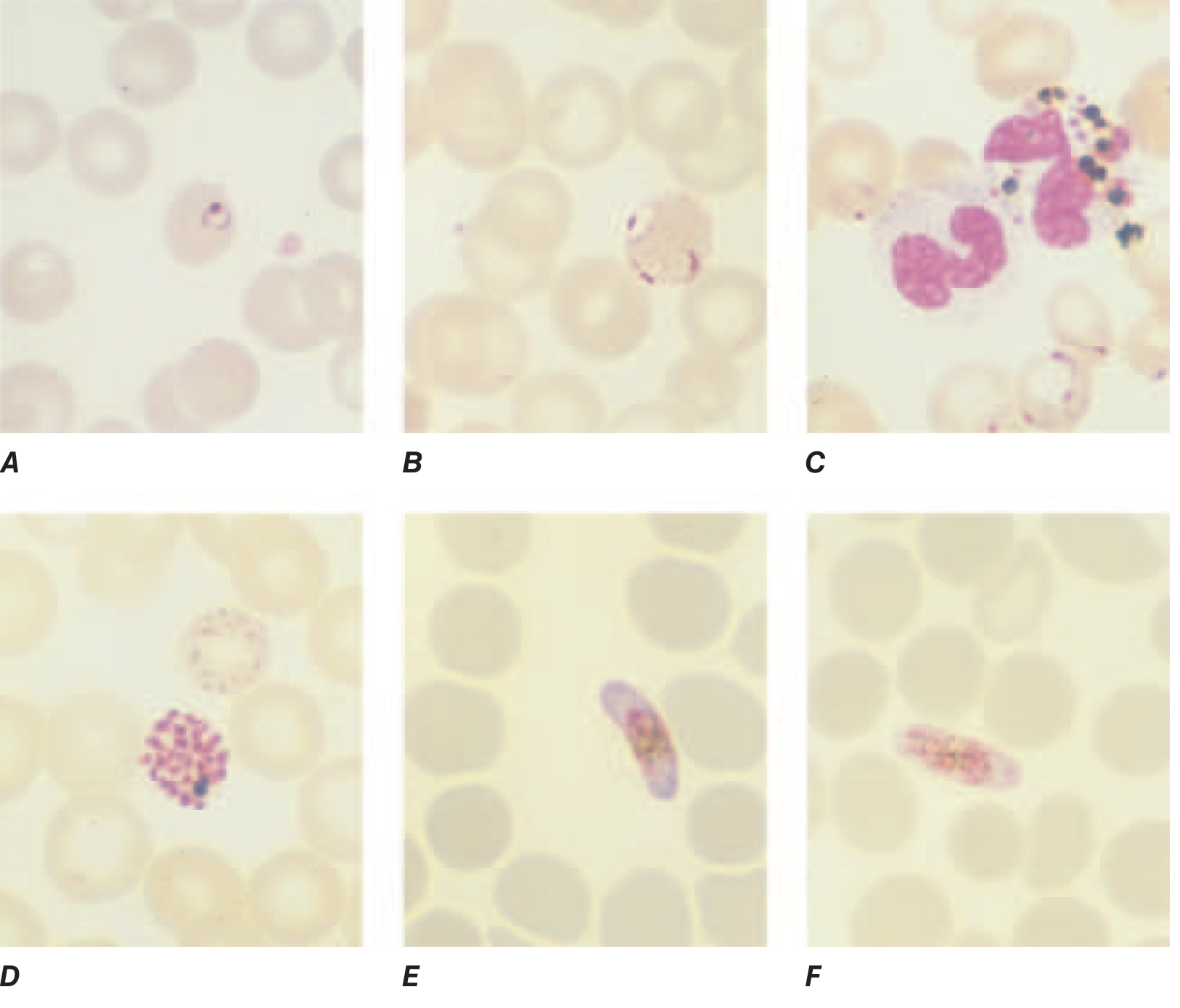
P. vivax thin film appearances:
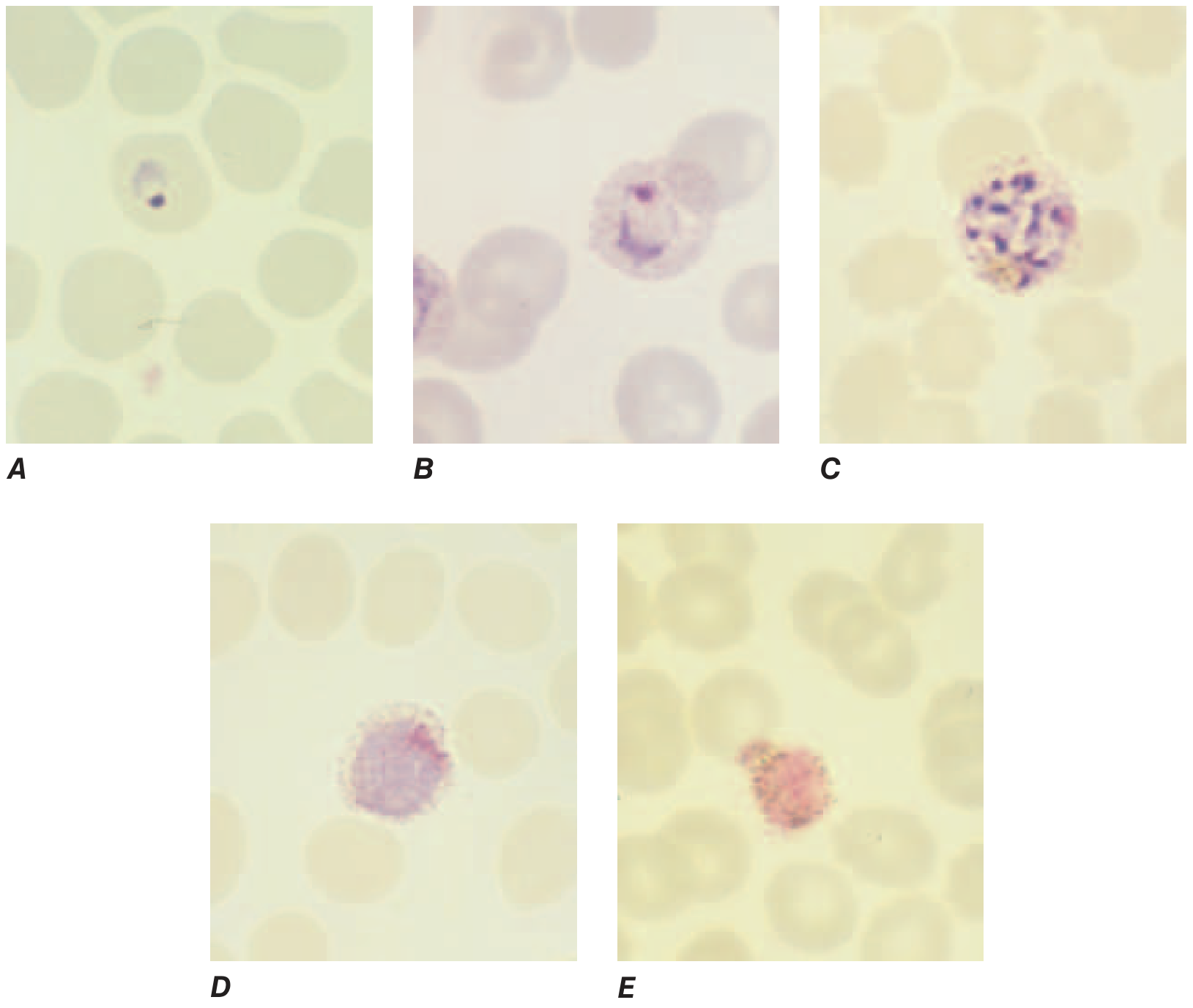
2. Rapid Diagnostic Tests (RDTs)
When reliable microscopy is unavailable, an RDT must be performed. RDTs detect parasite antigens in finger-prick blood samples:
| Antigen Detected | Parasite | Notes |
|---|---|---|
| PfHRP2 (histidine-rich protein 2) | P. falciparum only | Remains positive for weeks post-infection - useful in severe malaria after drug clearance; risk of false-negative with PfHRP2/3 gene deletions (increasingly common in Horn of Africa) |
| pLDH (parasite lactate dehydrogenase) | Pan-malaria or species-specific | Clears more rapidly after treatment |
| Aldolase | Pan-malaria | Less common |
- Dual-antibody RDTs (PfHRP2 + pan-malaria or P. vivax-specific) can distinguish falciparum from non-falciparum malaria
- Key limitation: RDTs do not quantify parasitemia
- Smear should always accompany or follow an RDT to confirm species and assess parasite density
3. Parasitemia Density and Prognosis
- >10⁵ parasites/µL - increased risk of death
- Non-immune patients may die at lower counts; partially immune individuals may tolerate much higher counts
- Poor prognostic signs on smear in P. falciparum:
-
20% of parasites with visible pigment (mature forms)
- Malarial pigment in >5% of neutrophils (indicates recent schizogony)
-
- Gametocytemia of P. falciparum peaks ~1 week after peak of asexual parasitemia; gametocytes persist after treatment - do not indicate treatment failure
- Intraphagocytic malarial pigment in monocytes may suggest recent infection even if no live parasites visible
4. Molecular Diagnosis (PCR)
- More sensitive than both microscopy and RDTs for detecting parasites and identifying species
- Used in reference centres and for confirmation of low-density infections
- Not used for primary diagnosis in endemic areas due to cost and turnaround time
- Useful for detecting mixed infections, drug-resistance genotyping, and epidemiological studies
5. Supporting Laboratory Investigations
These are not diagnostic but help assess severity:
| Investigation | Typical Findings in Malaria |
|---|---|
| FBC | Anaemia (normocytic), thrombocytopenia |
| Blood film | Parasitaemia (as above) |
| Reticulocyte count | Raised (haemolytic anaemia) |
| LFTs | Raised bilirubin (jaundice from haemolysis), elevated transaminases |
| RFTs | Raised creatinine/urea in severe disease (acute kidney injury) |
| Blood glucose | Hypoglycaemia - especially with P. falciparum or quinine treatment |
| Coagulation screen | DIC in severe falciparum malaria |
| Blood cultures | To exclude co-infection with bacteraemia |
| Urinalysis | Haemoglobinuria ("blackwater fever" in severe P. falciparum) |
| Chest X-ray | If pulmonary oedema (ARDS) suspected |
| Lumbar puncture | If cerebral malaria vs bacterial meningitis cannot be distinguished |
6. Species Identification - Key Microscopy Differentials
| Feature | P. falciparum | P. vivax | P. ovale | P. malariae |
|---|---|---|---|---|
| RBC size | Normal or small | Enlarged | Slightly enlarged | Normal or small |
| Schüffner's dots | Absent (Maurer's clefts instead) | Present | Present | Absent |
| Trophozoite | Delicate ring, often multiple per RBC, "appliqué" (accolé) position | Amoeboid, irregular | Compact | Band form |
| Gametocyte | Crescent/banana-shaped (pathognomonic) | Round/oval | Round/oval | Round |
| Max. merozoites in schizont | 8-24 | 12-24 | 6-12 | 6-12 |
7. Approach by Clinical Setting
Where microscopy is available within 24 hours: Use smear as primary test, treat according to species identified.
Where microscopy is delayed and monovalent RDT (PfHRP2) is used: Treat positive as P. falciparum; if negative and symptoms persist, arrange microscopy.
Where bivalent RDT (PfHRP2 + pan) is used: Can distinguish falciparum from non-falciparum and guide treatment accordingly. (Park's Preventive Medicine, p.308)
In the United States: The CDC Malaria Hotline is available for guidance: (770) 488-7100 after hours / (855) 856-4713 toll-free. Smear is mandatory even if RDT is performed - results should be available as soon as possible. (Sherris & Ryan Medical Microbiology 8E, Fig. 51-7)
Summary Flow
Fever + travel to endemic area
         ↓
Thick + thin blood smear (Giemsa, ×1000)
         ↓
Positive → species ID + count parasitemia → guide treatment
Negative → repeat smear every 12-24h × 3 if clinical suspicion remains
         ↓
If microscopy unavailable → RDT immediately
         ↓
All positives → smear when possible to confirm species + density
         ↓
PCR if species uncertain or mixed infection suspected
This is a shared conversation. Sign in to Orris to start your own chat.