
CVP monitoring for MD anaesthesia exam answer
Reading File
Now let me search the medical library for CVP monitoring content in parallel:
Finding Sources
Finding Sources
Miller's Anesthesia is the key reference. Let me read content from Miller's, plus Roberts & Hedges and Pye's Surgical Handicraft in parallel:
Reading File
Reading File
Reading File
Good start. Now let me read the Miller's Anesthesia CVP section and more of Roberts & Hedges in parallel:
Reading File
Reading File
Finding Sources
Excellent - found detailed CVP waveform content in Miller's. Let me now read those sections:
Reading File
Finding Sources
Now let me fetch the CVP waveform image from Miller's and read more of the abnormal waveforms section:
Loading Image
Reading File
Reading File
Excellent - I now have comprehensive content. Let me get the CVP limitations and fluid challenge data plus the abnormal waveform image:
Reading File
Finding Sources
Finding Sources
Finding Sources
Reading File
Reading File
I now have comprehensive data to write a thorough MD anaesthesia exam answer. Let me compile this into a complete, exam-quality response:
Central Venous Pressure (CVP) Monitoring - MD Anaesthesia Exam Answer
Definition
CVP is the pressure exerted by blood against the walls of the intrathoracic venae cavae. Because pressure in the venae cavae is generally within 1 mmHg of right atrial pressure, CVP reflects the pressure under which blood is returning to the heart. It is measured by placing a catheter tip in any of the great systemic veins of the thorax or the right atrium.
- Normal CVP: 2-8 mmHg (approximately 3-10 cmH2O)
- Conversion: 1 mmHg = 1.36 cmH2O
Physiology
CVP has two important hemodynamic effects:
- Preload determinant - promotes filling of the heart during diastole (reflects RV end-diastolic volume)
- Venous return back-pressure - opposes return of blood from the peripheral venous circulation to the heart
CVP values are determined by the interaction of:
- Intravascular volume
- Right atrial and ventricular function
- Venomotor tone
- Intrathoracic pressures
CVP reflects right heart filling pressure only. It does not reliably reflect left heart pressures unless both ventricles function normally.
- Miller's Anesthesia, 10e, p. 4806
The CVP Waveform
The normal CVP waveform has three positive deflections (waves) and two negative deflections (descents):
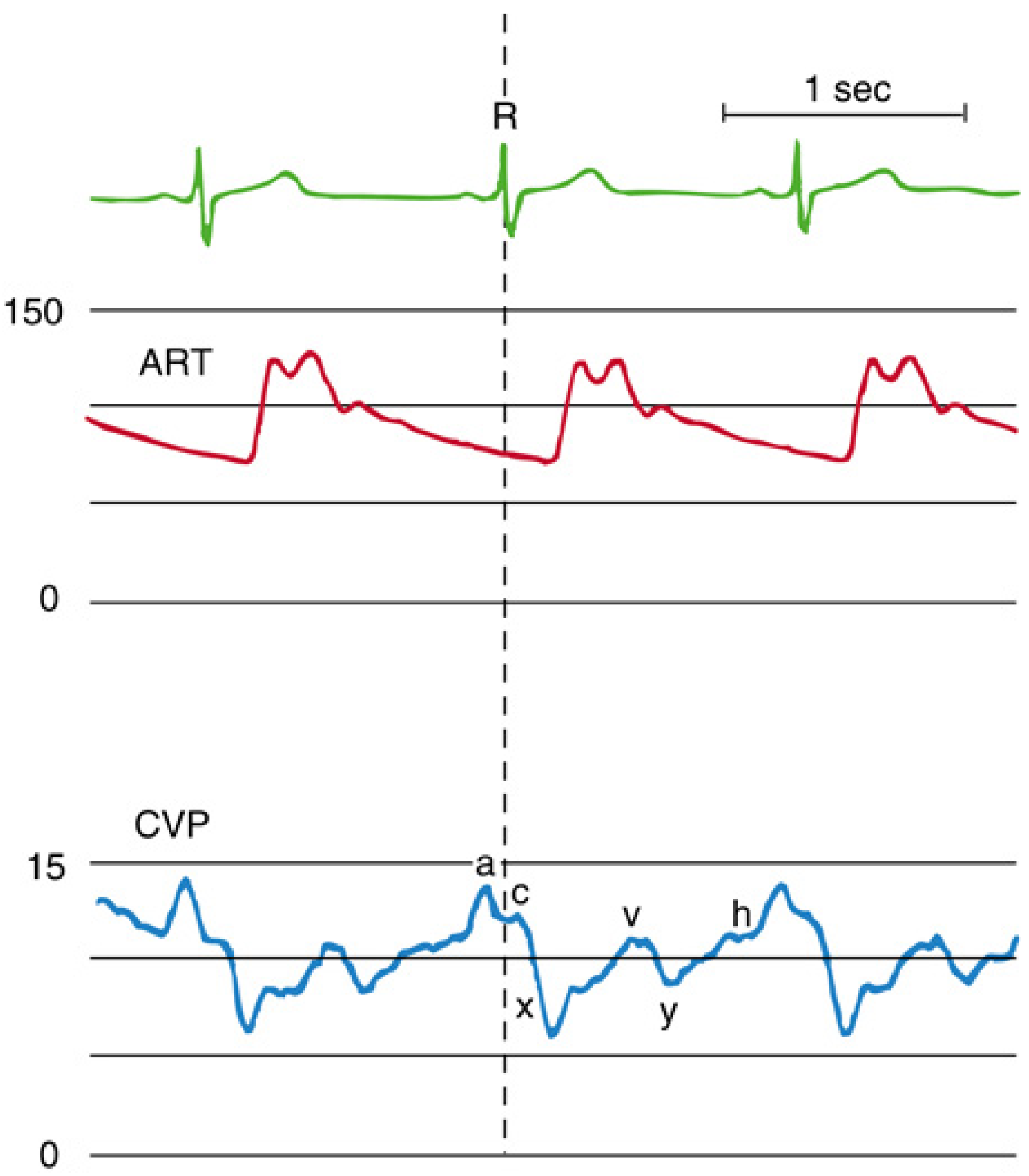
Waveform Components (Table)
| Component | Phase of Cardiac Cycle | Mechanical Event |
|---|---|---|
| a wave | End-diastole | Atrial contraction ("a = atrial kick") |
| c wave | Early systole | Isovolumic ventricular contraction; tricuspid valve closure moves toward RA |
| x descent | Mid-systole | Atrial relaxation + descent of tricuspid annulus toward apex (systolic collapse) |
| v wave | Late systole | Venous filling of atrium while tricuspid valve is closed |
| y descent | Early diastole | Tricuspid valve opens; blood flows from atrium to ventricle (diastolic collapse) |
| h wave | Mid- to late diastole | Diastolic plateau (only seen with slow heart rate or elevated CVP) |
Timing relative to ECG:
-
a wave follows the P wave
-
c wave follows the QRS (R wave)
-
v wave peaks just after the T wave
-
Miller's Anesthesia, 10e, p. 4806-4808
Abnormal CVP Waveforms
| Condition | Waveform Change | Mechanism |
|---|---|---|
| Atrial fibrillation | Loss of a wave; prominent c wave | No organised atrial contraction; greater atrial volume at onset of systole |
| AV dissociation / junctional rhythm / ventricular pacing | Cannon a waves | Atrium contracts against closed tricuspid valve |
| Tricuspid regurgitation | Tall systolic c-v wave; loss of x descent | Retrograde systolic filling of RA; "ventricularised" trace |
| Tricuspid stenosis | Tall a wave; attenuated y descent | Increased atrial work; slow diastolic emptying |
| RV ischaemia / pericardial constriction | Tall a and v waves; steep x and y descents; M or W configuration | Impaired RV compliance |
| Cardiac tamponade | Dominant x descent; attenuated y descent | Pericardial fluid limits diastolic filling |
Key exam pearl: In tricuspid regurgitation, the monitor displays an overestimated mean CVP. True RVEDP is best measured at the ECG R wave, before the regurgitant wave.
- Miller's Anesthesia, 10e, p. 4811-4813
Indications for CVP Monitoring
- Acute circulatory failure / haemodynamic instability
- Major surgery with anticipated large fluid shifts (esophagectomy, pneumonectomy, hepatic resection, cardiac surgery)
- Anticipated massive blood transfusion
- Cautious fluid replacement in patients with compromised cardiovascular status
- Suspected cardiac tamponade
- Fluid resuscitation in severe sepsis (goal-directed therapy)
- Additional uses of the central venous catheter (not purely for pressure monitoring):
- Administration of vasoactive drugs, total parenteral nutrition, chemotherapy, concentrated electrolytes
- Transvenous cardiac pacing
- Temporary haemodialysis
- Pulmonary artery catheter introduction
- Aspiration of venous air embolism
- Inadequate peripheral IV access
- Roberts & Hedges' Clinical Procedures in Emergency Medicine, p. 518; Miller's Anesthesia, 10e, p. 4792-4793
Contraindications
| Absolute | Relative |
|---|---|
| Other resuscitative interventions that take priority | Coagulopathy (prefer site compressible with direct pressure, e.g., internal jugular over subclavian) |
| SVC syndrome | Severe emphysema (subclavian approach risky) |
| Large vegetations on tricuspid valve | Infection at proposed insertion site |
| Right atrial tumour or thrombus | Thrombocytopenia |
Sites of Insertion
| Site | Advantages | Disadvantages |
|---|---|---|
| Right internal jugular | Best route to right heart; highest success rate; safe in coagulopathy (compressible); preferred for PA catheter and pacing | Risk of carotid puncture; patient discomfort; difficulty in obese/short necks |
| Subclavian | Comfortable for patient; lower infection risk | Higher pneumothorax risk (~2%); non-compressible if arterial puncture; avoid in emphysema/bilateral disease |
| Femoral | Easiest in emergency/resuscitation; no pneumothorax risk | Higher infection rate; DVT risk; less reliable CVP if intra-abdominal pressure elevated; slower drug delivery to central circulation |
| External jugular | Visible, safe | May kink; tortuous angle; less reliable positioning |
Catheter tip position: Superior vena cava, at the cavo-atrial junction. Confirmed by CXR. Tip within 2 cm of the cardiac silhouette on AP film.
Ultrasound guidance is strongly recommended (mandated by most guidelines) for internal jugular cannulation and should be considered for subclavian or femoral access.
- Miller's Anesthesia, 10e, p. 4792-4795
Measurement Technique
Manometric method (water column):
- Zero the manometer at the level of the right atrium (mid-axillary line, 4th intercostal space, with patient supine)
- Fill the column with IV fluid; open to the patient
- Water level falls and oscillates with respiration
- Read at end-expiration
Electronic transducer method:
- Transducer zeroed at the phlebostatic axis (same reference point as above)
- Provides continuous waveform display and digital mean value
- Read at end-expiration in spontaneously breathing patients; read at end-expiration (before ventilator breath) in mechanically ventilated patients
Sources of error in CVP measurement:
-
Failure to zero or calibrate the transducer
-
Incorrect reference point (transducer not at right atrial level)
-
Catheter tip malposition
-
Air bubbles in the circuit
-
Catheter obstruction
-
Reading during the wrong phase of ventilation
-
Increased intrathoracic pressure (IPPV, PEEP, coughing, straining, pneumothorax)
-
Vasopressors (may falsely elevate readings)
-
Roberts & Hedges' Clinical Procedures in Emergency Medicine, p. 518-519
Normal Values and the Fluid Challenge
Static CVP value alone is a poor predictor of volume status or fluid responsiveness - many studies have confirmed this. In shocked patients, there is no single "normal" CVP target; some patients need a CVP of 5 cmH2O while others may require 15 cmH2O or more. Ventricular compliance changes rapidly in shock, making CVP a poor reflection of RVEDP.
Dynamic assessment - the fluid challenge:
- Infuse 250-500 mL rapidly over 5-10 minutes
- Assess CVP response:
| Response | Interpretation | Action |
|---|---|---|
| No change in CVP | Volume depleted - empty ventricle, steep portion of Starling curve | Further fluid resuscitation |
| Rise of 2-5 cmH2O that drifts back to baseline over 10-20 minutes | Normal/adequate response | Continue monitoring |
| Large, sustained rise in CVP | High preload - cardiac insufficiency or volume overload | Stop fluids; consider inotropes |
- Bailey & Love's Short Practice of Surgery, 28e, p. 40
Limitations of CVP
This is a high-yield exam area. The main limitations are:
- Does not reflect left heart filling - PCWP (pulmonary artery occlusion pressure) is needed to estimate left atrial pressure
- Poor predictor of fluid responsiveness - static CVP cannot reliably predict whether a patient will respond to a fluid challenge (landmark meta-analyses have confirmed this)
- Affected by ventricular compliance - conditions like RV ischaemia, tamponade, pericardial constriction, and PEEP alter the CVP-volume relationship
- Intrathoracic pressure effects - IPPV, PEEP, and pneumothorax elevate CVP without a corresponding increase in preload
- Venomotor tone changes - vasoconstriction may maintain a "normal" CVP despite hypovolaemia
- Tricuspid valve disease - distorts waveform and numeric value
- Right vs. left heart discordance - in conditions with primary left heart failure or pulmonary hypertension, CVP may not reflect left-sided haemodynamics at all
- Practical sources of error (zeroing, tip position, ventilation phase - as above)
Current status: CVP has largely been supplanted in the ICU by dynamic preload indicators (pulse pressure variation [PPV], stroke volume variation [SVV]), point-of-care echocardiography, and functional haemodynamic tests. However, the central venous catheter remains indispensable for drug delivery, pacing, and haemodialysis.
- Barash's Clinical Anesthesia, 9e, p. 3161; Miller's Anesthesia, 10e, p. 4789-4790
Complications of CVP Catheterisation
Mechanical (immediate)
- Arterial puncture (most common acute complication; 1.9-15%)
- Pneumothorax (~2% with subclavian; less with internal jugular)
- Haemothorax, haemomediastinum, hydrothorax, chylothorax
- Cardiac tamponade - most life-threatening; results from tip perforation of intrapericardial SVC, RA, or RV (especially with malpositioned tip abutting at steep angle)
- Air embolism
- Catheter malposition (coiling, migration into wrong vessel)
- Nerve injury (brachial plexus, phrenic nerve)
Thromboembolic
- Deep vein thrombosis (especially femoral)
- Catheter-related thrombosis; pulmonary embolism
Infectious
- Catheter-related bloodstream infection (CRBSI / CLABSI)
- Up to 15% of patients experience some adverse event related to central venous catheterisation
Prevention
-
Ultrasound guidance
-
Maximal sterile barrier precautions (cap, mask, sterile gown and gloves, large sterile drape)
-
Checklist/protocol use
-
Tip confirmation by CXR before use
-
Waveform manometry or pressure measurement to confirm venous placement before securing
-
Miller's Anesthesia, 10e, p. 4795-4796
CVP vs. Other Haemodynamic Monitors
| Monitor | Measures | Advantage over CVP |
|---|---|---|
| PCWP (PA catheter) | Left atrial pressure surrogate; CO by thermodilution | Left heart filling; cardiac output; SVR |
| PPV/SVV | Dynamic preload responsiveness | Superior predictor of fluid response (in mechanically ventilated, sinus rhythm patients) |
| Echocardiography (TTE/TOE) | Direct ventricular volume; wall motion; valve function | Real-time, visual, no assumptions |
| Passive Leg Raise (PLR) | Functional fluid challenge | Reversible; valid even in arrhythmia, spontaneous breathing |
Key Exam Points to Remember
- CVP = RAP = RVEDP (only when tricuspid valve is normal and no pericardial constraint)
- The a wave is absent in atrial fibrillation
- Cannon a waves = AV dissociation (atrium contracts against closed tricuspid)
- Tricuspid regurgitation = "ventricularised" trace (c-v wave, loss of x descent)
- Tamponade = prominent x, attenuated y descent
- Constrictive pericarditis = deep x AND deep y descent (M/W pattern)
- Always read CVP at end-expiration
- Fluid challenge (250-500 mL) is more informative than a static CVP reading alone
- CVP is NOT a reliable single-time-point predictor of volume status or fluid responsiveness
- Ultrasound guidance is the current standard of care for central venous cannulation
Sources: Miller's Anesthesia, 10e (Elsevier); Barash's Clinical Anesthesia, 9e; Roberts & Hedges' Clinical Procedures in Emergency Medicine; Bailey & Love's Surgery, 28e
This is a shared conversation. Sign in to Orris to start your own chat.